Sometimes it is a word on a scan report. Sometimes it is a red sticker on the pregnancy card, or a relative saying her pregnancy is "high risk" in a lowered voice.
A high-risk pregnancy is one where the woman or her baby has a higher chance of a health problem, so doctors watch it more closely than usual. It is a care plan, not a prediction, and many women with this label go on to have healthy pregnancies and healthy babies.
In this article: who gets the label, what the red sticker on the Mother and Child Protection (MCP) card means, and what extra care involves.
Key takeaways
- A high-risk label decides how closely a pregnancy is watched. It does not decide how the pregnancy will turn out.
- At free Pradhan Mantri Surakshit Matritva Abhiyan (PMSMA) check-ups, a red sticker on the MCP card marks a high-risk pregnancy. A green one means no risk factor was found.
- Some conditions behind the label, including high blood pressure, may cause no symptoms, which is why regular check-ups matter.
This is for education and general understanding, not a diagnosis. Every pregnancy is different, so please speak with your doctor about your own situation.
What does "high risk" really mean?
It means more eyes on the pregnancy, not a problem already in motion. The label tells the care team where to look harder and when to act early.
Who is considered a high risk pregnancy?
These are common factors that can make a pregnancy higher risk.
| Where the risk comes from | Common examples |
|---|---|
| Health before pregnancy | High blood pressure, diabetes, thyroid disease, polycystic ovary syndrome (PCOS), kidney disease, lupus, obesity |
| Age | Teenage pregnancy, or a first pregnancy after 35 |
| Past pregnancies | Previous preterm birth, pre-eclampsia, pregnancy loss or caesarean section |
| This pregnancy | Anaemia, gestational diabetes, high blood pressure, twins, placenta or fibroid concerns, severe vomiting |
| Habits | Smoking, chewing tobacco such as gutka or khaini, alcohol |
Anaemia deserves a special mention. It is very common in India, and it is one of the conditions PMSMA screening is designed to catch.
Carrying two babies at once changes the plan, and so can vomiting that does not let up or fibroids that sit close to the baby.
Where the placenta settles also matters, which is why doctors track it on scans. Our guide on how the placenta forms and why it matters explains this gently. If a scan shows the placenta lying low, our guide to placenta previa explains what happens next.
Why does hearing "high risk" feel so frightening?
Because the words can land like a judgement, even when nobody meant them that way. Many women hear "high risk" and immediately go back over everything they ate, lifted or skipped.
Most risk factors are nobody's fault. Age, twins, a low-lying placenta or a family history of diabetes are not things a woman chose, and the label exists so that help reaches her sooner.
The red sticker on the MCP card, explained
Under PMSMA, the Ministry of Health and Family Welfare (MoHFW) offers free antenatal check-ups on the 9th of every month at government health facilities.
At each visit, a sticker on the MCP card shows her risk status. Green means no risk factor was found. Red (laal) means a high-risk pregnancy.
For her, a red sticker means individual follow-up. The Accredited Social Health Activist (ASHA) and Auxiliary Nurse Midwife (ANM) help her reach extra check-ups and plan delivery at a hospital equipped to handle complications.
High-risk pregnancy care: what changes and what stays the same
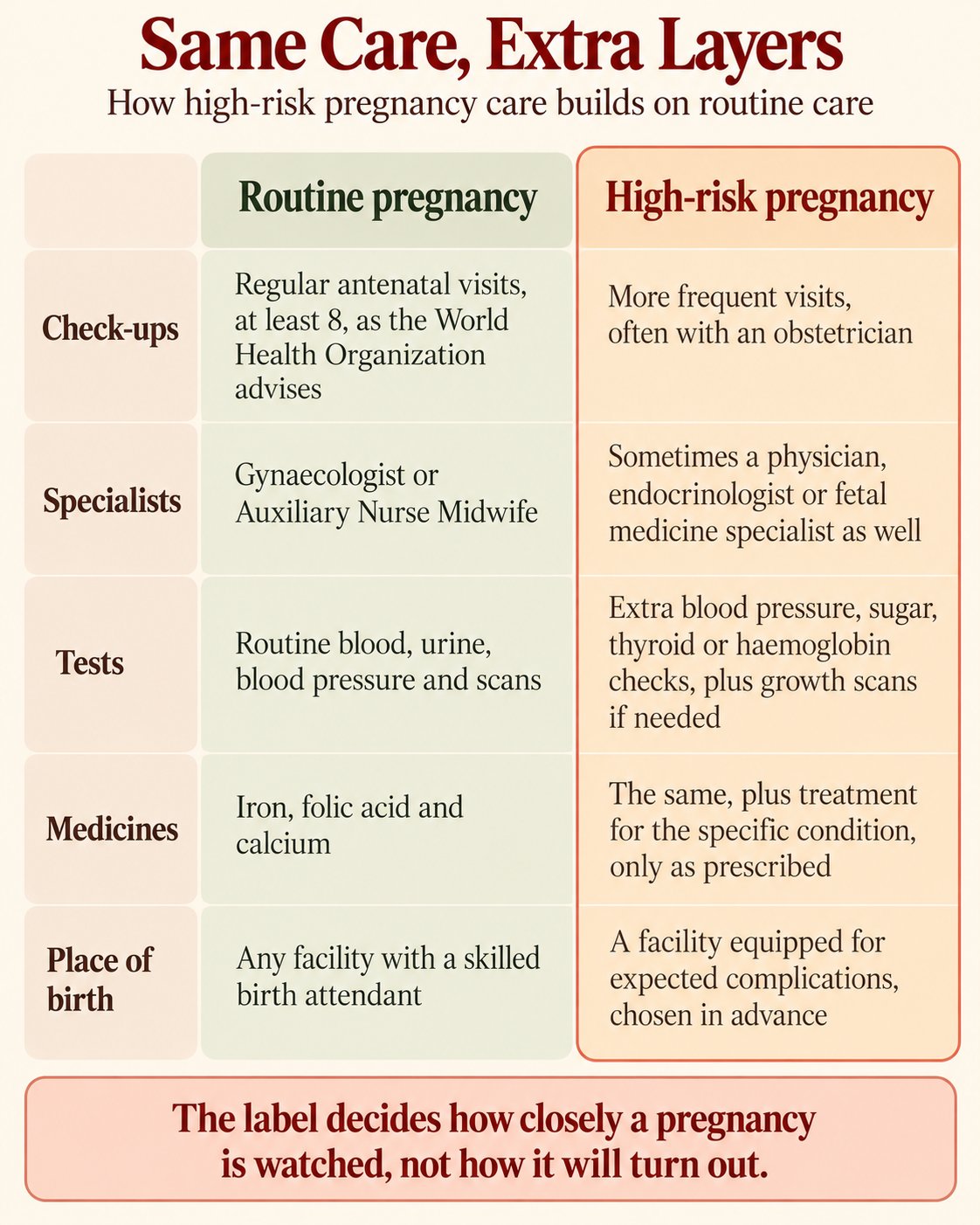
Good high risk pregnancy care adds layers to routine care rather than replacing it. These layers follow MoHFW antenatal care guidelines and condition-specific guidance from the Federation of Obstetric and Gynaecological Societies of India (FOGSI).
| Routine pregnancy | High-risk pregnancy | |
|---|---|---|
| Check-ups | Regular antenatal visits; the World Health Organization (WHO) advises at least 8 contacts | More frequent visits, often with an obstetrician |
| Specialists | Gynaecologist or ANM | Sometimes a physician, endocrinologist or fetal medicine specialist as well |
| Tests | Routine blood, urine, blood pressure and scans | Extra blood pressure, sugar, thyroid or haemoglobin checks, plus growth scans if needed |
| Medicines | Iron, folic acid and calcium | The same, plus treatment for the specific condition, only as prescribed |
| Place of birth | Any facility with a skilled birth attendant | A facility equipped to manage the expected complications, chosen in advance |
Many women can continue much of their usual routine, with any adjustments their doctor recommends.
Are there high risk pregnancy symptoms?
A high-risk label itself does not cause symptoms. Some conditions behind it, such as anaemia, can cause tiredness or breathlessness. Others, including high blood pressure, may cause none at all.
This is why regular check-ups matter more than waiting for symptoms to appear.
Small steps that make extra care easier
- One folder for everything: the MCP card, scan reports and prescriptions, especially if delivery is planned at her maika in another town.
- Three questions at each visit: why the label was given, what the team is watching, and which signs mean coming in early.
- Tablets as prescribed: iron-rich foods like ragi, rajma and green leafy vegetables help, but do not replace iron tablets when haemoglobin is low.
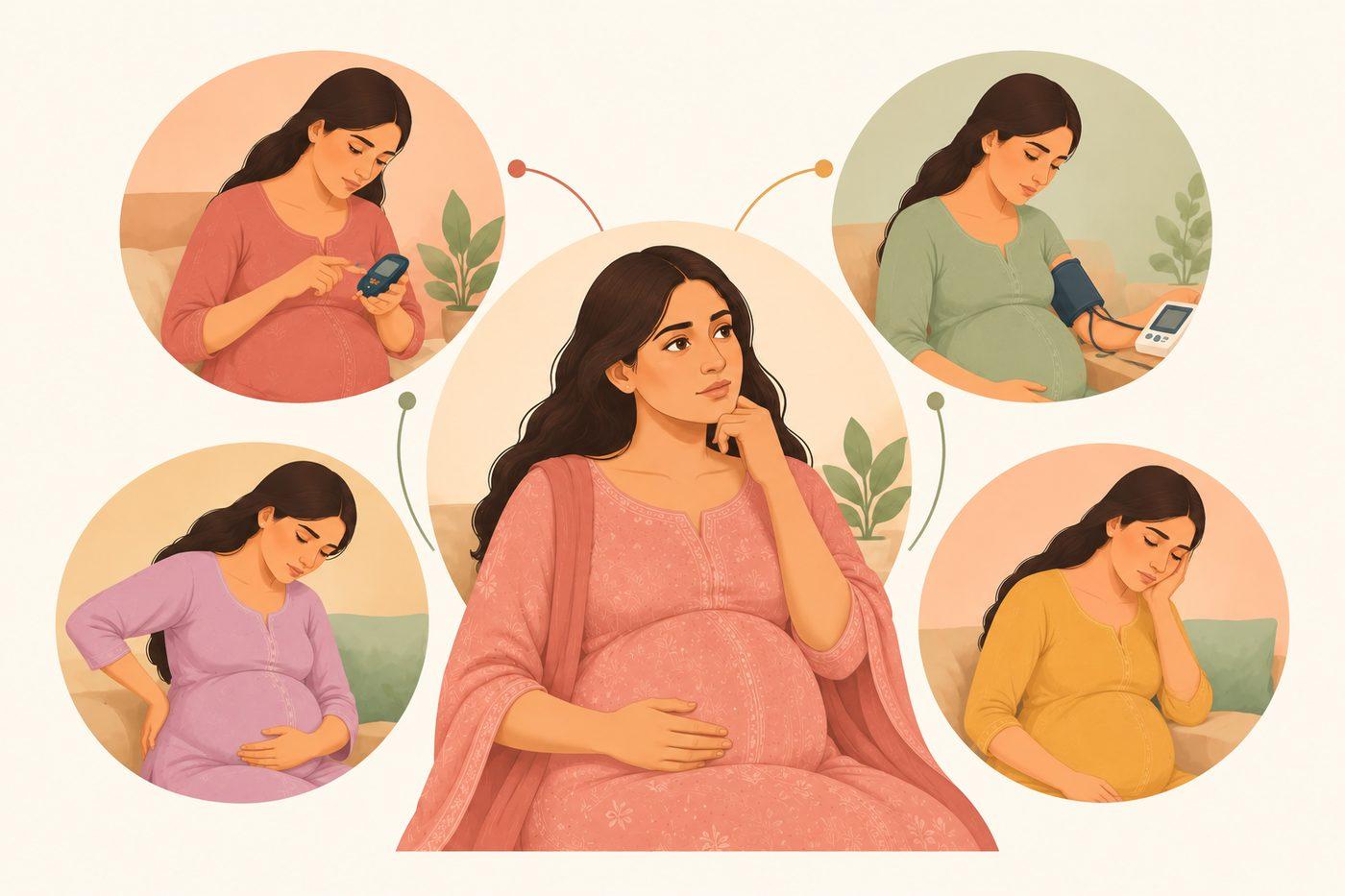
- Home checks if advised: some women are asked to track blood pressure or sugar at home.
- Emergency numbers: keep the hospital's number and a local emergency transport number handy.
When to speak to a doctor
Seek urgent medical care if she has:
- Bleeding from the vagina, or leaking fluid
- Severe headache, blurred vision, or swelling of the face and hands
- Seizures, fainting or difficulty breathing
- Severe pain in the abdomen
- High fever
- Fewer baby movements than usual in later pregnancy
Book a routine visit if:
- She is unsure why her pregnancy was labelled high risk
- She has missed a check-up or a test
- She has a long-standing condition and is planning a pregnancy
Looking ahead
The label is reviewed at every visit, so the plan can shift as treatment works or as the pregnancy changes.
As the due date nears, the focus moves to where and how she will give birth, a decision made with her doctor.
After birth, care turns to her own recovery. Women who had gestational diabetes are advised a sugar test about 6 weeks after delivery. Those who had high blood pressure need it checked in the weeks that follow.
References
- Ministry of Health and Family Welfare, Government of India. About Pradhan Mantri Surakshit Matritva Abhiyan.
- Ministry of Health and Family Welfare, Government of India. Tracking of High Risk Pregnancies and Monitoring of PMSMA.
- National Health Mission, Himachal Pradesh. Extended PMSMA guidelines for tracking high-risk pregnancies.
- Ministry of Health and Family Welfare, Government of India. Guidelines for Antenatal Care and Skilled Attendance at Birth by ANMs, LHVs and SNs (2010).
- Ministry of Health and Family Welfare, Government of India. National Guidelines for Diagnosis and Management of Gestational Diabetes Mellitus (2018).
- Federation of Obstetric and Gynaecological Societies of India (FOGSI). Hypertensive Disorders in Pregnancy.
- World Health Organization. New guidelines on antenatal care for a positive pregnancy experience (2016).
- American College of Obstetricians and Gynecologists and Society for Maternal-Fetal Medicine. Obstetric Care Consensus No. 11: Pregnancy at Age 35 Years or Older (2022).
- American Academy of Family Physicians. Choosing Wisely: bed rest and activity restriction in pregnancy.
- Eunice Kennedy Shriver National Institute of Child Health and Human Development (NICHD). High-Risk Pregnancy fact sheet.
Common questions
Is there one main cause of a high risk pregnancy?
No. There is no single checklist of high risk pregnancy causes. Doctors look at her health, age, past pregnancies and how this pregnancy is going, all together. One factor on its own may only mean an extra test or two. Several factors together may mean closer specialist care. Her doctor can explain which factors apply to her and what they change.
Does a high-risk pregnancy always mean a caesarean section?
No. Many women with a high-risk label have a vaginal birth. The way she gives birth depends on the reason for the label, how the pregnancy progresses and how the baby is doing near the due date. Some conditions, such as a placenta covering the cervix, do need a caesarean section.
Can a high-risk pregnancy become low risk again?
Sometimes, yes. Anaemia can improve with iron treatment, and a low placenta often moves upward as the uterus grows. Other reasons, such as twins or a previous preterm birth, stay for the whole pregnancy. Her doctor reviews the status at each visit.
Is bed rest needed in a high-risk pregnancy?
Not routinely. Reviews of the evidence have not shown that restricting activity improves outcomes for most pregnancy conditions. Long bed rest can also raise the risk of blood clots and loss of muscle strength. Her doctor may still advise less activity for a specific reason.
Are PMSMA check-ups really free?
Yes. PMSMA check-ups at government facilities are free. They include tests, one ultrasound in the second trimester, and iron, folic acid, and calcium supplements.
This article is for general education and does not replace advice from a qualified doctor. Every pregnancy is different, and the reasons behind a high-risk label vary from woman to woman. For decisions about tests, medicines, or birth plans, please speak with an obstetrician who knows her history.
 Medically reviewed byDr. Mahender Singh, MBBS, DCH, MD (Paediatrics)A consultant child specialist and neonatologist with over four decades of practice in newborn and child health.
 Written bySarthak ThakurCo-founder, CTO and Chief Marketing Officer of ParentVeda, and the software engineer who builds its app and the pipeline that checks its articles.
This article explains; it doesn’t diagnose. If your doctor has told you something different, your doctor is right.