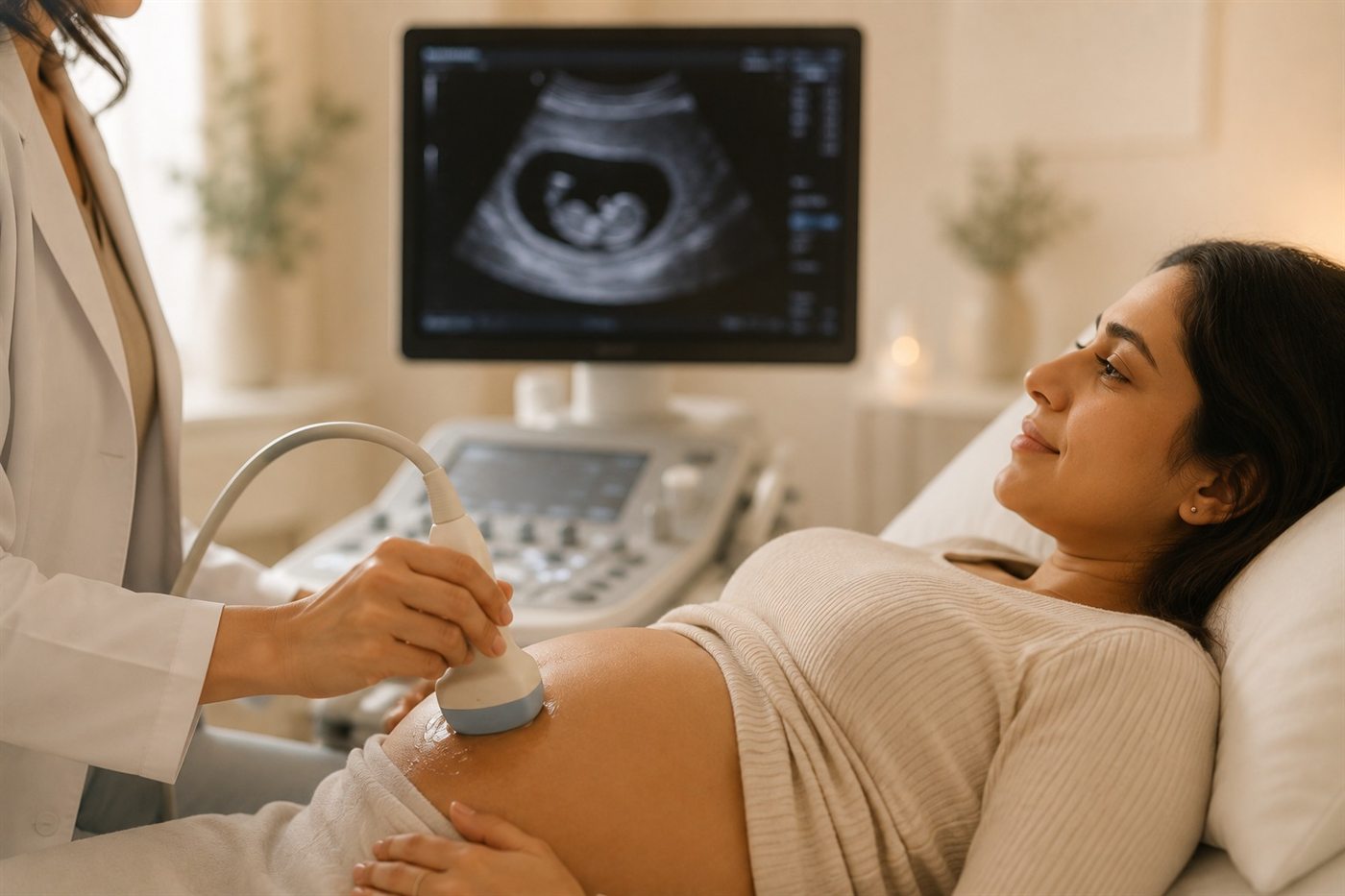
At the mid-pregnancy scan, the sonographer pauses and says the placenta is lying low. The word that follows, previa, sounds serious, and the mind races ahead to whether the baby is safe.
Here is the first thing to know, and it reframes the rest. Placenta previa is not a sign that anything is wrong with the placenta or the baby. It is a matter of location. The placenta is healthy; it has simply settled in a low spot, and most of the time, that spot sorts itself out.
Key takeaways
- Placenta previa is about where the placenta sits, not whether it is healthy.
- It is usually found on the mid-pregnancy scan, before any symptom.
- Roughly 9 in 10 low placentas found early move up on their own by the third trimester.
- The warning sign is painless, bright red bleeding, and it always needs same-day attention.
- If it persists, birth is a planned caesarean, often around 36 to 37 weeks.
- A previous caesarean is the single biggest risk factor.
This is for understanding, not diagnosis. A mother's own doctor interprets her scans and guides her care.
The quick answer
Placenta previa means the placenta has settled low and is covering or touching the cervix, the opening the baby would pass through at birth. Because that path must be clear for a vaginal birth, a placenta that stays over it means a planned caesarean is the safe way to deliver.
The main sign is sudden, painless bleeding in the second half of pregnancy. The reassuring part: spotted early, most low placentas drift upward as the uterus grows, and the few that do not are safely planned around.
What placenta previa really is
Picture the uterus as an upside-down pear, with the cervix as the narrow opening at the bottom. Normally the placenta implants high up, well away from it. In previa, it has settled low, over or beside the cervix.
Doctors now use two plain terms: placenta previa if it covers any part of the opening, and low-lying placenta if its edge sits within about two centimetres of the opening but not over it. The concern is only the exit route for birth, and the fact that a low placenta can bleed. It does not change how well the placenta nourishes the baby.
The types (grades 1 to 4)
Older reports grade previa by how much of the cervix is covered:
- Grades 1 to 2: the placenta reaches close to, or partly over, the opening.
- Grades 3 to 4: more of the opening is covered, with grade 4 (sometimes "type 4") covering it completely.
A higher grade only makes a planned caesarean more certain. It does not mean the baby is in more danger, only that the delivery plan is clearer.
What makes it more likely
Most of the time there is no clear reason, and nothing the mother did. Known risk factors:
- A previous caesarean or uterine surgery, the strongest factor, because the scar can change where the next placenta attaches. The risk rises a little with each caesarean.
- A previous placenta previa.
- Twins or more.
- Older maternal age, or several past pregnancies.
- Smoking, or a pregnancy conceived through IVF.
The caesarean link matters quietly, because caesarean rates have climbed in recent years. It is not a reason to second-guess a caesarean that was needed, but a good reason to plan any future birth with that history in mind.
Why most low placentas move up
A low placenta at 20 weeks rarely stays low, and this is one of the more reassuring facts in pregnancy. As the weeks pass, the lower uterus stretches and grows upward, gently carrying the placenta away from the cervix.
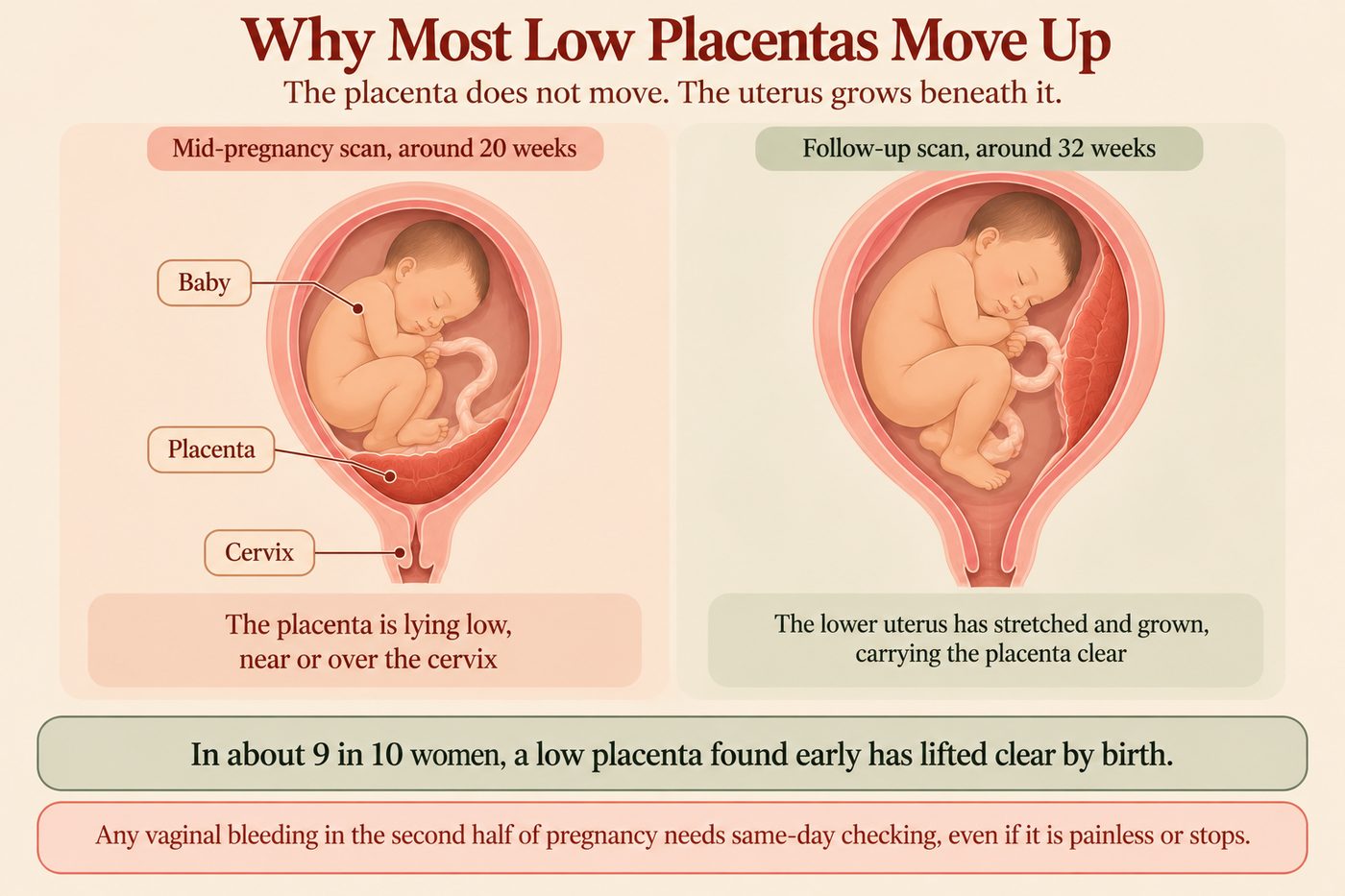
The placenta does not crawl anywhere. The uterus grows beneath it. So a low finding early on usually leads to a simple follow-up scan around 32 weeks, not a problem, and in about 9 in 10 women it has lifted clear by birth.
The bleeding sign to know
If placenta previa shows itself, it is usually through vaginal bleeding, typically bright red, often sudden, and painless. It may be light or heavy, may stop on its own, and may return later.
That painless quality is what makes it important. Pain is the body's usual alarm, so bleeding without it can feel less urgent than it is. Here the opposite is true: any bleeding in the second half of pregnancy needs same-day checking, even if slight, even if it stops, and without any internal examination at home.
What the team watches for
For the baby, the headline is reassuring: the placenta keeps feeding and supporting normally, so growth usually continues as it should. The main risk is indirect, an early delivery if bleeding becomes a problem, so prematurity is the thing watched, not the placenta's position itself.
For the mother, the watch-list is small and every item is easier when anticipated:
- Bleeding in pregnancy: why persistent previa is monitored closely, sometimes with a hospital stay.
- Placenta accreta: less common, but named honestly. When a previa sits over an old caesarean scar, the placenta can attach too deeply, raising the risk of heavy bleeding at birth. Doctors look for it on scans in advance and, if suspected, plan delivery with a specialist team and blood ready.
- Heavier bleeding after birth: the lower uterus does not squeeze down as firmly, a known risk the team prepares for.
- Anemia: if there has been bleeding, which is why iron may be advised.
None of this is a forecast. It is what lets the team keep both safe, and the single most protective step is simple: report any bleeding promptly.
Birth: caesarean or vaginal
The late scan decides, based on where the placenta ends up:
- Still covering or very close to the cervix: a planned caesarean is the safe route, usually scheduled a little early, often around 36 to 37 weeks, to avoid labour or bleeding starting first.
- Moved up and clear (most women): a vaginal birth may well be possible.
In other words, a low placenta at 20 weeks does not lock a mother into a caesarean. The decision simply waits for that later scan.
What helps, what to avoid
With a persistent low placenta or any bleeding, a doctor usually advises pelvic rest:
- No sexual intercourse, vaginal insertions, or internal examinations.
- No heavy lifting, intense exercise, or long spells on the feet.
What helps most:
- Keeping every follow-up scan.
- Taking any iron advised.
- Keeping the hospital bag and maternity unit's number within reach through the third trimester.
Strict, complete bed rest is no longer routinely recommended; its benefits are unclear and it carries its own downsides. A clear plan, not constant caution, is what turns a frightening moment into a managed one.
After the baby is born
Once the baby is delivered, the placenta is removed and the situation resolves. For most women, that is the end of it. Having had previa slightly raises the chance of it recurring, and each caesarean adds a little to that risk, useful to carry into planning a future pregnancy, not a worry for now.
When to see a doctor
Seek care the same day for:
- Any vaginal bleeding in the second half of pregnancy, even light, even if it stops.
- Bleeding with cramping, tightening, or pain.
- A gush of fluid, or a noticeable change in the baby's movements.
Get emergency care straight away for heavy bleeding, dizziness, or faintness.
Looking ahead
If the placenta is lying low today, the most likely path is quietly uneventful: another scan, strong odds it has lifted, and a pregnancy that carries on as usual.
And if it stays low, this is not the unknown. It is something a team sees often, watches carefully, and plans for calmly, as part of extra care in a high-risk pregnancy, with a safe, scheduled birth at the end. The picture is far gentler than that word on the scan first suggested.
References
- Royal College of Obstetricians and Gynaecologists. Placenta Praevia and Placenta Accreta: Diagnosis and Management (Green-top Guideline No. 27a).
- Royal College of Obstetricians and Gynaecologists. Placenta praevia, placenta accreta and vasa praevia (patient information).
- American College of Obstetricians and Gynecologists. Bleeding During Pregnancy.
- StatPearls. Placenta Previa. National Library of Medicine.
- Cleveland Clinic. Placenta Previa: Symptoms, Causes and Treatments.
Common questions
Why is the bleeding painless, and does that make it less serious?
The opposite. Painless bleeding is the classic previa sign, and its lack of pain is exactly why it gets ignored. Any bleeding needs same-day care.
Can anything be done to move the placenta up?
No procedure moves it, and none is needed. The uterus usually carries it upward on its own; care is about monitoring and a safe delivery plan.
Is a low-lying placenta the same as previa?
Not quite. Previa covers the opening; low-lying sits near it but clear. Low-lying is more likely to resolve and more often allows a vaginal birth.
Does bed rest help?
Strict bed rest is no longer routine. Pelvic rest, kept appointments, and a clear bleeding plan matter more.
This article is general information, not medical advice. Every pregnancy is different, so a mother's own doctor, who knows her scans and history, is the right person to guide her care.
 Medically reviewed byDr. Mahender Singh, MBBS, DCH, MD (Paediatrics)A consultant child specialist and neonatologist with over four decades of practice in newborn and child health.
 Written bySarthak ThakurCo-founder, CTO and Chief Marketing Officer of ParentVeda, and the software engineer who builds its app and the pipeline that checks its articles.
This article explains; it doesn’t diagnose. If your doctor has told you something different, your doctor is right.