
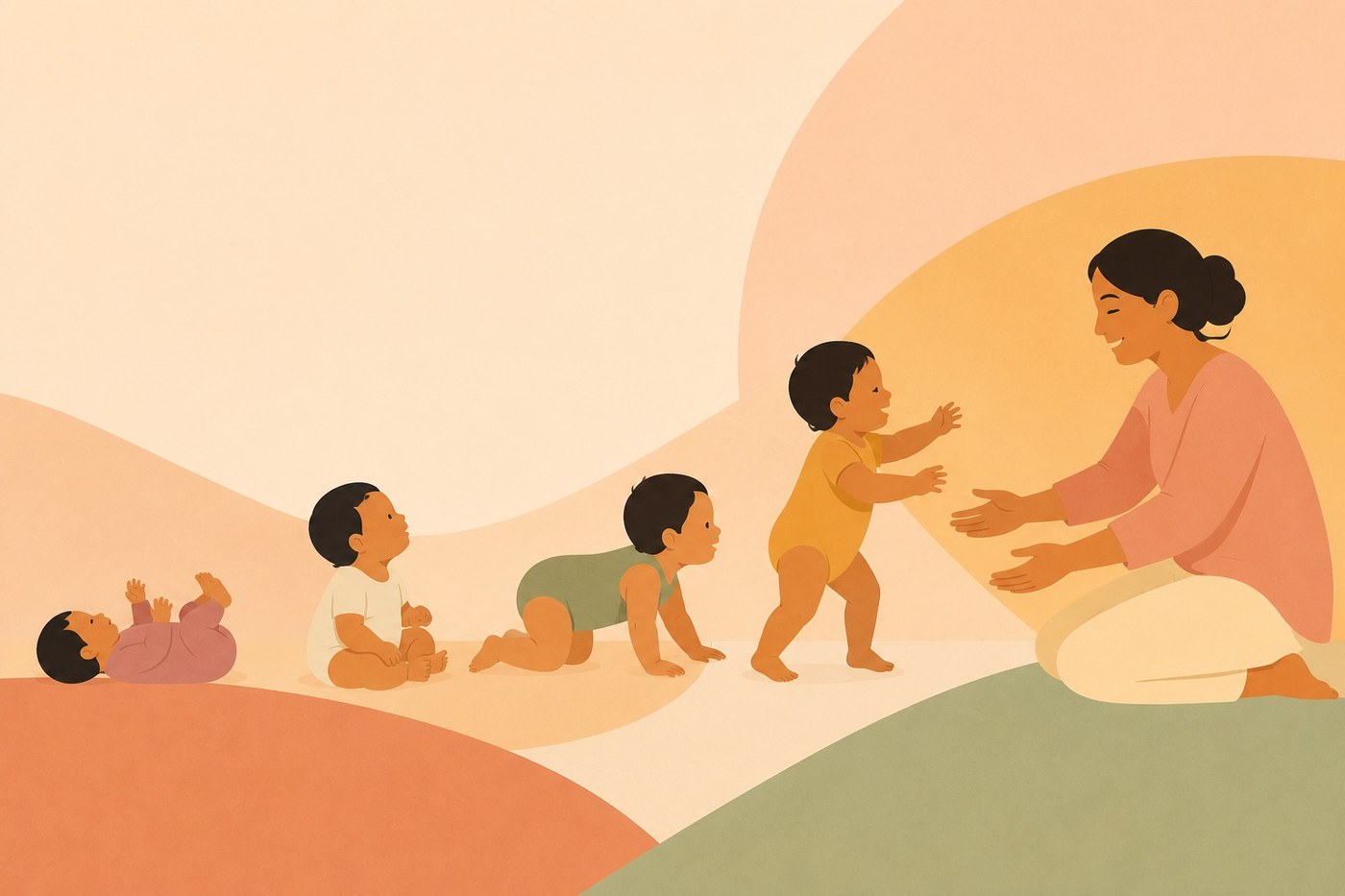
Watching your baby grow through the first year is full of small firsts, a first smile, a first roll, a first wobbly step. It is natural to want to know what usually comes next, and whether your baby is doing what most babies their age do. That gentle curiosity is one of the most common reasons parents look up milestones.
Here is the short version. Baby milestones are the skills most babies gain in a broadly similar order during the first year, such as smiling, holding up the head, sitting, babbling and walking. They are a helpful way to notice how your baby is developing, and a later milestone does not, on its own, mean something is wrong.
This guide walks through the first twelve months and, just as importantly, how to tell steady progress from a concern worth raising. Think of it as a map, not a deadline.
Key takeaways
- Milestones help you notice development. They are a guide for around 75 percent of babies at a given age, not a test your baby passes or fails.
- Skills tend to emerge in a broadly predictable sequence, but the timing and the way babies reach them can vary.
- A single later skill is common. What matters more is the overall pattern across several areas, and whether progress keeps going.
- If your baby was born prematurely, milestones may need to be read using corrected age, and your paediatrician can guide you.
- A missed milestone does not diagnose anything, but a persistent or broader concern is worth discussing rather than dismissing.
This is for general education and understanding. It is not medical advice and cannot replace a personal assessment by your paediatrician, who can consider your baby's full history.
What are baby milestones, and why do they matter?
Baby milestones are the everyday skills most babies gain as they grow, grouped by roughly when they tend to appear. Health bodies like the Centers for Disease Control and Prevention (CDC) describe them as things most children, around 75 percent, can do by a given age. They are meant to open a conversation with your doctor, not to grade your baby.
They matter because they help you notice how your baby is developing over time. Used well, they lower unnecessary worry while still helping you spot a genuine concern early. They are a prompt to observe and, when needed, to ask, rather than a chart your baby must match.
Why do babies reach milestones at different times?
Because babies are not built to a fixed schedule. Many developmental skills tend to emerge in a broadly predictable sequence, but the timing and the way babies reach them can vary from baby to baby, and that variation is a normal part of development.
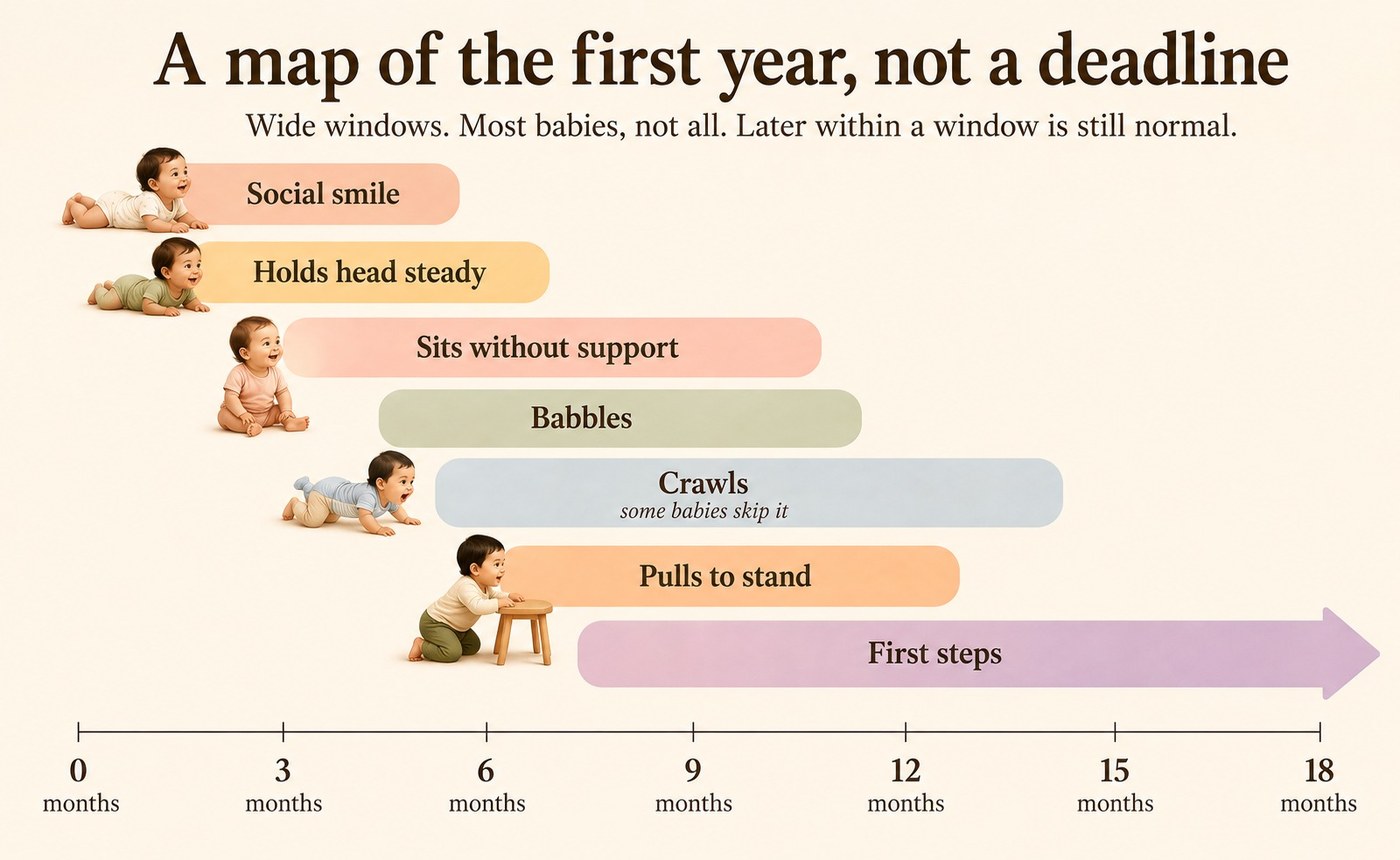
The World Health Organization (WHO) studied babies across several countries, including India, and found wide normal windows for movement skills. Sitting without support, for example, is reached across a span of months, and the window for walking alone is wider still.
Individual differences, opportunities to move and explore, and whether a baby was born early can all influence how development unfolds. A baby who skips crawling and goes straight to cruising along the furniture can still be developing typically.
Your baby month by month, 0 to 12 months
These are broad developmental signposts, not deadlines or a diagnostic checklist. Missing a single item for your baby's age does not, on its own, mean your baby is delayed. The guide uses developmental age bands rather than strict months, and brings together the CDC's age-based milestones and the WHO's wider movement windows as a single ParentVeda view.
| Around this age | Many babies | Some babies may begin to |
|---|---|---|
| Newborn (0 to 1 month) | Focus briefly on a face, turn towards sounds, and settle when comforted | Lift the head for a moment during tummy time |
| Around 2 months | Smile back, make cooing sounds, and follow you with their eyes | Hold the head a little steadier |
| Around 3 months | Push up on the forearms during tummy time, which builds the strength behind sitting later | Open and close the hands and coo in reply |
| Around 4 months | Hold the head steady, babble, and reach for toys | Push down through the legs when their feet touch a firm surface |
| Around 5 months | Bring objects to the mouth, which is how they explore and learn about them | Roll one way and laugh out loud |
| Around 6 months | Sit with support and babble strings of sounds | Pass a toy between hands, a sign of growing coordination |
| Around 7 to 8 months | Sit without support and look for a dropped toy | Rock or shuffle on the tummy |
| Around 9 months | Explore their own ways of moving and begin using gestures or sounds to communicate | Pull up to stand |
| Around 10 to 11 months | Wave, copy simple actions, and pick up small bits with finger and thumb | Cruise along furniture and say sounds like mama or dada |
| Around 12 months | Stand while holding on, hand you a toy in play, and use one or two sounds with meaning | Stand alone briefly or take first steps |
Walking is worth a special mention, because it often carries the most worry. It arrives across an unusually wide window, so a baby who walks before the first birthday and one who walks some time after can both fall within the normal range.
Which areas of development should you watch?
Milestones fall into a few areas that grow together, and it helps to see the whole picture rather than one skill on its own.
- Movement (gross motor): rolling, sitting, crawling and walking.
- Hands (fine motor): grasping, passing toys between hands, and the finger-and-thumb pincer grip.
- Communication: cooing, babbling and first words.
- Social and emotional: smiling, recognising you, and reacting to your mood.
- Thinking (cognitive): watching, exploring, and looking for a hidden toy.
A paediatrician or child-development professional does not tick these off one by one. They read them together as a pattern: what your baby can already do, what new skills are emerging, whether progress is continuing across the different areas, how your baby interacts and responds to people, and whether skills once gained are being kept.
What if your baby seems behind?
A later milestone on its own is common, and often it means nothing at all. Before worrying, it helps to step back from the single box on the chart and look at the whole picture.
Three questions are a good place to start. Is this one isolated skill, or are you noticing concerns across several areas such as movement, communication, social interaction and learning? Is your baby still gaining new skills over time? Has your baby lost a skill they clearly had before?
If a concern persists, the milestone chart is not the place to settle it, and it is not a reason to assume a particular therapy is needed either. A paediatrician can look at your baby's overall developmental profile and, especially if concerns appear in more than one area, decide whether to keep watching, assess further, or offer support. Our guide on developmental red flags goes through the signs worth raising, by age.
So much is developing at once
It is easy to watch for one skill at a time, the next roll, the next word. But your baby is never working on just one thing. While one skill may seem quiet, your baby is developing across several areas at the same time.
Progress is also often uneven. Your baby may surge ahead in one area for a few weeks while another stays quiet, then swap. A quieter patch does not necessarily mean development has stopped. What matters is whether new skills continue to emerge over time.
How can you gently support your baby's development?
You do not need special equipment, classes, or a plan to train your baby. What helps most in the first year is everyday, responsive interaction and safe chances to practise.
- Follow your baby's attention, and join in with whatever they are looking at.
- Respond to their sounds and gestures, so they learn that communicating works.
- Talk about what is in front of them, naming and describing as you go.
- Give safe, supervised chances to move and explore, including tummy time.
- Offer plenty of face-to-face time, songs and shared reading.
The aim is not to push your baby towards the next milestone, but to give them the interaction and space to reach it in their own time.
Looking ahead
The second year brings a different kind of change: more movement, more words, more independence and much more purposeful play. Development gradually shifts from big physical firsts towards language, personality and the way your baby connects with you.
For now, keep using milestones as a guide rather than a target, and enjoy the range as much as the achievements.
When should you speak to a doctor?
Milestones are most useful as a prompt to talk, not a reason to panic. These are examples of situations worth discussing promptly with your paediatrician; they are not diagnoses.
- Your baby loses a skill they had before, such as babbling or reaching.
- By around 6 months, your baby does not smile, respond to sounds, or hold their head up.
- By around 9 to 12 months, your baby is not sitting, is not babbling, or does not respond to their name.
- You feel something is wrong. Your instinct is reason enough for a conversation.
Health bodies encourage acting early rather than waiting, because support tends to help most when it starts sooner. If your baby was born prematurely, milestones may need to be interpreted using corrected age, particularly in the early years, and your paediatrician can help you understand which age to use.
References
- World Health Organization. Motor development milestones.
- Centers for Disease Control and Prevention. Learn the Signs. Act Early: Developmental Milestones.
- Centers for Disease Control and Prevention. Key Points about CDC's Developmental Milestone Checklists.
- American Academy of Pediatrics (HealthyChildren.org). Developmental Milestones: 12 Months.
- National Health Service (NHS UK). Baby's development.