

Many couples spend months thinking about this moment. Then, once the decision is made, the next question is often surprisingly simple: what should we actually do first? It is normal for that question to arrive with a flood of others, and to quietly wonder whether you have already missed something. Please be reassured: a short list of simple, well-timed steps covers most of what matters, and you have more time than it often feels like.
The gentle version is this. It helps to start getting ready about three months before trying. Begin a daily folic acid supplement once your doctor says it suits you, book a relaxed check-up, sort out a few tests and vaccinations, and ease into some healthy habits. The rest of this article simply walks you through those steps, one at a time.
Key takeaways
- Giving yourself about three months eases the pressure and leaves gentle room to sort out anything that comes up.
- Starting a daily folic acid supplement early, with your doctor's okay, gently supports your baby's earliest development.
- A single preconception check-up can quietly take care of tests, vaccinations, family history and any conditions worth settling first.
- It is worth checking your rubella immunity now, since the measles, mumps and rubella (MMR) vaccine is given before pregnancy rather than during it.
- Your partner's health matters here too, as sperm also takes a few months to mature.
This is for education and general understanding, not a diagnosis. Your situation is unique, and it is always best to follow the guidance of your own doctor, especially on tests, vaccinations, supplements and any existing conditions.
Why start about three months before trying?
Three months is not a hard rule, more of a comfortable runway. What surprises many couples is that those first few weeks, when your baby's spine and brain begin to form, often pass before you even know you are pregnant. That is exactly why a daily folic acid supplement does its best work when it has had time to build up beforehand, and why doctors suggest starting early.
Starting early also gives you unhurried time to sort out anything small. Some vaccinations need to be completed before pregnancy, so starting early gives you time to do this without feeling rushed. There is no rush in any of it, and beginning early just means fewer things to think about later.
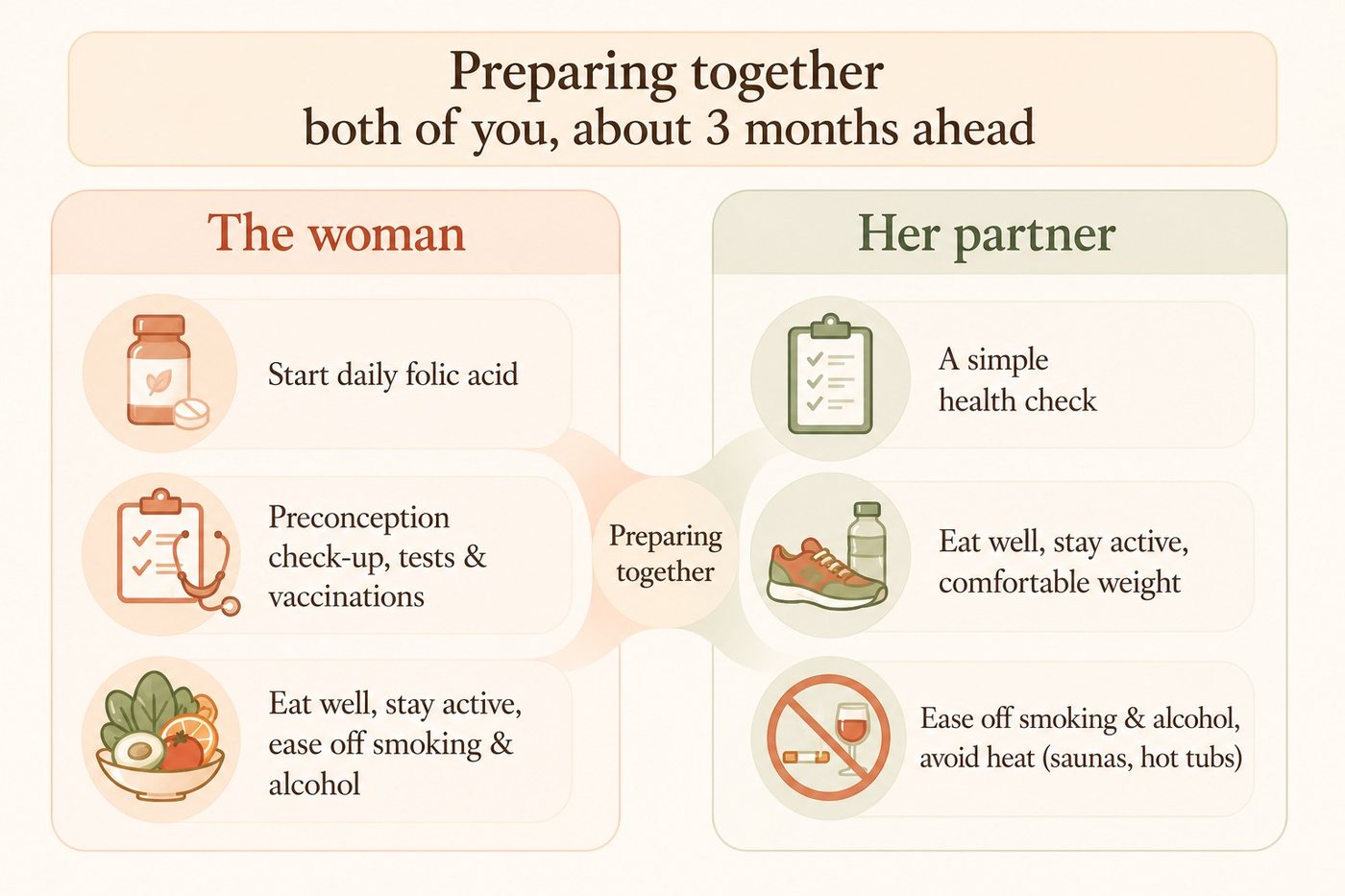
The preconception checklist at a glance
Here is the whole plan in one calm view. Each item is explained gently below, and none of it needs to happen at once.
| # | What to do | Why it helps |
|---|---|---|
| 1 | Begin a daily folic acid supplement, once your doctor says it suits you | Gently supports your baby's developing spine and brain in the very first weeks |
| 2 | Book a preconception check-up | A relaxed chat about your health, any medicines you take, and your family history, with advice made for you |
| 3 | Discuss which tests you need | Depending on your history, your doctor may discuss blood group and Rh, haemoglobin, blood sugar, thyroid testing, or carrier screening such as thalassemia |
| 4 | Check your vaccinations | Check your rubella immunity before pregnancy; if you need the MMR vaccine, it is given before pregnancy |
| 5 | Eat well and settle at a comfortable weight | Folate-rich foods (leafy greens, legumes, citrus) and iron-rich foods (dal, beans, green leafy vegetables) help you start well-nourished |
| 6 | Ease off smoking and alcohol, keep caffeine modest | There is no known safe level of smoking or alcohol when trying, so gently letting them go helps |
The checklist is a guide, not a test you have to pass. Some things can be done before you try, some can be discussed with your doctor along the way, and some may not apply to you at all.
Which health checks and tests are worth doing?
A single, unhurried visit to your doctor before trying can save a lot of second-guessing later. Together you can look over any ongoing conditions, the medicines you already take, and your family history, and arrange the tests worth doing early. Your doctor will usually suggest only the tests that matter for you. The ones most often mentioned are these.
- Blood group and Rhesus (Rh) factor, so anything to do with an Rh-negative result is known well ahead of time.
- Thalassemia carrier screening, which is worth doing in India, where carrier rates are relatively common.
- Rubella immunity, since the MMR vaccine is given before pregnancy.
- Thyroid function, measured as thyroid-stimulating hormone (TSH), which is often best brought closer to the usual range before conceiving.
- Haemoglobin and blood sugar, to gently pick up anaemia or diabetes early.
What is worth sharing about your family history?
Your family and personal history is one of the most helpful things to bring to that visit. A history of thalassemia, diabetes, high blood pressure, or an inherited condition on either side can gently shape which tests matter most for you. A previous pregnancy affected by a neural tube defect, or a close relative with one, may also change what your doctor suggests, so it is worth mentioning.
If you have polycystic ovary syndrome (PCOS), thyroid changes or diabetes, a preconception review is especially worthwhile. Because PCOS can affect blood sugar and blood pressure in pregnancy, settling it early with your doctor gently lowers those chances. Getting these steady beforehand looks after both you and your baby, and your doctor can let you know whether anything you already take needs a small adjustment.
How can your partner get ready?
Half of this picture is your partner, and something many couples do not realise is that it is not only your body that benefits from a head start. Sperm takes roughly two to three months to mature, so the same gentle three-month window applies to your partner too, which is why it is lovely when preparing feels shared.
In short, your partner can:
- Book a simple health check of their own.
- Eat well, stay active, and settle at a comfortable weight.
- Ease off alcohol and step away from smoking.
- Avoid long spells of heat, such as hot tubs, saunas, or a laptop resting on the lap.
- Come along to appointments, so none of the preparing feels like yours alone.
Small habits that gently make a difference
If you are starting today, begin with the changes that matter most: take your folic acid, stop smoking and alcohol, review any medicines or health conditions with your doctor, and build toward a balanced routine. The rest can follow gradually.
Looking ahead
With the basics gently in place, the natural next step is timing. Getting to know how your fertile window works, and how to notice the signs of ovulation, is what turns quiet preparation into a real, hopeful plan for trying.
References
- National Health Service (NHS UK). Planning your pregnancy.
- National Health Service (NHS UK). Vitamins, supplements and nutrition in pregnancy.
- Centers for Disease Control and Prevention (CDC). Planning for Pregnancy.
- American College of Obstetricians and Gynecologists (ACOG). Good Health Before Pregnancy: Prepregnancy Care.
- Mayo Clinic. Getting pregnant: Preconception planning.