


You have decided you want to try for a baby, and almost at once the questions start. Someone says get your tests done first, a relative mentions thalassemia, and one search buries you in a list long enough to make you wonder if you are already behind.
Take a breath. The real list is far shorter than the internet suggests, and most of it is simple blood work done a few months before you start trying. Which tests you actually need depends on your age, your health, and your family history.
This guide separates the tests most couples consider from the ones only some couples need, so you can walk into a doctor's visit knowing what to ask. Throughout, "you" means both of you as a couple, with a few tests meant only for the partner who will carry the pregnancy.
Key takeaways
- Preconception testing is not one fixed checklist; some tests are commonly useful, others depend on your situation.
- For most couples the starting set is simple blood work, ideally a few months before trying.
- In India, thalassemia carrier screening matters because many carriers feel completely well and never know.
- AMH is not a fertility pass or fail, and most couples do not need it.
- An abnormal result usually means a conversation and a next step, not the end of your plans.
- Folic acid should start before conception, whatever your results show.
This is for education and general understanding, not a diagnosis. It cannot replace a consultation with a qualified doctor who knows your history.
Do you need every test? The honest short list
Not every couple needs every test. The clearest way through the noise is to split preconception tests into two groups: the ones most couples consider, and the ones that depend on your situation.
Often considered
| Test | What it tells you | Usually for |
|---|---|---|
| Complete blood count (CBC) | Anaemia, plus early clues to thalassemia trait | Both of you |
| Blood group and Rh (Rhesus) typing | Your blood type and Rh factor | Both of you |
| Thalassemia carrier screening | Whether you carry the beta-thalassemia trait | Both of you |
| Rubella immunity (IgG antibody) | Whether you are already protected against rubella | You (carrying) |
| Blood sugar and thyroid, when indicated | Undiagnosed high sugar, or an under or overactive thyroid | You (carrying) |
| Infection screen: HIV, hepatitis B, hepatitis C, syphilis | Infections that can pass to a baby | Both of you |
Depends on your situation
| Test | When it becomes relevant |
|---|---|
| AMH (anti-Mullerian hormone) | Older age, PCOS, or considering fertility treatment |
| HbA1c or detailed diabetes testing | Known risk factors, or a high fasting sugar |
| Detailed thyroid panel | An abnormal thyroid result, or existing thyroid disease |
| Wider genetic carrier screening | Family history beyond thalassemia |
| Semen analysis | Trouble conceiving, or a known reason to check early |
Which of the second group apply to you comes down to your age, your history and any existing conditions. That is a conversation for a doctor, and our preconception checklist shows how they weigh it.
Why thalassemia screening matters so much in India
Here is something many couples never learn: you can carry thalassemia your whole life and feel completely well. India has a high number of these silent carriers, which is why the trait so often goes unnoticed.
The risk appears only when both partners carry it. Then each pregnancy has a higher chance of a baby with the severe form, which needs lifelong care, so Indian guidelines recommend offering screening to every couple, whatever the family history.
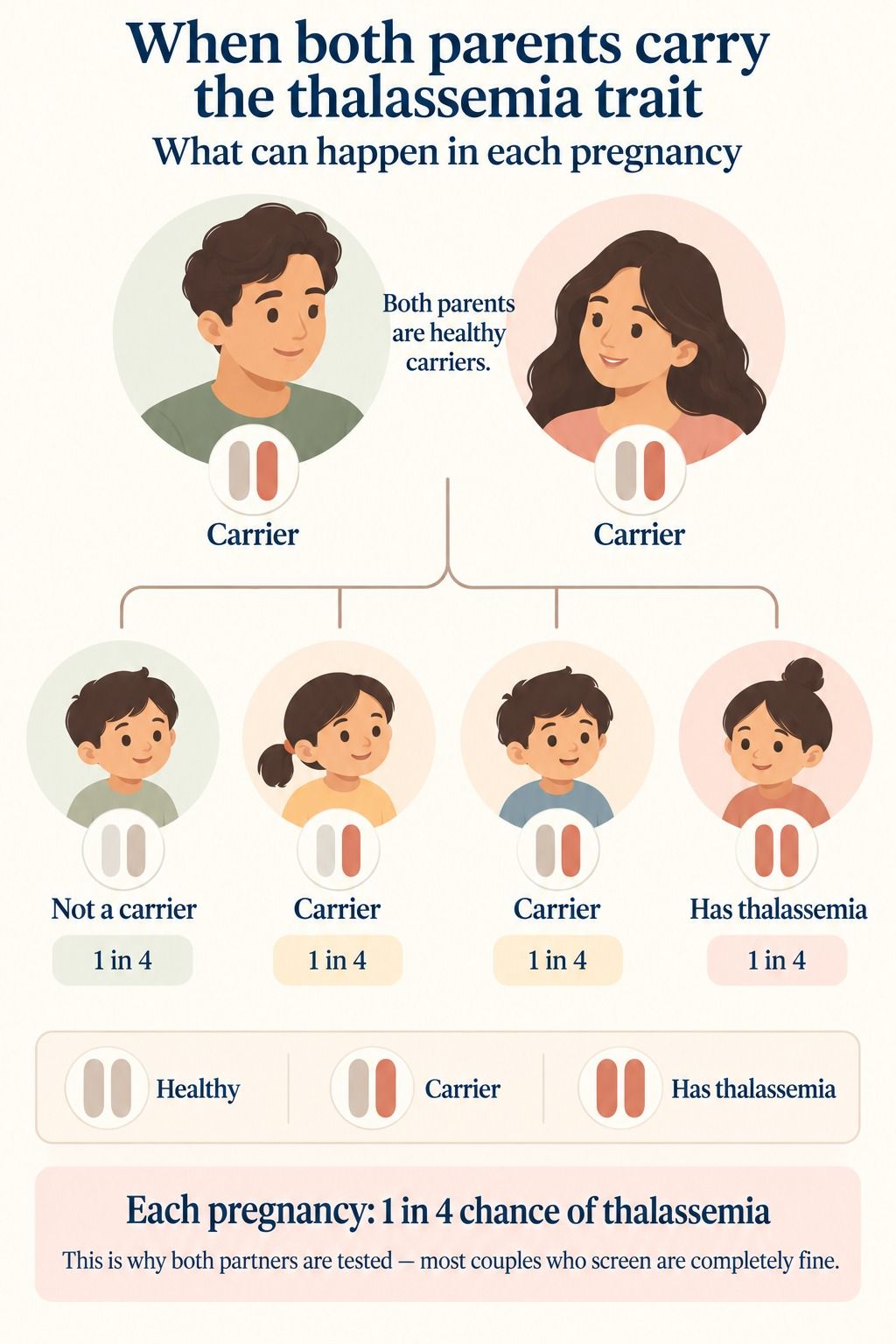
The test itself is undramatic. It usually starts with a complete blood count, followed if needed by a haemoglobin test run on a method called high performance liquid chromatography (HPLC).
Do you need an AMH test before trying?
Probably not, and it helps to know why. AMH (anti-Mullerian hormone) is often ordered as if it were a fertility score, but it does not work that way.
It reflects roughly how many eggs you have left, your ovarian reserve. It does not tell you whether you will conceive, so a low number is not a closed door and a high one is not a promise.
Outside the few situations listed above, an AMH result usually adds worry rather than answers, which is the opposite of what you came here for.
What happens if a result comes back abnormal?
An abnormal result is rarely an emergency, and almost never the end of your plans. It is the start of a conversation, not a full stop.
The path is usually calm and stepwise. The result is confirmed, a doctor explains what it means for you, and any treatment, vaccination or follow-up happens before you start trying.
Some findings are settled quickly, like starting iron or completing a vaccine. Others take a little more attention, and that is exactly what the preconception window is for.
Your partner is half of the picture
It is easy to treat preconception care as one person's homework. It is not.
For your partner, think in two layers. A basic health review, together with the shared tests of blood group, thalassemia screening, and the infection screen, covers most couples, while fertility testing is a separate step.
A semen analysis is not automatic before trying. It matters after a longer stretch without success, or when there is a clear reason to check sooner. Everyday habits like sleep, weight, smoking and heat shape sperm health more than most people expect, and our guide on improving sperm count goes deeper.
When to book, and why you do not have to wait
Aim for roughly three months before you start trying. That window leaves room to repeat anything borderline, finish a vaccine if you need one, and let small changes take hold.
Rubella is the clearest example. If you are not immune, you can have the measles, mumps and rubella (MMR) vaccine before trying, then wait about a month before you conceive.
Two things do not wait. A folic acid supplement should be started before pregnancy and continued until at least week twelve, to lower the risk of neural tube defects. And you never need to delay trying simply because you have not ticked off every test.
Looking ahead
Once you know which, if any, issues need attention, you can move from checking to preparing. The next useful steps are understanding your fertile window, getting your nutrition in place, and knowing when a specialist's advice is worthwhile.
When to speak to a doctor
Book a preconception consult sooner rather than later if:
- You or your partner have a family history of thalassemia, another inherited blood disorder, or a genetic condition.
- You have a known thyroid problem, diabetes, high blood pressure, or take regular medication.
- You are 35 or older and want personalised advice about fertility or pregnancy planning.
- You have had a previous pregnancy loss, or a baby with a health condition.
- You have been trying for over 12 months, or over 6 months if you are 35 or older.
References
- Federation of Obstetric and Gynaecological Societies of India (FOGSI). Good Clinical Practice Recommendations on Thalassemia.
- Indian Journal of Medical Research. Prenatal screening for genetic disorders: Suggested guidelines for the Indian scenario.
- National Health Service (NHS UK). Planning your pregnancy.
- Cleveland Clinic. Anti-Mullerian Hormone Test.
- Tommy's. Rubella vaccine (MMR) and pregnancy.
- MotherToBaby. Measles, Mumps, and Rubella (MMR) Vaccine.