

When a couple starts trying for a baby, most of the attention tends to land on the woman. Yet sperm are an important part of the fertility picture for both partners, and they are often given far less thought.
Whether you are just beginning or have been trying for a while, giving your sperm the best possible start is a worthwhile step. The good news is that some of it is within your control.
Key takeaways
- Male factors are an important part of fertility, and some lifestyle changes can support sperm health.
- The habits that help most are a healthy weight, no smoking, limited alcohol, good sleep and keeping the area cool.
- A sperm takes roughly 74 days to develop, so changes now may take about two to three months to show in a semen analysis.
- A low result has more than one possible cause, so it does not automatically point to lifestyle.
- A semen analysis is a simple first test, and a single result on its own is not a diagnosis.
This is for education and general understanding, not a diagnosis. Sperm health and fertility vary from person to person, so please speak with a qualified doctor about your own situation.
Can you actually improve your sperm count?
Sometimes, yes. Sperm quality is not fixed for life, and for many men it can be supported by changes to everyday habits.
For others the cause lies elsewhere and needs medical input. Either way, the practical place to start is the same, with the everyday factors you can influence.
The habits that support sperm health
A handful of everyday habits carry most of the influence you have. They work in different ways, so it helps to look at the overall pattern rather than search for one perfect change.
| Supports sperm health | Works against it |
|---|---|
| A healthy weight | Being significantly overweight |
| Not smoking | Tobacco and cannabis |
| Little or no alcohol | Regular heavy drinking |
| Moderate, regular exercise | Long, mostly sedentary days |
| Good sleep and lower stress | Chronic sleep loss and stress |
| Keeping the area cool | Frequent heat exposure |
Do not try to fix everything at once. If you are starting today, focus first on the changes with the clearest evidence: stop smoking, reduce heavy alcohol use, work toward a healthy weight, and give the changes time.
Why changes take about three months to show
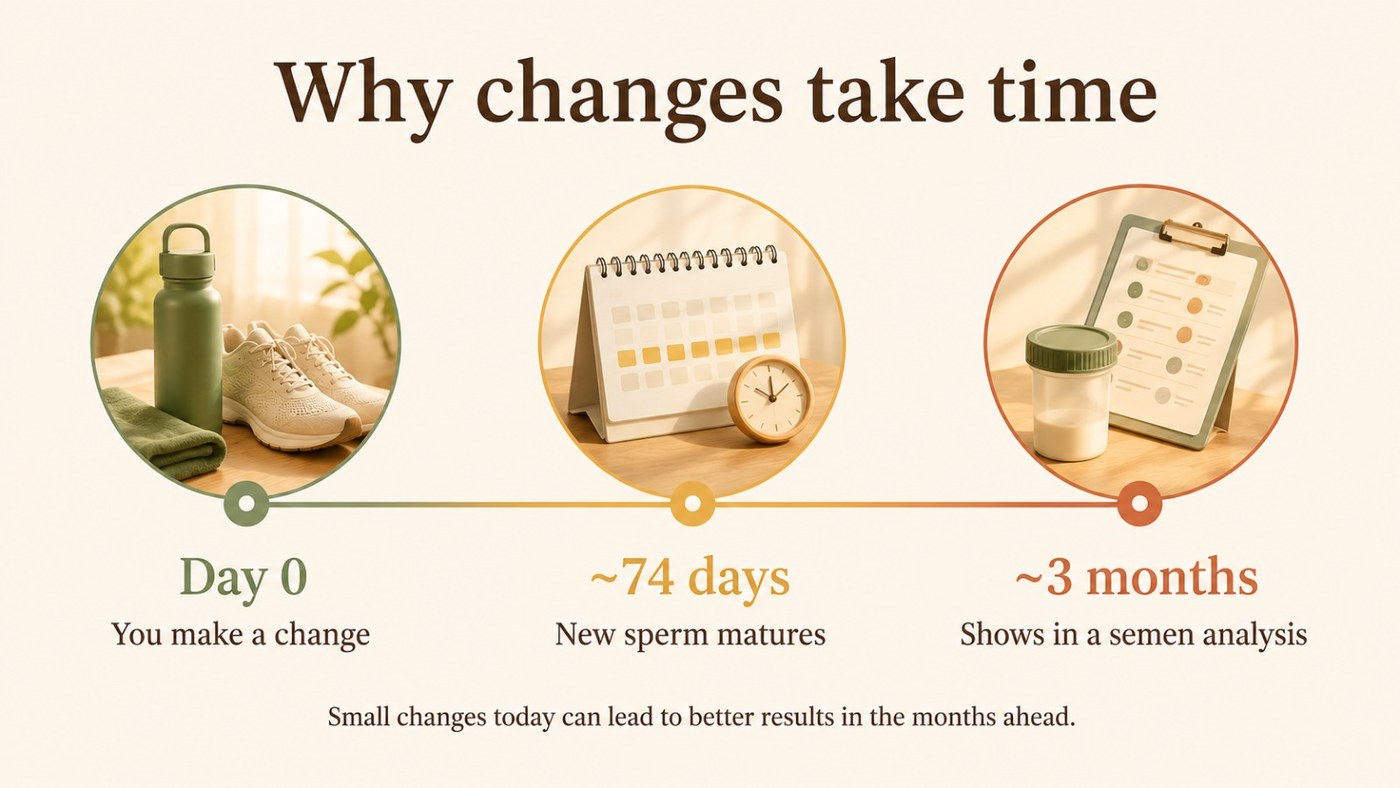
Your body makes sperm continuously, but a single sperm takes roughly 74 days to develop and mature. Add a short journey through the reproductive tract, and the full process sits close to three months.
That is why a change you make now may take around two to three months to appear in a semen analysis. Steady habits across that window matter more than any single day.
Here is the part worth holding onto: a healthy change you make today will not affect the sperm already waiting. It helps the next generation of sperm your body is making right now.
What affects sperm count and quality?
Not everything that lowers sperm health is about lifestyle. Seeing the full range helps explain why a low result usually has more behind it than one habit.
- Smoking, tobacco or cannabis
- Regular heavy alcohol use
- Being significantly above a healthy weight
- Frequent heat exposure to the area
- Ongoing stress or long-term poor sleep
- Some medicines, including testosterone or anabolic steroids
- Infections affecting the reproductive tract
- Hormone problems
- A varicocele, which is a group of enlarged veins in the scrotum
- A past injury, surgery or infection involving the testicles
- Certain longer-term medical conditions
Some of these you can influence yourself. Others need a doctor to look into, so a low result is a reason to ask questions, not to assume blame.
Does heat affect sperm?
Sperm form best a little below body temperature, which is why the testicles sit outside the body. Significant, regular heat may tip that balance.
If you are often exposed to real heat, such as long hours in a hot workplace, reducing that exposure may be a reasonable step while you are trying to conceive. The evidence around laptops and tight underwear is less clear, so these are worth easing rather than worrying about.
Diet, weight and supplements for sperm health
An everyday balanced plate, with plenty of vegetables, fruit, whole grains and good protein, supports your sperm alongside the rest of you.
If you are above a healthy weight, gradual weight loss may improve some aspects of sperm quality, particularly where excess weight is affecting your overall health.
Supplements such as zinc, folate and antioxidants are widely marketed, but the evidence that they improve the chance of a pregnancy is limited and uncertain. There is more on this in the questions below.
When should you get a semen analysis?
A semen analysis is the main test of sperm health. A sample is checked for how many sperm there are, how well they move, and their shape.
If you have been trying without success, when to investigate depends on the ages and circumstances of both partners. As a general guide, the NHS suggests seeking help after about a year, or six months if your partner is over 35, though it can be done sooner if there are risk factors or symptoms.
Results are read against reference points, not a strict pass or fail. The World Health Organization (WHO) puts the lower reference for sperm concentration at 16 million per millilitre and total movement at 42 percent. These values help a clinician interpret a result; they do not by themselves decide whether pregnancy is possible.
A single low result does not necessarily reflect your usual sperm production, so a repeat test may be recommended before drawing any conclusion.
Does a low sperm count mean infertility?
No, not on its own. A low count lowers the odds in a given month rather than closing the door, and fertility depends on many factors across both partners.
Some couples still conceive naturally, sometimes with a little more time. Where more help is needed there are effective options, so a low result is information to act on, not a verdict.
Looking ahead
Whatever the results show, the next few months can be a useful window for making changes that support sperm health. For some couples, healthier habits may help, while others may need further evaluation or treatment.
If testing finds a specific cause, such as a hormone problem or a varicocele, treatment may be available depending on what is causing it. A fertility specialist can explain what the findings mean and what options are appropriate.
Getting the right information can replace some of the guesswork with clearer next steps, so you can focus on what is actually within your control.
When to speak to a doctor
- You and your partner have been trying for about a year, or six months if your partner is over 35, without success.
- You have had an injury, surgery or infection involving the testicles or groin.
- You notice swelling, a lump, pain, or a heavy feeling in the scrotum.
- You take medicines or supplements, including testosterone or steroids, that can affect fertility.
- A semen analysis comes back low on more than one occasion.
References
- National Health Service (NHS UK). Low sperm count.
- American Society for Reproductive Medicine (ASRM). Optimizing Male Fertility.
- Bjorndahl L, et al. The sixth edition of the WHO Laboratory Manual for the Examination and Processing of Human Semen (2021). Fertility and Sterility.
- de Ligny W, et al. Antioxidants for male subfertility (2022). Cochrane Database of Systematic Reviews.