Being told that no sperm was found in a semen sample can feel like the ground shifting. For many couples it is one of the hardest moments in the journey to a baby, and the first fear is almost always the same: does this mean children are now impossible?
The reassuring part is that this finding is rarely the end of the story. No sperm in the semen, a result doctors call azoospermia, is uncommon but often treatable, and just because you have the condition does not mean you cannot have biological children.
Key takeaways
- No sperm in the semen (azoospermia) rarely means a man can never have children.
- There are two types: obstructive, where sperm is made but blocked, and non-obstructive, where little or no sperm is made. The type guides treatment.
- A true zero is the one semen finding that needs a specialist, not just a repeat test.
- Simple blood and genetic tests, an examination and sometimes an ultrasound usually reveal the cause.
- Even when no sperm reaches the semen, sperm can often be found in the testes and used with in vitro fertilisation to create a pregnancy.
This is for understanding, not diagnosis. A fertility specialist who has seen the reports is the right person to guide what happens next.
The quick answer
Azoospermia means no sperm is found in the semen. It is not a single verdict. It comes in two forms, one caused by a blockage and one by a production problem, and both can often be treated. Unlike a merely low result, a true zero needs a fertility specialist rather than a simple repeat test, because the cause changes what happens next.
What does "no sperm found" actually mean?
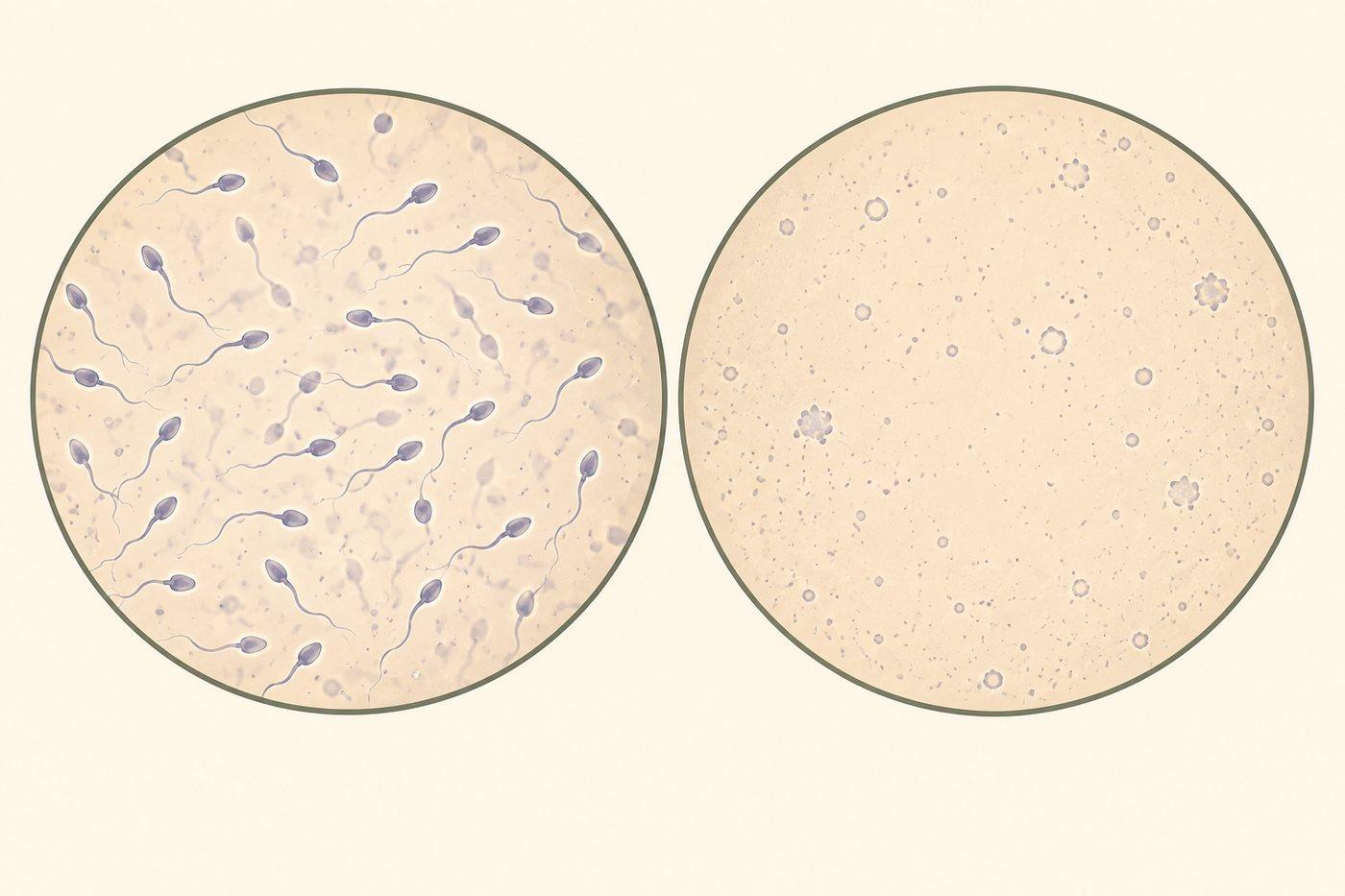
Azoospermia means a laboratory looked at the semen under a microscope and found no sperm at all. It is different from a low count, where some sperm are present but fewer than expected.
It is genuinely uncommon. It is seen in roughly 1 percent of all men and in about 10 percent of men who are investigated for fertility problems.
Before the label is confirmed, a good laboratory repeats the test and spins the sample in a centrifuge to check for even a few hidden sperm. Only when careful samples show none is azoospermia confirmed.
One low report is not the same as azoospermia
Most abnormal semen results, such as a low count or poor movement, are simply repeated after a few weeks, because sperm numbers swing with illness, stress, heat and timing. A true zero is the exception.
For a low count rather than a zero, the lifestyle steps that may help are covered in how to improve sperm count.
When no sperm is found at all, repeating the same test on your own is not the useful next step. This is the one result that calls for a specialist, an andrologist or reproductive urologist, who can find why the number is zero.
The reason matters because a blockage and a production problem can look similar on the report but need completely different treatment.
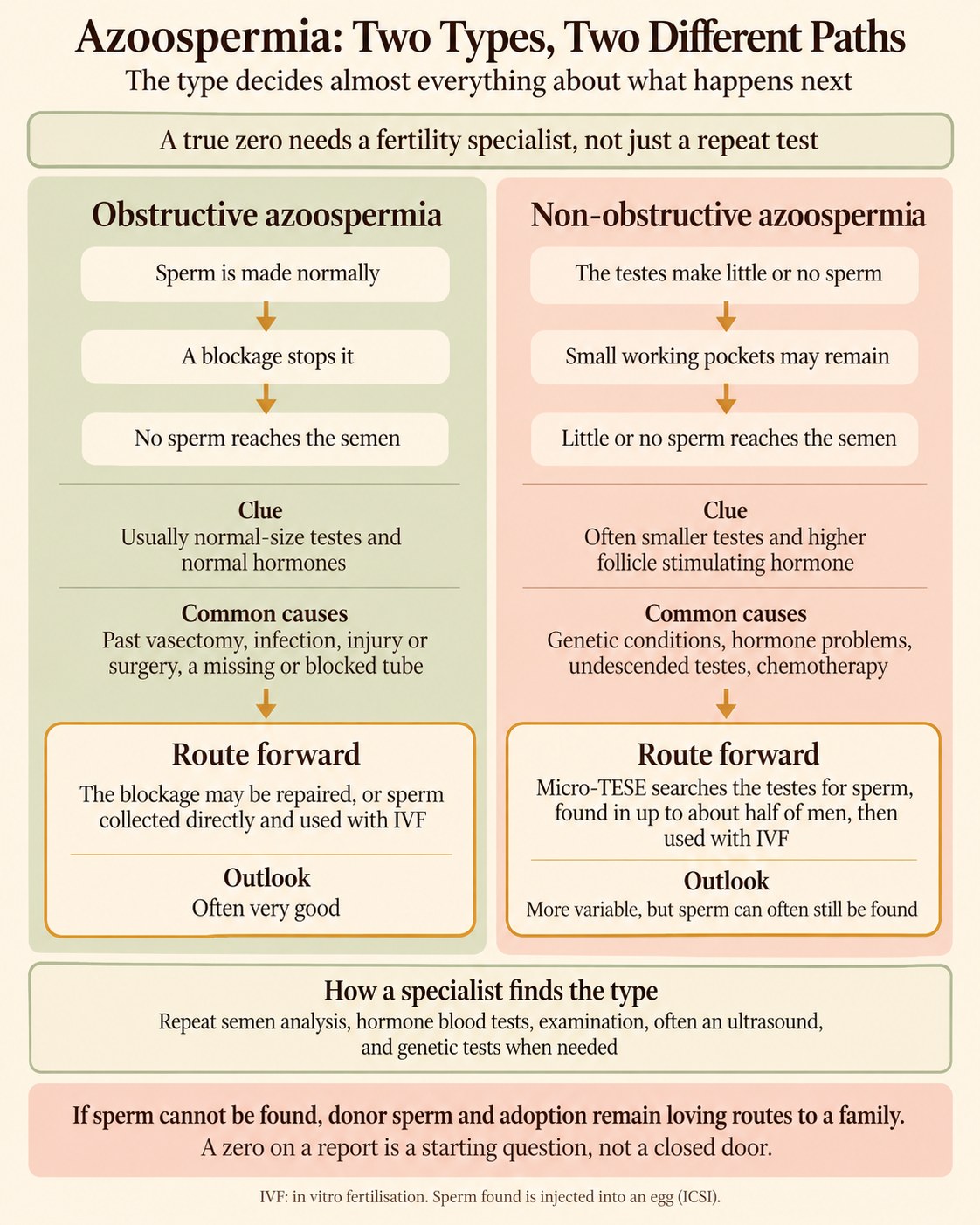
The two types decide almost everything
Almost everything about the outlook depends on which of the two types you have. A specialist works this out early, often from an examination, a hormone blood test and an ultrasound.
| Obstructive azoospermia | Non-obstructive azoospermia | |
|---|---|---|
| What is happening | Sperm is made normally, but a blockage stops it reaching the semen | The testes make little or no sperm |
| Common causes | Past vasectomy, infection, injury or surgery, a missing or blocked tube | Genetic conditions, hormone problems, undescended testes, chemotherapy |
| Typical clue | Normal-size testes, normal hormones | Smaller testes, higher follicle stimulating hormone |
| Usual outlook | Often very good; the blockage can be bypassed or repaired | More variable, but sperm can still often be found |
What causes azoospermia?
The causes fall into the two groups above. The common ones include:
- A past vasectomy, or scarring from infection, injury or hernia surgery that blocks the sperm's path
- A missing or blocked tube (the vas deferens), sometimes linked to a carrier gene for cystic fibrosis
- Hormone imbalances that switch off the signal for sperm production
- Genetic differences such as Klinefelter syndrome or small missing pieces of the Y chromosome
- A varicocele, undescended testes in childhood, or past chemotherapy or radiation
An untreated varicocele, a common group of swollen veins in the scrotum, is one cause worth asking about, since treating it sometimes helps.
How a specialist finds the reason
Finding the cause is usually straightforward and rarely needs surgery to begin with. A specialist typically arranges:
- A repeat semen analysis at a trusted laboratory
- Blood tests for hormones, mainly follicle stimulating hormone and testosterone
- A physical examination and often a scrotal ultrasound
- Genetic tests when a production problem is suspected
These results together usually show whether sperm is blocked or not being made, which sets the plan for what comes next.
Can you still have a biological child?
For most couples, this is the only question that truly matters, and the answer is more hopeful than the word azoospermia suggests.
When the cause is a blockage, the outlook is often very good. Surgeons can sometimes reconnect the tubes, or collect sperm directly and use it to fertilise an egg in the laboratory.
When little sperm is being made, a delicate operation called micro-TESE searches the testes under a microscope for tiny pockets that are still working. Sperm is retrieved in up to about half of these men.
Any sperm that is found is then injected into an egg, a technique called intracytoplasmic sperm injection, used within in vitro fertilisation. Before this became possible, the only routes were donor sperm or adoption; now many men with azoospermia father their own biological child.
If sperm cannot be found, donor sperm and adoption remain loving routes to a family. A zero on a report is a starting question, not a closed door.
When to see a doctor
Azoospermia is not a medical emergency, so there is no need to rush in panic. It does, though, always deserve a proper assessment rather than a wait-and-see approach.
See a fertility specialist if:
- A semen analysis reports no sperm.
- There is a history of undescended testes, injury, childhood mumps or cancer treatment.
- There is a family history of fertility problems.
Genetic counselling is wise when a genetic cause is found, since it can affect a future child.
Looking ahead
Your next step is a single, specific one: book an appointment with a reproductive urologist or andrologist, not another home test, and bring the semen report with you.
It also helps to treat this as a couple's plan rather than one person's problem, since your partner's age and fertility shape the timeline, so the two evaluations often move forward together.
If the news is weighing heavily on either of you, talking helps. A counsellor, a peer support group, or Tele-MANAS, the government's free mental health helpline on 14416, are all places to start.
References
- Cleveland Clinic. Azoospermia (Zero Sperm Count): Causes & Treatment.
- University of Utah Health. Azoospermia: Sperm Production, Types, Causes and Treatment.
- Weill Cornell Medicine (maleinfertility.org). Obstructive vs. Non-Obstructive Azoospermia.
- Healthy Male (Australia). How successful is TESE-ICSI in couples with non-obstructive azoospermia?
- Nova IVF Fertility (India). What is Obstructive and Non-Obstructive Azoospermia?
- Minhas S et al. Role of interventions in non-obstructive azoospermia. PMC.
Common questions
Can a man with azoospermia have a baby?
Often, yes. When sperm is blocked it can usually be collected or the blockage repaired. When little is made, a micro-TESE operation finds usable sperm in up to about half of men, which is then used with in vitro fertilisation. Donor sperm and adoption are further routes.
Is azoospermia curable or treatable?
Many cases are treatable, though whether it is curable depends on the cause. Blockages can often be bypassed or repaired, and hormone-related types may respond to medication. Some genetic causes cannot be reversed, but sperm can still often be retrieved for fertility treatment.
What is the difference between obstructive and non-obstructive azoospermia?
In the obstructive type, the testes make sperm normally but a blockage stops it reaching the semen, and the outlook is usually good. In the non-obstructive type, the testes make little or no sperm, which is harder to treat but still often workable.
Does a single "no sperm" report confirm azoospermia?
Not on its own. A reliable laboratory repeats the test and spins the sample down to look for hidden sperm before confirming it. A single result should be checked by a specialist rather than acted on alone.
This article is for education and general understanding. It is not a diagnosis or personal medical advice. Azoospermia has many causes with different treatments, so any semen result showing no sperm should be assessed by a qualified fertility specialist who can guide you on your own situation.
 Medically reviewed byDr. Mahender Singh, MBBS, DCH, MD (Paediatrics)A consultant child specialist and neonatologist with over four decades of practice in newborn and child health.
 Written bySarthak ThakurCo-founder, CTO and Chief Marketing Officer of ParentVeda, and the software engineer who builds its app and the pipeline that checks its articles.
This article explains; it doesn’t diagnose. If your doctor has told you something different, your doctor is right.