
Many mothers expect breastfeeding to come naturally, and are surprised when the first feeds feel clumsy. Knowing how to breastfeed comes down to three steps: hold the baby skin to skin soon after birth, help the baby take a wide mouthful of breast rather than just the nipple, and feed whenever the baby shows hunger, at least 8 to 10 times in 24 hours.
For most healthy newborns, breast milk alone is enough from the first feed, unless a doctor advises extra feeds for a medical reason. The rest is learned with practice.
Key takeaways
- A good feed depends on the baby taking a mouthful of breast, not just the nipple.
- When mother and baby are both stable, the first feed ideally happens within an hour of birth, including after a caesarean section.
- Avoid honey before 12 months. Do not give a newborn water, sugar water or janam ghutti unless a qualified clinician advises it as a medical treatment.
- Wet nappies rise day by day. From day 6, six or more heavy wet nappies a day is reassuring.
This is for education and general support, not a diagnosis. Every mother and baby are different, so please ask your doctor or a lactation consultant about your own feeds.
Breastfeeding is a skill mother and baby learn together
In many Indian homes, a new mother hears that feeding should be instinctive. So when the baby fusses or the nipple hurts, she may quietly wonder whether something is wrong with her.
Nothing is wrong. A newborn has reflexes to root and suck, but has never fed before. The first days are practice for both.
One idea makes the whole skill easier: the baby breastfeeds, not nipple-feeds. When the mouth takes in much of the darker skin around the nipple, milk flows well and the nipple sits safely at the back of the mouth, away from friction.
When should the first breastfeed happen?
When mother and baby are both stable, the World Health Organization (WHO) and the United Nations Children's Fund (UNICEF) recommend starting breastfeeding within an hour of birth, with skin-to-skin contact straight after delivery. Yet the National Family Health Survey (NFHS-6, 2023 to 2024) found that only about half of children under three in India were breastfed within an hour of birth, even though about nine in ten births took place in a health facility.
Babies can be remarkably ready. Placed skin to skin on the mother's tummy, some newborns may root and move towards the breast, a behaviour known as the breast crawl. The Indian Academy of Pediatrics (IAP) describes it as one way to support the first feed, with the mother and nurse helping as needed.
The thick, yellowish first milk, colostrum (pehla doodh), comes in small amounts, and that is exactly what a newborn needs.
After a caesarean section, a healthy baby can still go skin to skin and be offered the breast early, as the IAP advises. The mother may just need a nurse or family member to help position the baby away from the stitches.
If either mother or baby needs urgent medical care first, that care comes first. Skin-to-skin and feeding can start as soon as both are stable, and nurses can help her express colostrum by hand in the meantime.
It helps to tell the hospital team before delivery: "If we are both well, please put the baby on my chest and help me feed in the first hour."
Breast milk is the only first feed a newborn needs
Many families lovingly offer something before the first breastfeed. These are called prelacteal feeds. WHO and UNICEF advise giving newborns nothing but breast milk unless a clinician says another feed is medically needed.
| Common first offering | Why it is best skipped |
|---|---|
| Honey (shehad) | Can carry bacteria that cause infant botulism, a serious illness. No honey before the first birthday. |
| Janam ghutti or herbal drops | Fills a tiny stomach and can delay or replace the first breastfeed. |
| Plain water or sugar water | Breast milk meets all fluid needs for the first 6 months, even in Indian summers. |
If an elder insists, sharing that the doctor advised breast milk only, and inviting her to help with burping, often settles it.
How to breastfeed a newborn: getting the latch right
A good breastfeeding latch matters more than any single position. These five steps work in almost any hold.
- Get comfortable. Back supported, baby tummy to tummy with the mother. A nursing pillow or rolled shawl raises the baby to breast height.
- Line up nose to nipple. The baby's head tips slightly back.
- Wait for the wide mouth. Brushing the nipple on the top lip usually brings a big, yawn-like gape.
- Bring the baby to the breast, chin first. Move the baby, not the breast, without pressing the back of the head.
- Check and adjust. If it pinches, a clean little finger in the corner of the mouth breaks the suction so she can try again.
| Signs of a good latch | Signs the latch needs adjusting |
|---|---|
| Mouth wide open, lips turned outwards | Lips tucked in, mouth narrow |
| More dark skin visible above the top lip than below | Only the nipple is in the mouth |
| Cheeks full and rounded | Cheeks sucked in, clicking sounds |
| Slow, rhythmic sucks with swallowing | Fast sucking with no swallowing |
| A tugging feeling that eases after a few sucks | Sharp pain through the feed, or a flattened nipple afterwards |
Different holds suit different bodies and births. This guide to breastfeeding positions helps find the right one.
How often does a newborn need to feed?
In the early weeks, the IAP advises breastfeeding at least 8 to 10 times in 24 hours, day and night, following the baby's cues. Many babies bunch feeds closer together in the evenings.
Early hunger cues include turning the head with an open mouth, sucking on hands and lip smacking. Crying is a late cue, so feeding at the first signs is calmer for both.
Milk becomes gradually creamier as a feed goes on, so there is no need to switch sides on a timer. When the baby slows down or comes off the first side, the second can be offered.
Signs that breastfeeding is going well
No mother can see how much milk the baby takes. Nappies give one of the clearest answers, and the number rises day by day.
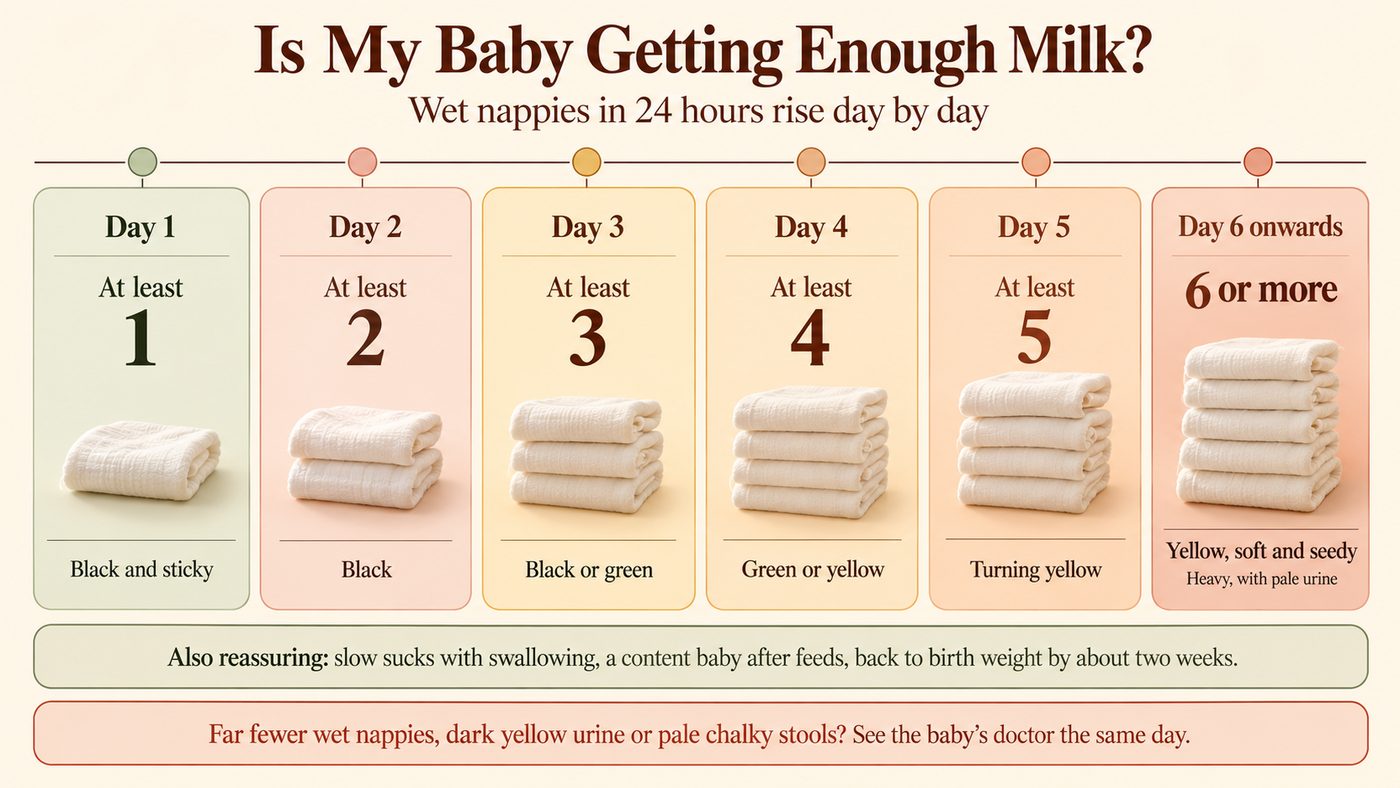
| Baby's age | Wet nappies in 24 hours | Stools |
|---|---|---|
| Day 1 | At least 1 | Black and sticky |
| Day 2 | At least 2 | Black |
| Day 3 | At least 3 | Black or green |
| Day 4 | At least 4 | Green or yellow |
| Day 5 | At least 5 | Turning yellow |
| Day 6 onwards | 6 or more, heavy, with pale urine | Yellow, soft and seedy |
Nappies work best alongside other signs:
- During feeds: sucks slow down and swallowing can be heard.
- After feeds: the baby comes off the breast and seems content.
- Weight: a small loss in the first days is expected. Most babies are back to birth weight by about two weeks.
Looking ahead
Around day 2 to 4, many mothers feel the milk come in (doodh utarna), and the breasts turn fuller and heavier. Feeding often in these days usually eases the fullness.
Over the next few weeks, latching usually needs less adjusting and feeds start to feel familiar. If they don't, that is a reason to ask for help early, not a reason to stop.
When to speak to a doctor
Get urgent medical help now, at the nearest hospital emergency, if the baby:
- is very sleepy, hard to wake, or not feeding
- looks yellow in the skin or eyes in the first 24 hours of life
See the baby's doctor the same day if:
- yellowness of the skin or eyes is spreading or deepening
- urine is dark yellow, or stools are pale and chalky
- the baby has far fewer wet nappies than the table above
Book a check with the doctor or a lactation consultant if:
- the baby regularly feeds fewer than 8 times in 24 hours
- stools have not started turning yellow by day 5
- the baby is not back to birth weight by about two weeks
- nipple pain lasts through every feed, or nipples crack or bleed
For the mother: a red, hot, painful area on the breast with fever needs a doctor's check the same day.
Under the Ministry of Health and Family Welfare's MAA (Mothers' Absolute Affection) programme, nurses and ANMs (Auxiliary Nurse Midwives) at government facilities are trained in breastfeeding support, and ASHA (Accredited Social Health Activist) workers run mothers' meetings in the community. Asking early is a strength, not a failure.
References
- World Health Organization. Infant and young child feeding (fact sheet, updated 4 August 2026).
- World Health Organization and UNICEF. Ten steps to successful breastfeeding.
- Tiwari S, Bharadva K, Yadav B, et al., for the Infant and Young Child Feeding (IYCF) Chapter of the Indian Academy of Pediatrics. Infant and Young Child Feeding Guidelines, 2016. Indian Pediatrics. 2016;53:703 to 713.
- Ministry of Health and Family Welfare and International Institute for Population Sciences. National Family Health Survey (NFHS-6), 2023-24.
- Ministry of Health and Family Welfare, Government of India. Programme for Promotion of Breastfeeding (MAA, Mothers' Absolute Affection): Operational Guidelines. 2016.
- National Health Service (NHS). Breastfeeding: positioning and attachment.
- National Health Service (NHS). Foods to avoid giving babies and young children.
- Health Service Executive (HSE), Ireland. How to tell if your newborn is getting enough breast milk.
- National Health Service (NHS). Jaundice in babies.
Common questions
Can a mother breastfeed after a C-section (caesarean section)?
Yes. When mother and baby are both stable, a healthy baby can usually go skin to skin and feed within the first hour after a caesarean section. Pain and limited movement are the main hurdles in the first days, not the milk itself. Side-lying and football holds keep the baby's weight off the stitches, and a pillow over the tummy adds protection. Asking a nurse or family member to lift and pass the baby makes each feed easier.
Is breastfeeding supposed to hurt?
Some tenderness in the first week is common and usually eases after the first few sucks. Pain through the whole feed, or nipples that look flattened, creased or cracked afterwards, often points to a shallow latch. Breaking the suction with a clean finger and latching again, with a wider mouth and chin first, often helps. If pain continues across several feeds, a lactation consultant can check the latch and look for causes such as tongue-tie.
How long does each breastfeed last?
It varies a lot. Some feeds are short and some are long, and both can be normal, especially in the first weeks. Steady swallowing, a baby who comes off the breast relaxed, and nappies that match the baby's age matter far more than the clock. If almost every feed feels endless and the baby still seems hungry afterwards, a lactation consultant can check whether the latch is deep enough.
This article is for general education and support. It does not replace personal advice from a doctor, lactation consultant or other qualified health professional who knows the mother and baby. If something feels wrong, asking for help is always the right step.
 Medically reviewed byDr. Mahender Singh, MBBS, DCH, MD (Paediatrics)A consultant child specialist and neonatologist with over four decades of practice in newborn and child health.
 Written bySarthak ThakurCo-founder, CTO and Chief Marketing Officer of ParentVeda, and the software engineer who builds its app and the pipeline that checks its articles.
This article explains; it doesn’t diagnose. If your doctor has told you something different, your doctor is right.