
In the early days of feeding, one question tends to sit above all others: is my baby latched on properly? It is a fair thing to wonder, because the latch shapes both how comfortable feeding feels and how well your baby draws milk. Getting it right is less about doing something perfectly and more about a few small adjustments.
Key takeaways
- A good latch means a big mouthful of breast, not the nipple alone: mouth open wide, lips rolled out, chin snug against the breast, nose free to breathe.
- Feeds that feel comfortable, with swallows that come in an even pattern, are the everyday signs the latch is working.
- Pinching that does not ease, a clicking noise, or a nipple that comes out squashed flat or wedge-shaped usually point to a latch that is too shallow.
- Most latch problems improve with position and depth, so unlatch gently and try again instead of pushing through.
- Latch pain that persists despite good positioning, or cracked and bleeding nipples, is worth a professional check.
This is for understanding, not diagnosis. A lactation consultant or doctor who can watch a feed is the best person to check a latch in person.
The quick answer
A good latch usually means your baby has taken a large mouthful of breast, not just the nipple, with the mouth stretched wide and both lips rolled outward. With a deep latch, any early tug eases within moments and your baby swallows in an even, regular pattern.
A latch that is too shallow tends to pinch, and that discomfort is a signal you can act on rather than a verdict on you.
What does a good latch actually mean?
A latch is how your baby fastens onto the breast to feed. When the latch is good, your baby draws in the nipple along with a good portion of the areola, the darker skin around it, so the nipple sits far back against the soft palate, where it is protected from friction.
This depth matters twice over. It lets your baby remove milk efficiently, which in turn signals your body to keep making it, and it keeps the nipple away from the pressure that leads to soreness. You do not need a perfect latch, only one that moves milk well and feels comfortable, which most pairs settle into with practice.
Good latch and poor latch: what to look and listen for
The clearest way to read a latch is to notice how it looks, how it sounds, and how it feels. The table below sets the everyday signs side by side.
| What to check | Signs of a good latch | Signs of a latch that is too shallow |
|---|---|---|
| Mouth and lips | Mouth open wide, lips rolled outward | Lips turned in, mouth only slightly open |
| Breast in the mouth | A large mouthful, with the lower lip covering more of the areola than the upper lip | Mostly the nipple tip |
| Chin and nose | Chin sunk into the breast, nose free or just touching | Chin held away, baby sucking on the tip |
| Cheeks | Full and rounded | Dimpled or drawn in |
| Sound | An even pattern of sucks and swallows, with soft sighs | A clicking or smacking noise |
| How it feels | A firm tug that settles within moments | A pinch, or pain that lasts the whole feed |
| Nipple afterwards | Rounded, its usual shape | Squashed, ridged, or angled to a wedge |
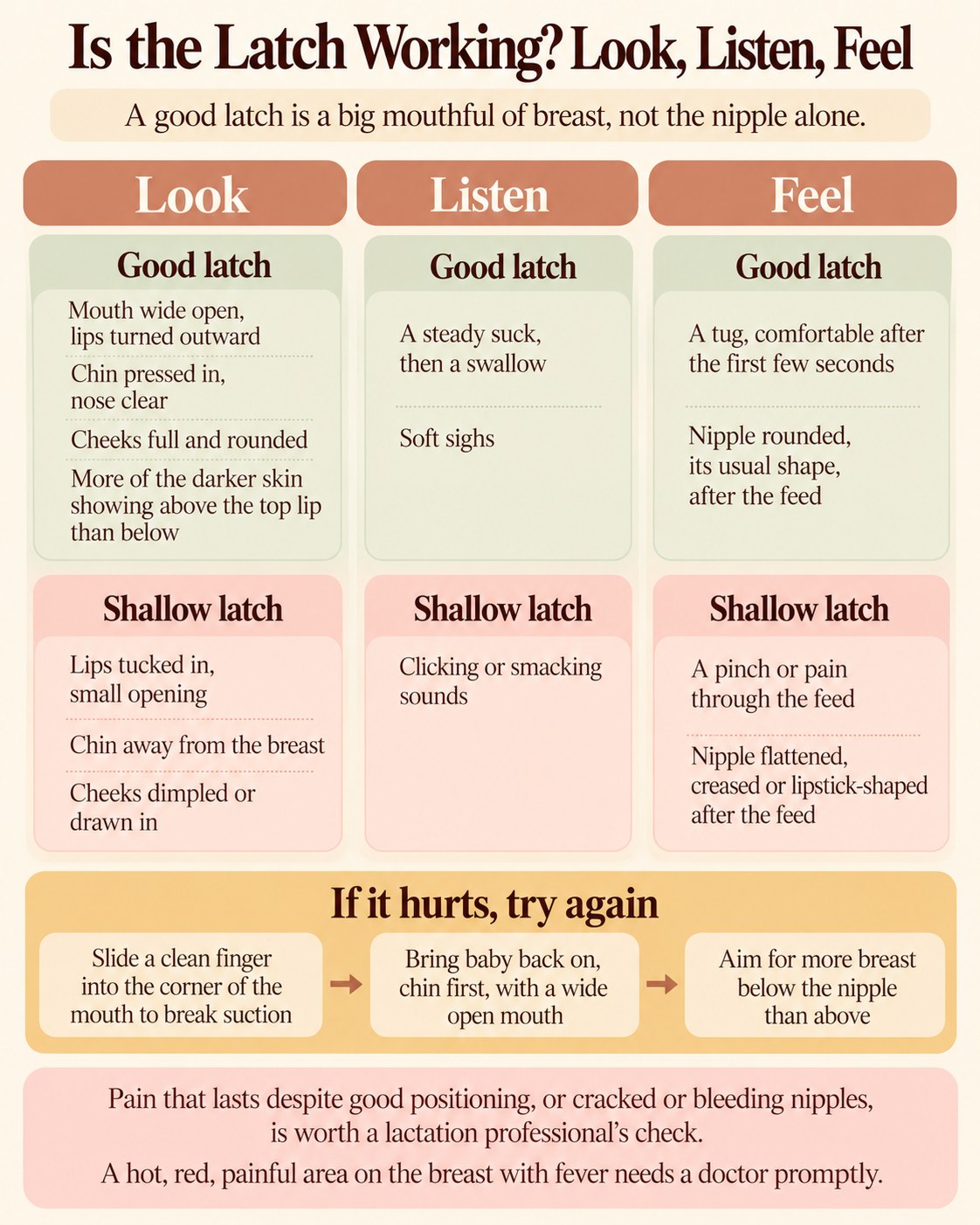
Brief initial tenderness can occur, but breastfeeding should not remain painful throughout a feed. Pain that lingers past the opening moments is a useful reason to reassess the latch and positioning. A latch that is too shallow is one possible cause, but persistent pain can have other causes too.
How do you help your baby latch on deeply, step by step?
Latching deeply mostly comes down to the setup, and the same steps work in any hold.
- Get comfortable, support your back, and bring your baby up to your breast rather than leaning down to your baby.
- Keep your baby's head, shoulders and body aligned so the neck is not twisted, with their tummy turned toward you.
- Start with the nipple level with their nose rather than their lips, so they tilt their head back and open up.
- Wait until the mouth opens really wide, like a yawn, gently stroking the nipple across the upper lip to encourage it.
- Then draw your baby in swiftly, leading with the lower jaw, so they scoop up a large mouthful from beneath the nipple.
- Run a quick check: chin snug, nose free, lips rolled out. If it pinches, you can fix it in the next step.
For more on the first feeds, read how to breastfeed.
What to do when the latch hurts or slips
If a latch feels wrong, you do not have to pull your baby straight off, which can hurt. Ease a clean little finger between their gums at the side to release the seal, then begin again. It is completely fine to relatch more than once.
A few small changes fix most shallow latches. Aim for more breast below the nipple than above, so the nipple angles up and back toward the soft palate. Switching holds also helps: some pairs find a reclined (laid-back) position, or holding the baby across the body with the opposite arm, makes a deeper latch easier. If your breast is very full and firm, softening it a little first can help your baby take hold.
To compare holds and find one that suits you both, read breastfeeding positions.
If your nipples are already sore or cracked, an ineffective latch is one possible reason, and improving the latch often helps. Persistent pain deserves a closer look, since a tight band of tissue under the tongue (tongue-tie) can make latching hard no matter what you try.
When to see a doctor
Many latch problems improve with small changes, but some deserve a professional eye.
Reach out to your doctor, your hospital lactation consultant, or a certified lactation consultant if:
- Latching stays painful after you adjust position and depth.
- Your nipples are cracked or bleeding.
- Your baby cannot stay attached, or stays unsettled after long feeds.
- Your baby is not gaining weight as expected or has fewer wet nappies than usual.
- You notice a hot, painful, red area on the breast with fever.
In many Indian hospitals you can ask to see the lactation nurse before discharge, a good moment to have your latch checked in person.
Looking ahead
The deliberate steps you are practising now do not stay effortful for long, and latching becomes quicker and more automatic as you both settle into it.
Once the latch stops being the struggle, the next question is often whether your baby is feeding often enough and whether your supply is keeping up. That is the natural moment to read is my baby getting enough breast milk.
References
- NHS. Breastfeeding: positioning and attachment.
- American Academy of Pediatrics (HealthyChildren.org). Ensuring Proper Latch On While Breastfeeding.
- Office on Women's Health, US Department of Health and Human Services. Getting a good latch.
- La Leche League International. Breastfeeding Positions, Latch, and Positioning.
Common questions
Why does breastfeeding still hurt even when the latch looks right?
A short pinch as your baby latches can be normal early on, but pain that carries on for the whole feed often means the latch is shallower than it appears. Try relatching, bringing your baby's lower jaw in closer and letting them take more of the underside of the areola. If pain continues despite good positioning, cracked skin or tongue-tie may be involved, and a lactation professional can check what is happening.
How do I know the latch is working?
The signs show up during the feed. Any early tug settles quickly, and you can see a slow, rhythmic jaw movement that reaches back toward your baby's ear as they draw milk. You may hear soft swallowing, and their cheeks stay rounded rather than dimpling. A clicking noise, sharp pain, or a feed that never settles into a rhythm suggest the latch needs adjusting.
How do I know my baby is getting enough milk with a good latch?
Over a day, enough wet and dirty nappies and steady weight gain are the most reliable measures, alongside a baby who seems settled after most feeds. These matter more than what any single feed looks like. Any worry about weight or output is worth raising with your doctor.
Does a flat or inverted nipple mean my baby cannot latch?
Not usually. Your baby latches onto a mouthful of breast rather than the nipple alone, so many babies manage well even when the nipple is flat or drawn inward. Shaping the breast with your fingers well back from the areola, or drawing the nipple out just before a feed, can help. If latching stays difficult, a lactation professional can suggest options, including a nipple shield used temporarily and with guidance.
What if my baby keeps slipping off or is too sleepy to latch?
Slipping off often means the latch is shallow or your baby needs more support, so try tucking them in closer with the lower jaw pressed in more deeply. If your baby is consistently too sleepy to feed well, is difficult to wake, or is feeding much less than usual, contact your baby's doctor promptly.
This article is for education and general understanding. It is not a substitute for personal medical advice. For concerns about feeding, your nipples, or your baby's growth, please speak with your doctor or a qualified lactation professional.
 Medically reviewed byDr. Mahender Singh, MBBS, DCH, MD (Paediatrics)A consultant child specialist and neonatologist with over four decades of practice in newborn and child health.
 Written bySarthak ThakurCo-founder, CTO and Chief Marketing Officer of ParentVeda, and the software engineer who builds its app and the pipeline that checks its articles.
This article explains; it doesn’t diagnose. If your doctor has told you something different, your doctor is right.