
Few questions follow a new mother home as closely as this one. The baby cries soon after a feed, the breasts feel soft, and someone in the family gently suggests a bottle "just in case".
Breast milk cannot be seen going in, so doubt fills the gap easily. Many mothers quietly begin to wonder whether their body is falling short.
Key takeaways
- Worry about low milk is very common and often does not match actual supply. The baby's nappies and weight are a better guide than breast fullness or pump output.
- Frequent and effective milk removal is the main way to increase supply. A good latch matters as much as how often the baby feeds.
- Short feeds, evening cluster feeding and softer breasts are usually normal, not signs of low supply.
- Fewer than six heavy wet nappies a day after day five, or slow weight gain, needs a doctor's review.
This is for understanding, not diagnosis. A doctor or lactation consultant who can see the baby is the right person to guide feeding.
The quick answer
Many mothers who worry about low milk are in fact making enough for their baby. The most reliable signs are the baby's nappies and weight, not how full the breasts feel, how long feeds last or how much a pump collects.
Milk supply works on demand: when milk is removed often and effectively, the body usually makes more. When supply is truly low, finding the cause with expert help and feeding often and well usually help more than any special food.
Why does it so often feel like there is not enough milk?
Almost every breastfeeding mother asks this at some point. In one study from Western Australia, 44 out of every 100 mothers felt their milk was not enough within three weeks of birth.
That study measured how mothers felt, not how much milk they actually made. Many felt reassured after expert advice. The worry usually comes from signs that look alarming but are part of normal feeding.
| What mothers notice | What it usually means |
|---|---|
| Baby wants to feed every hour in the evening | Cluster feeding, which is common in the early weeks |
| Breasts feel soft and no longer full | Early fullness easing as supply adjusts, often by around 6 weeks |
| A pump collects only a little milk | Pumped amounts do not reflect true supply |
| Baby cries soon after a feed | Babies cry for wind, tiredness or closeness, not only hunger |
| Feeds become shorter | Babies get faster and more efficient as they grow |
| Baby drinks a bottle after breastfeeding | Sucking is a reflex, and bottles flow fast even for a full baby |
How the breast makes milk: a kitchen that cooks to order
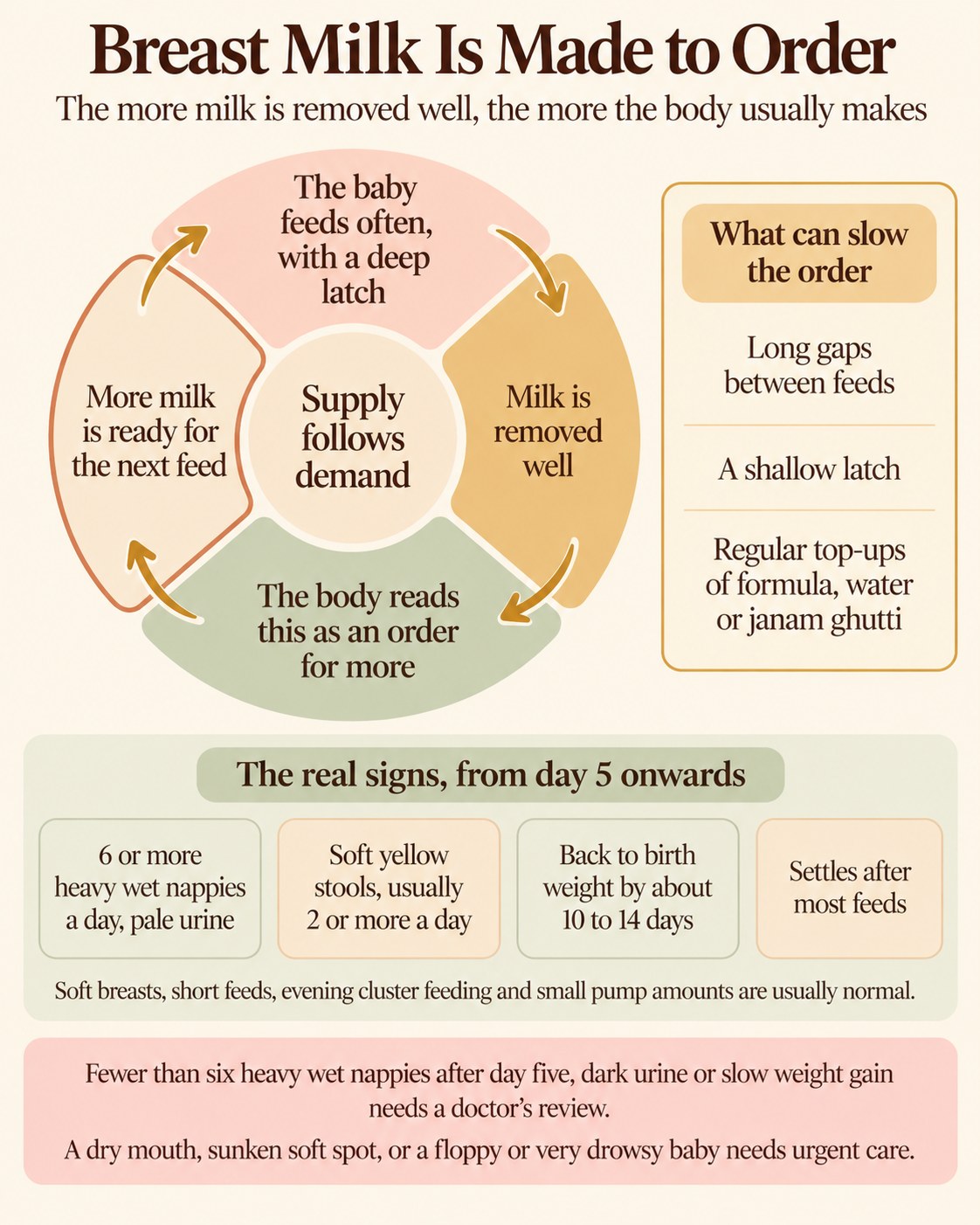
The breast is not a tank that fills up and runs dry. It works more like a kitchen that cooks to order, making milk throughout the day and even during a feed.
As currently understood, each time milk is removed well, the body receives a fresh order to make more. When milk sits in the breast for a long time, the body reads it as "less needed" and slows down.
The order works best when the baby removes milk effectively, which is why the latch matters as much as how often feeds happen. Skipped feeds, strict clock schedules and regular top-ups can slowly lower supply.
How can a mother tell her baby is getting enough?
The baby gives clearer answers than the breast does. What goes in must come out, so nappies are a simple daily check.
| Baby's age | Wet nappies in 24 hours | Stools |
|---|---|---|
| Day 1 to 2 | 1 to 2 or more | Black and sticky (meconium, the first stool) |
| Day 3 to 4 | 3 to 4 or more, getting heavier | Changing to green or brown |
| Day 5 onwards | 6 or more heavy, with pale urine | Yellow and soft, usually at least 2 a day in the early weeks |
These are general guides used by health services. A doctor or nurse may use slightly different numbers for a particular baby.
Other reassuring signs include:
- Weight back to birth weight by around 10 to 14 days, then steady gain at each check-up.
- At least 8 feeds in 24 hours in the early weeks, often 8 to 12.
- Rhythmic sucking with audible swallows during feeds.
- A baby who is alert when awake and settles after most feeds.
Sometimes supply really is low, and there is usually a reason
True low supply does happen. Feeding-related issues are a common reason and often improve with the right support, while some health conditions need a doctor to assess them.
Feeding-related causes can include:
- A shallow latch, or a tongue-tie that limits how well the baby removes milk.
- Fewer than 8 feeds a day, long gaps at night in the early weeks, or feeding by the clock.
- Regular top-ups of formula, water or janam ghutti that replace breastfeeds.
- A sleepy, jaundiced or premature baby who feeds weakly.
Some health factors in the mother have been linked with lower supply and need a doctor's assessment:
- Heavy bleeding after birth, or fragments of placenta left in the uterus.
- Thyroid conditions or polycystic ovary syndrome (PCOS).
- Previous breast surgery, or breasts that did not change much during pregnancy.
- Some medicines, including contraceptive pills that contain oestrogen.
What actually increases breast milk?
The answer is simple, even if it takes patience: more milk removal, done well. How quickly supply responds depends on the cause, so steady effort and regular weight checks matter more than any fixed timeline.
| What helps | Why it works |
|---|---|
| Feeding at least 8 times in 24 hours (often 8 to 12), following the baby's cues | Every effective feed is a new order for more milk |
| Getting the latch checked | A deep latch removes more milk and protects the nipples |
| Offering both breasts and gently compressing the breast | Keeps milk flowing when the baby's sucking slows |
| Hand expressing or pumping after some feeds | Extra removal signals the body to make more |
| Plenty of skin-to-skin contact | Supports the hormones that release milk and wakes sleepy babies |
| Reducing top-ups gradually, with medical guidance | Each top-up replaced by a breastfeed adds to demand |
For step-by-step help with positioning and a deep latch, read how to breastfeed and breastfeeding positions.
Traditional foods such as methi, jeera, gond and shatavari ladoos are a familiar part of many Indian homes after birth. Expert reviews describe the evidence that they increase milk supply as limited and mixed, so they work best as part of a balanced diet, not as a treatment.
Concentrated herbal powders, capsules and teas can differ a lot from everyday cooking amounts, and side effects have been reported. These are best discussed with a doctor first, as are prescription medicines that raise supply.
The Indian Academy of Pediatrics recommends breast milk alone for the first six months, with no other foods or fluids. The World Health Organization (WHO) specifies that this means not even water.
Gripe water and janam ghutti count as other fluids too. Extra liquids take up space in a small tummy, which can mean fewer breastfeeds and fewer orders sent to the body.
When to see a doctor
Contact a doctor or lactation consultant early, rather than waiting, if:
- There are fewer than six heavy wet nappies a day after day five, or the urine is dark.
- Stools have not turned yellow by day five, or become very few in the first weeks.
- The baby is not back to birth weight by about two weeks, or is losing weight.
- The baby is very sleepy, hard to wake for feeds, or the skin and eyes look more yellow.
- Feeds stay painful, or nipples crack and bleed.
- A breast becomes red, hot and painful, especially with fever.
Seek urgent care for a dry mouth, a sunken soft spot on the head, or a baby who seems floppy or unusually drowsy.
Looking ahead
Within the first six weeks or so, many mothers notice softer breasts and less leaking. This often feels like the milk is drying up, but health services describe it as supply adjusting to the baby's needs.
Growth spurts in the first few months can bring a day or two of almost constant feeding. These hungry days are the baby placing a bigger order, and supply often catches up soon after.
References
- World Health Organization. Infant and young child feeding: fact sheet.
- Tiwari S, Bharadva K, Yadav B, et al. Infant and Young Child Feeding Guidelines, 2016. Indian Academy of Pediatrics. Indian Pediatrics. 2016;53(8):703–713.
- Brodribb W; Academy of Breastfeeding Medicine. ABM Clinical Protocol #9: Use of Galactogogues in Initiating or Augmenting Maternal Milk Production, Second Revision 2018. Breastfeeding Medicine. 2018;13(5):307–314.
- Kent JC, Ashton E, Hardwick CM, Rea A, Murray K, Geddes DT. Causes of perception of insufficient milk supply in Western Australian mothers. Maternal & Child Nutrition. 2021;17(1):e13080.
- Gatti L. Maternal perceptions of insufficient milk supply in breastfeeding. Journal of Nursing Scholarship. 2008;40(4):355–363.
- Huang Y, Liu Y, Yu XY, Zeng TY. The rates and factors of perceived insufficient milk supply: A systematic review. Maternal & Child Nutrition. 2022;18(1):e13255.
- Kent JC, Gardner H, Geddes DT. Breastmilk Production in the First 4 Weeks after Birth of Term Infants. Nutrients. 2016;8(12):756.
- Eidelman AI. The Holy Grail of an Efficacious Galactagogue. Breastfeeding Medicine. 2024;19(10):751.
- Drugs and Lactation Database (LactMed). Fenugreek. National Institute of Child Health and Human Development.
- Health Service Executive (HSE), Ireland. Concern about your breast milk supply.
- Health Service Executive (HSE), Ireland. Is your baby getting enough breast milk?
- Dorset HealthCare University NHS Foundation Trust. How will I know my baby is getting enough milk?
Common questions
Does pumping only a little milk mean supply is low?
Usually not. Health services note that pumped amounts do not reflect true supply, because most babies remove milk more efficiently than a machine. Pump output also varies with the time of day, how recently the baby fed, how well the pump fits and how relaxed the mother feels. The nappy count and weight checks remain the better guide.
Do methi ladoos and other traditional foods increase breast milk?
Foods like methi, jeera, gond and shatavari are part of many Indian postpartum traditions and can add variety to a nourishing diet. Research on whether they raise milk supply is limited and mixed, and most studies are small. Concentrated herbal supplements are different from everyday cooking and are best discussed with a doctor first. Frequent, effective feeding remains the main driver of supply.
Are formula top-ups harmful to breastfeeding?
Top-ups are sometimes medically needed, for example when a baby is losing too much weight, and in those cases they protect the baby. The concern is regular top-ups that replace breastfeeds without a clear reason, because each skipped feed sends a smaller order to the body. When top-ups are advised, expressing milk at the same time helps protect supply while the cause is sorted out.
Can stress reduce breast milk?
Current understanding is that stress does not usually stop milk being made. It can slow the let-down reflex, which is the release of milk already in the breast. A tense or exhausted mother may notice feeds feel slower. Skin-to-skin contact, a calm space and practical help at home can make milk flow more easily. Ongoing low mood or anxiety deserves a conversation with a doctor in its own right.
Why does the baby want to feed every hour in the evening?
This is called cluster feeding, and it is very common in the early weeks. Many babies bunch feeds together in the evening, often before a longer stretch of sleep. It can look as though the milk has run out, but it is usually a normal feeding pattern. Steady nappies and weight gain show it is a phase, not a problem.
This article is for general education and is not a substitute for personal medical advice. Every mother and baby is different. Concerns about feeding, weight gain or milk supply are best discussed with a doctor, paediatrician or qualified lactation consultant who can assess the baby directly.
 Medically reviewed byDr. Mahender Singh, MBBS, DCH, MD (Paediatrics)A consultant child specialist and neonatologist with over four decades of practice in newborn and child health.
 Written bySarthak ThakurCo-founder, CTO and Chief Marketing Officer of ParentVeda, and the software engineer who builds its app and the pipeline that checks its articles.
This article explains; it doesn’t diagnose. If your doctor has told you something different, your doctor is right.