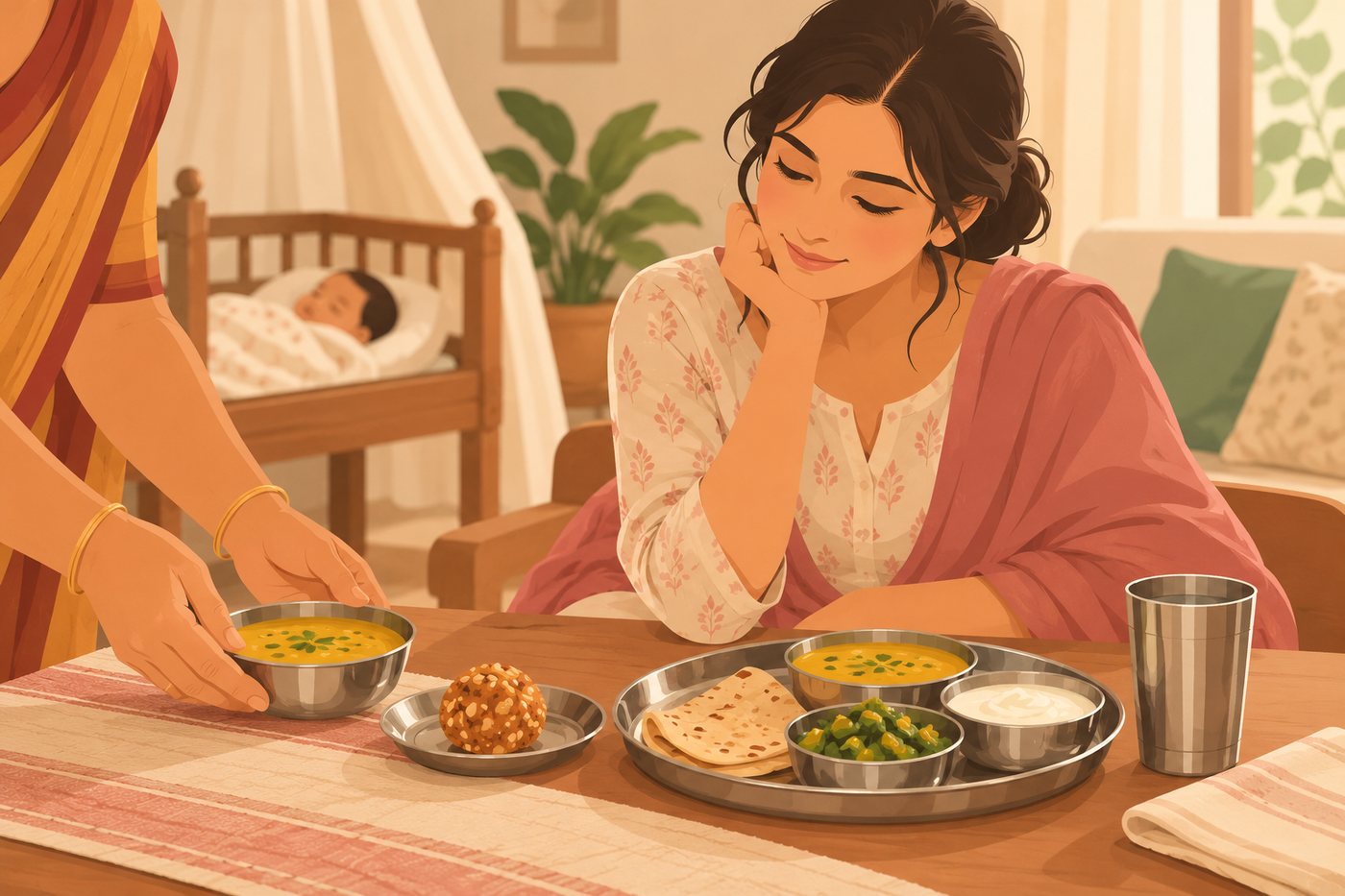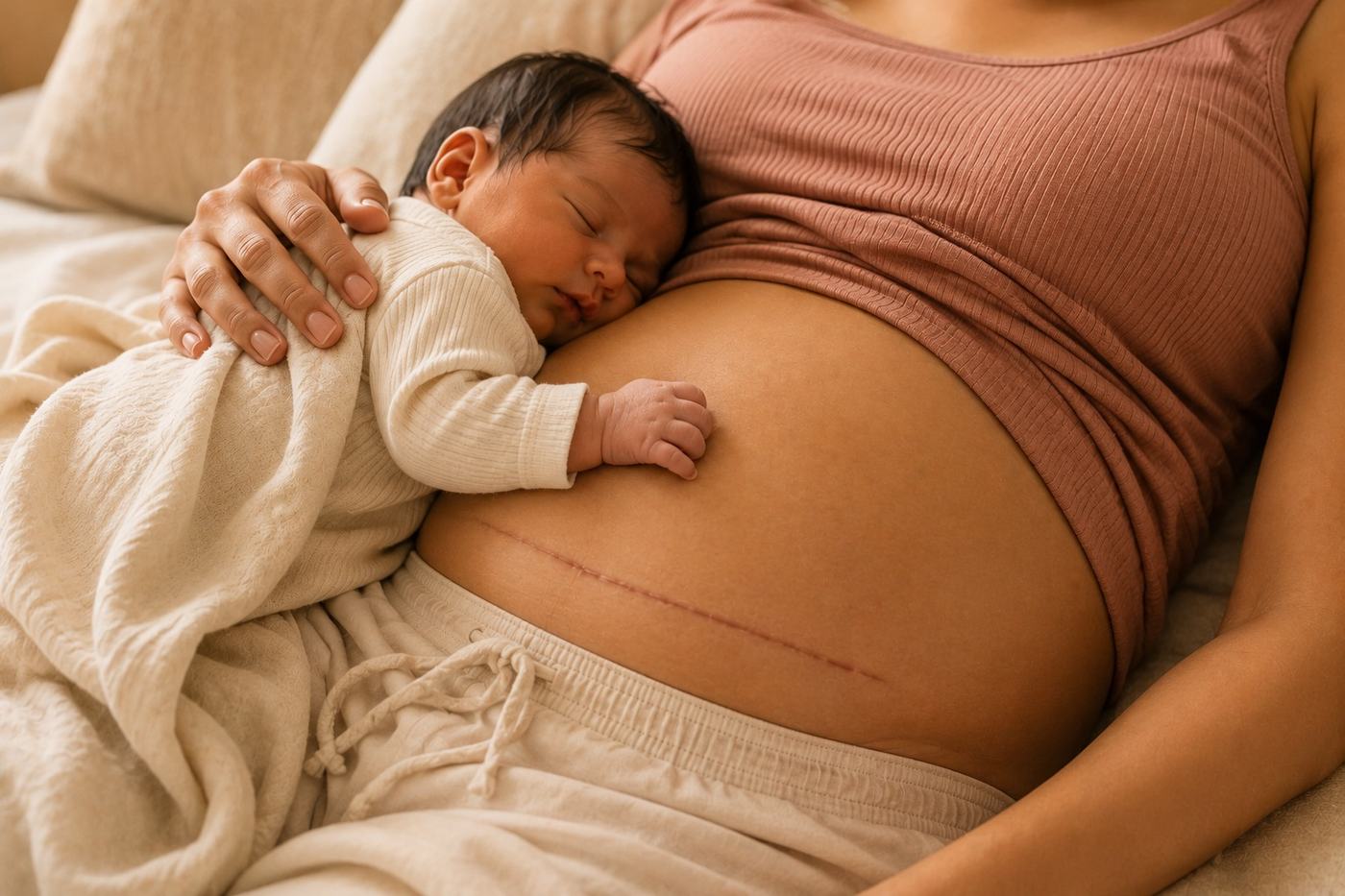
The baby arrives in a day. The mother's body takes longer, and postpartum recovery happens at two speeds. Changes that are easy to track, like bleeding and the womb shrinking, often settle over about six weeks.
Deeper repair, like the pelvic floor, core muscles, sleep and mood, usually continues for months. The Indian 40-day rest, known as jaappa, chilla or sava mahina, covers the first stretch of that journey.
Knowing what each week usually brings helps the whole household. The mother knows what is normal, and the family knows when rest matters most and when to call the doctor.
Key takeaways
- Bleeding, the womb shrinking and early stitch healing often settle over about six weeks, but there is no single end date for recovery.
- Bleeding usually moves from bright red to pink-brown to yellowish-white before it stops.
- The pelvic floor, core muscles, hormones and energy often take several months to recover.
- Rest, warm food and family help support healing. Restricting water, skipping washing and total bed rest do not.
This is for education and general understanding, not a diagnosis. Every recovery is different, so please speak with your doctor about your own healing.
Why the 40 days still make sense
For generations, many Indian families have set aside roughly 40 days for a new mother. Medicine calls roughly the same window the postpartum period, the first six weeks after birth.
A useful way to picture recovery is two clocks. The first tracks changes that are easy to follow: bleeding, the womb shrinking and the early healing of stitches or a wound. These often settle around six weeks.
The second clock tracks slower repair: the pelvic floor, stretched tummy muscles, hormones, energy and mood. It often runs for months. Pain, leaking or wound problems after six weeks are worth raising with a doctor, not waiting out.
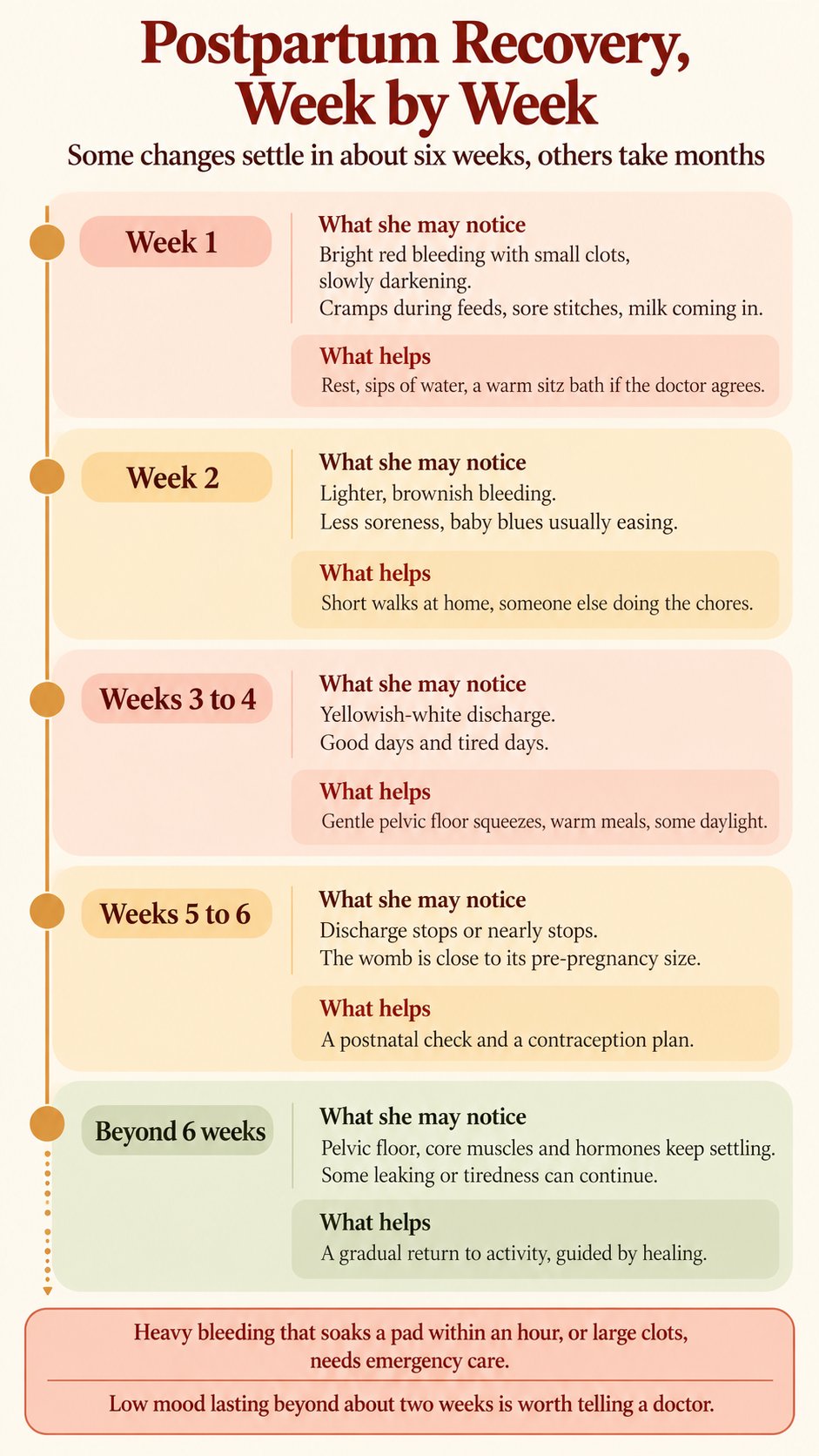
Postpartum recovery timeline, week by week
Many uncomplicated recoveries follow a similar pattern.
| Week | What the body is doing | What she may notice | What helps |
|---|---|---|---|
| Week 1 | The uterus (womb) contracts back down; milk comes in, usually between days 2 and 5; pregnancy hormones drop sharply | Bright red bleeding with small clots that slowly darkens, cramps during feeds, sore stitches, full breasts, night sweats, tearful days | Rest, regular sips of water, changing maternity pads every few hours, a warm sitz bath (sitting in shallow warm water) for stitches if the doctor agrees |
| Week 2 | The womb has shrunk back inside the pelvis; stitches are knitting | Lighter, brownish bleeding, less soreness, baby blues usually easing | Short walks at home, someone else handling chores |
| Weeks 3 to 4 | Tissues keep healing; most dissolvable stitches are gone | Yellowish-white discharge, good days and tired days | Gentle pelvic floor squeezes, warm meals, some daylight |
| Weeks 5 to 6 | The womb is close to its pre-pregnancy size | Discharge stops or nearly stops; she feels more like herself on some days | A postnatal check and a contraception plan |
| Beyond 6 weeks | Pelvic floor, core muscles and hormones keep settling | Some leaking, a softer belly or tiredness may continue | A gradual return to activity, guided by how she is healing |
Is recovery after a normal delivery different from a C-section?
Yes, in a few important ways. Recovery after a normal delivery centres on the perineum, the area between the vagina and the anus, which may have a tear or a cut with stitches.
A C-section (caesarean section) is major abdominal surgery. Bleeding and the womb shrinking follow a similar pattern, but the wound needs extra care, and lifting and driving wait longer.
ParentVeda's guide to recovering from a C-section while becoming a mother walks through those weeks in detail.
Where tradition helps, and where it needs a rethink
Many jaappa customs carry real wisdom. A few are worth adjusting.
| Tradition | What may help | What to rethink |
|---|---|---|
| Rest and staying home | Rest supports healing and feeding | Long periods without moving can raise the risk of blood clots after birth; staying gently active, like short walks, helps |
| Warm food: dal, khichdi, ajwain, methi, gond ke laddoo, panjiri | Warm, home-cooked meals are a comforting way to get enough energy while she heals and feeds | Laddoos and panjiri are rich in ghee and sugar; small portions are enough |
| Malish (oil massage) | Many mothers find gentle massage relaxing and soothing for aches | Start when her doctor is comfortable; keep oil and pressure away from stitches or a healing wound |
| Pet bandhna (belly binding) | Some mothers find it supportive, especially after a C-section | Check with the doctor before use and never tie it tight |
| Drinking less water | No clear benefit | Enough fluids help keep stools soft and keep her hydrated while breastfeeding |
| Skipping baths for days | No clear benefit | A daily shower or wash helps keep stitches clean; ask before soaking in a tub, especially after a C-section or a larger tear |
| Closed, very warm room | Quiet and warmth feel comforting | Overheating is a risk in Indian summers; keep air moving |
The recovery nobody sees
Many mothers notice something they rarely say aloud. Everyone asks about the baby, and she feels guilty for wishing someone would ask about her.
That feeling is common and does not make her ungrateful. In the first days, sudden hormone changes often bring tears and mood swings, called the baby blues.
The baby blues usually ease within about two weeks. Low mood, worry or numbness that lasts longer may be postpartum depression, which is common and treatable.
What happens at the six-week check?
The six-week visit is one part of postnatal care, not the only check. The World Health Organization (WHO) advises at least four postnatal contacts: within 24 hours, around day 3, between days 7 and 14, and at six weeks.
In India, Accredited Social Health Activists (ASHAs) also make home visits after birth under the National Health Mission. Around six weeks, the doctor usually checks:
- blood pressure and healing of stitches or the wound
- bleeding, bladder and bowel control
- mood, sleep and feeding
- contraception
Ovulation can return before the first period, so contraception matters even without one. ParentVeda's guide to sex after childbirth and avoiding another pregnancy too soon covers the options.
Looking ahead
Many mothers notice hair shedding a few months after birth, which usually regrows. The first period returns on its own timeline, usually later for mothers who breastfeed often.
A return to strengthening, and later to running or other high-impact exercise, works best when it is gradual and guided by her healing, any symptoms and her doctor's advice. If leaking or a heavy, dragging feeling continues, a pelvic floor physiotherapist can often help. If her belly still looks rounded weeks later, our guide to diastasis recti explains the gap between the tummy muscles and how it recovers.
When to speak to a doctor
Call emergency medical services or go to the nearest emergency department for:
- heavy bleeding that soaks a pad within an hour, or large clots
- chest pain or sudden breathlessness
- a severe headache, blurred vision or sudden swelling of the face or hands
Get urgent mental health help the same day if:
- she has thoughts of harming herself or the baby, or feels unable to keep herself or the baby safe. Go to the nearest emergency department or contact her doctor straight away. Tele-MANAS (Tele Mental Health Assistance and Networked Across States) also offers free support on 14416.
See a doctor soon for:
- fever, chills or foul-smelling discharge
- stitches or a wound that is red, swollen, oozing or opening
- pain, swelling or redness in one calf
- a hot, red, painful patch on the breast with fever
- burning or difficulty while passing urine
- low mood, worry or numbness lasting beyond about two weeks
References
- World Health Organization. WHO recommendations on maternal and newborn care for a positive postnatal experience. Geneva: WHO; 2022.
- National Health Systems Resource Centre, Ministry of Health and Family Welfare, Government of India. Post Partum Care: Home Visits for Normal Babies.
- NHS. Your post-pregnancy body.
- University Hospital Southampton NHS Foundation Trust. Blood loss: what to expect after the birth of your baby.
- Gustafson JL, Dong F, Duong J, Kuhlmann ZC. Elastic abdominal binders reduce cesarean pain postoperatively: a randomized controlled pilot trial. Kansas Journal of Medicine. 2018;11(2):48 to 53.
- Royal College of Obstetricians and Gynaecologists. Reducing the risk of venous thrombosis in pregnancy and after birth (patient information).
Common questions
How long does postpartum recovery take after a normal delivery?
There is no single end date. Bleeding, the womb shrinking and early stitch healing often settle over about six weeks. Energy, the pelvic floor and core strength often take several months, so feeling better but not fully back at six weeks is common.
Can she take a bath during the 40 days?
A daily shower or wash is generally fine and helps keep stitches clean. Soaking in a tub is different, so it is best to ask the doctor first, especially after a C-section or a larger tear.
When can she start exercising after delivery?
After an uncomplicated delivery, many mothers can begin gentle walking and pelvic floor squeezes within days, if their doctor agrees. After a C-section or a complicated birth, the timing is individual. More demanding exercise usually waits until after a postnatal check.
Is it normal for bleeding to get heavier again after a few weeks?
A brief increase after a busy day can happen and often settles with rest. Fresh, heavy, bright red bleeding, large clots or a bad smell are not normal and need a doctor's review.
This article explains common patterns of recovery after birth to help families understand what to expect. It is not a substitute for personal medical advice. Every recovery is different, so any concern about bleeding, pain, healing or mood is worth discussing with a doctor.
 Medically reviewed byDr. Mahender Singh, MBBS, DCH, MD (Paediatrics)A consultant child specialist and neonatologist with over four decades of practice in newborn and child health.
 Written bySarthak ThakurCo-founder, CTO and Chief Marketing Officer of ParentVeda, and the software engineer who builds its app and the pipeline that checks its articles.
This article explains; it doesn’t diagnose. If your doctor has told you something different, your doctor is right.