In the first weeks after birth, your body is still very much in transition, and your stomach is often the part that surprises you most. You may expect it to shrink back quickly, yet weeks later it can still look softly rounded, almost as if you were still pregnant. If you have looked down and wondered whether that is normal, this article explains what is happening and what helps.
One common reason for a rounded post-baby belly is a separation of the tummy muscles known as diastasis recti. It is common during and after pregnancy, and for many people the separation gradually narrows as the connective tissue recovers. Understanding it early makes the weeks ahead feel much less worrying.
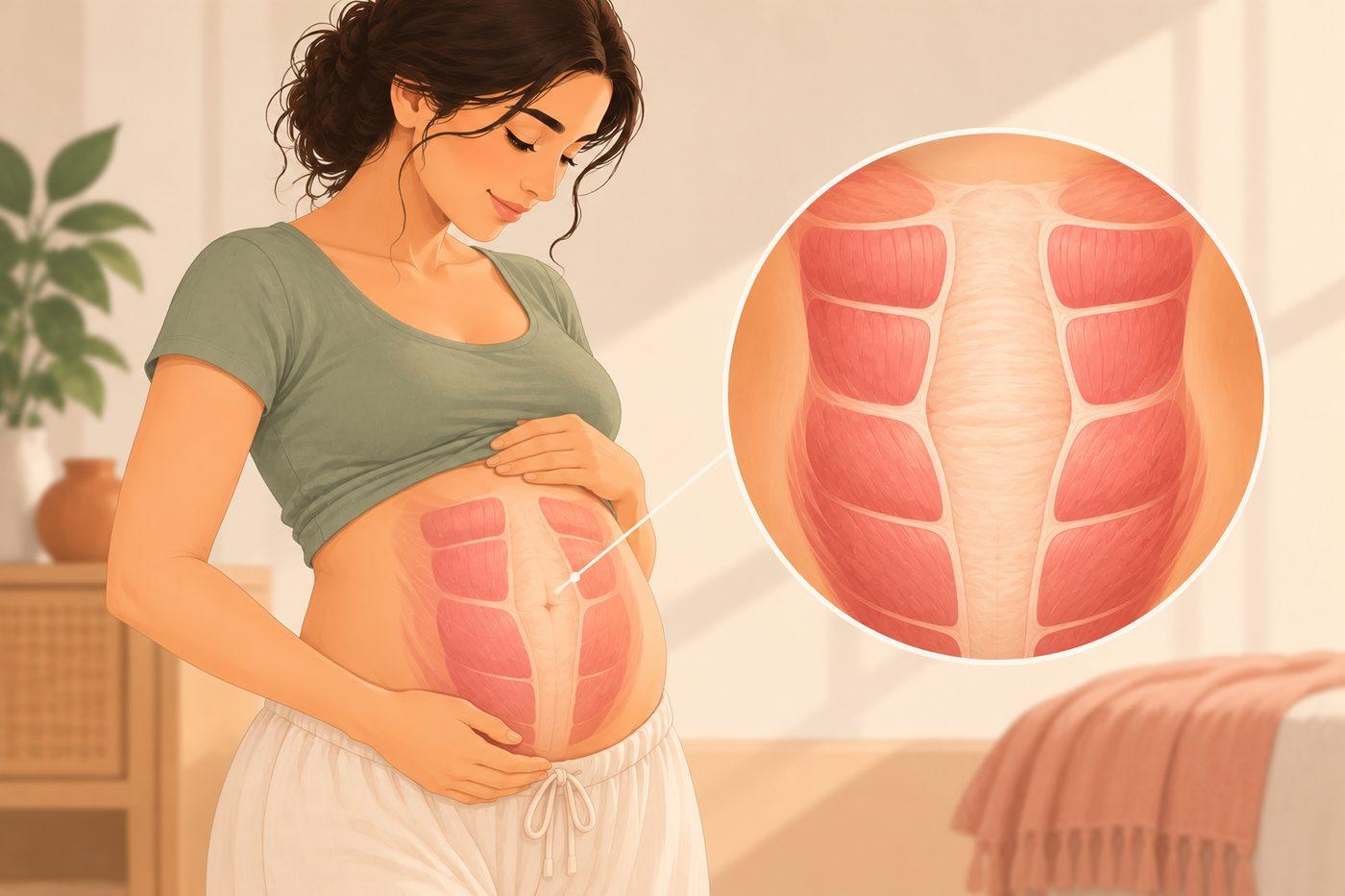
Diastasis recti is when the connective tissue running down the centre of your stomach stretches and thins during pregnancy, leaving the two sides of your abdominal muscles sitting further apart. As the uterus grows during pregnancy, the abdominal wall stretches and the linea alba becomes wider and thinner. Gentle core and pelvic floor exercises can help rebuild abdominal strength and function, and a separation that persists or comes with symptoms is worth discussing with a professional.
Key takeaways
- Diastasis recti is a common stretching of the tissue between your stomach muscles during pregnancy, not a sign you did anything wrong.
- After birth the gap often narrows gradually as the tissue recovers, but the timeline varies and some separation can remain for months.
- Gentle deep-core and pelvic floor exercises help rebuild your abdominal strength and function while the tissue recovers.
- A separation that persists, or that comes with doming, core weakness, or back or pelvic symptoms, is worth discussing with a pelvic health physiotherapist.
This is for education and general understanding, not a diagnosis. Please speak with your doctor or a pelvic health physiotherapist about your own recovery.
What is diastasis recti?
Your stomach has a pair of long muscles running vertically down the front, often called the six-pack muscles, or in medical terms the rectus abdominis. They are joined down the middle by a band of connective tissue called the linea alba, which works like a seam holding the two sides together. Diastasis recti simply means that seam has stretched and thinned, letting the two muscles sit further apart than usual.
Why your belly can still look pregnant after birth
As your baby grows, your womb pushes steadily outward, and the seam down the front of your stomach softens under pregnancy hormones and widens. Once your baby is born the pressure is gone, but that connective tissue stays stretched for a while, which is why your stomach can still look rounded even when nothing is wrong. A rounded belly after birth does not automatically mean diastasis recti, because your womb, abdominal tissues, posture, and normal postpartum body changes all take time to recover too.
Is a gap between the muscles normal?
Some degree of separation is common during pregnancy, particularly in the later weeks, and it can develop whether you have a vaginal birth or a caesarean (C-section). After birth the gap often narrows gradually as the connective tissue recovers, but how quickly this happens varies a great deal from one body to the next. A noticeable separation can still be present a year after giving birth, so persistent symptoms or concerns are worth assessing.
| Often settles with time | Worth getting assessed |
|---|---|
| A gap that narrows as the weeks pass | A separation that stays the same or feels wider over time |
| A soft rounded look with no other symptoms | Doming or a ridge along the midline when you sit up |
| Core feels weak but steadily improving | Ongoing core weakness, or back, bladder, or pelvic symptoms |
How to check for the gap at home
You can feel the gap yourself once the early tenderness has eased, though this is a rough guide rather than a diagnosis. The check involves lying on your back, raising your shoulders slightly, and using your fingertips to feel the space above and below your belly button. Finger width varies from one body to the next, so treat what you feel as a rough sense of things rather than a precise measurement.
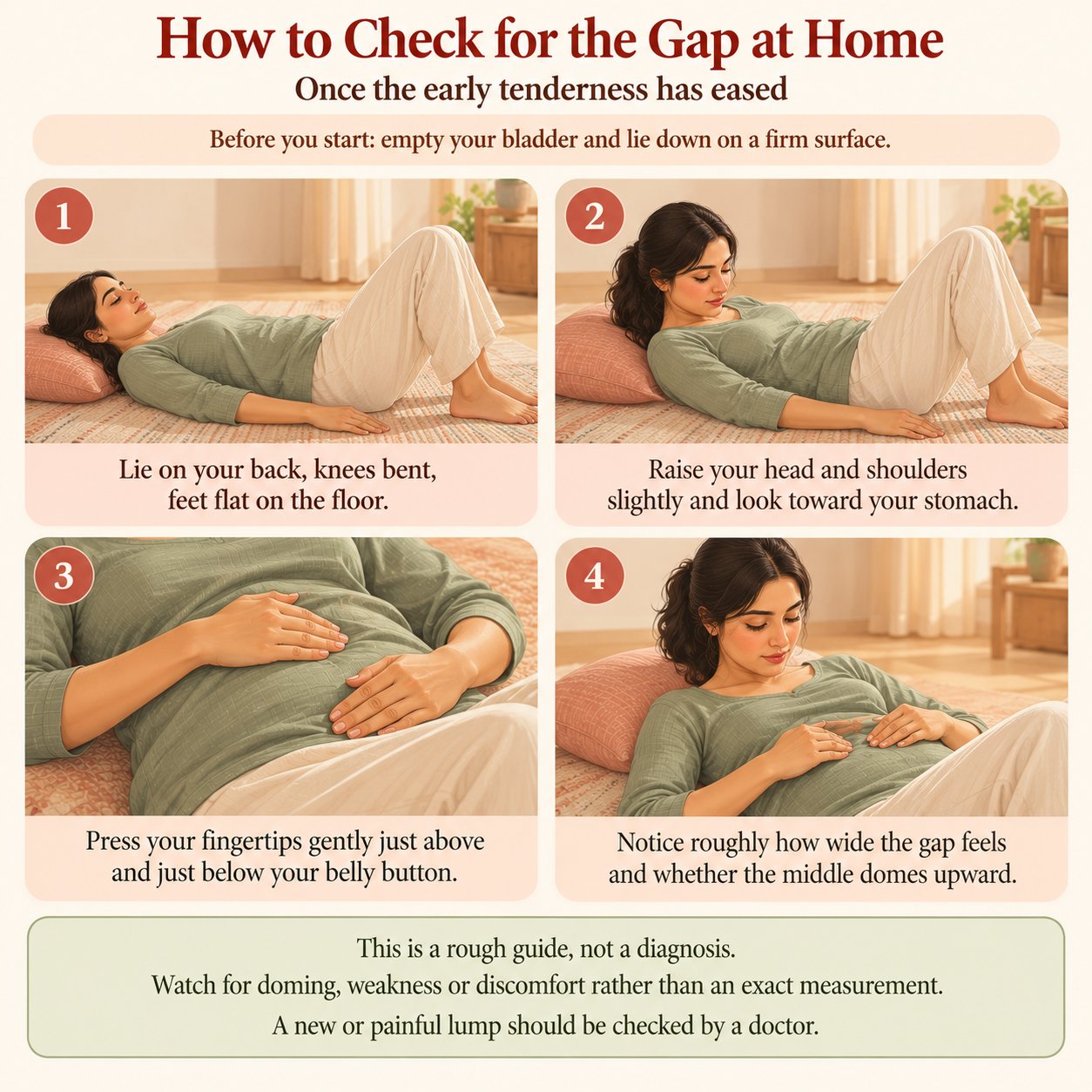
- Lie on your back, knees bent, feet flat on the floor.
- Raise your head and shoulders slightly and look toward your stomach.
- Press your fingertips gently just above and just below your belly button.
- Notice roughly how wide the gap feels and whether the middle domes upward.
Rather than focusing on an exact finger-width measurement, pay attention to whether you notice persistent doming, weakness, discomfort, or other symptoms, and discuss concerns with a healthcare professional. A new or painful lump in your abdomen is not something to assume is diastasis recti, and it should be checked by a healthcare professional.
What helps it heal, and what to avoid early
Recovery is less about effort and more about the right kind of gentle, consistent movement. The aim is to rebuild the strength and coordination of your deep core while the connective tissue recovers, rather than to force the two sides together. Early on, it helps to avoid movements that cause pain, doming, or a lot of pressure through your midline.
What helps:
- Gentle breathing and deep-core activation, focusing on controlled movement rather than forceful bracing.
- Pelvic floor exercises, which work hand in hand with your deep core.
- Rolling onto your side to get up, instead of sitting straight up from lying.
- Bracing your stomach gently and keeping loads close when you lift your baby.
What to avoid early:
- Anything that causes pain, doming, or a bulge along your midline.
- If sit-ups, crunches, full planks, or other demanding core exercises cause pain, pressure, or doming, pause them and consider having them modified as your strength returns.
- Heavy lifting or straining that causes pain, pressure, or doming, particularly before your strength has returned.
Pelvic floor training is a recovery topic in its own right, and it can be part of broader postpartum core rehabilitation.
When should you speak to your doctor?
Many separations improve gradually without causing significant symptoms, so there is usually no need for alarm in the early weeks. Speak to your doctor or a physiotherapist if the separation persists, feels wide, or domes when you sit up. It is also worth seeking assessment if you have back pain, urinary leakage, pelvic heaviness, or a feeling of pressure, because these can point to other parts of your postpartum pelvic floor and core recovery that deserve attention.
A pelvic health physiotherapist can assess your abdominal wall, your breathing, and how your core and pelvic floor work together. Treatment usually focuses on restoring strength and coordination rather than simply trying to close a measured gap. With the right guidance, function and comfort often improve even when some separation remains.
Looking ahead
Over the coming weeks, gentle, consistent core and pelvic floor work can support your recovery more reliably than chasing a quick fix. As your strength returns you can slowly rebuild toward the movement you enjoyed before, ideally with a professional setting the pace if your separation was wide. Your recovery is a whole-body process, and your belly is simply one part of it finding its way back. To see how the rest of your body heals over the coming weeks, read our guide to postpartum recovery week by week.
References
- NHS. Your post-pregnancy body.
- Cleveland Clinic. Diastasis Recti (Abdominal Separation).
- Leeds Teaching Hospitals NHS Trust. Diastasis of Recti (separation of stomach muscles).
- Bedfordshire Hospitals NHS Trust. Physiotherapy: Diastasis Recti following Pregnancy (DRAM).
Common questions
Can diastasis recti heal on its own?
Often, yes. The gap frequently narrows in the months after birth as the connective tissue recovers, and gentle core and pelvic floor exercises support that by rebuilding strength and function. If the separation persists or comes with symptoms, guided rehab can help, so it is worth a check.
How long does diastasis recti take to close?
It varies. A small separation frequently improves within the first couple of months, while a larger one can take several months and sometimes longer. Consistency with safe exercises matters more than speed, and steady improvement is common well beyond the early weeks.
Can I improve diastasis recti months or years after birth?
Yes. Even long after birth, targeted deep-core and pelvic floor exercises can help the muscles work together again and improve how your abdomen feels and functions. A pelvic health physiotherapist can assess your separation and set a safe, progressive plan.
Does a C-section cause diastasis recti?
No. The separation is driven by the growing womb stretching the midline during pregnancy, so it can happen after either kind of birth. If you had a caesarean, recovery is layered on top of surgical healing, so follow your team's guidance on when to begin core work.
This article is for education and understanding. It is not a diagnosis or personal medical advice. Your own recovery depends on your body, your birth, and your history, so please use it alongside guidance from your doctor or a pelvic health physiotherapist.
 Medically reviewed byDr. Mahender Singh, MBBS, DCH, MD (Paediatrics)A consultant child specialist and neonatologist with over four decades of practice in newborn and child health.
 Written bySarthak ThakurCo-founder, CTO and Chief Marketing Officer of ParentVeda, and the software engineer who builds its app and the pipeline that checks its articles.
This article explains; it doesn’t diagnose. If your doctor has told you something different, your doctor is right.