
Everything a baby is built from passes through the mother first. The food on her plate becomes bone and brain tissue. Her voice is the first sound it will ever hear. Her bloodstream is the weather it develops in.
The Charaka Samhita, one of Ayurveda's foundational medical texts and well over two thousand years old, built its entire account of pregnancy on that fact. It described the Shadgarbhakarabhavas, six streams that come together to form a child: what comes from the mother, what comes from the father, the nourishment she takes, the habits she keeps, the state of her mind, and what the texts call the soul. Garbh sanskar grew out of that idea. Not a ritual to be performed correctly, but a way of caring for what flows in.
What is new is that the caring can now be traced.
What matters most
- The baby's environment is the mother, so tending her is the entire mechanism.
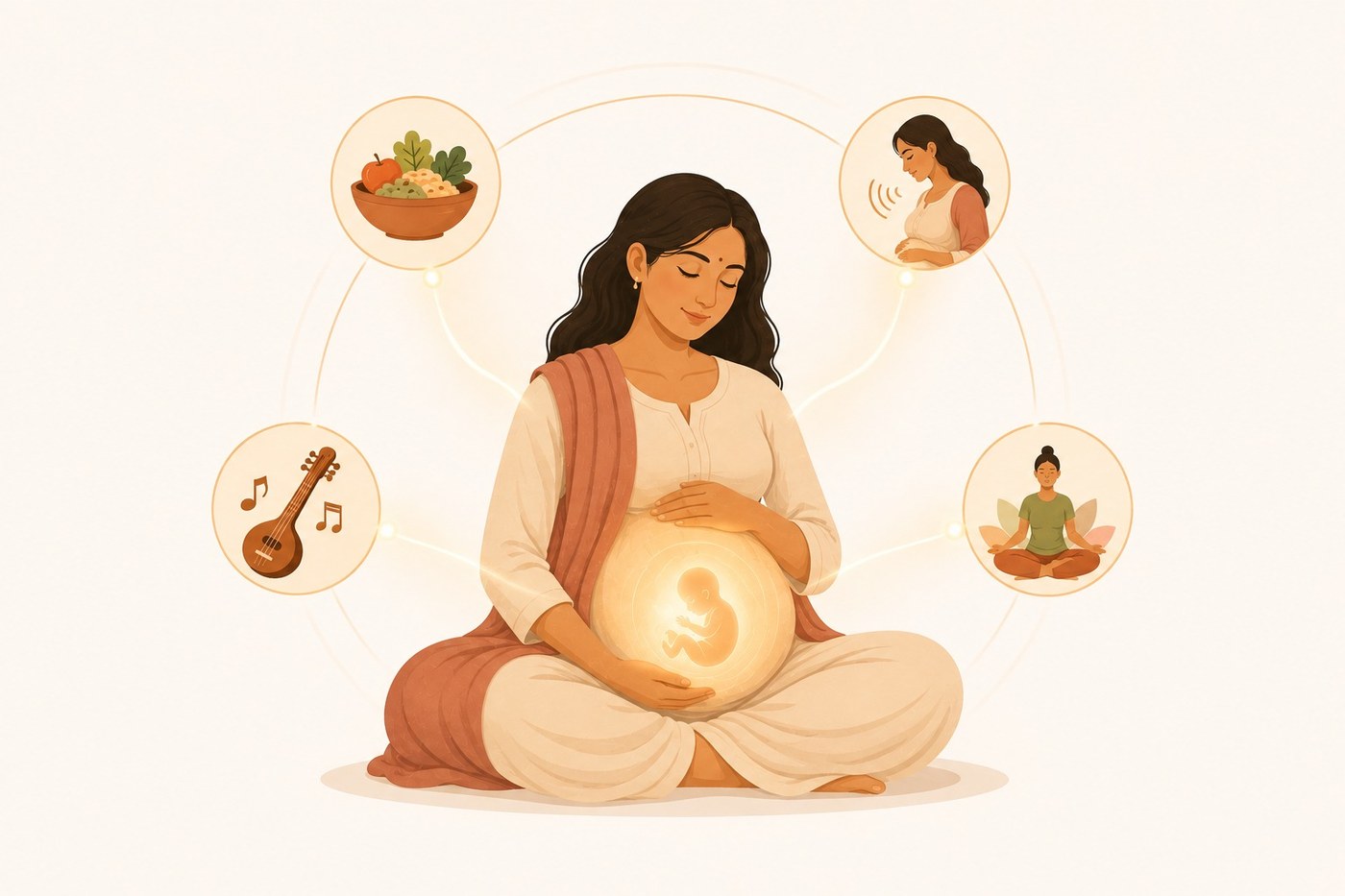
- Four pillars carry it, in every trimester: Samvad and Vichar, Shravan, Kriya, Aahar.
- What changes month to month is not her effort. It is what the baby can receive.
- No book, kit, class or app is needed to begin, and it is never too late.
- Doing one thing daily beats doing everything for a week.
This explains garbh sanskar as prenatal wellbeing and bonding. It sits alongside good antenatal care and never replaces it, and nothing here treats a medical condition. Any exercise or practice should be cleared with a doctor first.
Epigenetics: how the womb writes on a baby's DNA
For a long time it was assumed that a baby's traits and long-term health were sealed at conception, written into the DNA and unchangeable from there. That turned out to be half the story. The sequence is indeed fixed. But which of those genes are switched on, and how loudly they speak, is directed by the conditions the baby develops in. This is epigenetics, and it is where an old philosophy meets cell biology.
The signals come from the mother's chemistry. What she eats supplies the raw material for how genes are read. Her stress hormones, when they run high for long stretches, leave marks of their own, and researchers have traced changes in the genes that govern a baby's stress response back to what her body was carrying while it formed. A nourished, settled body sends a very different set of instructions than one running on empty and on alert.
Which is the whole of garbh sanskar in one line: the deliberate management of that internal chemistry. Not to redesign a child, but to give the genes the best possible conditions to be read in. It is also why Garbhini Paricharya, Ayurveda's month-by-month regimen for a pregnant mother, bothered to change the food from month to month, rather than issue one list for all nine.
A brain that wires itself around the mother's voice
Through the second and third trimesters the baby's brain does something it will never do again. At peak, new nerve cells form at a rate often estimated at around a quarter of a million a minute, and they wire themselves not in silence, but in response to what arrives.
Sound is the richest supply. The womb is not a quiet place: it is an underwater world of heartbeat and blood, where low frequencies pass through fluid and tissue with ease while high ones are filtered away. Most of the outside world arrives muffled.
The mother's voice is the exception. It travels through her own body as well as through the air, so it reaches the baby with a clarity nothing else has. And it lands. By the third trimester a baby's brain responds differently to the mother's voice than to a stranger's. Newborns prefer it over every other sound, recognise the rhythm of the language spoken around them, and settle to a rhyme or melody that was repeated in the final weeks.
So Samvad, talking to the unborn child, is not a symbolic gesture. The baby is listening, learning the voice, and will know it at birth.
Her calm is the baby's first shelter
The placenta carries an enzyme whose entire job is to keep the mother's stress hormones from reaching the baby, and against everyday stress it does that well. A hard morning does not get through.
Sustained, unrelieved stress is a different matter. Enough of it, for long enough, and some crosses, and the baby's own stress-response system calibrates to what it meets.
The useful reading of this is the opposite of guilt. A mother's calm is not a mood or a nicety. It is part of the environment a baby is being built in, which makes protecting it, with rest, with help, with people who carry some of the load, an act of care for the child. Sadvritta and achara rasayana, Ayurveda's terms for good conduct and a settled daily rhythm, treated as medicine in their own right, is that idea, named.
The four pillars
Hence these are the four pillars that together make up the whole practice of garbh sanskar:
- Samvad and Vichar (speaking and thinking): the voice, and the inner world behind it, which is the chemistry the baby shares.
- Shravan (listening): what the baby hears, and what the mother lets into her own ears.
- Kriya (doing): movement, creativity, rest, routine.
- Aahar (nourishment): what she eats, and how.
All four run through all three trimesters. What changes is only which doorway is open widest.
First trimester: laying the foundation
Everything that will matter is being founded right now. The neural tube closes and becomes a brain and spinal cord, the first heart cells begin to beat, and the outline of every organ is drawn. The baby is smaller than a strawberry and doing the most consequential work of the entire pregnancy.
The mother's exhaustion is the other half of that same fact: her body is building a placenta from scratch, an entire organ, usually while working a full day. Charaka's image for her is a vessel filled to the brim with oil, to be carried and not jolted. The tiredness is not weakness. It is the cost of construction.
- Samvad and Vichar: the conversation is inward this trimester. The early weeks carry a fear most women never say aloud, that something could go wrong before anyone even knows. Naming it, to a partner or a doctor, does more than carrying it silently. A simple daily greeting to the baby costs nothing and makes real what nothing yet shows.
- Shravan: her own listening is the point, since the ear has not formed. What plays in the house, what runs on the phone at midnight. A nervous system does not distinguish between a real threat and a distressing feed.
- Kriya: rest without apology. Once a doctor clears it, Marjariasana (cat-cow) to keep the spine mobile and ease the back, and Baddhakonasana (butterfly) to keep the pelvis open and circulating.
- Aahar: small, warm, easily digestible meals that survive nausea, and the folic acid the doctor advised, which matters precisely now, while the neural tube is closing. The baby is tiny and needs very little. Eating for steadiness, not for two.
Second trimester: the senses wake up
Between about 18 and 24 weeks the tiny bones of the inner ear harden, and the voice she has been using all along begins to arrive. Nothing about her has changed. The listener has.
The rest of the baby wakes with it. Taste buds form and flavours from her meals pass into the amniotic fluid, so the family's kitchen is already being learned. The first kicks come, and a one-way pregnancy turns into a conversation. Her own body meets her halfway: nausea lifts and energy returns. The texts call the fourth month dauhrida, two-hearted, and read her cravings as the baby's own, which is a generous way of saying the two are no longer easy to separate.
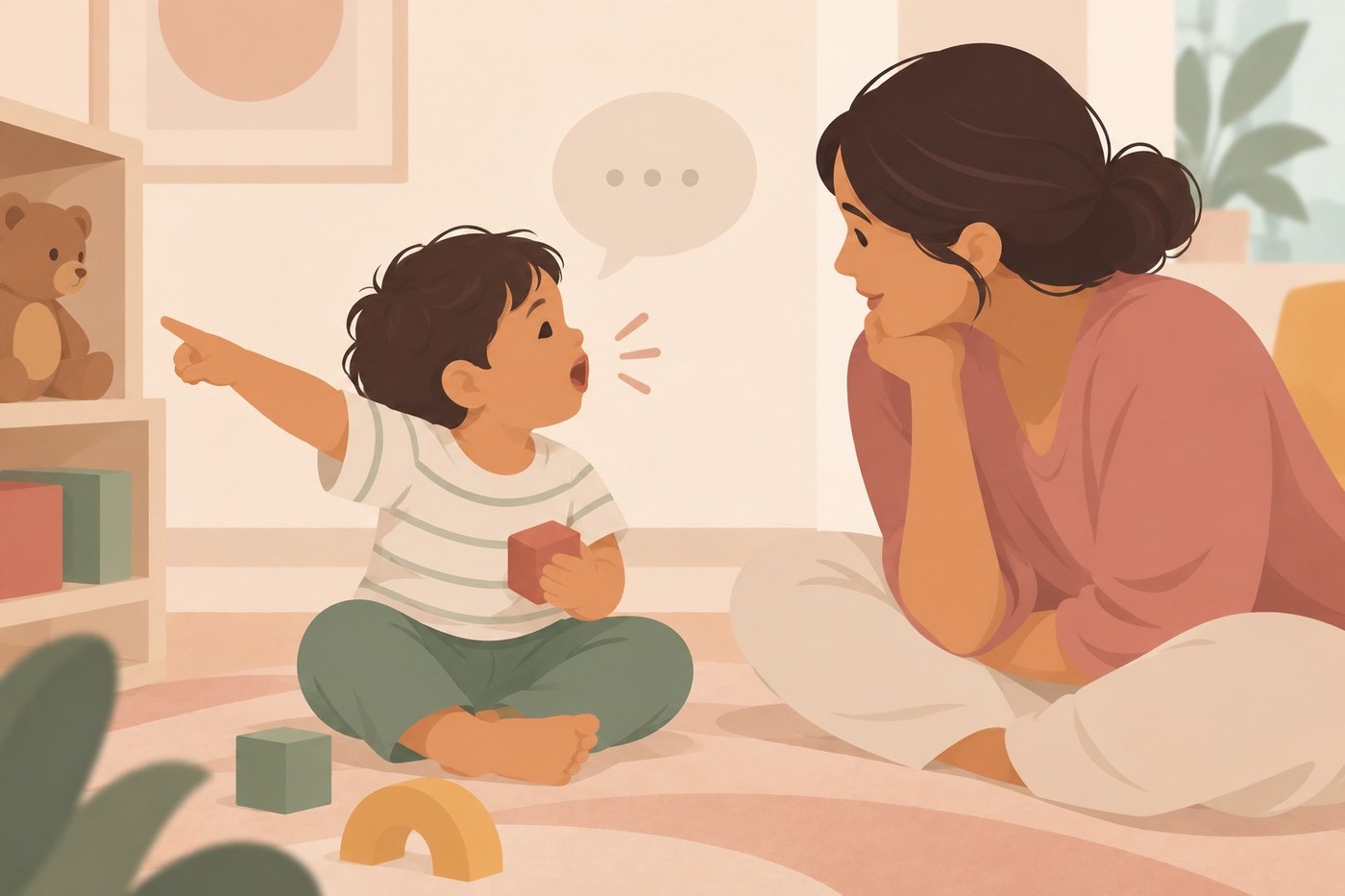
- Samvad and Vichar: the season for it. Now stories work, and the ones that carry are the ones with cadence: folk tales, verse, poetry, anything with rhythm and repetition, read aloud rather than thought. Describing the ordinary day works just as well. When a kick answers, the loop closes, and that is the bond forming, not a coincidence.
- Shravan: low, melodic, repeated. In the tradition, morning ragas like Bhairav and evening ones like Yaman or Bhupali are the usual choices, and they suit the science too, since what carries through fluid is melody and rhythm rather than words. A few pieces repeated beat a long playlist.
- Kriya: as the belly grows, alignment matters. Tadasana (mountain pose) for balance and even weight, Kati Chakrasana (standing spinal twist) to make room through the torso. This is also the window with enough energy for the creative work that absorbs her, which is the point of kriya, not a bonus.
- Aahar: variety now, because flavours are reaching the baby and taste is being taught. Growth accelerates, so this is where iron, protein and calcium earn their place, in whatever form the doctor advises.
Third trimester: what repeats becomes memory
Now the baby begins to remember. Every system is formed and running, eyelids open, light registers through the abdominal wall, touch gets an answer, and sleep and waking settle into cycles. Whatever recurs in these weeks is what a newborn will recognise from outside.
Which changes what the practice is for. A familiar tune in a bright, loud delivery room is not sentiment. It is the first thing that will settle a baby who has just arrived. She, meanwhile, is heavy, sleeping badly, and carrying a fear about labour she may not have said to anyone.
- Samvad and Vichar: narrow down and repeat. The same greeting at night, the same short story, the same words on waking, chosen now because they will be used later. Talking the baby through what is coming helps her as much as the baby. And the birth fear, said out loud rather than carried, gets smaller when it is spoken.
- Shravan: one lullaby or raga, chosen once and repeated. Darbari Kanada is the traditional late-evening choice, though any calm piece works, so long as it is the same one. This is the most practical instruction in this article.
- Kriya: supported Malasana (prenatal squat) on a stool or blocks to open the pelvic outlet, Upavistha Konasana (seated wide-angle) for the inner thighs, and Bhramari (humming breath), which many mothers find settles them quickly and is worth practising before labour.
- Aahar: smaller, steadier meals as the stomach loses room, and the iron that matters more as birth approaches, on the doctor's advice.
None of this is a checklist to be completed. A mother who does one thing daily, whichever fits her day, is doing garbh sanskar properly. Regularity is the method, not intensity, and the standard is far lower than the internet suggests.
The father's part
A baby learns the father's voice too, and low voices carry particularly well through the womb's filter, so a father who talks or sings is not assisting garbh sanskar. He is doing it, and building his own bond months early. The rest of the household does it more plainly still: keeping a pregnant woman fed, rested and unhurried shapes the environment more than any playlist can.
Myths worth setting down
| Myth | What's actually true |
|---|---|
| A bad day harms the baby | It does not. The climate of a pregnancy matters, not one hard afternoon. |
| It produces a genius | It produces a calm, well-fed, spoken-to start. That is the honest promise. |
| The right mantra is essential | The baby receives rhythm and melody, not meaning. |
| It needs a book or a class | Every pillar that reaches the baby is free. |
| Starting late means missing it | Memory forms last. There is time. |
| It is the mother's job | It never was. |
Looking ahead
It asks for nothing exotic: eat well, speak to a baby who is listening, protect the calm where it can be protected, and let the days find a rhythm. Whatever a family adds on top, mantra, music, prayer, ritual, belongs, and is theirs for its meaning. The base beneath it is real, it is already working, and it starts today.