The baby is home, but the belly in the mirror looks almost the same as before delivery. Then the visitors arrive, and so do the comments: “Pet abhi tak andar nahi gaya?”
That is why “delivery ke baad pet kaise kam kare” is one of the first questions asked in many Indian homes after a birth.
Key takeaways
- The postpartum belly is four things: a shrinking womb, extra fluid, stretched muscles and stored fat. Each one changes on its own clock.
- The first few weeks are mainly about recovery, comfort and slowly returning to movement, not about trying to flatten the belly.
- A belly belt may make movement more comfortable after a caesarean section, but it does not melt fat or close a muscle gap.
The quick answer
The belly after delivery shrinks in stages, not all at once. The womb usually returns to its earlier size in about six weeks, and extra fluid usually eases in the early weeks. Stretched tummy muscles and stored fat change more slowly, and at a different pace for every mother.
What helps most is gentle and steady: walking, breathing and pelvic floor exercises, home food in sensible portions, and rest. Crash diets, early sit-ups and belts that promise to “burn” fat do not help.
Why does the belly still look pregnant after delivery?
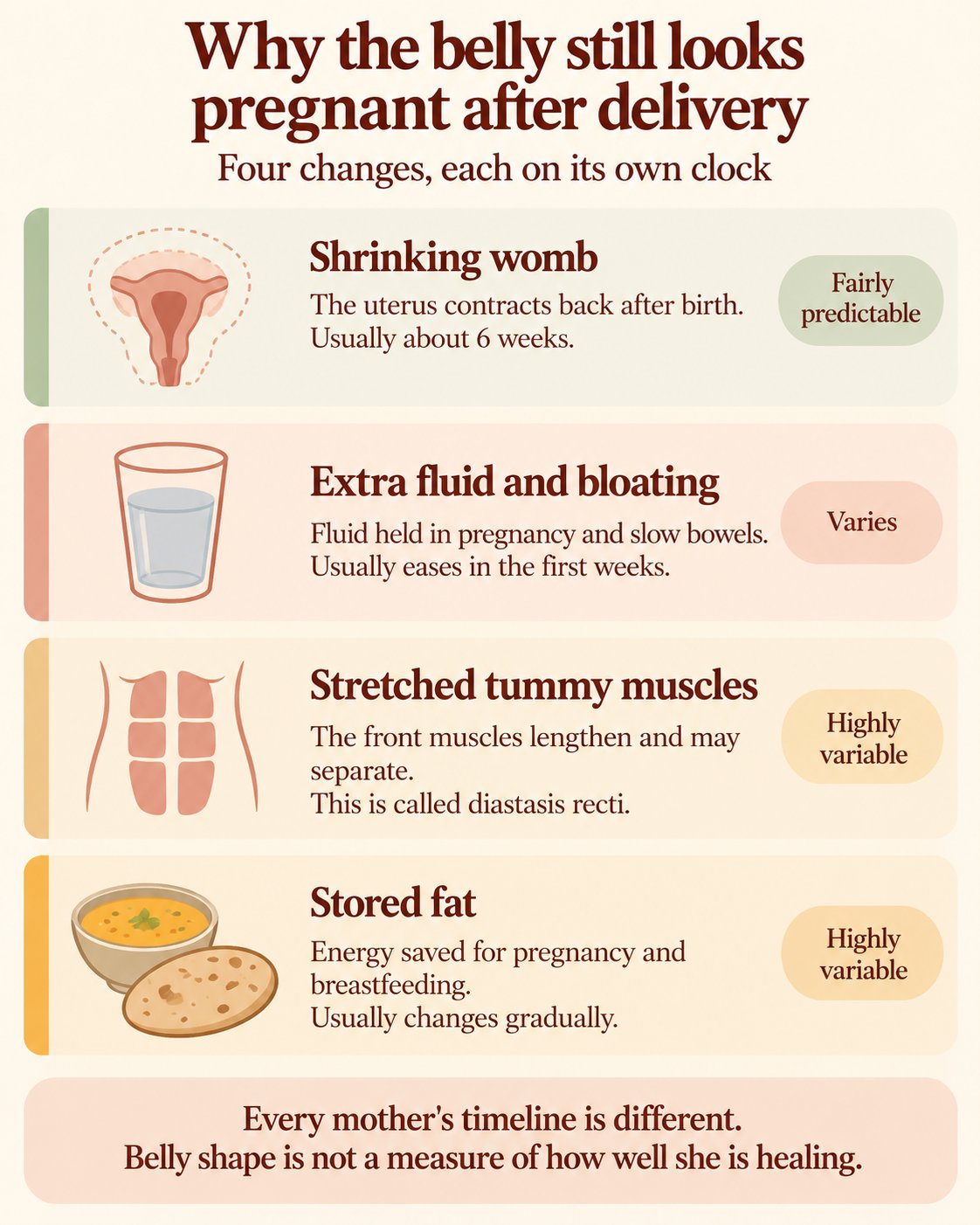
The postpartum belly is not one thing. It is four changes sitting in one place, and each one leaves at its own pace.
| What makes the belly look big | What is happening | How predictable it is | What helps |
|---|---|---|---|
| Shrinking womb | The uterus stretched to hold the baby and is now contracting back | Fairly predictable: usually about 6 weeks | Breastfeeding, which releases oxytocin and helps the womb contract |
| Extra fluid and bloating | The body held extra fluid in pregnancy, and bowels are slow after delivery | Usually eases in the first weeks, but varies | Water, fibre, short walks |
| Stretched tummy muscles | The front muscles lengthened and may have separated (diastasis recti) | Highly variable from mother to mother | May include breathing, pelvic floor and core exercises, tailored to her comfort, symptoms and clinical advice |
| Stored fat | The body saved energy for pregnancy and breastfeeding | Highly variable; usually gradual | Steady meals, regular activity, sleep where possible |
The muscle gap is more common than most mothers expect. A Norwegian study of 300 first-time mothers found a gap of two finger widths or more in 60 out of 100 at six weeks after birth. At 12 months, about one in three still had it.
To learn how to check for the gap and which exercises help, read Diastasis Recti: Check, Exercises and Recovery.
Many mothers feel a quiet disappointment the first time they look down after birth. The body was never meant to snap back in a week, and there is no single deadline for returning to a previous shape.
Belly shape is also not a reliable measure of how well she is healing, or of how hard she is trying.
The first few weeks are for recovery, not flattening
In many Indian families, the first 40 days (often called sawa mahina or the japa period) are traditionally set aside for rest and support. Rest can be valuable during recovery. The right balance of rest and movement depends on the type of birth, any complications, how wounds are healing and how the mother feels.
For what healing usually looks like through these weeks, read Postpartum Recovery Week by Week.
Twins, a difficult birth or an existing health condition can also change what suits her. Practical help at home with the baby and the housework is often what makes real rest possible.
Can often be tried gently, if comfortable:
- Short walks, adding a little at a time
- Belly breathing: draw the lower tummy in softly on each out-breath
- Pelvic floor squeezes: tighten as if stopping the flow of urine, then let the muscles relax fully before the next squeeze; the exercise should never hurt
- Good feeding posture: a pillow under the baby so the mother is not hunched over
Best discussed with her doctor or physiotherapist first:
- Sit-ups, crunches and planks
- Heavy lifting
- Running, jumping and other high-impact exercise
Stop and seek advice if there is: pain, a feeling of heaviness or pressure in the vagina, leaking urine, bleeding that gets heavier, or any symptom that gets worse.
C section delivery ke baad pet kaise kam kare?
The goals are the same after a caesarean section (C-section), but the pace is usually slower. The wound runs through the very layers of the tummy wall that need to heal. ParentVeda’s guide to recovering from a C-section covers wound care in more detail.
| After normal delivery | After C-section | |
|---|---|---|
| Walking | Usually within a day or two | Usually from the first day, as the hospital advises |
| Breathing and pelvic floor | From the early days, if comfortable | From the early days, gently and without pressure on the wound |
| Harder exercise | After the doctor’s check, often around 6 weeks | Only once the doctor clears it, which may take longer |
| Extra care | Perineal stitches, if any | Supporting the wound with a pillow when coughing or laughing |
These timings are a general guide only. The American College of Obstetricians and Gynecologists (ACOG) advises returning to exercise gradually, as soon as it is medically safe. The right timing depends on how the baby was born and whether there were complications.
Does tying the pet with a belt really help?
A belt helps comfort more than shape. Pet bandhna, tying the belly with a cloth or belt, is an old Indian tradition, and a modern binder works the same way.
A 2025 review of 13 trials found that abdominal binders reduced pain and helped mothers walk sooner in the first days after a C-section. That is a comfort benefit for some mothers, and not every mother needs a binder.
A belt is not a weight-loss treatment. It does not burn fat or reliably correct a muscle separation. Recovery may involve time, appropriate exercise and, when needed, a physiotherapist. Over a C-section wound, a belt should be used only on medical advice.
Eating to lose belly fat without affecting breast milk
Breastfeeding needs extra energy. The Centers for Disease Control and Prevention (CDC) in the United States suggests 330 to 400 extra kilocalories a day for well-nourished breastfeeding mothers.
That makes strict dieting in the early weeks a poor trade. Johns Hopkins Medicine suggests waiting until milk supply is well established, at around two months, before actively trying to lose weight, and keeping any weight loss gradual.
The right pace differs for every mother, and a doctor or dietitian can help her decide.
| Food | Why it helps |
|---|---|
| Dal, rajma, chana, eggs, paneer, curd | Provide protein and other nutrients needed for recovery and general health |
| Seasonal sabzi and fruit | Fibre that eases bloating and constipation |
| Roti, brown rice, ragi, oats | Steady energy without sudden hunger |
| Water, chaach, nimbu pani | Help her stay hydrated, especially while breastfeeding |
| Gond ladoo, panjiri, ghee-rich halwa | Customary in many homes after delivery; dense in calories, with no proven extra benefit for recovery, so small portions suit most mothers |
| Ajwain water | Many families use it for gas; there is no good evidence that it reduces belly fat |
Detox teas and slimming powders sold online are best avoided while breastfeeding, because their ingredients are often unclear.
When to see a doctor
These signs apply after both normal delivery and C-section. If she is unsure how serious something is, she does not have to decide alone. Calling the hospital or doctor is always reasonable.
Call 112 or 108, or go to the nearest emergency department immediately, if there is:
- Chest pain or sudden breathlessness
- Very heavy bleeding, or feeling faint or dizzy
Contact the doctor or hospital the same day if there is:
- Fever with tummy pain that is getting worse
- A belly that feels hard and very tender
- A C-section wound that is red, swollen, hot, oozing pus or opening, or pain around it that keeps increasing
- Bleeding that gets heavier, or large clots
- Pain or swelling in one leg
Raise at a doctor’s appointment:
- A ridge or bulge down the middle of the tummy that is still clear around 8 weeks after birth
- Leaking urine when coughing, sneezing or lifting
- A feeling of heaviness or of something coming down in the vagina
- Back or pelvic pain that is not settling
- Low mood or distress about her body that does not ease
Looking ahead
After the postnatal check, many mothers slowly add brisk walks, postnatal yoga and guided core work, if the doctor agrees. The World Health Organization (WHO) encourages regular physical activity in the months after birth, built up gradually. The same steady approach suits postpartum weight loss.
A useful next step is the muscle-gap check in the questions below. Leaking urine, pelvic heaviness or a bulge that does not settle can often be helped by a pelvic-health physiotherapist. They are not something a mother simply has to live with.
References
- Cleveland Clinic. Uterus Involution: Causes, Process and How It Feels.
- Sperstad JB, Tennfjord MK, Hilde G, Ellström-Engh M, Bø K. Diastasis recti abdominis during pregnancy and 12 months after childbirth: prevalence, risk factors and report of lumbopelvic pain. British Journal of Sports Medicine. 2016;50(17):1092 to 1096.
- National Health Service (NHS). Your post-pregnancy body.
- American College of Obstetricians and Gynecologists. Physical Activity and Exercise During Pregnancy and the Postpartum Period. Committee Opinion No. 804. Obstetrics and Gynecology. 2020;135(4):e178 to e188.
- Lin SL, Yen CF, Hsieh CJ, Chang WP, Wang CH. The efficacy of abdominal binder in women undergoing cesarean delivery: a meta-analysis of randomized controlled trials. Midwifery. 2025;142:104281.
- Centers for Disease Control and Prevention. Maternal Diet and Breastfeeding.
- Johns Hopkins Medicine. 5 Breastfeeding Diet Myths.
- World Health Organization. WHO recommendations on maternal and newborn care for a positive postnatal experience. 2022.
Common questions
How can she check for a muscle gap at home?
She can lie on her back with knees bent, lift her head and shoulders slightly, and press her fingers gently into the middle of her tummy, above and below the belly button. A gap that fits two or more fingers, or a ridge that bulges, is worth noting.
This check is only an observation, not a diagnosis. A bulge that persists, discomfort, difficulty with everyday movements, or simply not being sure are all good reasons to ask a doctor or physiotherapist for an assessment.
Does breastfeeding help reduce belly fat?
Breastfeeding helps the womb contract faster, but it does not reliably reduce belly fat. Its effect on weight varies. Some mothers lose weight easily while feeding, while others feel hungrier and lose it slowly. Both are common.
When can she start postnatal yoga?
A postnatal yoga class is best started after the postnatal check, once the doctor agrees. It helps to tell the teacher about a C-section or a muscle gap, so that deep twists and crunch-like poses can be avoided at first.
This article is for general education and does not replace advice from a doctor who knows her health. Every recovery is different, especially after a C-section or a complicated birth. Please speak to an obstetrician or physiotherapist before starting any exercise programme after delivery.
 Medically reviewed byDr. Mahender Singh, MBBS, DCH, MD (Paediatrics)A consultant child specialist and neonatologist with over four decades of practice in newborn and child health.
 Written bySarthak ThakurCo-founder, CTO and Chief Marketing Officer of ParentVeda, and the software engineer who builds its app and the pipeline that checks its articles.
This article explains; it doesn’t diagnose. If your doctor has told you something different, your doctor is right.