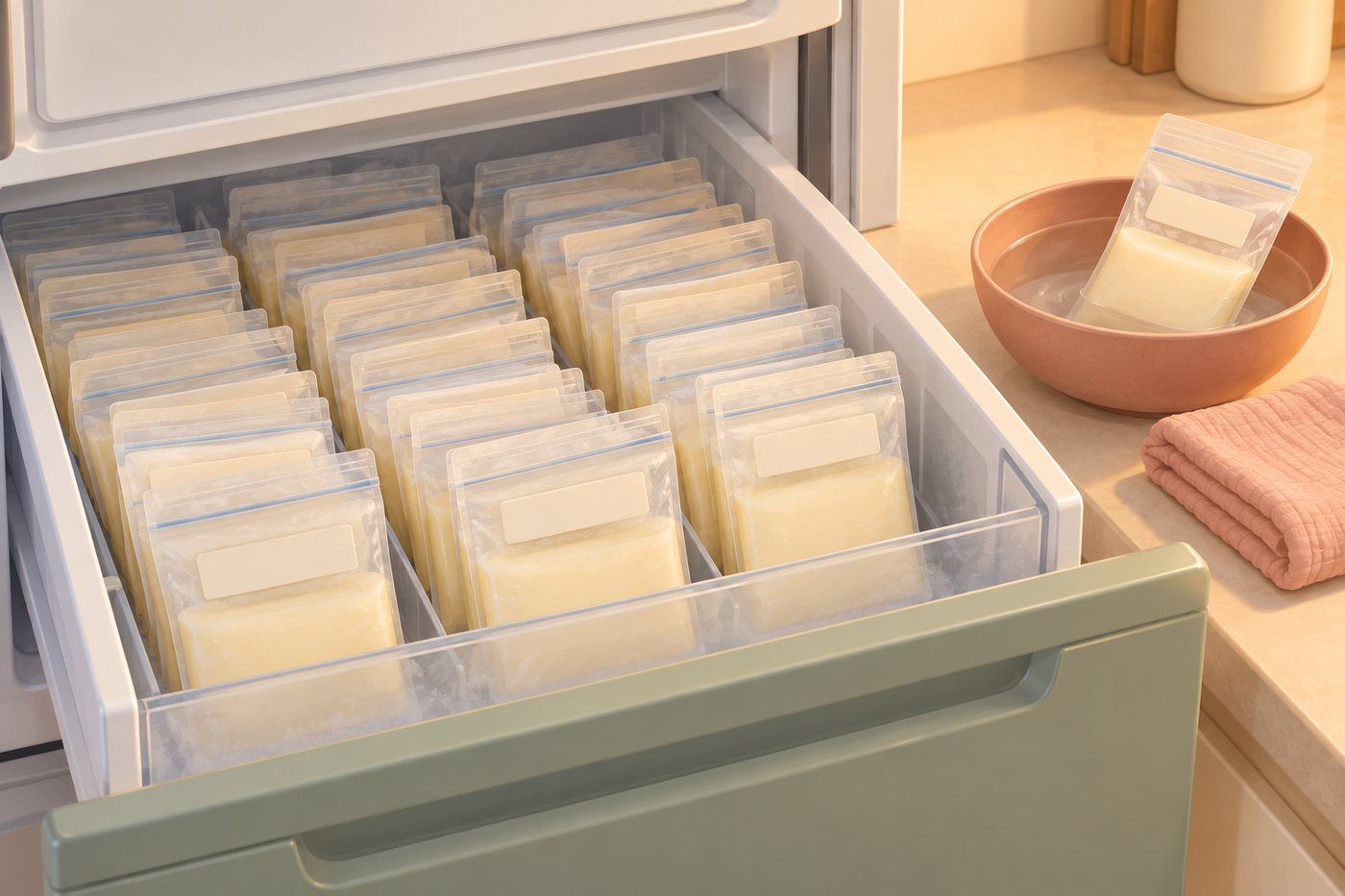
The last weeks of maternity leave often bring a quiet new question. Who will feed the baby while she is at work, and will her milk keep up?
Whether a mother is planning her return or a grandparent is learning to handle stored milk, the worries are usually the same. How often should she pump, how long does milk stay safe, and what must the office allow?
Key takeaways
- Each pumping session at work stands in for a feed the baby would have had.
- Most office days have room for two or three pumping breaks.
- The Rule of 4 applies to cool rooms: a maximum of 4 hours out at 25°C or below, and 4 days chilled. When the room is warmer, chill milk straight away.
- Once thawed, milk should not go back into the freezer, and anything left in the bottle after a feed is finished or thrown away no later than 2 hours after the feed began.
- Nursing breaks are a legal entitlement until the child is 15 months old.
The quick answer
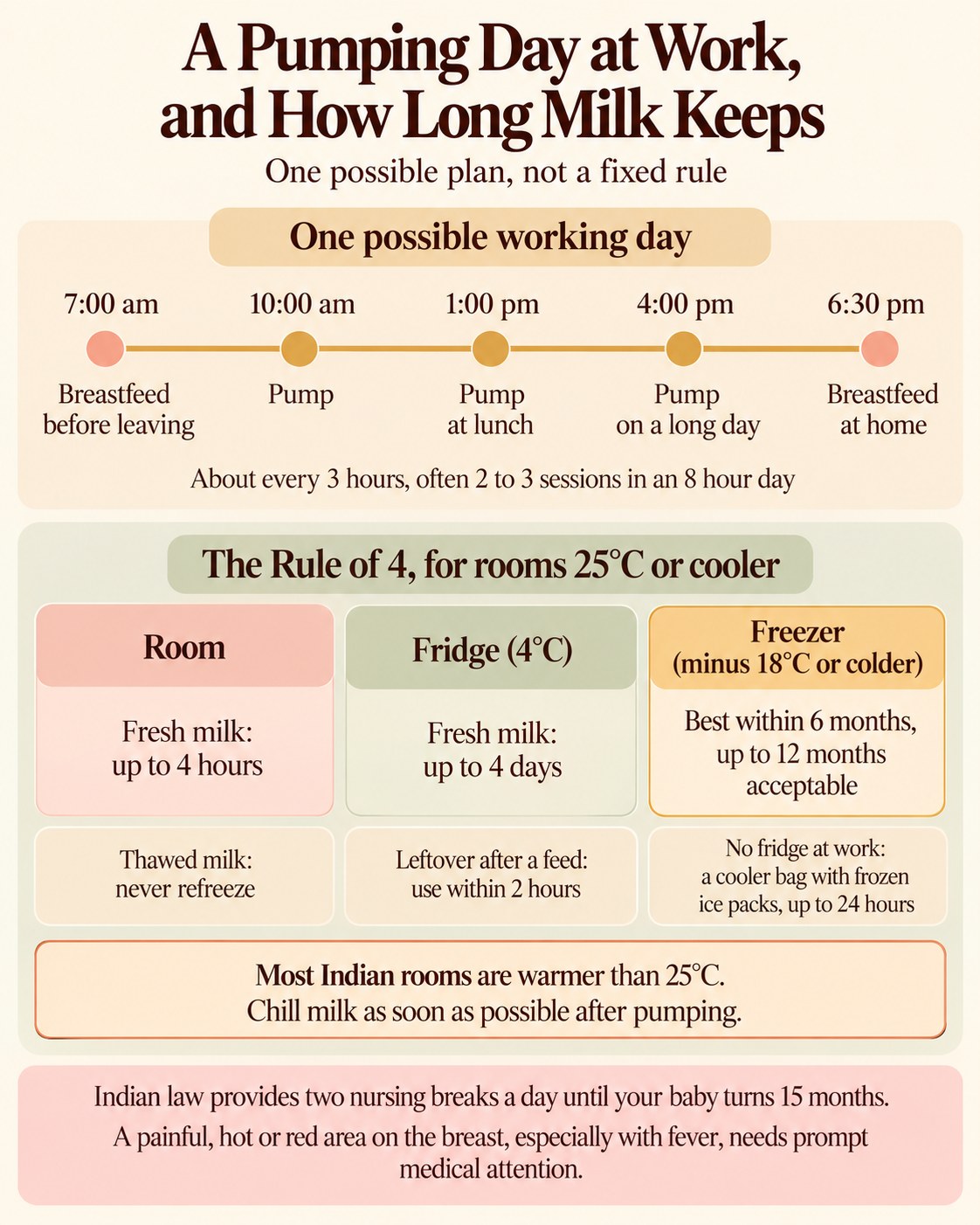
The answer is more manageable than it first feels. Many mothers pump about every three hours to help keep supply steady. Fresh milk is generally safe for a maximum of 4 hours in a room at 25 degrees Celsius (°C) or below, and for 4 days once chilled. Indian labour law also provides nursing breaks until the baby turns 15 months.
Milk works on demand, and the pump keeps the order open
Breasts make milk on a supply-and-demand basis. The more often milk is removed, the more the body is signalled to keep making it.
At work, the pump simply stands in for the baby. Each session tells the body the feed still happened, even when the baby is across the city.
So timing matters more than the amount in any one bottle. Over several days, long gaps without removing milk can signal the body to make less.
How often should she pump at work?
Many mothers match their pumping to the baby's usual feeding rhythm, which often works out to roughly every three hours, and count travel time in their planning. Across a typical office day, that comes to two or three sessions.
This is a starting point, not a fixed rule. A doctor or lactation consultant can help tailor it to the baby's age and feeding pattern.
| Time | One possible working day |
|---|---|
| 7:00 am | Breastfeed before leaving home |
| 10:00 am | First pumping session |
| 1:00 pm | Second session, at lunch |
| 4:00 pm | Third session, on a long day |
| 6:30 pm | Breastfeed soon after reaching home |
Breastfeeding in the morning, the evening and on days off can help keep supply steady. Many babies also feed more at night once their mother is back at work.
For help keeping those home feeds comfortable and effective, read How to Breastfeed: A Simple Guide for New Mothers.
Starting a little early makes the first day easier
- Build a small stash. Add one pumping session a day, often after the first morning feed.
- Let the baby practise. A family member can offer expressed milk by paladai (a small traditional feeding cup), cup or bottle.
- Scout the office. Find a clean, private place to pump and ask about a fridge.
- Do a trial run. Try a few hours away while the caregiver handles feeds.
Why does the bottle look so small some days?
Many mothers pump less at work than they expected. They quietly take it as a sign that their milk is drying up.
Often it is not. A pump may remove less milk than a baby who feeds well, and stress can affect how much comes out. A rushed break can also slow the let-down, the reflex that releases milk.
A photo of the baby, a few slow breaths, or gentle breast massage before expressing helps many mothers' milk flow. A few minutes of hand expression at the end can collect a little more.
The Rule of 4, and why Indian heat changes it
The Centers for Disease Control and Prevention (CDC) guidance gives an easy way to remember storage. Freshly expressed milk can sit out for a maximum of 4 hours, as long as the room is no warmer than 25°C, and lasts 4 days once chilled.
These are upper limits under cool conditions, not a target. Many Indian homes and offices run warmer for much of the year. The safest habit is to refrigerate milk, or move it into a cooler bag, soon after pumping.
| Type of milk | Room (25°C or cooler only) | Fridge (4°C) | Freezer (minus 18°C or colder) |
|---|---|---|---|
| Freshly pumped | 4 hours at most | 4 days at most | Ideally used by 6 months; acceptable to 12 months |
| Thawed after freezing | 1 to 2 hours | A maximum of 24 hours | Do not freeze again |
| Left over after a feed | Finish or discard by 2 hours after the feed starts | Do not keep | Do not keep |
Getting milk home and ready to feed
- No fridge at work? A cool bag packed with frozen gel packs keeps milk safe for as long as a full day (24 hours), according to CDC guidance.
- Small portions. Portions of roughly 60 to 120 millilitres (ml), each dated, freeze and thaw with less waste.
- Right containers. Choose bags made for storing breast milk, or clean containers that are safe for food, rather than ordinary plastic bags.
- Safe thawing. Move frozen milk to the fridge the night before, or stand it in a bowl of warm water. A microwave should never be used.
- Separated cream is normal. A gentle swirl mixes the fat back in.
- Warming is optional. Cold or room-temperature milk is fine to feed; warming is a comfort, not a safety step. If the baby prefers it warm, test a few drops on the inner wrist.
- Hygiene. Clean hands before each session, and wash pump parts after every use.
What does Indian law allow a working mother?
India's four Labour Codes took effect on 21 November 2025, and maternity protections now sit in the Code on Social Security, 2020. The central rules followed on 8 May 2026. Many private employers also come under state rules, so some details can vary.
These rules cover factories, mines, plantations, and shops or establishments with 10 or more employees.
| Entitlement | What it means |
|---|---|
| Nursing breaks | Two nursing breaks a day after returning to work, until the child turns 15 months, in addition to the usual rest interval |
| Break length | Each break is 15 minutes, with up to 15 minutes more if she has to travel to the creche or where the baby is kept |
| Creche | Establishments with 50 or more employees must provide a creche (a childcare facility at or near work), with four visits a day, counting her rest intervals. By agreement with employees, some employers pay an allowance of at least ₹500 a month per child instead. |
A calm conversation with Human Resources (HR) before rejoining helps confirm what applies at her workplace. The law speaks of nursing the child and does not mention pumping, so it is worth asking HR how the breaks can be used. It is worth asking about a private room, a fridge and break timings, ideally while planning maternity leave.
When to see a doctor
- A painful, hot or red area on the breast, especially with fever or chills. This can be a sign of mastitis (inflammation or infection of the breast) and needs prompt medical attention.
- Cracked nipples or pain that continues while pumping, which is sometimes a pump-fit problem
- A sudden drop in milk that does not recover with more frequent pumping or feeding
- A baby who has fewer wet nappies, seems unusually sleepy or is not gaining weight
Looking ahead
The first days or weeks back can take some adjustment for both mother and baby. For many mothers, supply settles as a routine forms.
From around six months, solid foods begin. The baby's daytime milk needs slowly shift, and pumping often becomes easier to fit in.
References
- Centers for Disease Control and Prevention. Breast Milk Storage and Preparation.
- Centers for Disease Control and Prevention. Storage and Preparation of Breast Milk (fact sheet).
- Eglash A, Simon L; Academy of Breastfeeding Medicine. ABM Clinical Protocol #8: Human Milk Storage Information for Home Use for Full-Term Infants, Revised 2017. Breastfeed Med. 2017;12(7):390-395.
- National Health Service (NHS). Expressing breast milk.
- NHS Start for Life. Expressing breast milk by hand.
- Dorset HealthCare University NHS Foundation Trust. Hand Expressing.
- University Hospitals (Cleveland). Breastfeeding: Returning to Work.
- Press Information Bureau, Government of India. Code on Social Security, 2020: Towards Universal and Inclusive Social Protection.
- KPMG India. Flash News: Government of India notifies implementation of Labour Codes.
- Taxmann. Maternity Benefit under the Code on Social Security 2020: Eligibility, Duration, Duties.
- Ministry of Labour and Employment, Government of India. The Maternity Benefit (Amendment) Act, 2017 (Gazette).
- Ministry of Labour and Employment, Government of India. The Code on Social Security, 2020 (Gazette).
- Ministry of Labour and Employment, Government of India. The Social Security (Central) Rules, 2026 (Gazette).
Common questions
Can freshly pumped milk be added to milk already in the fridge?
Yes, once the fresh milk has cooled in the fridge and both batches were pumped the same day. Newly collected milk can be cooled and added to stored milk on the same day. Fresh milk should not be added to milk that is already frozen.
Does she need an electric pump to pump at work?
Not always. Hand expression needs only clean hands and a container. Manual pumps also suit many mothers who pump once or twice a day. A double electric pump can save time on a packed schedule.
This article is for general education and is not a substitute for personal medical or legal advice. Every mother, baby and workplace is different. For concerns about milk supply, breast pain or a baby's feeding and growth, please speak to a doctor or lactation consultant. For workplace entitlements, the employer's HR team or a labour law professional can confirm what applies.
 Medically reviewed byDr. Mahender Singh, MBBS, DCH, MD (Paediatrics)A consultant child specialist and neonatologist with over four decades of practice in newborn and child health.
 Written bySarthak ThakurCo-founder, CTO and Chief Marketing Officer of ParentVeda, and the software engineer who builds its app and the pipeline that checks its articles.
This article explains; it doesn’t diagnose. If your doctor has told you something different, your doctor is right.