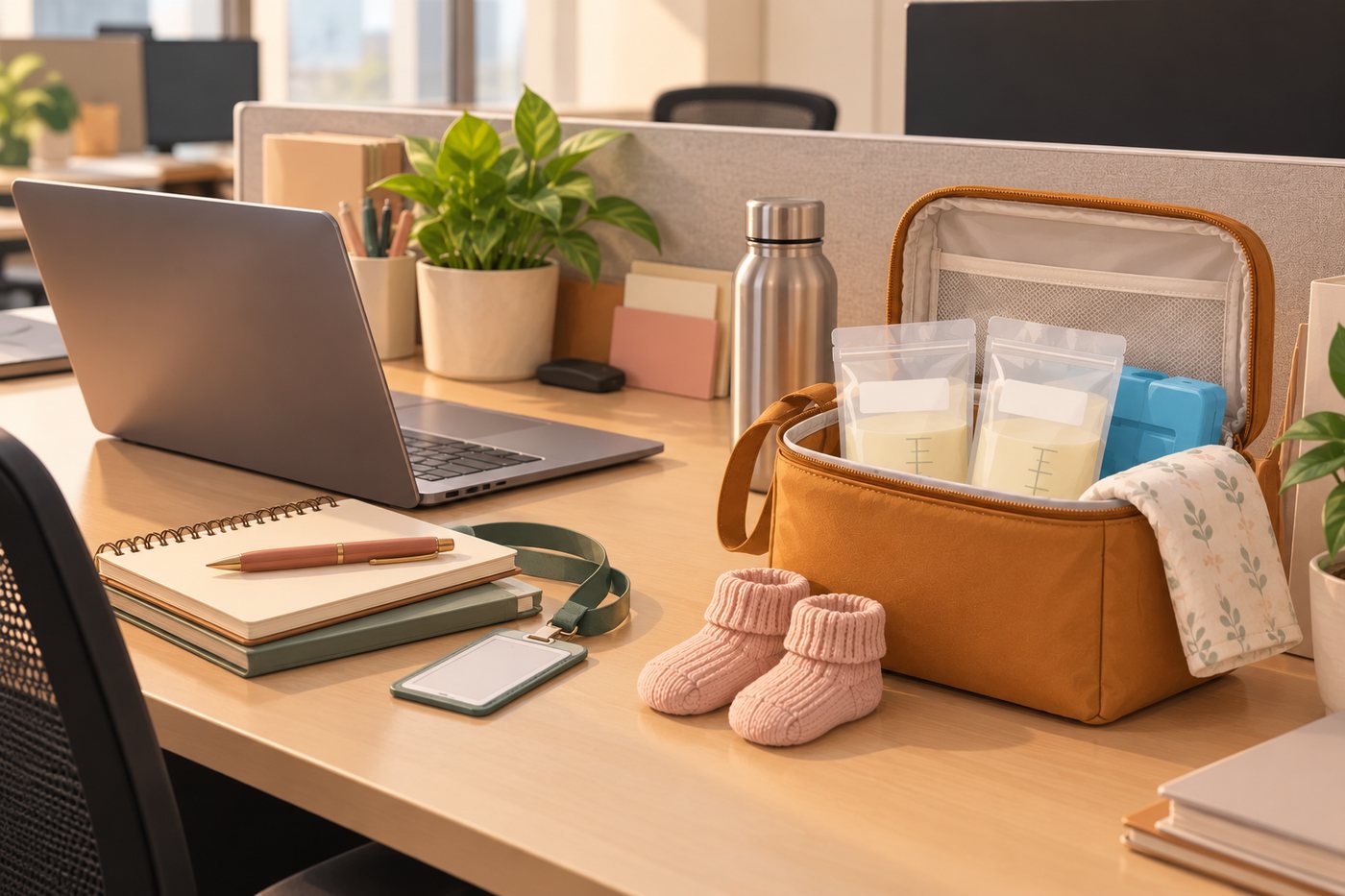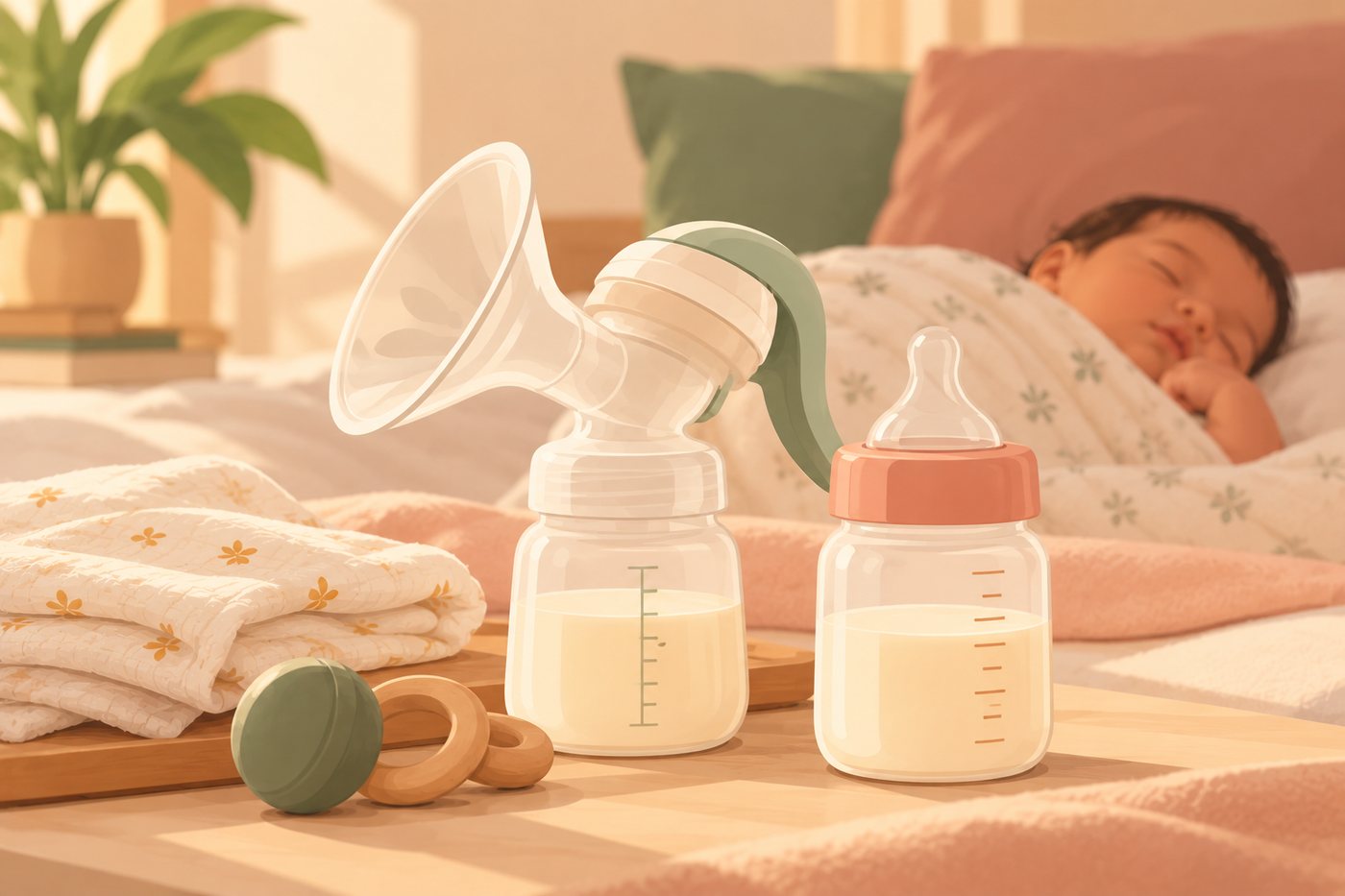
There are many reasons you might reach for a breast pump. You may be heading back to work, building a small stock before a trip, sharing night feeds with your partner, or simply easing the fullness when your breasts feel heavy. Whatever brought you here, the questions underneath are usually the same.
How do you actually do this, and how do you know the milk you store is still safe to give your baby? Pumping is a skill, not a talent. You may feel clumsy at first, and most of that awkwardness fades within a week or two.
Key takeaways
- You can express milk by hand, with a manual pump, or with an electric pump. All three work, and the best one is simply the one that fits your routine.
- For a healthy baby born at full term, freshly expressed milk generally keeps for up to 4 hours at room temperature, up to 4 days in the fridge, and about 6 months in the freezer.
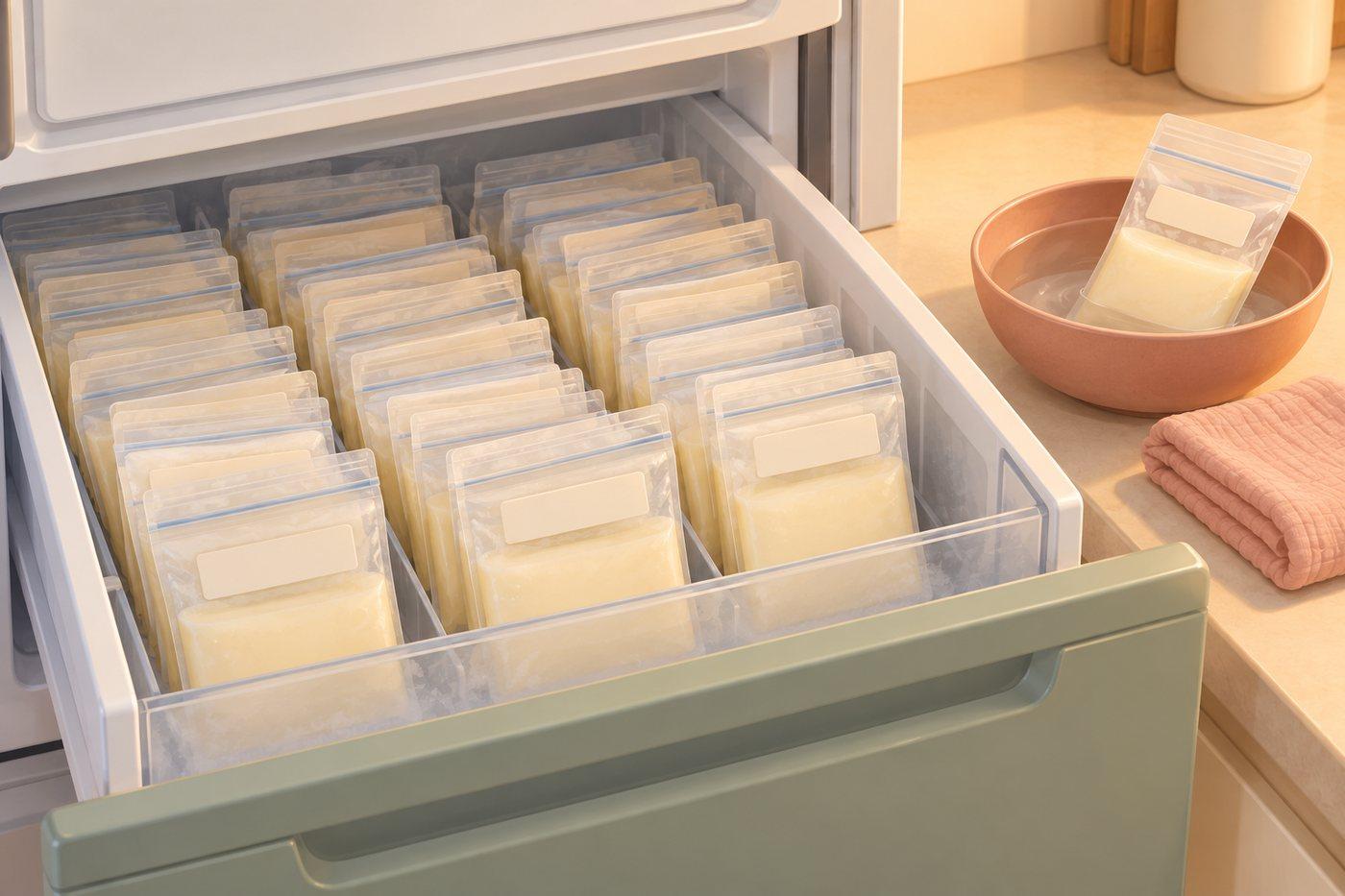
- Write the date on every container, keep milk towards the back of the fridge or freezer, and freeze it in small amounts so you only thaw what one feed needs.
- Use your oldest milk first, keep it out of the microwave, and once milk has thawed completely, do not freeze it again.
- If your baby does not finish a bottle, use that leftover milk within 2 hours.
Storage times here are for healthy babies born at full term. For a premature, unwell or hospitalised baby, follow your baby's clinical team.
The quick answer
For a healthy baby born at full term, freshly pumped milk can generally be kept for up to four hours at room temperature, up to four days in the refrigerator, and about six months in the freezer for best quality.
The room-temperature limit assumes a room at 25°C or cooler. Many Indian homes run warmer for much of the year, so chilling milk soon after pumping is the safer habit.
How do you pump breast milk, step by step?
Before anything else, wash your hands well with soap and water, and check that your pump parts and bottles are clean and dry. Find a spot where you can sit comfortably, since feeling relaxed helps your milk let down. You may find it easier when your baby, a photo, or even a worn baby vest is nearby.
- Get comfortable. You may find gentle warmth or a light breast massage helpful for comfort and let-down.
- Fit the flange correctly. Position the funnel-shaped part so your nipple sits centred and moves freely, without rubbing painfully. A poorly fitting flange is a common cause of pumping pain.
- Start low and gentle. Pumping should never hurt. Build up slowly to a setting that feels comfortable, not to maximum suction.
- Pump while milk is flowing. Many sessions last around 15 to 20 minutes, but there is no fixed time. Stop when the flow has slowed and pumping still feels comfortable.
- Store or use it. If you will not use the milk soon, label it with the date and refrigerate or freeze it, following the storage guidance below.
How much you collect varies a lot from day to day, so try not to read too much into a single session. You may find an extra morning session convenient, since milk volume can be higher then, but the best time is simply the one you can repeat comfortably.
Which type of pump should you use?
Hand expression needs no equipment and is useful for the early days or the occasional bottle. A manual pump, worked by hand, is quiet and affordable, and suits occasional use. An electric pump does the work for you and suits regular or daily pumping, such as after you return to work.
There is no single best pump, only the one that fits your routine and budget. For getting started, a flange that actually fits you matters far more than the price tag.
How long does expressed breast milk stay safe?
This is the question most parents search for. For healthy babies born at full term, the Centers for Disease Control and Prevention (CDC) offers an easy rule to remember: four hours on the counter and four days in the fridge for freshly expressed milk.
These times assume a room at 25°C or cooler, a fridge at around 4°C, and a freezer at -18°C or colder.
| Type of milk | Room temperature | Refrigerator | Freezer |
|---|---|---|---|
| Freshly expressed | Up to 4 hours | Up to 4 days | Best used within 6 months; up to 12 months is acceptable |
| Thawed (previously frozen) | Within 1 to 2 hours once warmed | Up to 24 hours | Do not freeze again once fully thawed |
| Leftover after a feed | Within 2 hours | Within 2 hours | Do not freeze again |
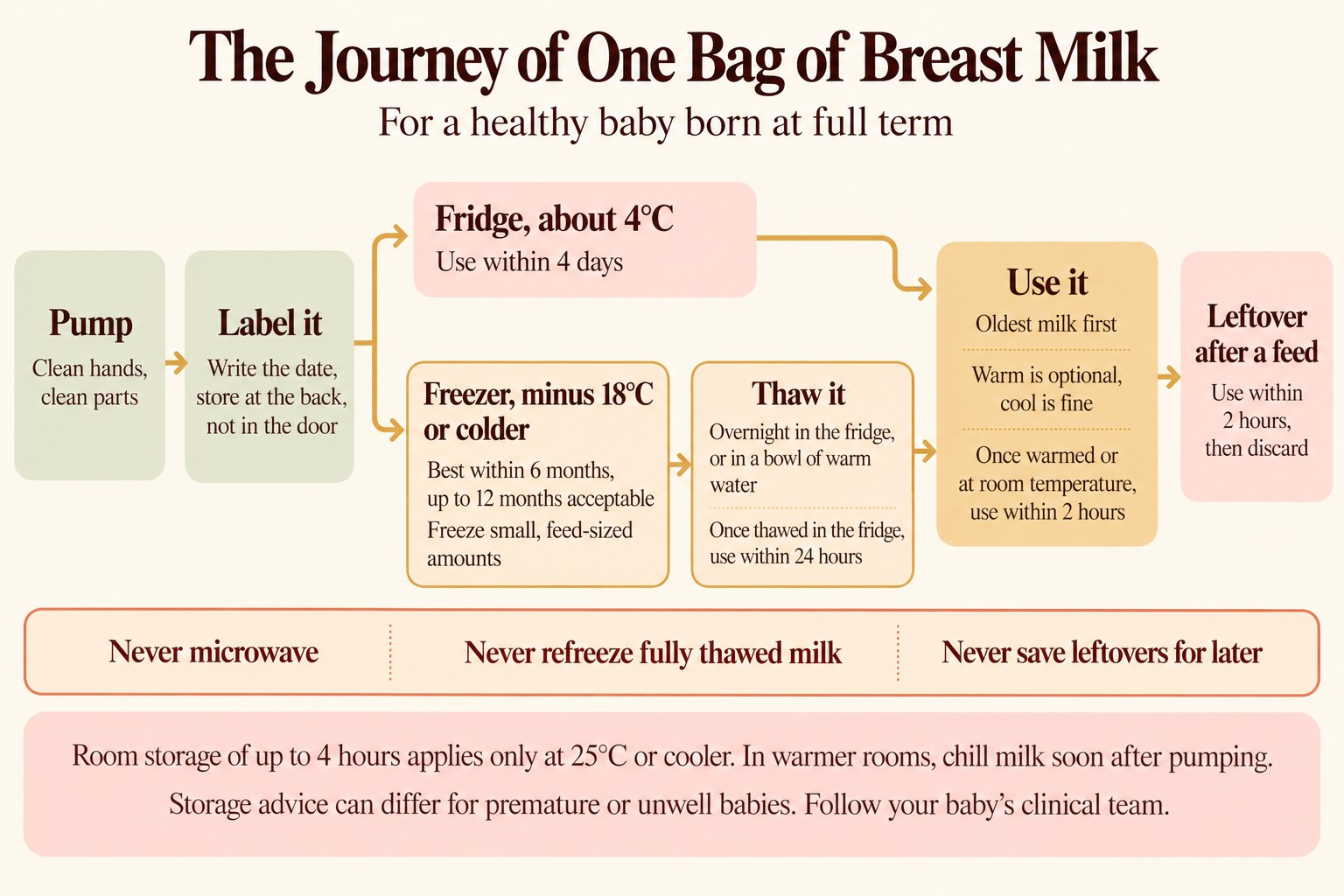
A few practical points sit alongside the table:
- The fridge and freezer door warms up each time it opens, so give milk a spot on a back shelf instead.
- Freeze milk in feed-sized amounts, and do not fill containers to the brim, because milk grows a little as it freezes.
- On a journey, a well-insulated cooler bag packed with frozen ice packs can hold milk safely for as long as 24 hours.
- Storage advice can differ for premature, medically fragile, or hospitalised babies. Follow your baby's clinical team in those situations.
Stored milk often settles into a creamy top layer, and its colour can vary. This is expected, and a gentle swirl blends it again.
How should you thaw and warm stored milk?
Reach for the earliest-dated milk first, so none of your stock goes past its best. Move frozen milk to the fridge the night before, or sit the sealed container in a bowl of warm water, or hold it under a warm tap.
Keep stored milk out of the microwave. It warms milk unevenly, leaving hot spots that can burn a baby's mouth even when the bottle feels fine.
Your baby does not need milk to be warm. Plenty of babies happily drink it cool or at room temperature. Milk that has thawed in the fridge is best used within a day, and milk that has been warmed, or has sat at room temperature, should be used within 2 hours, whether or not your baby has started on it.
Once milk has fully thawed, it should not go back into the freezer. If it still has some ice crystals in it, refreezing is fine. If it has thawed all the way but is still cold, keep it in the fridge and use it within a day.
Keeping your equipment clean
The cleanliness of your hands and pump parts matters more for milk safety than the type of container you choose. After each session, wash every part that touched milk in hot water with soap, then leave it to dry in the air on a clean towel.
If your baby is younger than two months, was born early, or has a weakened immune system, sanitise those parts at least once every day. For older babies who are well, a thorough wash after each use is usually enough.
If you are still finding your feet with feeds at the breast, how to breastfeed covers the basics step by step.
When to see a doctor
Pumping and early breastfeeding come with normal aches, but some signs are worth a call rather than a wait.
Reach out to your doctor or a lactation consultant if you notice:
- a red, swollen, or tender area on the breast, especially with fever or feeling generally unwell, which can point to mastitis
- nipple cracking or bleeding, or pain that does not settle even with a well-fitted flange
- ongoing difficulty expressing despite comfortable, correct technique
- any worry about your baby's feeding, weight gain, or intake
- worry about keeping up your milk supply
If feeding at the breast is also uncomfortable, working on a good latch often helps. If supply is on your mind, frequent and effective milk removal matters most; read is my baby getting enough breast milk. You do not have to work these out alone.
Looking ahead
Once you have a small, dated stock in the freezer and a method that feels routine, pumping quietly stops being a chore and becomes a form of freedom. It means someone else can feed your baby while you rest, work, or step out for an hour.
References
- Centers for Disease Control and Prevention. Breast Milk Storage and Preparation.
- Centers for Disease Control and Prevention. Breast Milk Storage Questions and Answers.
- Centers for Disease Control and Prevention. About Breast Pump Hygiene.
- Academy of Breastfeeding Medicine. Clinical Protocol #8: Human Milk Storage Information for Home Use for Full-Term Infants (Revised 2017).
Common questions
Can you mix freshly pumped milk with milk already in the fridge?
It is better to cool the fresh milk in the fridge first, so it does not rewarm the milk already stored. Once both are cold, you can combine them. Label the container using the date of the older batch, and follow the storage limit for that earlier milk. Avoid adding fresh, warm milk directly to frozen milk.
Is it normal for stored milk to smell slightly soapy?
A mild soapy or metallic smell after freezing is common and usually harmless. It is linked to an enzyme called lipase, which breaks down the fats in milk over time. A genuinely sour, off smell, like spoiled dairy, is different, and that milk should be discarded. If your baby refuses milk that smells soapy, a lactation professional can suggest ways to handle high-lipase milk.
How much should you aim to pump in one session?
There is no fixed amount you should aim for. Pumped volume varies widely from one day and one person to the next, and with the reason for pumping and the pump itself. A small amount from one session does not, on its own, mean you have a low supply. What your baby removes directly at the breast is usually more than any pump can measure.
This article is for general education and to help you feel more confident, not to replace personal medical advice. Storage times are general guidance for healthy, full-term babies, and factors such as room temperature and cleanliness affect them. For a premature, unwell, or hospitalised baby, or if you have concerns about feeding or your own health, follow your baby's clinical team or a qualified lactation consultant.
 Medically reviewed byDr. Mahender Singh, MBBS, DCH, MD (Paediatrics)A consultant child specialist and neonatologist with over four decades of practice in newborn and child health.
 Written bySarthak ThakurCo-founder, CTO and Chief Marketing Officer of ParentVeda, and the software engineer who builds its app and the pipeline that checks its articles.
This article explains; it doesn’t diagnose. If your doctor has told you something different, your doctor is right.