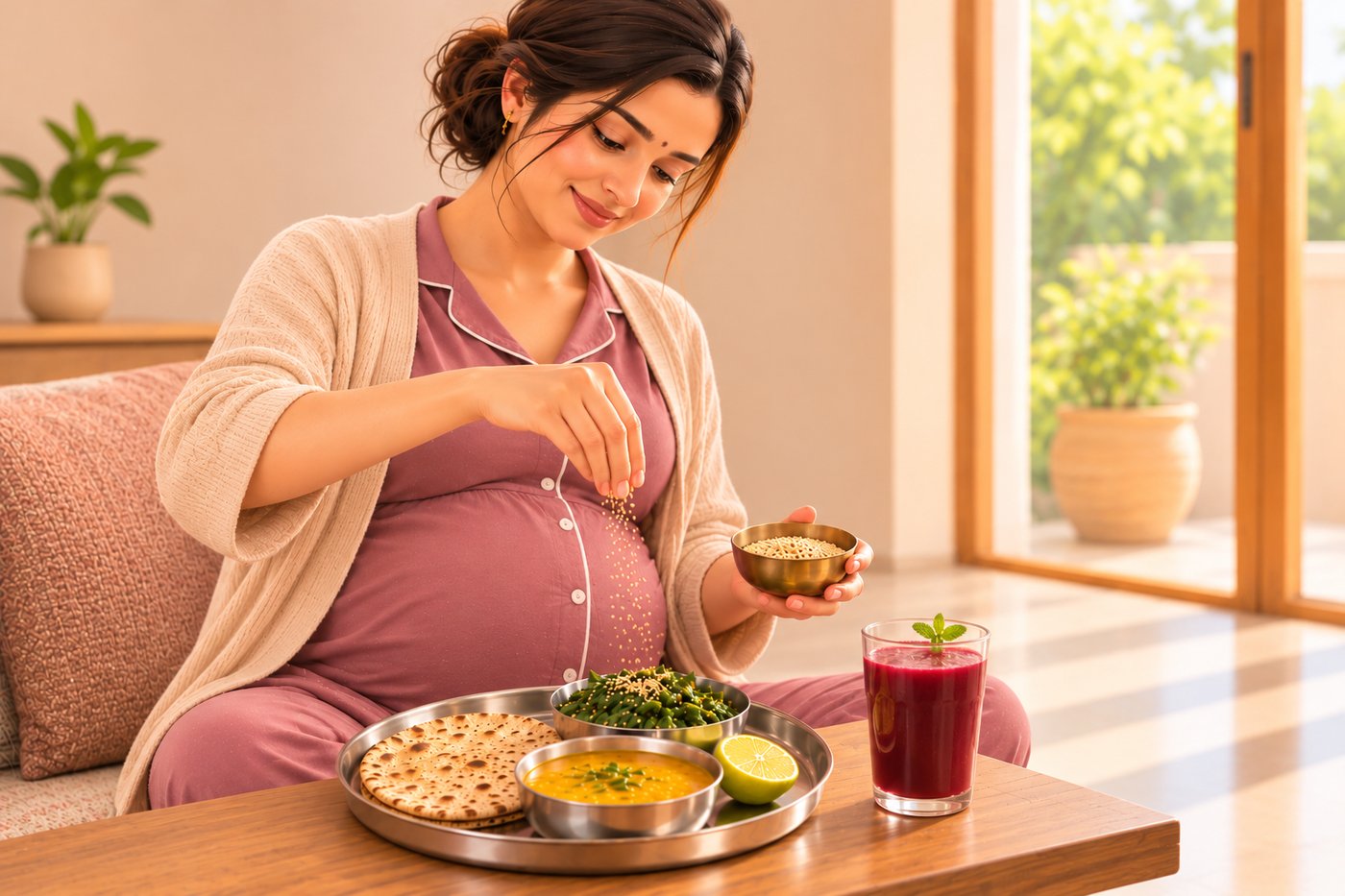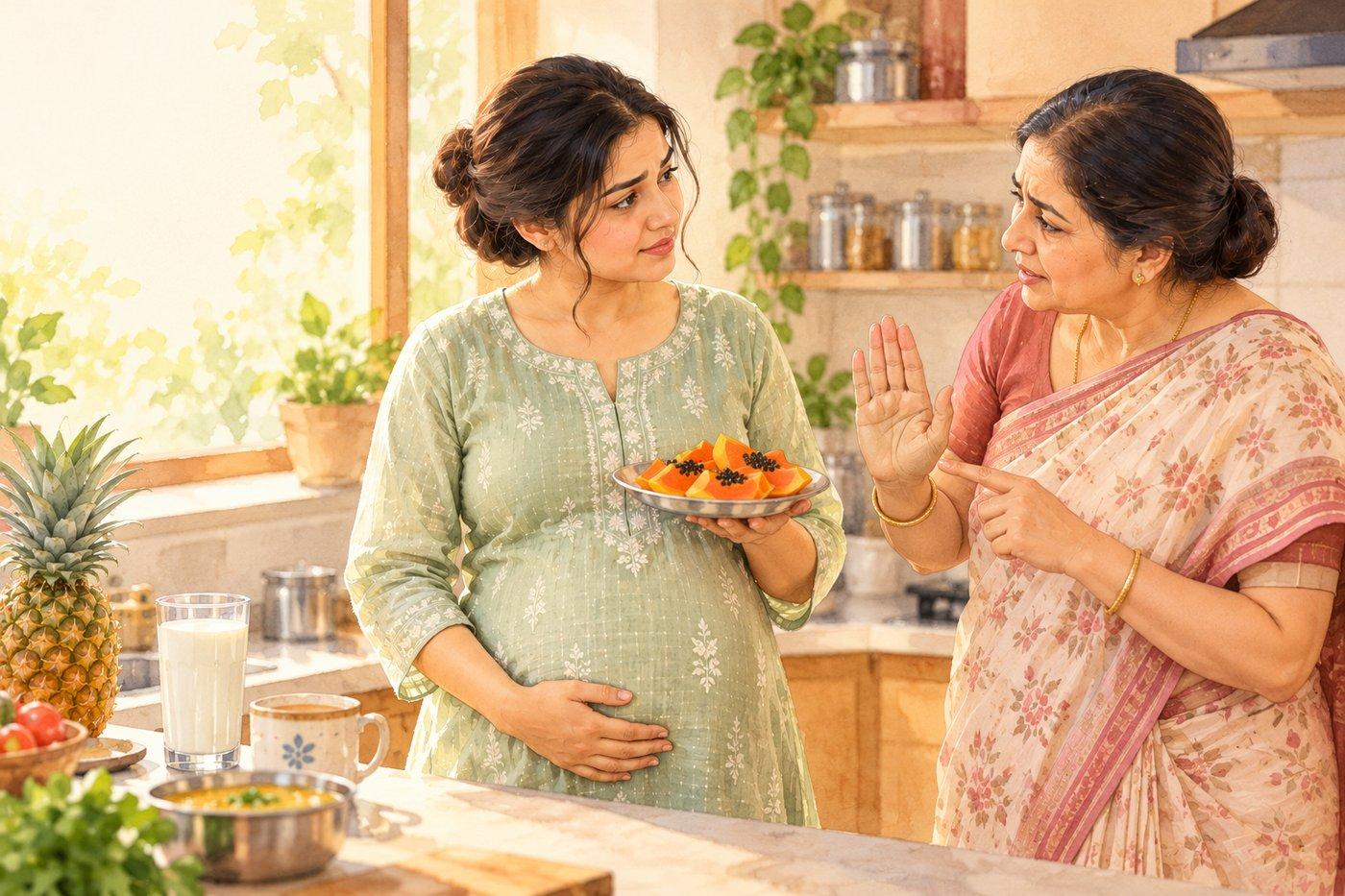
News of a pregnancy travels fast in an Indian home, and so does the food advice. One aunt warns about papaya, another about pineapple, and someone always has a story about til laddoos. Soon the list of foods to avoid during pregnancy feels longer than the list of foods allowed.
Key takeaways
- Food risks in pregnancy come from contamination, certain substances such as alcohol and mercury, and amounts that are too large.
- Milk, sprouts, eggs and meat are about preparation. Cooking and handling them well lowers the risk.
- All caffeine counts towards a daily ceiling of 200 milligrams, including chai, coffee and colas.
- Unripe papaya concerns come mainly from animal research. Ripe papaya is generally considered fine.
- Eating a listed food once does not mean harm has happened, but certain symptoms need a doctor.
The quick answer
Not every food warning carries the same level of risk or scientific evidence. Alcohol, liver and certain high-mercury fish are best avoided. Milk, eggs, meat, sprouts and street food need safe preparation, and caffeine needs a daily limit.
A simple way to sort every food
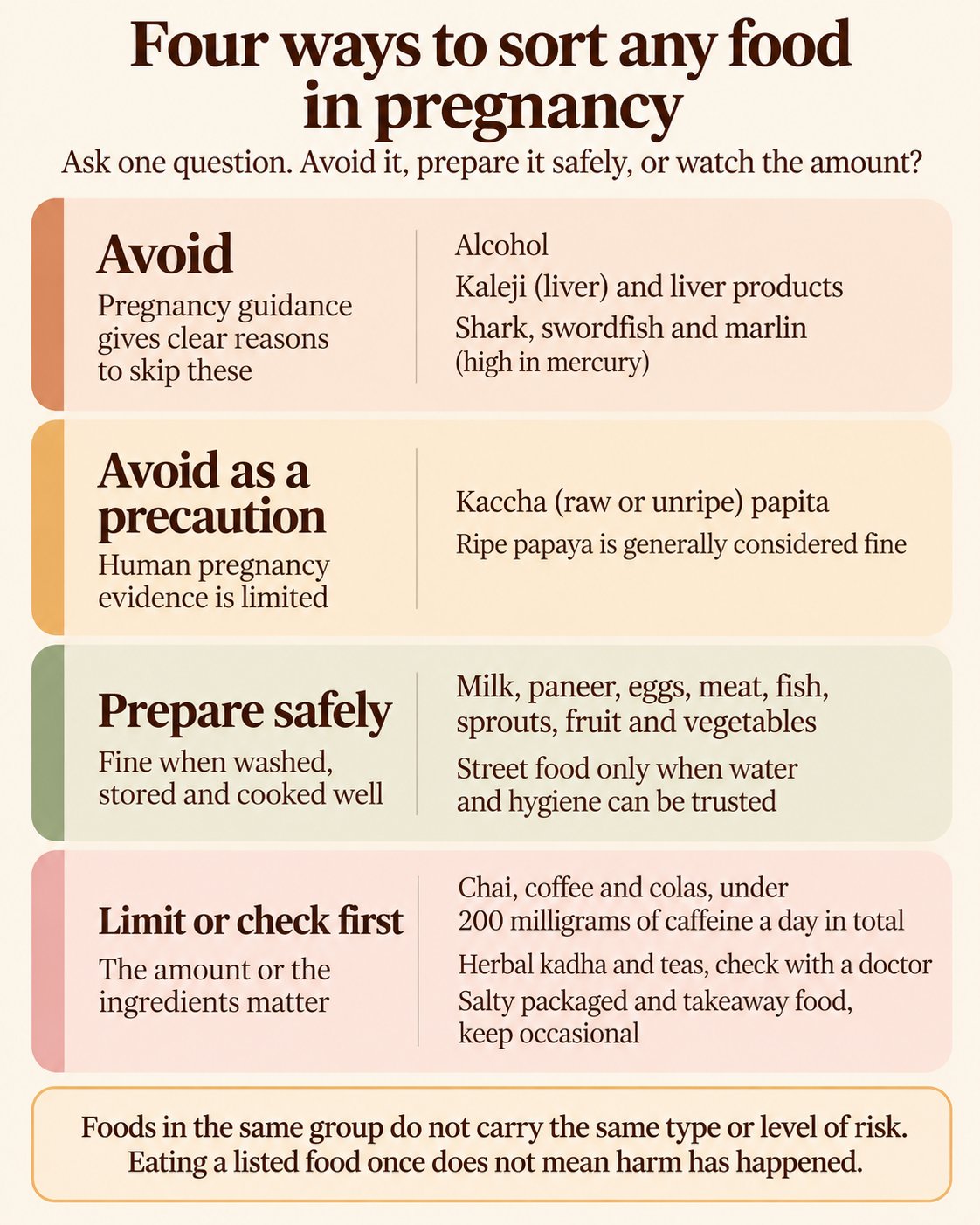
Instead of memorising a hundred rules, a mother-to-be can ask one question. Is this food best avoided, does it need safe preparation, or does the amount matter?
| Group | What it means | Everyday examples |
|---|---|---|
| Avoid | Pregnancy guidance gives established reasons to skip these | Alcohol, kaleji (liver) and liver products, large high-mercury fish such as shark, swordfish and marlin |
| Avoid as a precaution | Commonly skipped because human pregnancy evidence is limited | Kaccha (raw or unripe) papita |
| Prepare safely | Can be eaten when washed, stored and cooked well | Milk, paneer, eggs, meat, fish, sprouts, fruit and vegetables; street food only when water quality, hygiene and handling can be trusted |
| Limit or check first | Quantity, ingredients or limited evidence matter | Chai, coffee, colas, herbal kadha and teas, salty packaged and takeaway food |
Items in the same group do not carry the same type or level of risk. Alcohol can harm the baby’s development, mercury can affect the developing nervous system, and liver is very high in vitamin A.
Which foods need careful washing, storage or cooking?
Food infections can hit harder during pregnancy, and India’s national dietary guidelines advise extra care with food safety at this time. Listeria, found in unpasteurised dairy and some other foods, has been linked to miscarriage and stillbirth.
These kitchen habits lower the risk:
- Milk: Check the label for pasteurised or UHT (ultra-high temperature) milk. If the processing is unclear, as with loose milk, boil it, then refrigerate what is left.
- Paneer: Choose a trusted source or make it at home from pasteurised or boiled milk. Keep it refrigerated and eat it fresh.
- Eggs: Cook until the yolk is firm. Skip homemade mayonnaise and raw egg in shakes.
- Meat and fish: Cook until steaming hot all the way through. Avoid raw shellfish and raw-fish sushi. Choose thoroughly cooked seafood and follow pregnancy food-safety guidance.
- Sprouts: Avoid them raw or lightly cooked. Cook them thoroughly, as in a hot dal or sabzi.
- Fruit and vegetables: Washing removes soil and some surface germs, though it cannot make every food safe.
Boiling or cooking is only one step. Clean hands and utensils, and prompt refrigeration of leftovers, matter just as much.
Street food deserves its own caution
Pani puri, chaat, cut fruit from a cart and juice with ice can be risky when the water or handling is unsafe. The World Health Organization notes that hepatitis E spreads mainly through contaminated water and can be far more serious later in pregnancy.
The main concern is how the food is prepared, handled and stored. Preparing golgappe at home with safe water, clean utensils and freshly handled ingredients can reduce contamination risks.
Which foods need a limit, not a ban?
Some foods and drinks need a limit, while others require extra caution because their safety during pregnancy is not well established.
- Caffeine: Stay under 200 milligrams a day, counting caffeine from every source, including chai, coffee, colas and chocolate. A cup of tea has about 75 milligrams, though cup size, strength and brewing time can change this. Energy drinks can be high in caffeine and are best skipped during pregnancy.
- Chai and meals: Tea reduces iron absorption, so it is best kept away from mealtimes.
- Herbal kadha and teas: Safety evidence is limited and preparations vary a lot. Teas with mulethi (liquorice root) are best avoided, and specific herbs are worth checking with a doctor.
- Ajinomoto (monosodium glutamate): It is considered safe as a food additive. Separately, the instant noodles, chips and takeaways it often comes in tend to be high in salt, so they are best kept occasional.
- Fish: Fish is a valuable source of protein and omega-3 fats. Large predatory fish such as shark, swordfish and marlin are high in mercury. Many smaller fish tend to be lower, but mercury levels vary by species and source, and fish sold under one name can be different species. A dietitian can advise on choices sold locally.
Papaya, pineapple and kesar: fact or folklore?
Papaya is the most feared fruit in Indian homes. In animal research, latex from unripe papaya triggered uterine contractions, while ripe papaya contained very little latex.
That evidence does not prove that a normal serving causes miscarriage in humans. Raw or unripe papaya is commonly avoided as a precaution because human pregnancy evidence is limited. Ripe papaya is generally considered acceptable in normal food portions.
ParentVeda explains this further in Can I eat papaya during pregnancy?
Pineapple worries come from bromelain, an enzyme it contains. Research on pineapple in pregnancy is limited, so ordinary servings as part of meals are a sensible approach, and any concern is worth raising with a doctor. A pinch of kesar in milk is a common tradition, but it cannot make a baby fairer, because skin colour comes from genes.
What if she already ate something on the list?
Many discover a pregnancy only after a plate of pani puri, a bowl of raw papaya or a drink at a wedding. Then comes the quiet worry that something has already gone wrong.
Eating something once does not mean harm has occurred. The next step depends on what was eaten and how she feels. If she feels well, mentioning it at the next check-up is a reasonable step. The symptoms below need a call sooner.
When to see a doctor
After a suspected food exposure, she should contact her doctor promptly for:
- Fever, chills or flu-like body ache
- Vomiting or diarrhoea that stops her from keeping fluids down, which needs urgent care
- Yellowing of the eyes or skin, or dark urine
Separately, reduced baby movements in later pregnancy need immediate contact with the hospital or maternity team, without waiting.
If she has gestational diabetes, anaemia or a food allergy, a food plan made with her own doctor or dietitian works best.
Looking ahead
As nausea settles in the second trimester, the question slowly changes from “what should she avoid?” to “what should she add?” Iron, calcium, protein and folate start to matter more than any banned list.
A varied Indian thali can provide many of these nutrients, though every pregnancy’s needs differ. ParentVeda’s guide to why pregnancy nutrition isn’t about double portions is a calm next step.
References
- Indian Council of Medical Research, National Institute of Nutrition (ICMR-NIN). Dietary Guidelines for Indians, 2024. Guideline 2: Pregnant and lactating women (food safety, tea and iron).
- National Health Service (NHS). Foods to avoid in pregnancy.
- World Health Organization. Hepatitis E: Fact sheet (updated 28 July 2026).
- U.S. Food and Drug Administration. Advice about Eating Fish (updated 5 March 2024).
- U.S. Food and Drug Administration. Selecting and Serving Produce Safely.
- U.S. Food and Drug Administration. Questions and Answers on Monosodium Glutamate (MSG) (updated 17 July 2026).
- American College of Obstetricians and Gynecologists. Committee Opinion No. 462: Moderate caffeine consumption during pregnancy. Obstetrics and Gynecology. 2010;116(2 Pt 1):467-468.
- Adebiyi A, Adaikan PG, Prasad RNV. Papaya (Carica papaya) consumption is unsafe in pregnancy: fact or fable? Scientific evaluation of a common belief in some parts of Asia using a rat model. British Journal of Nutrition. 2002;88(2):199-203.
Common questions
Is it safe to eat pani puri during pregnancy?
The main concern with pani puri during pregnancy is whether the water and ingredients are safe and the food is handled hygienically. Water of uncertain quality can carry infections, including hepatitis E. Preparing pani puri at home with safe water, clean utensils and fresh ingredients can reduce contamination risks.
Pregnancy me kya nahi khana chahiye?
Alcohol, kaleji and large high-mercury fish like shark are best skipped. Doodh, sprouts, eggs and meat should be eaten only when properly boiled or cooked. Chai and coffee are fine within a total caffeine limit of 200 milligrams a day, and ripe papaya is generally considered fine.
Is paneer safe during pregnancy?
Paneer from a trusted source, made with pasteurised or boiled milk, kept in the fridge and eaten fresh, is generally considered safe. It is also a good source of protein and calcium. Paneer of unknown origin, or paneer left out for long, is better avoided.
This article is for general education and is not a substitute for personal medical advice. Every pregnancy is different. For guidance on diet, symptoms or any food-related illness, please speak with a qualified doctor or registered dietitian.
 Medically reviewed byDr. Mahender Singh, MBBS, DCH, MD (Paediatrics)A consultant child specialist and neonatologist with over four decades of practice in newborn and child health.
 Written bySarthak ThakurCo-founder, CTO and Chief Marketing Officer of ParentVeda, and the software engineer who builds its app and the pipeline that checks its articles.
This article explains; it doesn’t diagnose. If your doctor has told you something different, your doctor is right.