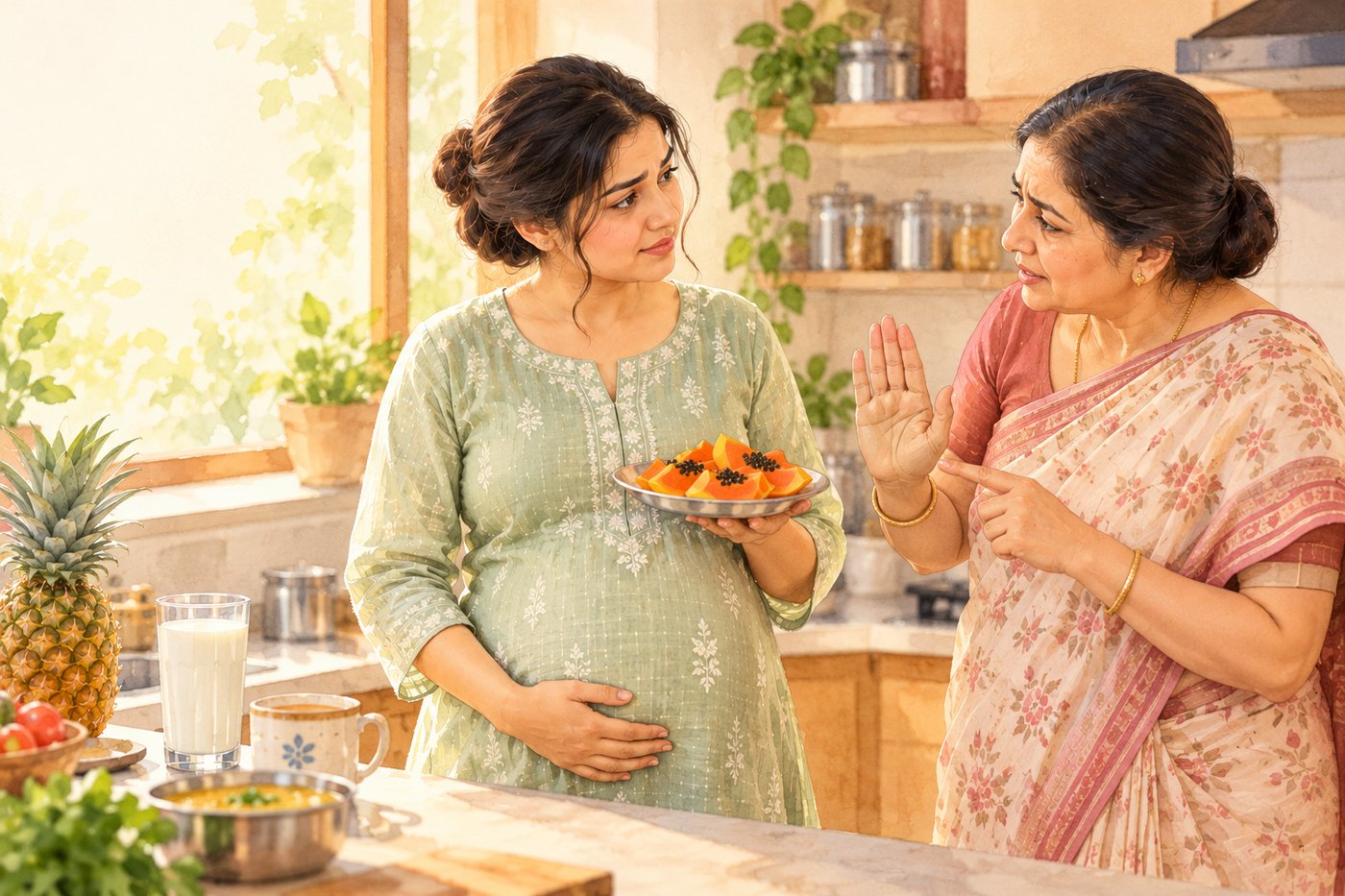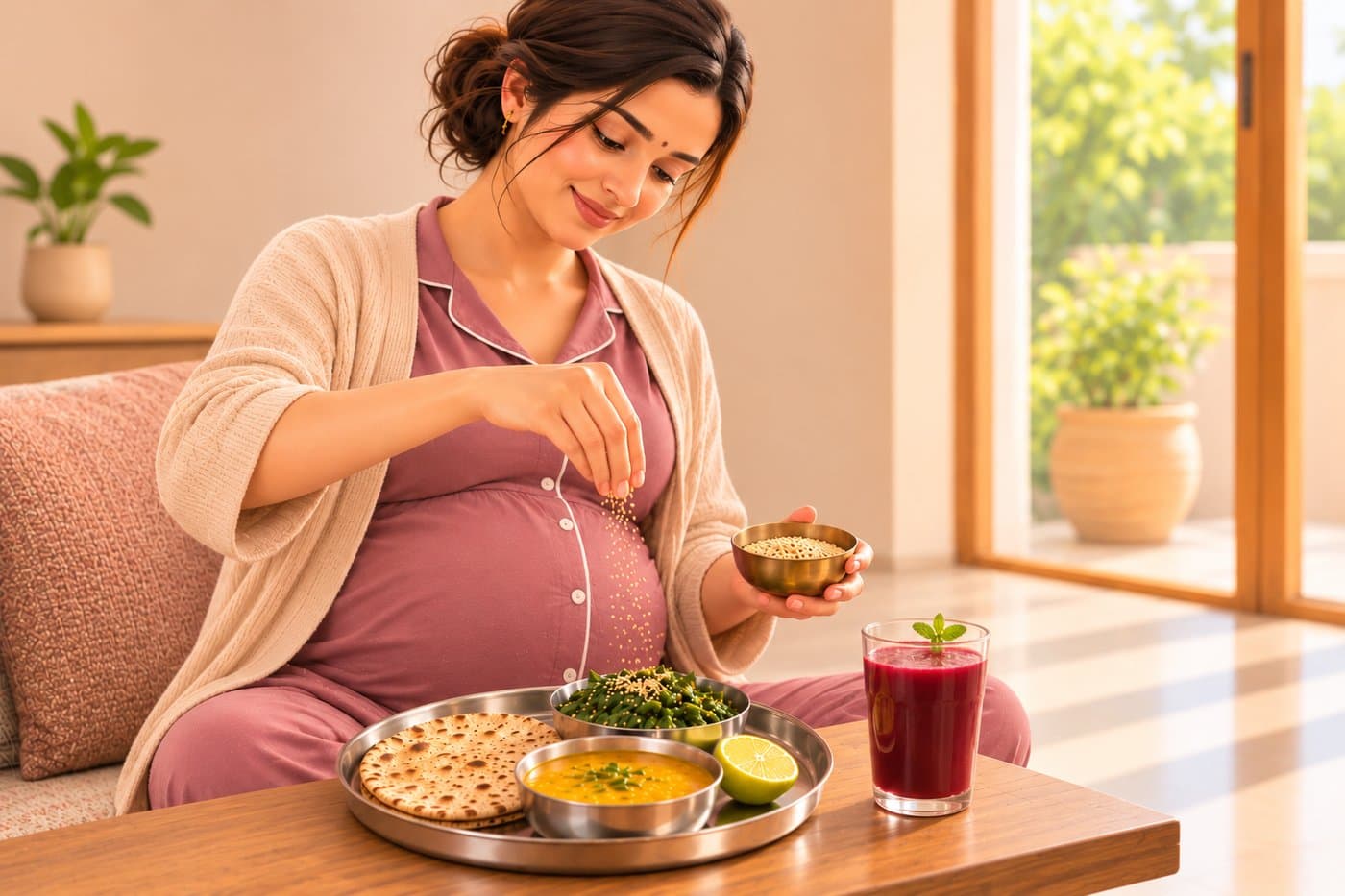
Somewhere between the first scan and the first blood report, almost every pregnant woman hears the word “iron.” A relative suggests gud, a neighbour swears by palak, and the doctor checks haemoglobin (Hb) at every visit. It is natural to wonder which of these actually helps.
Key takeaways
- Pregnancy needs far more iron because her body is building extra blood.
- Til, soybean, kulthi, masoor, bajra and chaulai give more iron per serving than palak, gud or khajur.
- Lemon, amla and guava help absorb plant iron; tea and coffee around meals reduce it.
- Even with a good diet, daily iron and folic acid (IFA) tablets are advised in pregnancy.
The quick answer
The best iron-rich foods during pregnancy in an Indian kitchen are til (sesame seeds), whole dals like masoor and kulthi, soybean, bajra, ragi, poha, and greens like chaulai and sahjan. Fish, chicken and meat also contain haem iron, a form the body absorbs more easily. The pairing matters as much as the food: lemon helps, and chai with the meal works against it.
Why pregnancy asks for so much iron
Red blood cells use iron to carry oxygen. In pregnancy her blood volume expands to supply the baby and placenta, and more blood means more iron.
The US National Institutes of Health (NIH) recommends 27 milligrams (mg) of iron a day in pregnancy. That daily figure stays the same, but the body’s actual demand for iron grows as the baby and placenta grow.
This matters in India, where 52.2% of pregnant women were anaemic in the National Family Health Survey 5 (NFHS-5, 2019 to 2021).
Iron-rich foods during pregnancy: the Indian mg chart
The chart below uses values from the Indian Food Composition Tables 2017 (IFCT 2017), published by the Indian Council of Medical Research, National Institute of Nutrition (ICMR-NIN). It shows three different things, which are not interchangeable:
- Iron per 100 g: the food as IFCT measures it, before cooking
- Serving: how much of that ingredient goes into one everyday portion
- Iron in that serving: the iron in those ingredients, not the amount the body absorbs
For dals, the chart counts the dry dal that goes into about one cooked katori. A cooked katori weighs more or less depending on how much water is added.
| Food (form measured) | Iron per 100 g | Serving (ingredient amount) | Iron in that serving (approx.) |
|---|---|---|---|
| Sesame seeds, til (dry) | 13.9 mg | 10 g (1 tablespoon) | 1.4 mg |
| Horse gram, kulthi (dry) | 8.76 mg | 30 g dry (about 1 cooked katori) | 2.6 mg |
| Soybean (dry) | 8.29 mg | 30 g dry (about 1 cooked katori) | 2.5 mg |
| Whole masoor (dry) | 7.57 mg | 30 g dry (about 1 cooked katori) | 2.3 mg |
| Pearl millet, bajra (flour) | 6.42 mg | 30 g flour (1 roti) | 1.9 mg |
| Rajma (dry) | 6.13 mg | 30 g dry (about 1 cooked katori) | 1.8 mg |
| Bengal gram, chana dal (dry) | 6.08 mg | 30 g dry (about 1 cooked katori) | 1.8 mg |
| Amaranth leaves, chaulai (raw) | 4.64 mg | 100 g raw (1 bowl) | 4.6 mg |
| Finger millet, ragi (flour) | 4.62 mg | 30 g flour (1 roti or dosa) | 1.4 mg |
| Drumstick leaves, sahjan (raw) | 4.56 mg | 50 g raw (½ bowl) | 2.3 mg |
| Rice flakes, poha (dry) | 4.46 mg | 50 g dry (1 plate) | 2.2 mg |
| Spinach, palak (raw) | 2.95 mg | 100 g raw (1 bowl) | 3.0 mg |
| Jaggery, gud | 4.63 mg | 10 g (1 small piece) | 0.5 mg |
| Dates, khajur | 3.2 mg | 25 g (3 dates) | 0.8 mg |
| Egg (whole) | 1.82 mg | 50 g (1 egg) | 0.9 mg |
| Mutton (raw) | 1.48 mg | 100 g raw | 1.5 mg, includes haem iron |
Serving values are rounded and worked out from IFCT 2017 figures. Actual iron varies with variety, soil and cooking.
Two katoris of dal, a millet roti, a bowl of greens and a spoon of til put roughly 10 to 12 mg of iron on the plate. Her body absorbs only part of this.
How can she absorb more iron from every meal?
Iron comes in two forms. Plants and eggs contain non-haem iron, which the body absorbs less easily. Meat, chicken and fish contain haem iron, which is absorbed more easily, along with some non-haem iron.
So the iron listed for a food is not the same as the iron her body takes in.
Palak is a good example. Natural plant compounds reduce how much of its iron is absorbed, so it works best as one of several greens.
| Helps absorption | Reduces absorption |
|---|---|
| Lemon, amla, guava, orange or tomato with the meal | Tea or coffee with or soon after meals |
| Fermented foods like idli, dosa and dhokla | Taking IFA tablets with chai |
| Sprouted moong, chana and matki | Calcium and iron tablets at the same time (her doctor can advise the spacing) |
| A little fish, chicken or meat alongside dal or greens | A large glass of milk with the iron-rich meal (may reduce it) |
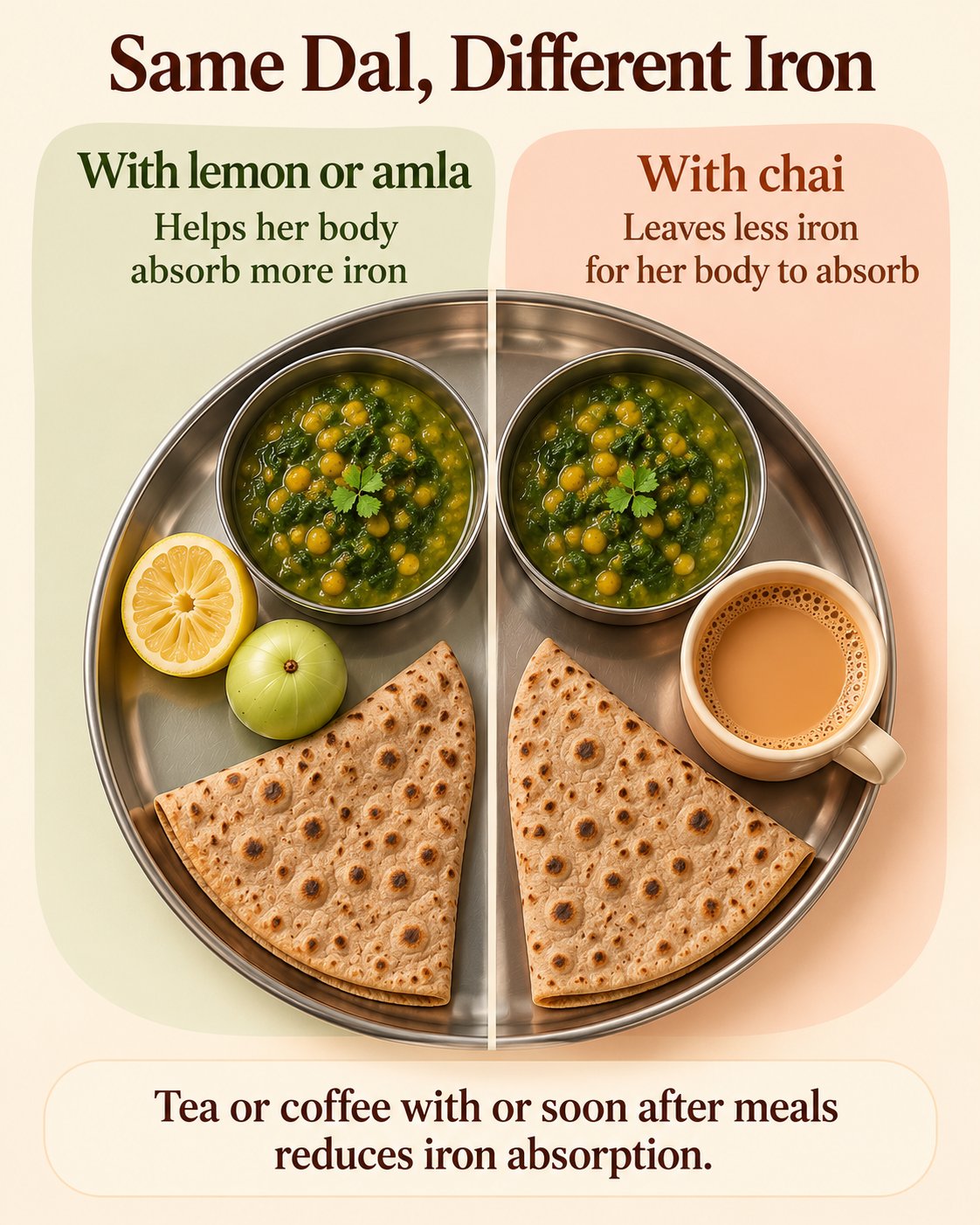
Simple pairings that fit Indian meals:
- Palak dal with a squeeze of lemon
- Ragi dosa with tomato chutney
- Poha with lemon and peanuts
- Chana or sprouts chaat with amla or tomato
Are khajur, gud and halim worth it?
- Khajur (dates): Three dates give under 1 mg of iron. A good snack, not an iron plan.
- Gud (jaggery): A small piece adds about 0.5 mg, with a lot of sugar.
- Halim (garden cress seeds): Often described as iron-rich and used in very small amounts. There is little research on its regular use in pregnancy, so it is best discussed with the doctor.
The quiet winner is til. A til ladoo or roasted til on sabzi adds real iron with little effort.
Food and IFA tablets work as a team
The ICMR-NIN Dietary Guidelines for Indians 2024 say a balanced diet can meet most nutrient needs, but still advise pregnant women to take daily IFA tablets. Under the government’s Anemia Mukt Bharat programme, pregnant women are given IFA tablets after the first trimester as part of antenatal care.
Tea and the tablet do not mix well. The same guidelines advise avoiding tea while taking IFA tablets, because tea binds iron and leaves less for the body to absorb. Taking the tablet with water, at the time her doctor suggests, keeps chai from undoing its work.
If the tablets cause constipation or nausea, her doctor can suggest ways to manage it, so it is worth asking rather than stopping.
When to see a doctor
She should speak to her doctor if she notices:
- Tiredness that does not ease with rest
- Breathlessness on light activity, or a racing heartbeat
- Pale skin, nails or inner eyelids, or dizziness
- Side effects from IFA tablets that make them hard to keep taking
Fainting, chest pain or severe breathlessness need urgent care.
Looking ahead
Her Hb will usually be checked again at later visits. Two or three of the chart’s foods in everyday meals, with lemon on the side, make those months easier.
After delivery, the same foods help her rebuild the iron lost during birth.
References
- Longvah T, Ananthan R, Bhaskarachary K, Venkaiah K. Indian Food Composition Tables 2017. ICMR-National Institute of Nutrition, Hyderabad.
- ICMR-National Institute of Nutrition. Dietary Guidelines for Indians, 2024.
- National Institutes of Health, Office of Dietary Supplements. Iron: Fact Sheet for Health Professionals.
- Ministry of Health and Family Welfare. Lok Sabha Unstarred Question No. 3031 (Anaemia), answered 9 August 2024.
- Reserve Bank of India. Handbook of Statistics on Indian States, Table 22: State-wise Pregnant Women Aged 15-49 Years who are Anaemic (source: NFHS Fact Sheets).
- National Health Service (UK). Vitamin A.
Common questions
Can a vegetarian diet give enough iron in pregnancy?
A vegetarian diet can cover a good share, though plant iron is absorbed less well. Daily dals, millets, greens and til, with a vitamin C food at each meal, help most. IFA tablets are still usually needed.
Is it safe to eat liver for iron during pregnancy?
Liver is rich in iron, but it is also very high in vitamin A. For this reason, the UK National Health Service (NHS) advises avoiding liver and liver products, such as liver pâté, during pregnancy. Fish and chicken are safer everyday sources of haem iron, and eggs add some non-haem iron.
Are pomegranate and beetroot good for iron?
Both are popular in Indian homes for “building blood.” They are healthy, but they hold much less iron than dals, millets, til or chaulai. Enjoy them as part of the plate rather than relying on them.
This article is for general education and is not a substitute for personal medical advice. Iron needs, Hb targets and tablet doses differ from woman to woman, so please follow the guidance of a doctor or dietitian. Specialist review of this article by a dietitian and an obstetrician-gynaecologist is in progress.
 Medically reviewed byDr. Mahender Singh, MBBS, DCH, MD (Paediatrics)A consultant child specialist and neonatologist with over four decades of practice in newborn and child health.
 Written bySarthak ThakurCo-founder, CTO and Chief Marketing Officer of ParentVeda, and the software engineer who builds its app and the pipeline that checks its articles.
This article explains; it doesn’t diagnose. If your doctor has told you something different, your doctor is right.