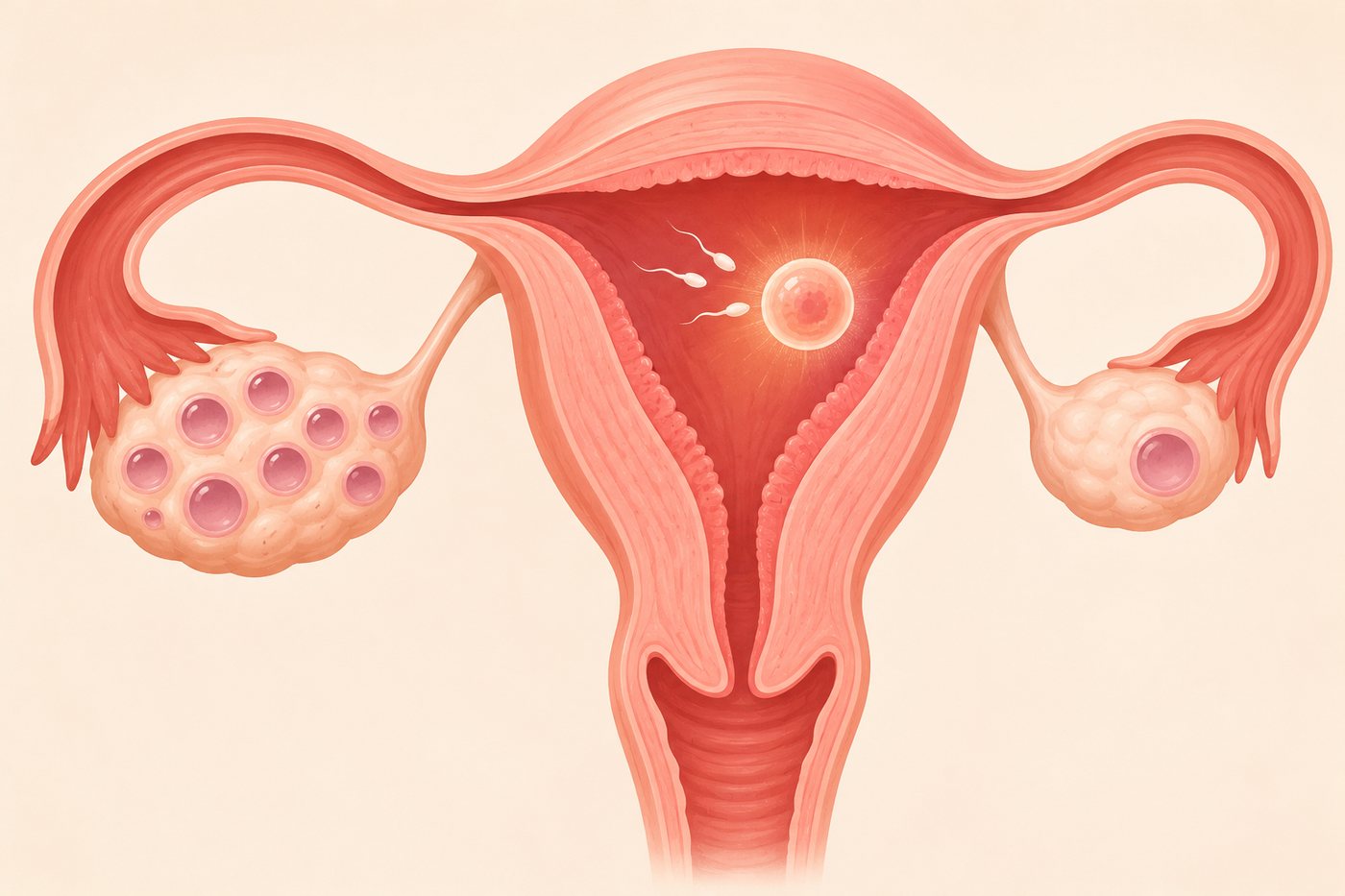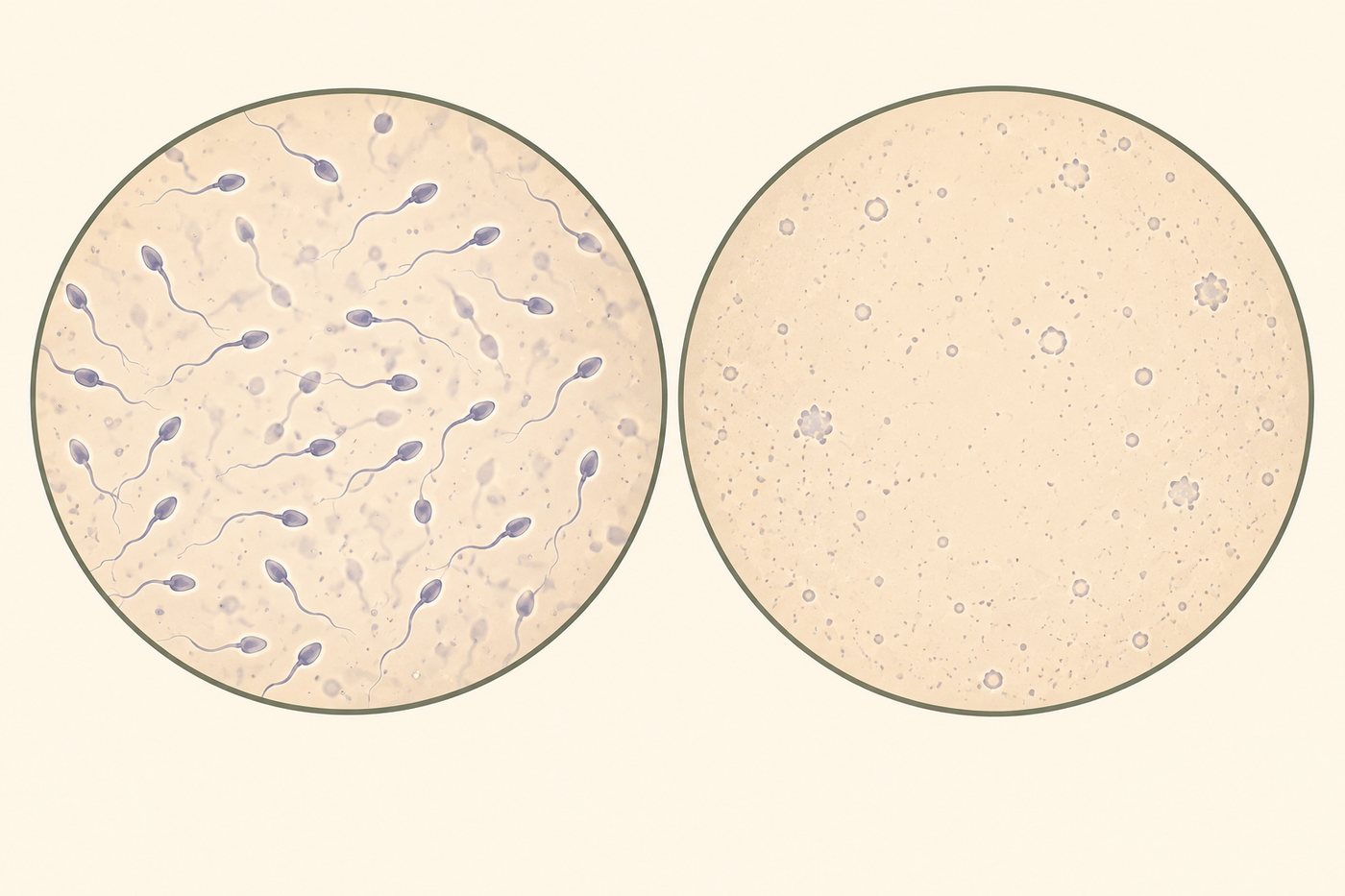
Reading the words in vitro fertilisation for the first time can feel like being handed a map in a language you do not speak. Some of you are only exploring whether IVF might be an option. Others already have a start date, a bag of injections, and a great many questions.
Much of the worry comes from not knowing the shape of the journey. IVF can sound like one enormous, uncertain leap. It becomes far easier to sit with once you see it as a sequence of ordinary, well practised steps.
Key takeaways
- An IVF cycle moves through several stages, from preparation and ovarian stimulation to egg collection, embryo development, transfer and a pregnancy test, usually over about four to six weeks.
- Different medicines do different jobs across the cycle, from growing eggs to supporting the uterine lining, and your clinic will explain each one as you go.
- Egg collection takes little time and is done while you are sedated, while the embryo transfer that follows is quick and usually needs no anaesthesia.
- Sometimes all embryos are frozen and used in a future cycle, which spreads the timeline beyond one month.
- Success depends heavily on age and the underlying cause, so two people can follow the same steps yet have very different odds.
The quick answer
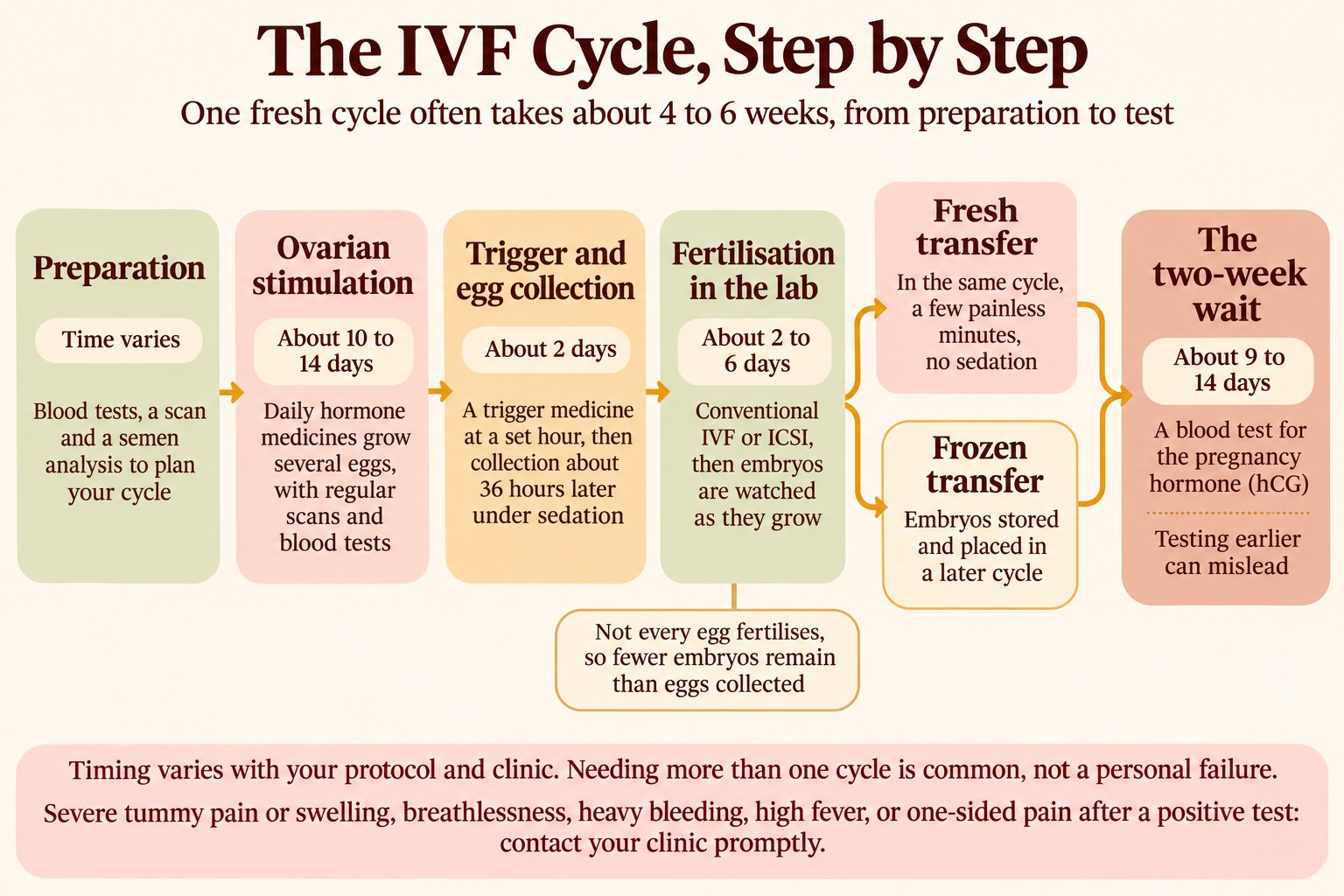
IVF, short for in vitro fertilisation, usually follows a series of planned stages that run over about four to six weeks for one cycle. Medicines help your ovaries grow several eggs, which are collected and fertilised with sperm in a laboratory, and a resulting embryo is then placed in your uterus, and roughly two weeks on, a blood test checks for pregnancy. The exact timing varies with your protocol, your clinic, the embryo stage, and whether the embryo is transferred fresh or frozen.
Before the cycle begins: tests and preparation
A cycle rarely starts at the first appointment. Your fertility team usually runs baseline blood tests, an ultrasound scan, and a semen analysis for your partner to plan the safest approach. This is also when you confirm whether IVF is the right step, or whether a simpler option such as intrauterine insemination (IUI) fits better.
The stages at a glance
| Stage | Roughly how long | What happens |
|---|---|---|
| Preparation | Varies | Baseline tests, scans, and planning before the cycle |
| Ovarian stimulation | About 10 to 14 days | Daily hormone medicines grow several eggs, with frequent scans and blood tests |
| Trigger and egg collection | About 2 days | A trigger medicine matures the eggs; collection follows around 36 hours later under sedation |
| Fertilisation and embryo development | About 2 to 6 days | Eggs are fertilised in the lab; embryos are grown and monitored |
| Embryo transfer | About 1 day, or a later cycle if frozen | A thin catheter places the selected embryo in your uterus |
| The two-week wait | About 9 to 14 days | A blood test is scheduled once pregnancy hormone levels can be detected |
The medicines and their different jobs
IVF is not a single injection but a set of medicines, each with a specific role. Based on your protocol, your clinic may use medicines to stimulate your ovaries, to prevent premature ovulation, to trigger the final maturation of the eggs, and to support the uterine lining after transfer. Your team will show you how and when to take each one.
Stage one: stimulating your ovaries
In a natural month your body matures a single egg. In IVF, daily hormone medicines, usually given by injection, encourage your ovaries to grow several eggs at once, over a phase that lasts around ten to fourteen days. You will visit the clinic often for ultrasound scans and blood tests so your team can adjust the dose.
These checks also watch for a rare but important over-response called ovarian hyperstimulation syndrome, or OHSS. OHSS happens when the ovaries respond too strongly to stimulation, causing fluid shifts that can lead to swelling and other symptoms. Frequent monitoring helps your team adjust treatment and make complications less likely.
Stage two: the trigger shot and egg collection
Once your eggs look ready, a final trigger injection promotes their final maturation and prepares them for collection, and it is given at a precise hour because timing matters. Egg collection usually follows about thirty-six hours later. The procedure is brief and done under sedation: an ultrasound image steers a slim needle that draws the eggs from your ovaries, and most people go home the same day.
What happens to your eggs in the laboratory?
Based on your clinical situation, treatment history and laboratory protocol, your eggs are fertilised using conventional IVF, where sperm are placed with the eggs, or ICSI (intracytoplasmic sperm injection), in which an embryologist places one sperm inside each egg using a very fine needle. ICSI is commonly used when sperm-related factors may affect fertilisation, but your clinic may recommend it for other reasons as well. Your team decides the method that suits your case.
The laboratory then checks which eggs fertilise and monitors the developing embryos before the team determines which are available and appropriate for transfer or freezing. Embryos may be transferred at an earlier stage or allowed to develop to the blastocyst stage, typically reached on the fifth or sixth day, depending on the plan. Not every egg fertilises and not every embryo develops well enough to use, which is why more eggs are usually collected than the embryos you finally have.
The embryo transfer
Transfer is often the step people fear most yet find easiest. A thin, soft catheter places the embryo or embryos selected for transfer through the cervix into your uterus, guided by ultrasound. It usually takes only a few painless minutes and needs no sedation.
With a fresh transfer, the embryo goes in during the same cycle as your egg collection. With a frozen transfer, embryos are stored first and used in a future cycle, which gives your body more time to recover or allows the uterine lining to be prepared separately. Your team will advise which approach suits your situation.
The two-week wait
After transfer comes the stretch often called the two-week wait. A blood test measures the pregnancy hormone, human chorionic gonadotropin or hCG. It is usually scheduled around nine to fourteen days later, once enough time has passed for hormone levels to become detectable. Testing before then can be misleading, because the trigger medicine may temporarily affect hCG-based tests.
How much time does a full cycle take?
The active treatment, from your first injection to collection and transfer, is often only about two to three weeks. Preparation beforehand and the wait afterwards usually bring one fresh cycle to around four to six weeks, while a freeze-all approach stretches this over more than a month. It also helps to know that many people need more than one attempt, which is common rather than a personal failure.
When to see a doctor
Contact your clinic promptly if any of the following happen.
During or after stimulation:
- severe abdominal pain or swelling
- putting on weight quickly over a day or two
- breathlessness
- reduced urination
After egg collection:
- heavy bleeding
- high fever
- fainting
After a positive pregnancy test:
- sharp, one-sided pain
- bleeding
The first group can occur with OHSS and should be discussed promptly with your clinic. One-sided pain or bleeding after a positive test should also be checked, because IVF makes ectopic pregnancy slightly more likely, though it remains uncommon.
Looking ahead
If your test is positive, your clinic may continue hormonal support and arrange early pregnancy monitoring before routine antenatal care takes over. If this cycle does not work, a negative result does not by itself tell you why, and your team will usually review what happened and adjust the plan. Either outcome informs the next step rather than closing the door.
References
- NHS. IVF.
- Mayo Clinic. In vitro fertilization (IVF).
- American College of Obstetricians and Gynecologists (ACOG). Treating Infertility.
- Indian Council of Medical Research (ICMR). The Assisted Reproductive Technology (Regulation) Act, 2021 and the Surrogacy (Regulation) Act, 2021.
Common questions
Is IVF painful?
Most steps cause discomfort rather than real pain. The daily injections use very fine needles and sting only briefly. Egg collection is done under sedation, so you should not feel it, though mild cramping afterwards is common, and embryo transfer usually needs no anaesthesia. Everyone differs, so tell your team if anything feels worse than you expected.
What happens if no eggs fertilise?
Occasionally, few or no eggs fertilise, or the embryos do not develop well enough to use. Your team can review what happened and decide whether anything about the next cycle should be changed, such as the medicines or the fertilisation method. It is a difficult outcome, and your specialist will talk through what a next step might look like.
How many cycles might I need?
There is no fixed answer, and needing more than one cycle is common rather than a sign of failure. Your age, ovarian reserve, sperm quality, embryo development, the underlying cause, and how you responded to previous treatment all shape the outlook. Your specialist can discuss what your results and treatment history suggest about the likely outlook.
This article is for education and general understanding. It is not medical advice, a diagnosis, or a treatment plan. IVF protocols vary between clinics and individuals, so please rely on your own fertility specialist for decisions about your care.
 Medically reviewed byDr. Mahender Singh, MBBS, DCH, MD (Paediatrics)A consultant child specialist and neonatologist with over four decades of practice in newborn and child health.
 Written bySarthak ThakurCo-founder, CTO and Chief Marketing Officer of ParentVeda, and the software engineer who builds its app and the pipeline that checks its articles.
This article explains; it doesn’t diagnose. If your doctor has told you something different, your doctor is right.