A diagnosis of polycystic ovary syndrome (PCOS) often arrives with one loud question sitting underneath it: will this stop you from having a baby? Whether you have just been told you have it, suspect it from irregular periods, or are reading for someone you love, that worry deserves a clear answer.
Key takeaways
- Most women with polycystic ovary syndrome (PCOS) go on to have a baby, with or without treatment.
- PCOS affects fertility mainly by making ovulation irregular or absent, not by making pregnancy impossible.
- Conceiving may take longer and feel less predictable than average.
- No tool can give you a personal probability. The honest figure is a range.
- If you carry extra weight, even a modest loss may improve ovulation for some, though it is not needed for everyone.
- Medicines that trigger ovulation help a large share of those who need them.
This is for understanding, not diagnosis. PCOS and fertility vary widely, so your own doctor is the right person to guide your plan.
The quick answer
Most women with PCOS go on to have a baby, with or without treatment. PCOS can make ovulation irregular, so conceiving may take longer or need some medical help, but it rarely closes the door.
What it does not come with is a personal percentage. No calculator can tell you your exact odds. This article explains why, what genuinely shapes your chances, and where the honest expectations lie.
How PCOS affects your chances
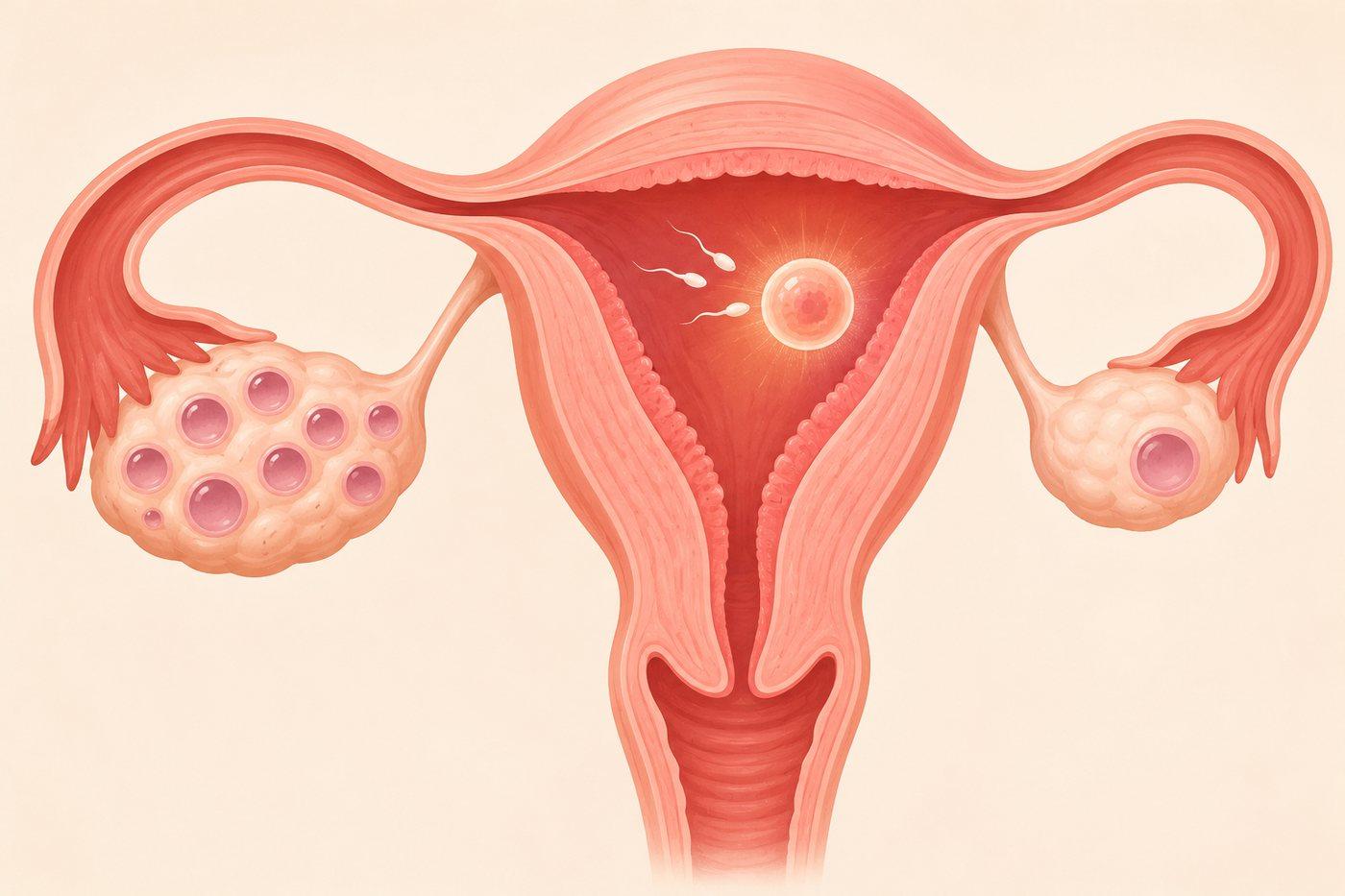
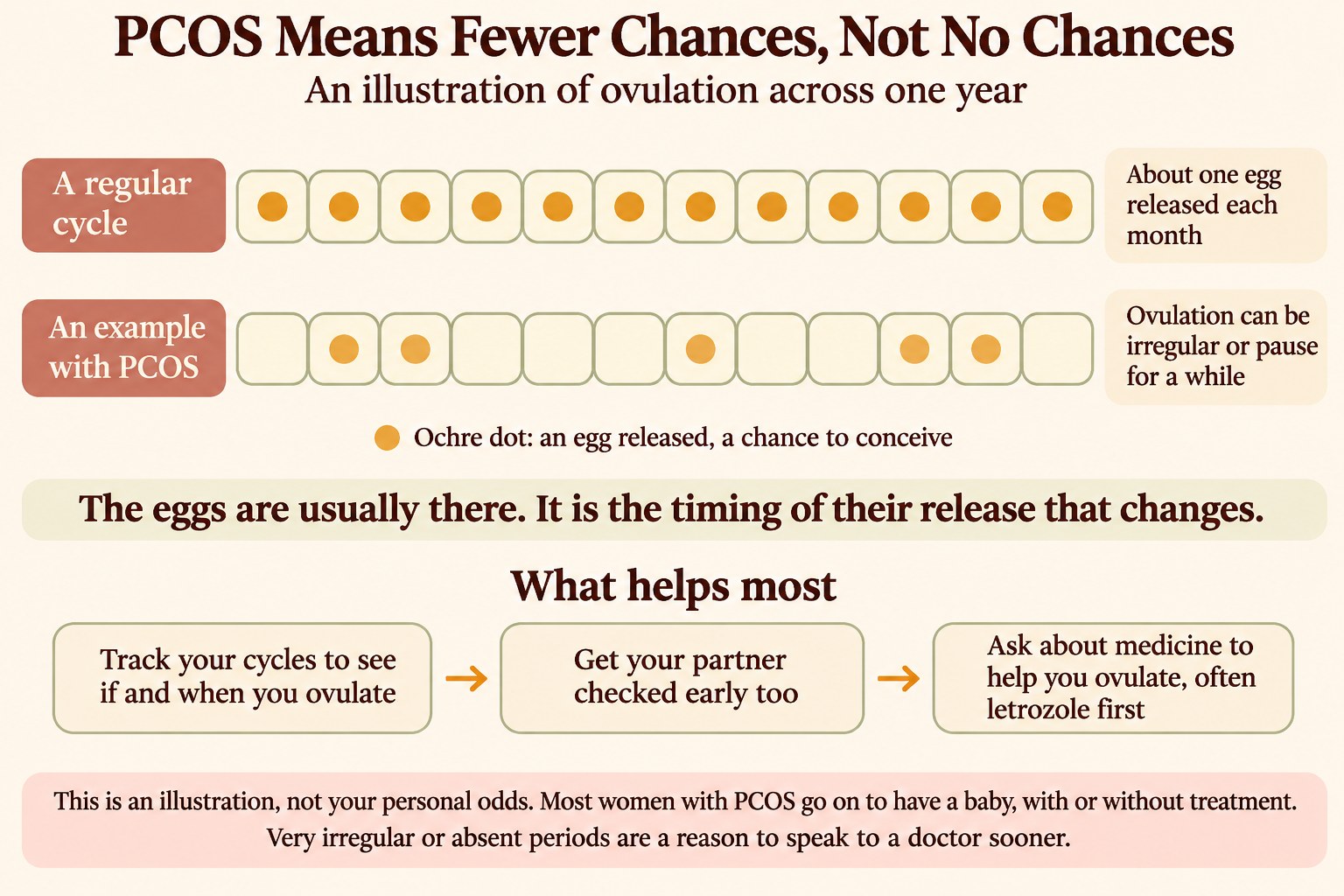
PCOS is a hormonal condition, and its main effect on fertility runs through ovulation. In a settled cycle, an ovary releases one egg roughly once a month.
With PCOS, that release can become irregular or pause for stretches at a time. Fewer eggs released across a year means fewer natural chances to conceive in that year.
This is why PCOS is the most common cause of anovulatory infertility, which means difficulty conceiving because ovulation is not happening. The eggs are usually present. It is the timing of their release that gets disrupted.
| PCOS often does | PCOS usually does not |
|---|---|
| Make periods irregular or infrequent | Make pregnancy impossible |
| Disrupt or delay ovulation | Damage the eggs themselves |
| Make timing hard to predict | Mean you will definitely need in vitro fertilisation |
To check the other signs of PCOS, including the ones that are easy to miss, read the PCOS symptoms checklist.
So can you actually get pregnant?
Yes. Most women with PCOS go on to conceive, whether on their own or with treatment that helps them ovulate.
Long-term studies that follow women for years find that the great majority have at least one child. PCOS is widely considered one of the more treatable causes of difficulty conceiving.
The realistic caveat is time. It may take longer than you hoped, and the route may include help you did not expect to need. Neither of those means it will not happen.
What shapes your realistic odds
Your chances are not a fixed figure. Several things move them, and some sit within your influence.
| What moves your odds | Why it matters |
|---|---|
| How regularly you ovulate | More regular ovulation gives more natural chances |
| Your age | Egg number and quality decline over time, with or without PCOS |
| Your weight | Higher weight can affect ovulation in some women |
| Your partner's fertility | Conception takes two, so sperm health counts just as much |
| Other conditions | A thyroid problem or blocked tubes changes the picture |
Why no one can give you a personal number
It is natural to want a single figure to hold on to. The honest position is that a population statistic cannot tell you your personal probability of conceiving.
Published figures are averages drawn from large groups of women. They describe populations. They cannot know the specific mix of your age, your cycles, your weight, and your partner.
A good doctor will talk to you in ranges and next steps rather than one probability. That is not the doctor being vague. That is the doctor being accurate.
What genuinely improves your chances
The evidence points to a fairly clear order of things worth doing.
- If appropriate, tracking your cycle or ovulation signs can help show whether and when ovulation is occurring, though home ovulation tests can be harder to read with PCOS.
- If you carry extra weight, even a modest loss may improve ovulation for some, but do not delay fertility care just to reach a particular number.
- Get your partner checked early, since male factors are common and easily overlooked. Read how to improve sperm count.
- If you are not ovulating regularly, ask about medication to help trigger ovulation. Letrozole is commonly recommended first for women with PCOS.
- Know when to move from trying to seeking help, rather than waiting indefinitely.
When to see a doctor
Book a visit sooner rather than later if any of these apply to you:
- Your periods are very irregular, far apart, or absent for months.
- You are under 35 and have been trying for 12 months without success.
- You are 35 or older and have been trying for 6 months.
- You already know you have PCOS and want to plan before trying.
Earlier advice is not panic. With PCOS, it often shortens the whole journey.
Looking ahead
If your periods are reasonably regular, noting your cycle patterns for a few months can give you and a doctor useful information to work with, rather than a rough memory.
If your periods are very irregular or absent for months, there is no need to wait several months before seeking advice. In that case, an earlier conversation is what moves you forward faster. It turns a vague, heavy worry into a specific plan with a clear answer.
References
- American Society for Reproductive Medicine. Recommendations from the 2023 International Evidence-based Guideline for the Assessment and Management of Polycystic Ovary Syndrome.
- Teede HJ, et al. Recommendations From the 2023 International Evidence-based Guideline. Journal of Clinical Endocrinology & Metabolism.
- Cleveland Clinic. Can You Get Pregnant With PCOS?
- Johns Hopkins Medicine. PCOS and Infertility.
- Association between body mass index, weight loss and the chance of pregnancy in women with PCOS and overweight or obesity. Human Reproduction.
- Melo AS, et al. A Review of First Line Infertility Treatments and Supporting Evidence in Women with PCOS.
Common questions
Does PCOS mean you are infertile?
No. PCOS is a common cause of difficulty conceiving, not a diagnosis of infertility. It usually affects how regularly you ovulate, and that is something treatment can often improve. Most women with PCOS go on to have a baby, whether naturally or with help.
Can PCOS affect pregnancy once you conceive?
It can slightly raise the chance of issues such as gestational diabetes or high blood pressure. Your antenatal team may therefore monitor some aspects of your pregnancy more closely.
How long does it take to get pregnant with PCOS?
There is no set timeline. Some women conceive within months, others take a year or longer, and many who use ovulation medication conceive within a few cycles. Your age, weight, and how regularly you ovulate are the biggest influences.
Can you get pregnant with PCOS without medication?
Yes, many women do, especially when they ovulate at least sometimes. Medication is offered when natural ovulation is not happening or when time is a factor, not as an automatic first step.
This article is for education and general understanding. It is not medical advice and is not a substitute for a consultation with a qualified doctor. PCOS and fertility vary widely from person to person, so please discuss your own situation with your healthcare provider.
 Medically reviewed byDr. Mahender Singh, MBBS, DCH, MD (Paediatrics)A consultant child specialist and neonatologist with over four decades of practice in newborn and child health.
 Written bySarthak ThakurCo-founder, CTO and Chief Marketing Officer of ParentVeda, and the software engineer who builds its app and the pipeline that checks its articles.
This article explains; it doesn’t diagnose. If your doctor has told you something different, your doctor is right.