
Most people expect their period to arrive on a predictable schedule, and it can be unsettling when it does not. Maybe it came early this month, vanished for weeks, or the gap keeps shifting. It is a common worry, and it does not always mean something is wrong.
There is no single pattern that defines an irregular period. Broadly, it means periods that come too close together or too far apart, timing that keeps changing, bleeding that is much longer or heavier than usual, or periods that stop altogether. For many adults a typical cycle is about 21 to 35 days, though what counts as normal also depends on your age and life stage.
Key takeaways
- For many adults, a typical cycle runs every 21 to 35 days, with bleeding for two to seven days.
- Irregular can mean periods too close together or too far apart, timing that keeps changing, or bleeding much longer or heavier than usual.
- Slight month-to-month variation is normal and rarely a problem.
- Irregular cycles are common after periods first begin, around menopause, after childbirth, and while breastfeeding.
- If a period is late and pregnancy is possible, take a pregnancy test first.
- See a doctor if periods stop for three months or more, come very often, or are very heavy.
This is for education and general understanding, not a diagnosis. Every body is different, so please speak with your doctor about your own cycle.
What a regular cycle actually looks like
Your period is the bleeding part of the menstrual cycle. The cycle itself runs from the first day of one period to the day before the next one starts. The bleeding usually lasts two to seven days, with the heaviest flow in the first few days.
There is no single correct number. One person may run a steady 26 day cycle and another a steady 33 day cycle, and both are regular. What matters more than the exact length is whether your own pattern stays roughly consistent.
So what counts as irregular?
Doctors look at your periods as a pattern over time, not a single month. A period is more likely to be called irregular when one or more of these keep happening.
| What is looked at | What tends to count as irregular |
|---|---|
| How often periods come | Coming closer than about every 21 days, or further apart than about every 35 days |
| How steady the timing is | The gap between periods keeps changing noticeably from one cycle to the next |
| How long bleeding lasts | Bleeding that regularly lasts longer than seven days |
| How heavy the flow is | Flow that is much heavier than usual for you |
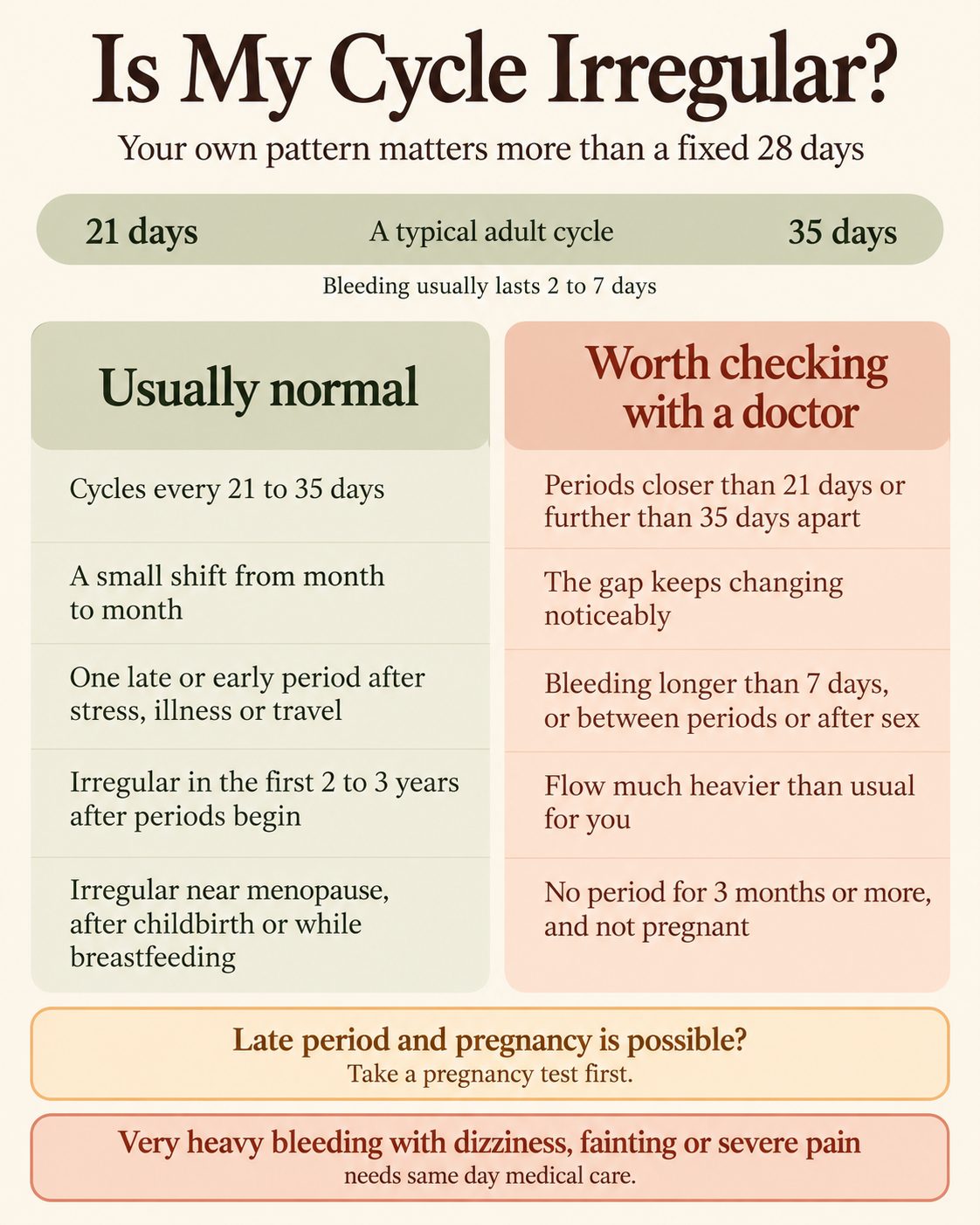
Periods stopping for around three months or more, when you are not pregnant, is a little different. This is sometimes called amenorrhea. It overlaps with irregular periods but is treated as its own issue, so it is always worth checking with a doctor.
Why your cycle might be off
Irregular periods often happen when the hormonal signals that control ovulation change. Sometimes the change is linked to stress, weight, exercise or contraception. Other times, it can be related to a condition such as polycystic ovary syndrome (PCOS) or a thyroid disorder.
If a period is late or absent and pregnancy is possible, take a pregnancy test rather than assuming the change is due to stress or another cause.
| Everyday factors that can affect your cycle | Medical conditions that can cause irregular periods |
|---|---|
| Ongoing or heavy stress | Polycystic ovary syndrome (PCOS) |
| Big changes in weight | Thyroid disorders (overactive or underactive) |
| Very intense exercise or low energy intake | Diabetes and some other hormone conditions |
| Some hormonal contraception | Other reproductive or hormonal conditions |
You may also come across the word oligomenorrhea. It describes periods that come very infrequently rather than being a cause in itself, and the exact clinical definition depends on the pattern and context.
Is it ever normal to be irregular?
Yes, and more often than people realise. Cycle patterns naturally differ at different life stages, so some irregularity is expected at certain times.
In the first two to three years after periods begin, cycles are commonly irregular while hormones settle. The same happens approaching menopause, when timing often becomes less predictable. After childbirth, and especially while breastfeeding, periods often pause or arrive unpredictably for months.
One important point after having a baby: breastfeeding can delay periods returning, but pregnancy can still happen before your first postpartum period, so think about contraception if you are not planning another pregnancy soon.
A single late or early period can also follow stress, illness, or travel, and does not necessarily mean there is a problem.
Looking ahead
If your periods have been unpredictable, a simple next step is to note the first day of each one, in a diary or a period tracking app. A few months of your own data makes any pattern clearer and gives a doctor far more to work with.
If you are trying to conceive, tracking helps, though with irregular cycles calendar predictions alone are often less reliable, so ovulation-tracking methods may suit you better. If treatment is ever needed, it depends on the reason behind your irregular periods rather than being one fixed approach.
When to speak to your doctor
Irregular periods often need no treatment, but it is worth seeing a doctor if:
- Your periods stop for three months or more and you are not pregnant.
- Cycles come more often than every 21 days or less often than every 35 days.
- Bleeding lasts longer than seven days, or happens between periods or after sex.
- Bleeding is very heavy, for example soaking a pad or tampon every hour for two hours or more.
- Irregular periods come with weight changes, tiredness, new or worsening acne, or increased facial or body hair.
- You are trying to conceive and your periods are irregular, or you have been trying for a while without success.
Seek urgent care if very heavy bleeding comes with dizziness, fainting, breathlessness, severe weakness, or severe pain in your lower abdomen. These need same-day medical attention.
References
- American College of Obstetricians and Gynecologists. Abnormal Uterine Bleeding.
- American College of Obstetricians and Gynecologists. Evaluating Infertility.
- National Health Service (UK). Irregular periods.
- Cleveland Clinic. Irregular Periods (Abnormal Menstruation): Causes and Treatment.
- Eunice Kennedy Shriver National Institute of Child Health and Human Development. What are menstrual irregularities?
- Munro MG, Critchley HOD, Fraser IS; FIGO Menstrual Disorders Committee. The two FIGO systems for normal and abnormal uterine bleeding, 2018 revisions. International Journal of Gynecology and Obstetrics.
Common questions
Can stress alone make my period irregular?
Yes. High or prolonged stress can affect the hormones that control ovulation, which can delay or skip a period. This is usually temporary and settles once the stressful stretch passes. If it keeps happening, mention it to a doctor.
Are irregular periods a sign I cannot get pregnant?
Not necessarily, but irregular cycles can make ovulation harder to predict and are sometimes a sign of an ovulation problem. Many people with irregular periods do conceive. General guidance is to seek advice after 12 months of trying if you are under 35, or after 6 months if you are 35 or older. With irregular periods, it is reasonable to speak to a doctor sooner.
I just started my periods and they are all over the place. Is that normal?
Usually, yes. It can take up to two to three years after your first period for a steadier pattern to develop. Even so, very heavy bleeding, long gaps between periods, or other worrying symptoms are still worth discussing with a doctor.
Could an irregular period actually be early pregnancy?
It can be. A missed or unusually light period is sometimes an early sign of pregnancy. If pregnancy is possible, a home pregnancy test can help check whether that is the reason your period is late.
This article is for general education and understanding. It is not a substitute for personal medical advice, diagnosis, or treatment. Please speak to a qualified doctor about your own symptoms and cycle.
 Medically reviewed byDr. Mahender Singh, MBBS, DCH, MD (Paediatrics)A consultant child specialist and neonatologist with over four decades of practice in newborn and child health.
 Written bySarthak ThakurCo-founder, CTO and Chief Marketing Officer of ParentVeda, and the software engineer who builds its app and the pipeline that checks its articles.
This article explains; it doesn’t diagnose. If your doctor has told you something different, your doctor is right.