
Your menstrual cycle can feel unpredictable, and there is a reason for that. Several things are happening at once: the lining of your uterus is shedding and rebuilding, an egg is maturing, hormone levels are shifting, and ovulation may happen at a slightly different time from one cycle to the next.
Whether you are tracking for pregnancy, making sense of your body, or simply curious, the underlying sequence is the same.
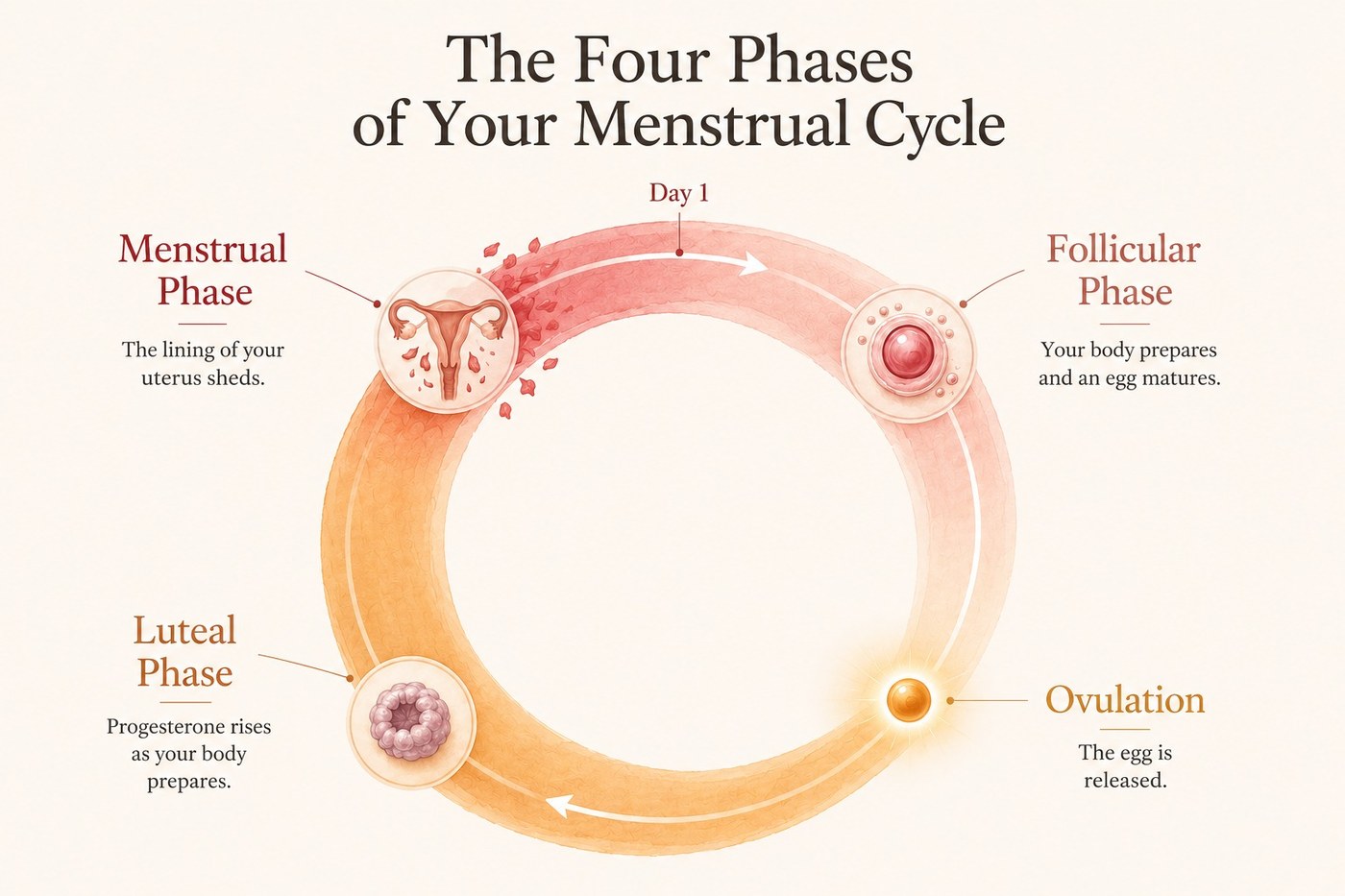
In short, your cycle moves through a menstrual phase, a follicular phase, ovulation, and a luteal phase. These phases reflect coordinated changes in hormones that influence your ovaries and the lining of your uterus.
Key takeaways
- Your cycle is usually described in four phases: menstrual, follicular, ovulatory, and luteal.
- It is regulated by changing levels of several hormones, including oestrogen, progesterone, luteinising hormone (LH), and follicle-stimulating hormone (FSH).
- The four phases are connected rather than four equal blocks on a calendar.
- Ovulation is a single event, not a phase lasting several days, and it does not always fall on day 14.
- Cycle length alone does not tell you whether a cycle is healthy.
This is for education and general understanding, not a diagnosis. For guidance about your own cycle or health, please speak to a qualified doctor.
What is the menstrual cycle?
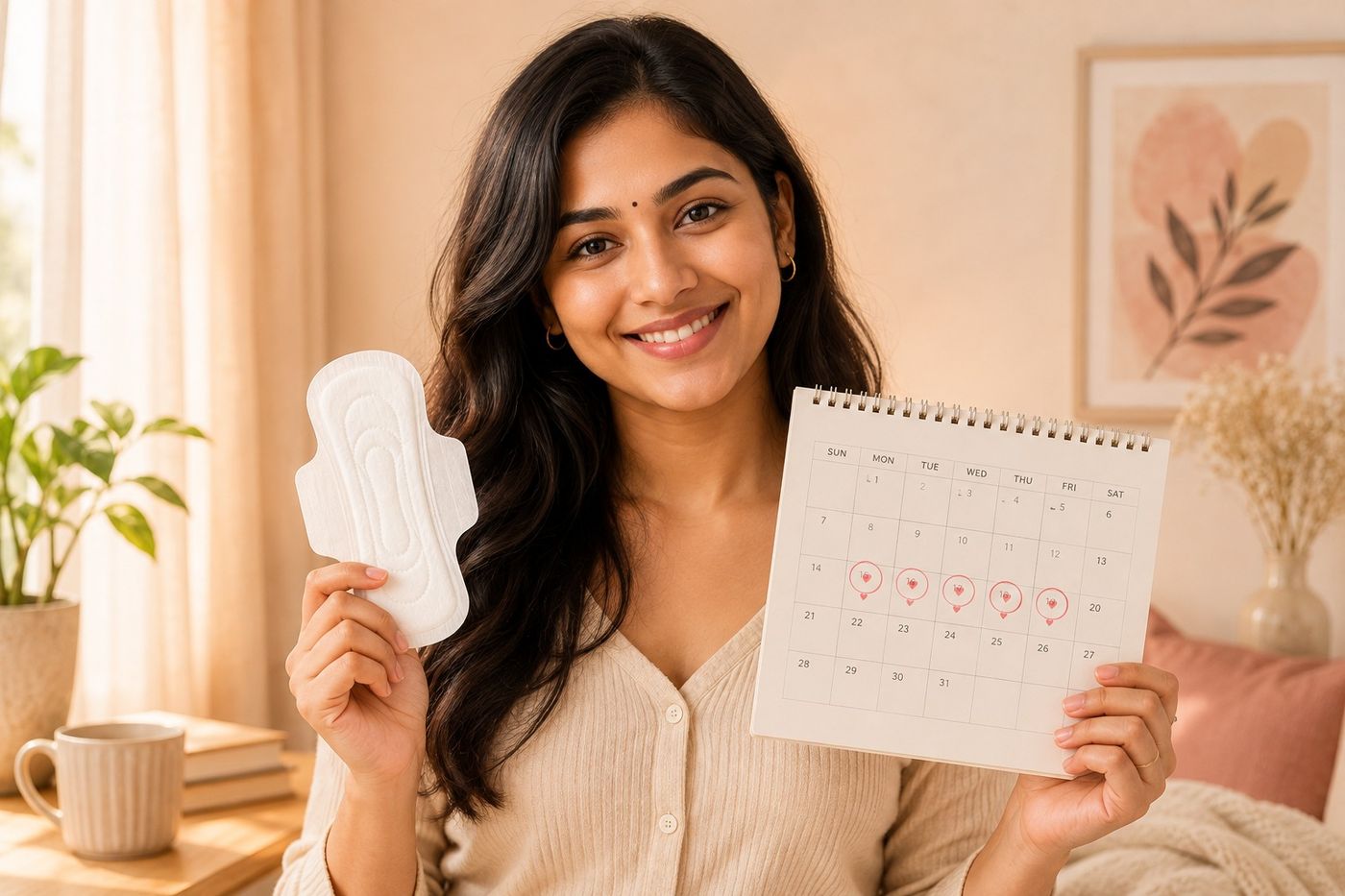
Your menstrual cycle is the monthly sequence your body follows to prepare for a possible pregnancy. It is counted from the first day of your period to the day before your next one starts.
Behind the scenes, your brain and your ovaries communicate through hormones. As those hormone levels change in a set order, they move your body through each phase.
You do not need to feel any of this for it to be working normally. Much of the cycle is quiet, which is part of why it can feel confusing.
The four phases at a glance
| Phase | What happens | Typical timing |
|---|---|---|
| Menstrual | The lining of your uterus sheds | Begins on Day 1 |
| Follicular | Follicles develop and the uterine lining rebuilds | Begins on Day 1 and continues until ovulation |
| Ovulation | An egg is released | Varies from cycle to cycle |
| Luteal | Progesterone rises and your body prepares for a possible pregnancy | Begins after ovulation |
A 28-day cycle is often used as a teaching example, but real cycles vary. The menstrual and follicular phases overlap, while ovulation is a brief event and its timing can vary.
The menstrual phase: what happens first
Day one of your cycle is the first day of real bleeding. This is when the lining your body built the previous month sheds, because no pregnancy occurred.
Oestrogen and progesterone levels are low around the start of menstruation. A period usually lasts about three to seven days, though this varies from person to person.
The follicular phase: your body prepares
The follicular phase begins on the first day of your period, so it overlaps with the menstrual phase. While your bleeding is ending, follicles in your ovaries are already developing and your uterine lining is beginning to rebuild.
Follicle-stimulating hormone prompts several small follicles to grow, and usually one becomes dominant and matures an egg. As it does, oestrogen rises and prepares the lining for a possible pregnancy.
The follicular phase can vary considerably in length from one cycle to another.
Ovulation: when the egg is released
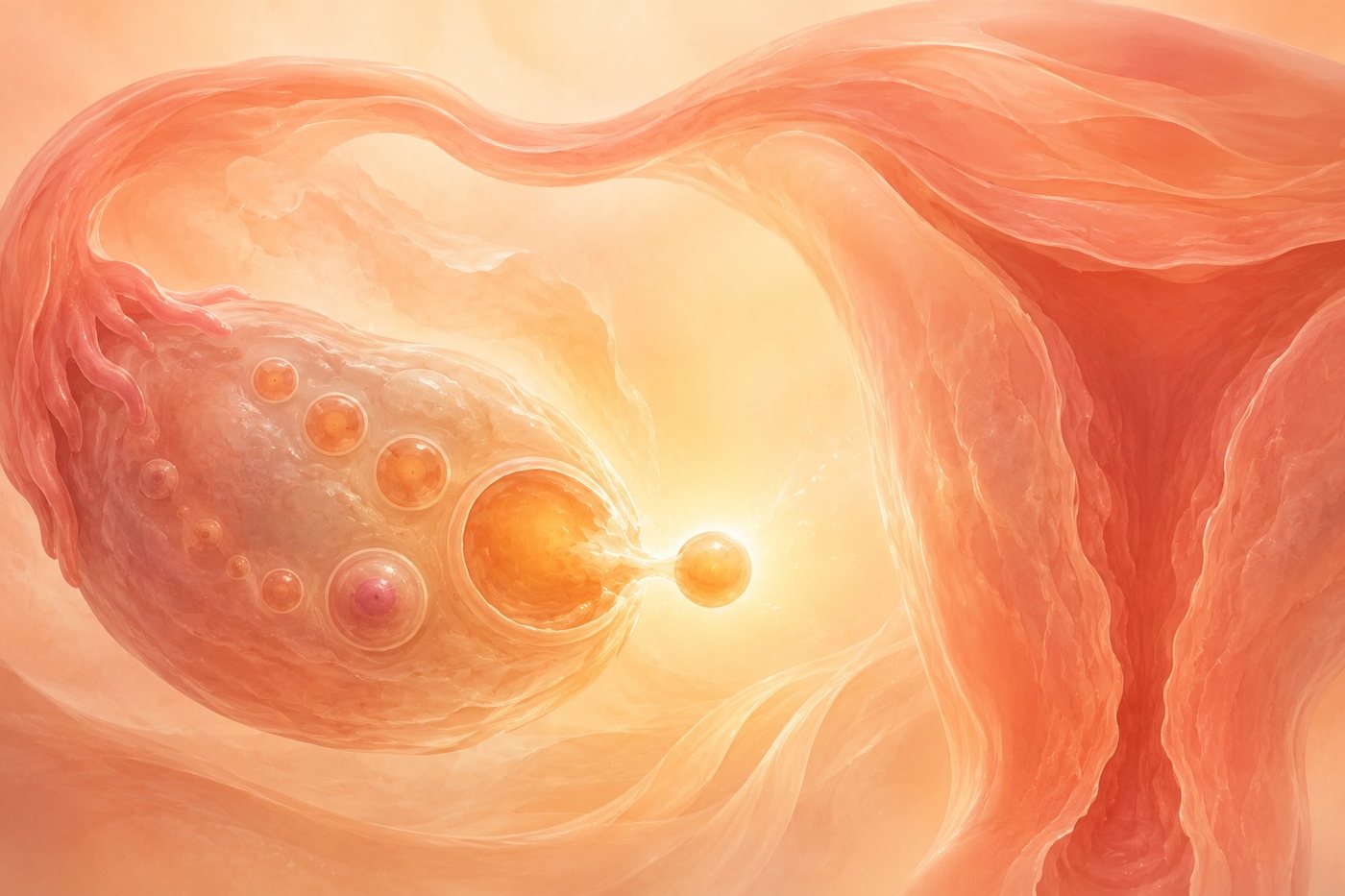
Ovulation is the release of a mature egg from one of your ovaries. It is triggered by a sharp rise in luteinising hormone, often called the LH surge.
In a textbook 28-day cycle, ovulation is often shown around day 14. In real life it can happen earlier or later, so counting from the first day of your period cannot reliably predict the exact day for everyone.
The egg can be fertilised for only about a day, but the days leading up to ovulation are fertile too, because sperm can survive for several days.
The luteal phase: the wait after ovulation
After ovulation, the follicle that released the egg becomes a small structure called the corpus luteum, which produces progesterone. Progesterone helps keep your uterine lining thick and ready.
If pregnancy does not occur, the corpus luteum breaks down, progesterone levels fall, and menstruation follows. If an embryo implants, hormone signals help maintain progesterone, and the lining stays in place.
How do the phases connect?
It helps to see the cycle as one connected story rather than four separate stages. Your period begins, follicles develop, and oestrogen rebuilds the lining. The LH surge then releases an egg, the corpus luteum raises progesterone, and if no pregnancy occurs, hormone levels fall and your next period starts.
Because the timing of ovulation can vary, the overall length of a cycle can vary too.
Why can one cycle be 26 days and another 32?
A 28-day cycle is a teaching example, not a rule. For many adults, cycles fall within roughly 21 to 35 days, though individual patterns vary, and cycle length on its own does not tell you whether a cycle is healthy.
Most of that variation comes from the follicular phase, since ovulation can happen earlier or later. This is also why the timing of your fertile days can shift from one month to the next.
A remarkable fact about your eggs
Here is something rarely explained. The eggs in your ovaries began developing before you were born, and the egg involved in ovulation comes from that lifelong pool, even though its final maturation happens over months.
It is a quiet reminder of how long your body has been preparing for this process, long before you ever thought about it.
Looking ahead
Now that you know how the cycle fits together, the next useful question is when ovulation happens, and how you can recognise your fertile window.
When to speak to a doctor
It is worth speaking with a doctor if:
- Your cycle changes are persistent or clearly different from your usual pattern.
- Your periods become very painful or interfere with daily life.
- You have bleeding between periods or after sex.
- Your periods stop unexpectedly and pregnancy is not the explanation.
- Your bleeding is unusually heavy or prolonged.
- You have concerns about fertility or whether you are ovulating.
References
- National Health Service (NHS UK). Fertility in the menstrual cycle.
- Cleveland Clinic. Menstrual Cycle.
- American College of Obstetricians and Gynecologists (ACOG). Your Menstrual Cycle.
- Office on Women's Health. Menstrual cycle.