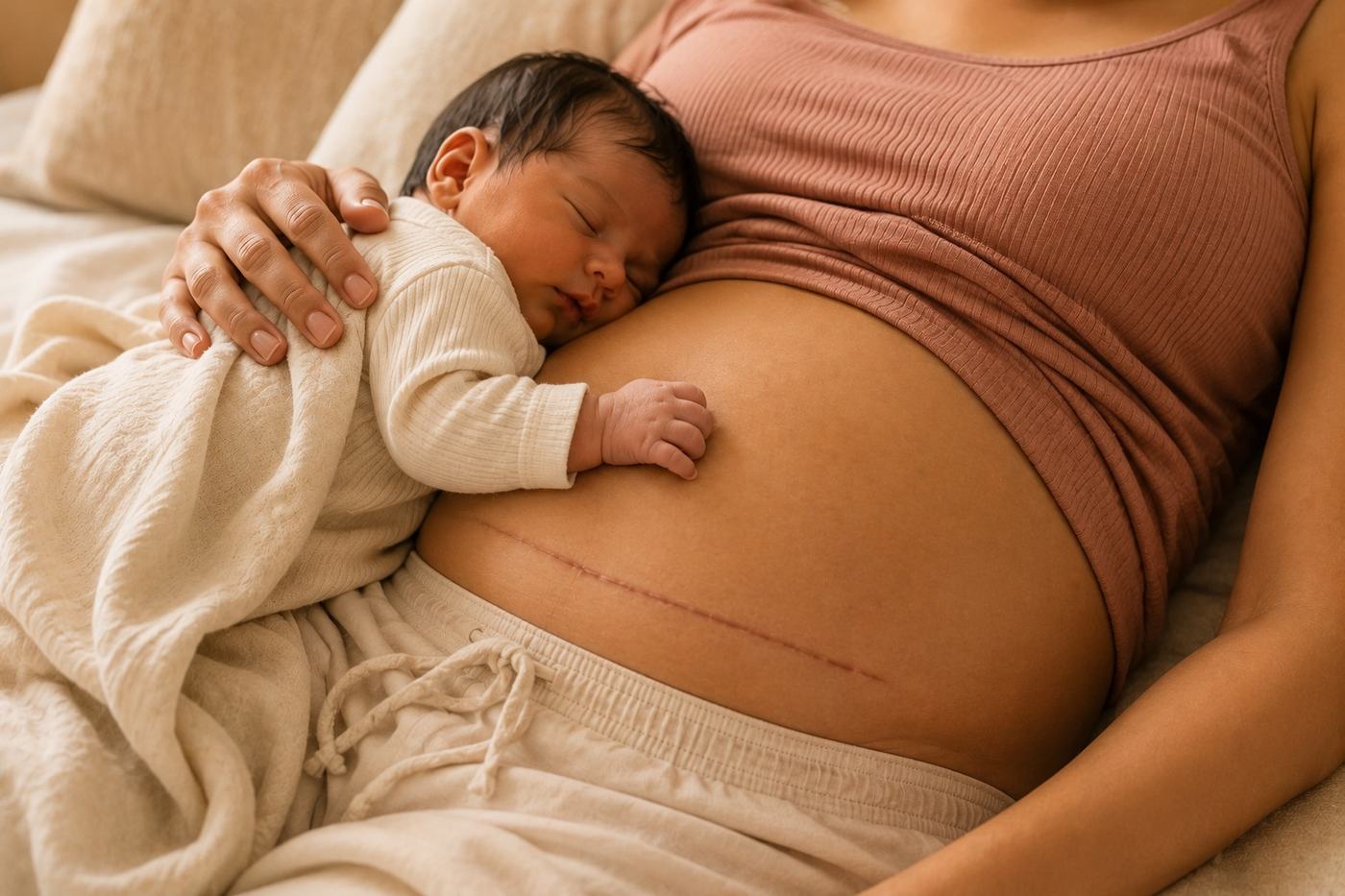


How you hold your baby at the breast shapes almost every feed. The right position helps your baby latch deeply, keeps your back and arms relaxed, and lets milk flow well. Most parents assume there is one correct way to do this, but there is not.
The best breastfeeding position is simply the one where your baby latches deeply and you feel no strain. Named holds like the cradle, cross-cradle, rugby, and side-lying are just different routes to that same result. Learning two or three that suit your body usually matters more than mastering every one.
If early feeds feel awkward or slow, that is common and does not necessarily mean something is wrong. Positioning is a skill you and your baby build together over days, not an instinct you are expected to arrive with. A small adjustment often fixes what feels like a big problem.
Key takeaways
- A position is working when your baby latches deeply and your body stays relaxed.
- Keep your baby's head, shoulders, and hips comfortably aligned, with their whole body turned towards you.
- Bring your baby to your breast rather than leaning your breast down to your baby, which protects your neck and back.
- The rugby (football) hold and side-lying position are especially helpful after a caesarean (C-section) and during night feeds.
- Pain that lasts through a whole feed often means the latch or position needs adjusting, though it can have other causes worth checking.
This is for education and general understanding. It is not a substitute for personal medical advice. Please speak with your doctor, midwife, or a qualified lactation consultant about your own feeding questions.
What actually makes a breastfeeding position work?
Every comfortable, effective feed shares the same few basics, whichever hold you choose. Get these right and almost any position will work:
- Turn your baby's whole body towards you, chest to chest, so their head is not twisted to reach the breast.
- Keep their head, shoulders, and hips comfortably aligned, which can make feeding and swallowing more comfortable.
- Line their nose up with your nipple so they tip their head back and open wide.
- Bring your baby to your breast, supporting their neck and shoulders, instead of hunching forward.
- Settle your own back, arms, and feet first, using cushions or a footrest.
The five positions most parents use
Most parents settle on a favourite or two from the holds below.
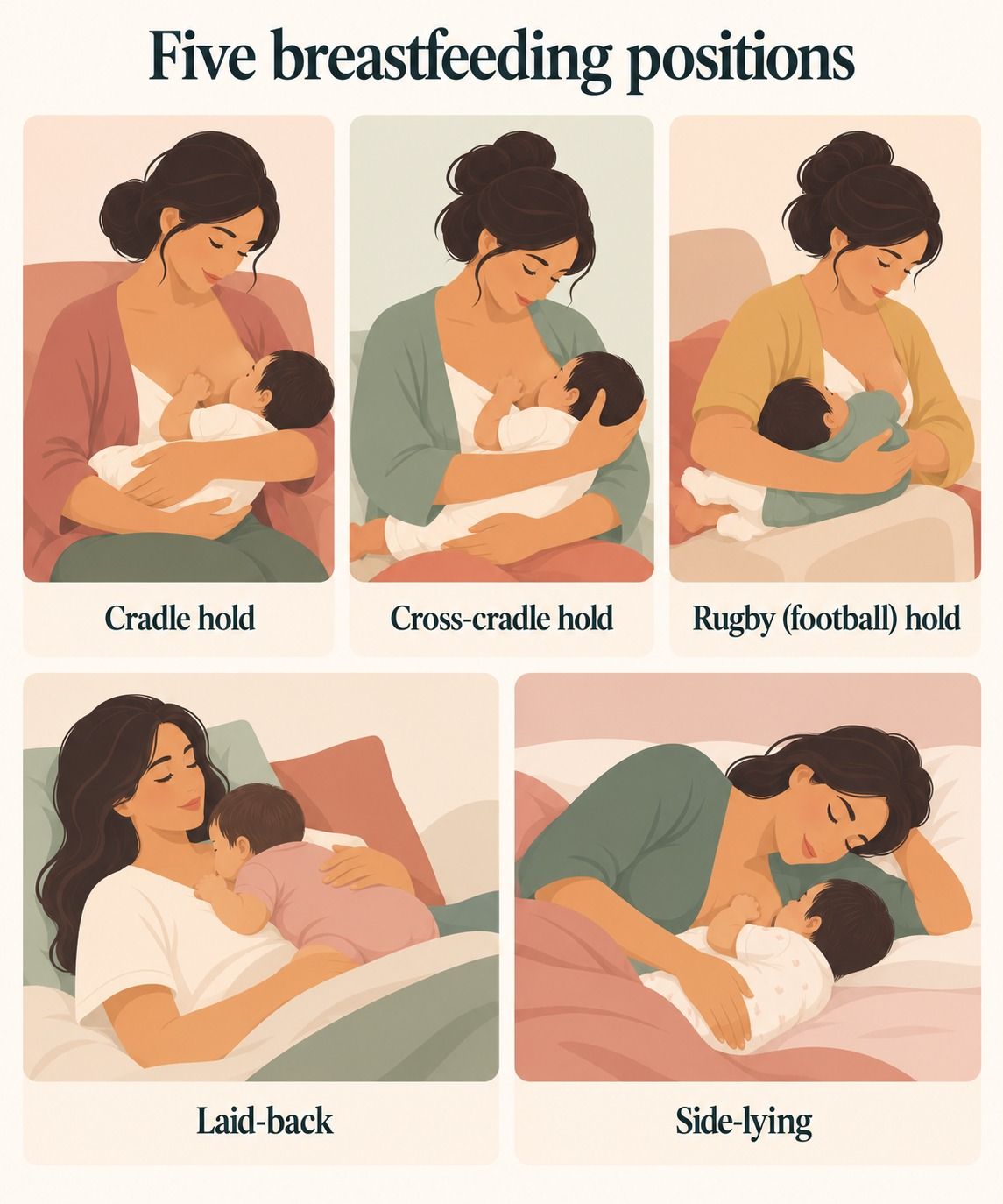
Cradle hold. Your baby lies across your body on the same side as the breast they feed from, head resting along your forearm and tummy against yours. Keep them tucked in close rather than leaning forward. It tends to suit settled feeds once latching feels easy.
Cross-cradle hold. Your baby lies across your body, but you support their neck and shoulders with the opposite hand, leaving your other hand free to shape the breast. That extra head control makes this especially useful while you and your baby are still learning to latch.
Rugby (football) hold. Your baby is tucked along your side, their body under your arm and their feet pointing behind you, while your hand supports their neck. Because their weight stays off your tummy, this hold suits recovery after a caesarean, larger breasts, and feeding twins.
Laid-back. You lean back on a supported surface and rest your baby tummy-down against your chest, letting gravity keep them close. Placed this way, many newborns bob, root, and inch towards the breast largely on their own. It suits sleepy or fussy babies and early latch practice.
Side-lying. You and your baby lie on your sides facing each other, their nose level with your nipple. It lets you feed while resting, which many parents value at night or during recovery. Keep pillows and bedding away from your baby's face.
Safe night feeding. Side-lying and laid-back holds can be comfortable for a night feed, but feeding in your bed is not the same as putting your baby to sleep there. If there is any chance you might fall asleep, keep off sofas and armchairs, which are especially unsafe, and keep pillows, blankets, and other soft items away from your baby. When the feed is over and you are ready to sleep, move your baby back to their own firm, flat sleep surface next to your bed.
Which position suits your situation?
Some holds suit certain situations better than others. Use these as starting points, then trust what feels comfortable:
- If your incision is sore after a caesarean, try the rugby hold or side-lying, which keep your baby's weight off the area. Our guide on recovering from a C-section has more on feeding while healing.
- If latching is still difficult, try cross-cradle or laid-back for more head control or to let your baby's reflexes help.
- If your baby keeps slipping off, choose a hold that gives you more control of their head and neck, such as cross-cradle.
- If you have larger breasts, the rugby hold or side-lying can make the latch easier to see and guide.
- If you are exhausted at night, side-lying may be comfortable, with the safe-sleep precautions above.
- If you are feeding twins, a double rugby hold can let both babies feed at once when you are comfortable doing so.
How do you know the position is working?
You will usually feel it before you see it. A feed that is going well is comfortable, not painful, once your baby is latched. Beyond comfort, a few signs often suggest things are working:
- Your baby's mouth is wide open as they take the breast, with their chin close to or touching it.
- Their lips are turned outward rather than tucked in.
- Sucking often becomes slower and deeper, with pauses to swallow.
- Their cheeks stay full and rounded rather than dimpled.
- Your baby seems settled rather than repeatedly slipping off.
- Your nipple usually looks rounded rather than pinched or flattened afterwards.
Deep, pain-free latching is the real engine behind every position, and it is a skill worth learning on its own.
Looking ahead
As your baby gains head and trunk control, you will often find the amount of support they need changes. A hold that felt essential in the newborn weeks, like the careful cross-cradle or rugby, may become less necessary later, and many parents drift towards a simple cradle or side-lying. There is no timeline to match. You are simply adjusting to a baby who can do a little more of the work themselves.
When is it time to get breastfeeding help?
Most positioning questions settle with practice, but some situations are worth acting on.
Get feeding support soon if:
- Pain continues through feeds even after trying different holds and adjusting the latch.
- Your nipples are cracked, bleeding, or badly painful.
- Your baby repeatedly slips off the breast or struggles to stay latched.
- Feeds are consistently very long or difficult.
Contact your baby's doctor if:
- Your baby is unusually sleepy or hard to wake for feeds.
- Wet nappies are fewer than expected, or you are worried about weight gain.
- There are any signs of dehydration or illness.
A lactation consultant, your doctor, or a trained breastfeeding counsellor can watch a full feed and correct small details that are hard to spot on your own.
References
- National Health Service (NHS UK). Breastfeeding: positioning and attachment.
- National Health Service (NHS UK). Breastfeeding positions.
- World Health Organization. Infant and young child feeding.
- American Academy of Pediatrics (HealthyChildren.org). A Parent's Guide to Safe Sleep.
- BMC Pregnancy and Childbirth. Breastfeeding positions and infant feeding outcomes.