

If your period is not due yet, every small change in your body can start to feel like a clue. A tender breast, a wave of tiredness, a mild cramp: it is natural to wonder whether any of these mean you are pregnant.
Here is the honest answer. Some symptoms of pregnancy can appear in the first week or two, before a missed period, but they look almost identical to ordinary premenstrual syndrome (PMS). On their own, no symptom can confirm a pregnancy. Only a test, taken at the right time, can do that.
Key takeaways
- Early pregnancy symptoms can begin before a missed period, but they usually become noticeable around four to six weeks of pregnancy, close to when your period is due.
- The most common early signs, such as tender breasts, tiredness and mild cramps, also happen before a normal period.
- No single symptom, and no combination of symptoms, can confirm pregnancy on its own.
- You can feel nothing at all in these early days and still be pregnant.
- A home pregnancy test is most reliable from the first day of a missed period. A very early negative often means it is too early to detect, not that you are not pregnant.
This is for education and general understanding, not a diagnosis. Early pregnancy can vary widely from person to person, and only a healthcare professional can assess your individual situation.
Why can pregnancy symptoms appear before a missed period?
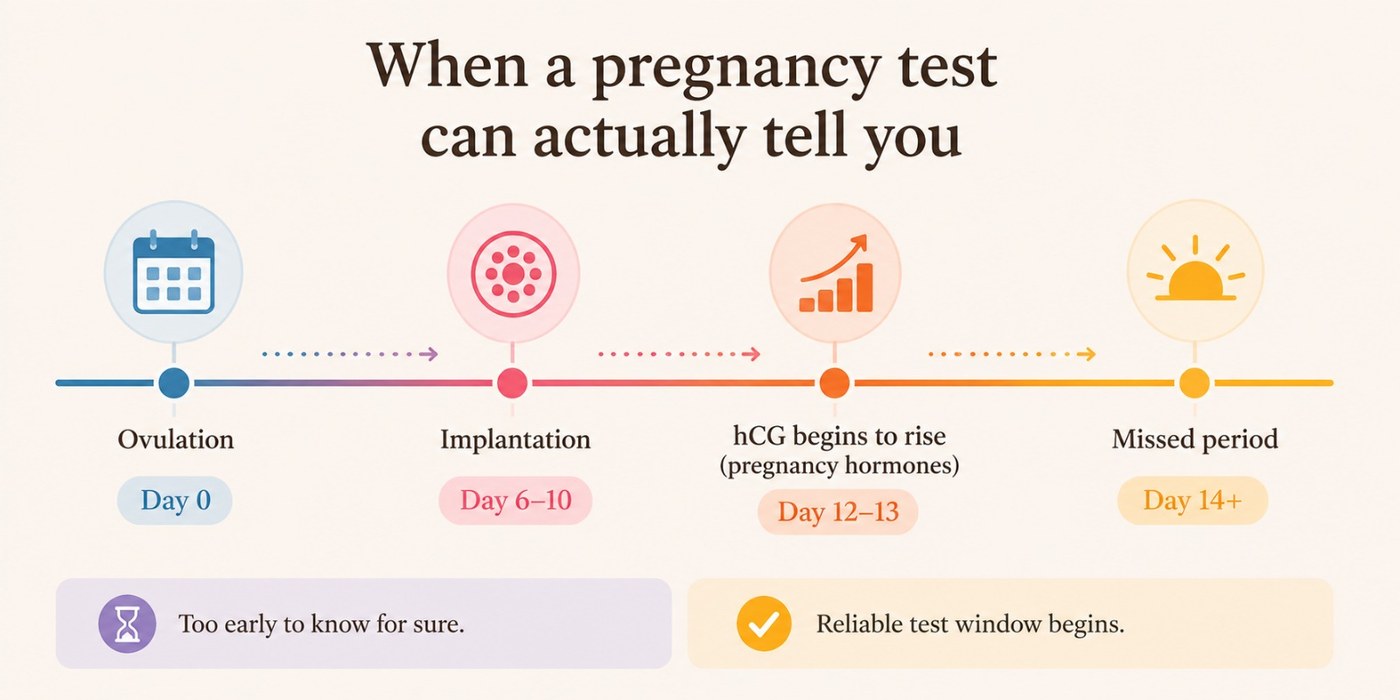
After an egg is fertilised, it travels to the uterus and implants in the lining, usually around six to ten days later. Implantation is simply the point where the pregnancy attaches and begins to establish itself.
Once this happens, your body gradually starts producing a pregnancy hormone called human chorionic gonadotropin (hCG). Rising hCG, along with a hormone called progesterone, can contribute to some of the earliest changes you might feel.
This is why a few signs can appear before your period is technically late. The timing varies a great deal from one pregnancy to the next, so these changes are possible rather than expected.
The early signs you might notice first
If early symptoms do appear, they tend to be subtle rather than dramatic. These are the ones most often linked to very early pregnancy:
- Tender or swollen breasts
- Unusual tiredness
- Mild cramping
- Light spotting
- Needing to pass urine more often
- Nausea, with or without being sick
- More vaginal discharge than usual
- A new sensitivity to certain smells or foods
It helps to treat each of these as a possible sign, not proof. Any one of them can happen for reasons that have nothing to do with pregnancy.
Why do these signs feel so much like your period?
The difficulty is that rising pregnancy hormones and the hormones behind your normal cycle produce very similar sensations. Sore breasts, tiredness and cramps are common in both situations.
This is why watching your symptoms in the days before a missed period rarely settles anything. The very same feeling can point in two completely different directions.
| Sign | Before a period | Early pregnancy |
|---|---|---|
| Breast tenderness | Common | Common |
| Tiredness | Common | Common |
| Mild cramps | Common | Can occur |
| Light spotting | Can occur | Can occur |
| Nausea | Less typical | Can occur |
| Passing urine more often | Can occur | Can occur |
There is no sign in this table that can reliably confirm a pregnancy before a missed period. That is the honest limit of what symptoms can tell you this early.
Having no symptoms this early is normal too
Feeling nothing is completely normal, and it does not mean you are not pregnant. Many pregnancies begin with no noticeable signs at all in the first couple of weeks.
Symptoms usually become clearer around four to six weeks of pregnancy, which is often around or just after the time your period is due. An absence of symptoms this early tells you very little either way.
So if you are watching closely and feeling nothing, try not to read that as an answer. It is simply not information that a test can replace.
When can a pregnancy test give a clearer answer?
A home pregnancy test works by detecting hCG in your urine, and that hormone needs a few days to build to a level the test can read. This is why timing matters far more than symptoms.
A very early test can miss a real pregnancy simply because hCG is still too low. A negative result a few days before your period usually means too early to tell, not that you are not pregnant.
For a reliable result, it helps to wait until the first day of your missed period, then test again after a few days if the result is negative and your period still has not arrived. There is more on this in our guide on when to take a pregnancy test.
If your cycle is irregular, counting from a missed period is harder. Testing around two to three weeks after possible conception, and repeating if you are unsure, tends to be more dependable than tracking symptoms.
A blood test at a clinic can detect pregnancy slightly earlier than a home test. Not everyone needs one, but it can help when an early or certain answer genuinely matters.
If your test is positive, that result is meaningful. The next step is not to prove it again, but to begin early pregnancy care with a doctor.
When should you speak to a doctor?
Most early symptoms are mild and settle on their own. A few, though, need prompt medical attention, especially if you have a positive or possible pregnancy. Seek urgent care, or contact a doctor straight away, if you have:
- Severe or worsening tummy pain, particularly on one side
- Bleeding that is heavy rather than light spotting
- Pain felt at the tip of your shoulder
- Faintness, dizziness or a feeling that you might collapse
These can be signs of an ectopic pregnancy, where a pregnancy develops outside the uterus, and they need to be checked quickly. It is always reasonable to ask for advice when something does not feel right, even before a positive test.
Looking ahead
Whatever this wait holds, you will not be left without a next step.
If your test is positive, your focus shifts to early pregnancy care: your first appointment and the small changes worth making now.
If it is negative but your period still has not come, a repeat test after a few days usually gives a clearer answer. And if anything ever feels physically wrong along the way, that is always worth checking, whatever a test says.
References
- National Health Service (NHS UK). Signs and symptoms of pregnancy.
- Johns Hopkins Medicine. 10 Early Signs of Pregnancy.
- Mayo Clinic. Symptoms of pregnancy: What happens first.
- Cleveland Clinic. Pregnancy Tests.