
If you have found yourself quietly counting how many words your toddler says, you are not alone. Somewhere between the first birthday and the fourth, most parents pause to wonder whether their child is talking enough. That pause is normal, and this article is here to make it calmer.
The most useful thing to know early is that talking is only one part of how a child communicates. Speech experts look at the whole picture: how your child understands you, gestures, takes turns, shows you things, and keeps finding new ways to connect. The number of words is one piece of that picture, not the whole of it.
So here is the honest version. Some children are simply slower to start, and some benefit from support, and you do not have to predict which yours will be. What helps most is noticing the whole picture, keeping communication rich at home, and raising any concern with your doctor early.
Key takeaways
- Talking is one part of communication. Understanding, gestures, turn-taking, and steady progress matter just as much.
- The Centers for Disease Control and Prevention (CDC) treat milestones as reference points, not a scorecard for a single birthday.
- Some children catch up on their own and some benefit from support, and you do not have to guess which; look at the whole picture and ask when unsure.
- Raising your child in two or more languages does not cause speech delay.
- Signs worth acting on include losing skills, rarely gesturing, little response to communication, or trouble understanding, and early evaluation helps when needed.
This is for education and general understanding, not personal medical advice. Every child develops differently, and only a qualified doctor or speech-language pathologist can assess your child.
Speech is only one part of how your toddler communicates
When a speech expert meets a toddler, they rarely start by counting words. They look at how your child communicates as a whole, because language shows up in several connected ways long before a child is fluent. It helps to keep four simple ideas separate.
- Speech: how clearly sounds and words come out
- Expressive language: how your child uses words and, later, sentences
- Receptive language: what your child understands
- Social communication: how your child uses all of this with other people, through eye contact, gestures, and taking turns
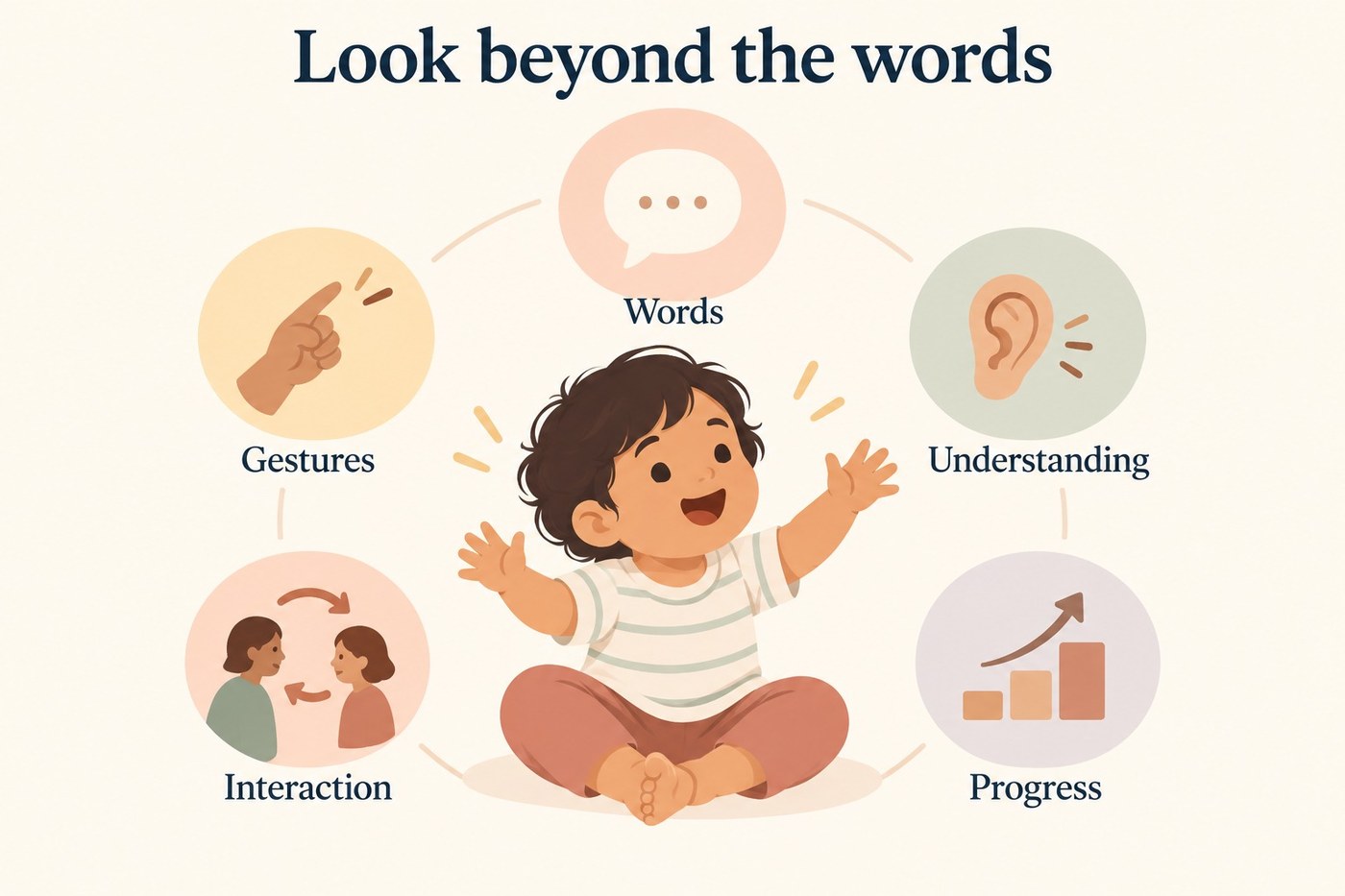
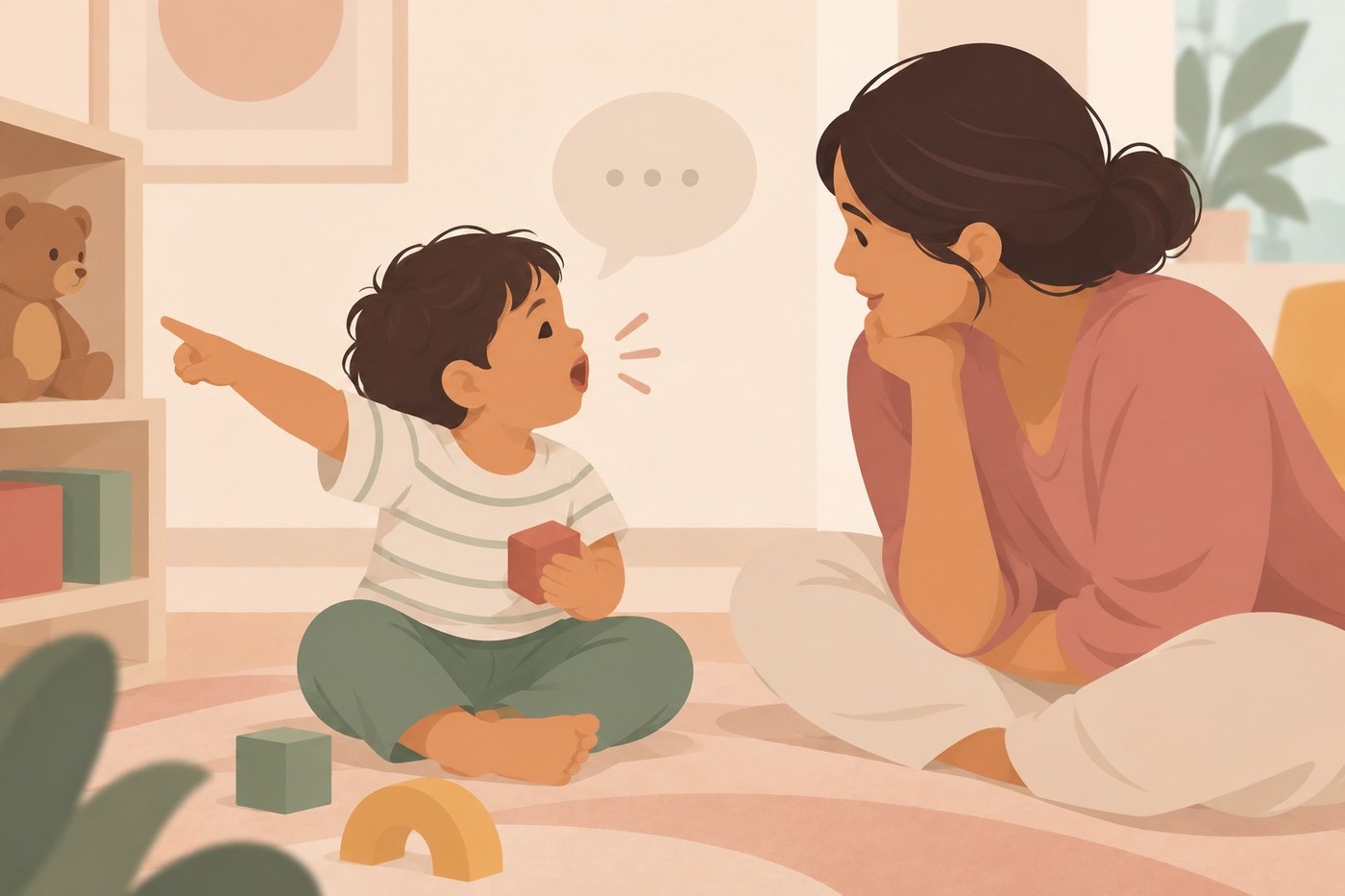
Alongside these, an expert notices gestures like pointing and showing, back-and-forth interaction, whether your child can make their wants and interests known, and whether new skills keep appearing month to month. A child who is rich in these areas but light on words sits in a very different place from one who is quiet across all of them.
Late talker or language delay: what is the difference?
These two phrases often get mixed up, and the difference is less about word count than about the overall picture. A late talker usually understands well and communicates in many other ways. A language delay can affect understanding, use of words, or both, and tends to show across more than one area.
| A reassuring picture often looks like | A picture worth assessing often looks like |
|---|---|
| Understands everyday instructions | Struggles to understand simple instructions |
| Points, shows, and gestures a lot | Rarely gestures or shows you things |
| Imitates sounds, actions, and words | Little imitation |
| Keeps adding new ways to communicate | Communication has stalled or gone backwards |
| Few words, but clearly connecting | Quiet across most areas, or lost skills |
These are patterns, not a diagnosis. If the right-hand picture feels familiar, that is simply a reason to seek a professional opinion, not a conclusion on your own.
A note if your child was born prematurely
If your child was born prematurely, milestones are usually read using corrected age, especially in the first two years. Corrected age adjusts your child's age for how early they arrived, so expectations match their development rather than the calendar. Your paediatrician can help you read the milestones below using the right age for your child.
How much talking is normal at each age
Milestones are reference points, not a scorecard. An expert reads them the way you just read the picture above, by asking whether your child is broadly on track across communication, not whether they had exactly the right number of words on one birthday. The CDC list below shows what most children, about 75 percent, do by each age.
| Age | What most children do by this age (CDC) |
|---|---|
| 15 months | Says one or two words besides "mama" and "dada" |
| 18 months | Says three or more words; follows a one-step instruction without a gesture |
| 2 years | Says at least two words together, like "more milk" |
| 30 months | Says about 50 words; joins words with an action word, like "doggie run" |
| 3 years | Talks well enough for others to understand most of the time |
When the bigger picture is reassuring
Some signs make it more likely that a slower start is just that. If your child understands daily instructions, gestures freely, takes turns with you, and keeps adding new ways to communicate, the wider picture is reassuring even when spoken words are few.
The American Speech-Language-Hearing Association notes that strong gesture use can be a reassuring sign in children who are late to start talking, although it does not predict development on its own. This does not mean you should sit and wait to see what happens. It means you can keep observing, keep communication rich, and raise anything that worries you, all at the same time.
Does raising your child in more than one language slow speech?
In many Indian homes a child hears Hindi, English, and a regional language every day, and parents often worry this is holding speech back. It is not. Leading bodies including the American Speech-Language-Hearing Association and the American Academy of Pediatrics agree that growing up with more than one language does not cause delay.
The key is to look at your child's communication across all their languages together, not to judge one language on its own. A child may hold some words in each, which is easy to undercount. There is no need to drop a home language to help your child talk, and doing so removes a rich source of connection.
When speech is only part of the picture
Sometimes a child is simply slower to start talking. Sometimes difficulty with speech or language is one part of a broader developmental difference. Your doctor may therefore look beyond words and ask about understanding, gestures, social interaction, play, movement, attention, and how your child learns.
This does not mean a speech delay points to autism, attention-deficit/hyperactivity disorder (ADHD), or any other condition. It simply means development is connected, and looking at the whole child is clearer than counting words. If your child has lost skills, has difficulty across several areas, or you have a concern beyond speech, bring it to your paediatrician rather than working out the cause yourself. Our guide on developmental red flags covers the wider signs worth raising.
The signs worth acting on
None of these means something is certainly wrong, but each is a good reason to check sooner rather than later.
- No single words by 18 months
- No two-word phrases by 2 years
- Losing words or skills your child once had
- Little response to their name or to everyday sounds, which can point to hearing
- Very few gestures such as pointing, waving, or showing
- Ongoing trouble understanding simple instructions
What happens when you get help early
Acting early rarely means anything dramatic, and it often brings relief. A hearing evaluation is often an important early part of the assessment, because even mild or temporary hearing loss from frequent ear infections can quietly slow speech.
If more support helps, a speech-language pathologist (SLP), a therapist trained in communication, will play with your child and guide you on building communication at home. This is called early intervention, and starting early gives your child access to appropriate support during an important period of language development. Choosing it is not a verdict on your parenting, it is a caring step.
What can I do at home?
You do not need a program or flashcards. A few simple ways of interacting, the kind a speech-language pathologist would suggest, turn ordinary moments into practice.
- Follow their lead: talk about whatever your child is already looking at or interested in.
- Expand what they say: if your child says "dog," you say "big dog," rather than asking them to repeat it.
- Give them time: leave a pause after you speak instead of filling every silence.
- Offer choices: "apple or banana?" gives an easier opening than an open question.
- Model, don't test: say the word naturally in play instead of asking your child to say it back.
Looking ahead
Speech often arrives in bursts, and a quiet stretch is frequently followed by a jump. The most useful habit is to keep watching the whole picture rather than the word count, and to stay in touch with your doctor about anything that feels off. Our guide on baby milestones sets out the path from babble to first sounds in the first year.
When to speak to a doctor
Book a routine visit if your child is missing several signposts, if understanding seems behind, if progress has stalled, or if your instinct says something is off. You know your child best, and asking early is always reasonable.
Seek prompt advice if your child loses words or skills they once had, or shows little reaction to sounds, since hearing deserves a quick check.
References
- Centers for Disease Control and Prevention (CDC). Developmental Milestones.
- Centers for Disease Control and Prevention (CDC). Milestones at 2 years and 30 months.
- American Speech-Language-Hearing Association (ASHA). Late Language Emergence.
- American Speech-Language-Hearing Association (ASHA). Late Blooming or Language Problem?
- National Institute on Deafness and Other Communication Disorders (NIDCD). Speech and Language Developmental Milestones.