
You have probably heard the word placenta many times, yet it stays a little mysterious until you are the one growing one. It is the temporary organ that makes the exchange between your body and your baby possible, handling the work your baby cannot yet do alone. Understanding how it forms and what it does can make a big part of pregnancy feel far less like a black box.
Here is the short version. The placenta begins developing around the time the fertilised egg settles into your womb, and it develops rapidly through the first trimester as it takes over feeding, protecting and supporting your baby. It grows alongside your baby, works hard for around nine months, then leaves your body soon after birth.
Key takeaways
- The placenta begins developing around the time the fertilised egg implants, then develops rapidly through the first trimester.
- It delivers oxygen and nutrients to your baby and carries waste away, while your blood and your baby's blood circulate separately.
- It also works as a hormone factory that keeps your pregnancy stable and later passes on some of your immunity.
- A placenta does not travel around your womb; the uterus grows around it, which is why a low-lying one often ends up higher later.
This is for education and understanding, not personal medical advice. It cannot replace a consultation with your own doctor, who knows your history and your pregnancy.
When does the placenta start to form?
It begins developing around the time the fertilised egg implants into the lining of your womb. As the tiny ball of cells settles in, its outer layer begins to burrow into the womb lining and reach towards your blood supply. Those outer cells are the very beginning of the placenta, forming long before you may even feel pregnant.
From there it develops rapidly through the first trimester, rather than switching on at a single fixed moment. In the earliest days, a small structure on your ovary, the corpus luteum, keeps the pregnancy going by producing progesterone. By the end of the first trimester, the placenta has taken over much of that hormonal support, along with the other jobs that sustain your pregnancy.
Your baby's lungs, kitchen and waste system in one organ
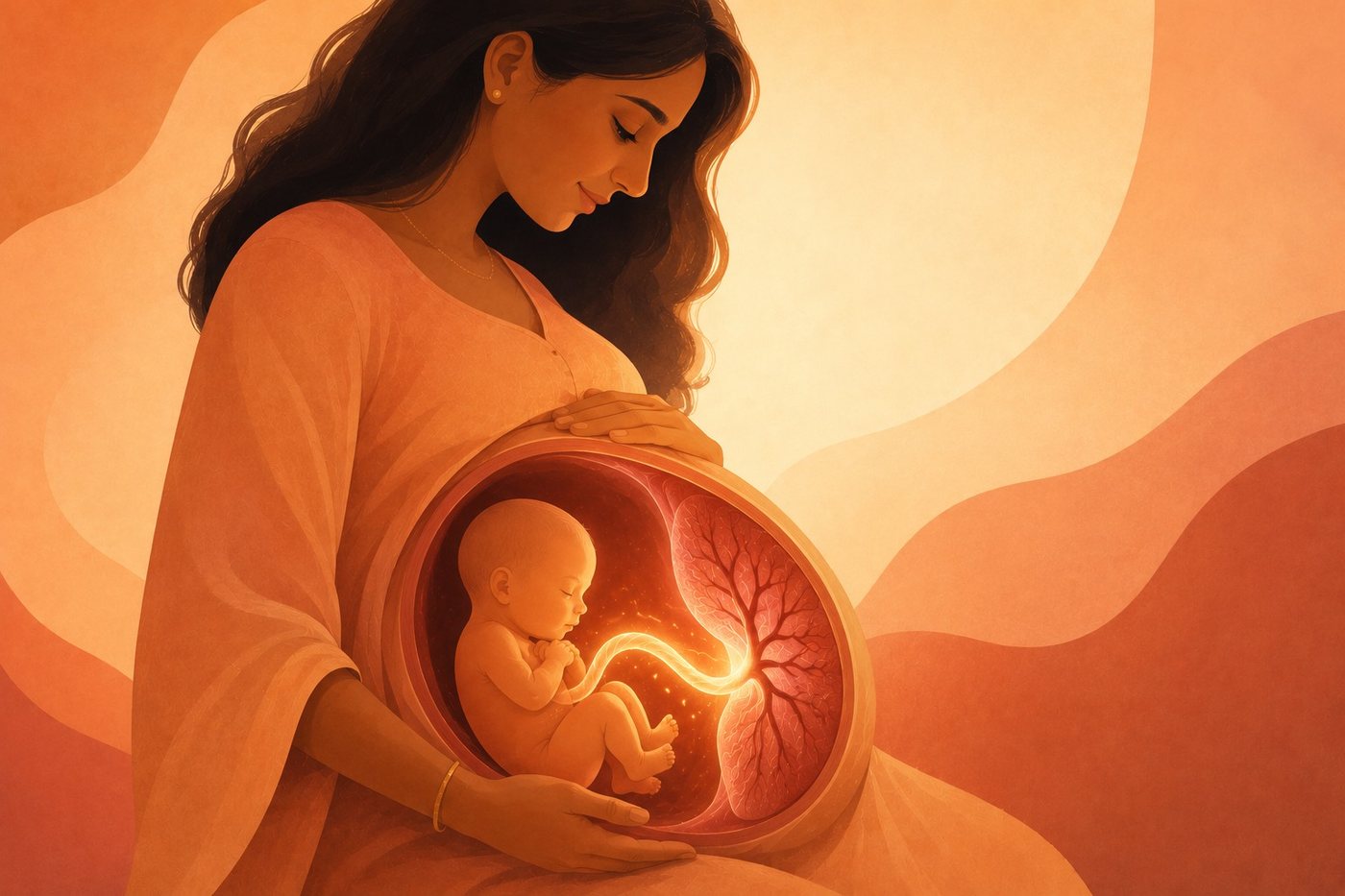
For most of pregnancy, the placenta does several jobs your baby's own organs are not yet ready to do. It brings oxygen and nutrients from your blood across to your baby, and it carries carbon dioxide and waste back so your body can clear them. For much of pregnancy, it performs several jobs that your baby's own lungs, kidneys and digestive system will eventually take over.
Here is the part that surprises many parents: in a healthy placenta, your blood and your baby's blood circulate separately. They flow extremely close together, separated by a thin barrier, and oxygen, nutrients and waste pass across it while the two circulations stay largely apart. It is a quiet, constant exchange happening every second of every day.
| The placenta's job | What it does |
|---|---|
| Oxygen exchange | Moves oxygen from your blood toward your baby |
| Nutrition | Transfers the nutrients your baby needs to grow |
| Waste removal | Moves carbon dioxide and other waste toward your circulation |
| Hormone production | Produces hormones that support the pregnancy |
| Immune support | Passes some of your antibodies to your baby |
Does the placenta actually move during pregnancy?
Not really, and this is one of the more reassuring things to understand. A placenta does not detach and travel around your womb. What happens is that your uterus grows upward and outward as your baby grows, and the placenta appears to shift higher simply because the wall it is attached to is stretching.
A placenta that looks low early in pregnancy often ends up farther from the cervix as the uterus grows, so an early finding does not always mean it will stay low. Your placenta's position is checked properly at your mid-pregnancy anomaly scan, and if it still sits low your doctor may recommend follow-up imaging later on.
What happens to the placenta after birth?
The placenta is a temporary organ, built for pregnancy and not needed once your baby arrives. After the birth your womb contracts and the placenta separates and is delivered a little while later, which is why it is sometimes called the afterbirth. A fully grown placenta is a flat, round disc, roughly the size of a dinner plate.
Looking ahead
Knowing how the placenta works quietly answers many of the questions that come up later in pregnancy. When you hear about placenta position at your anomaly scan, or see it noted in your reports, you will already understand what is being checked and why. A natural next step is to understand what that mid-pregnancy scan looks at fully.
When to speak to your doctor
Most of the time the placenta does its job without any trouble. It is worth a routine chat with your doctor if you have questions about your placenta's position after a scan.
Seek urgent care if you have heavy vaginal bleeding, severe or constant tummy pain, or a noticeable drop in your baby's movements, as these can occasionally signal a problem such as a low-lying placenta or placental abruption.
References
- Cleveland Clinic. Placenta.
- Mayo Clinic. Placenta: How it works, what's normal.
- StatPearls, National Center for Biotechnology Information (NCBI). Physiology, Placenta.
- Pregnancy, Birth and Baby (Australia). About the placenta.
- Tommy's. Anterior placenta.