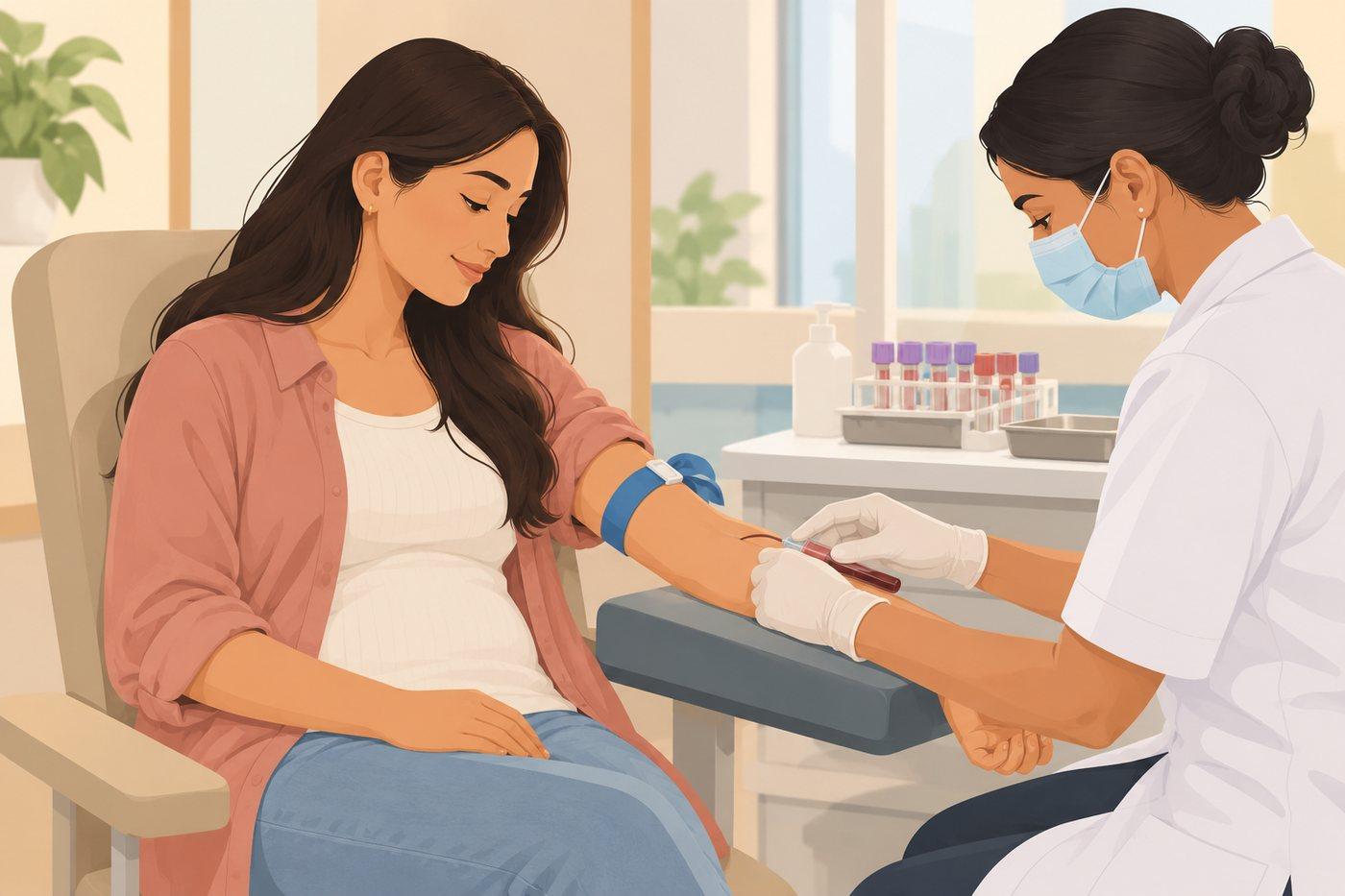
The first antenatal visit often ends with a long lab slip, a row of short forms you have never seen before and a few tubes of blood. For many, this is the moment pregnancy starts to feel a little more medical.
Whether you are holding that slip right now, getting ready for your first visit or simply want to know what lies ahead, it helps to know what each test is quietly looking for.
Key takeaways
- Doctors commonly recommend early blood tests at the first antenatal visit, between about 6 and 10 weeks, though the exact list varies.
- The core tests look at haemoglobin, blood group, sugar and infections, and many doctors also check your thyroid.
- Most are screening tests, so a result outside the range usually leads to a closer look, not a diagnosis.
- Only the sugar test may need fasting, and haemoglobin and sugar are usually rechecked at 24 to 28 weeks.
- If you are Rh negative, the anti-D injection can protect future pregnancies, and any bleeding needs a prompt call.
This is for understanding, not diagnosis. Your own doctor, who knows your history, is the right person to read your results.
The quick answer
Between about 6 and 10 weeks, doctors commonly recommend a set of blood tests. These check your haemoglobin, blood group and Rh (Rhesus) factor, blood sugar and a few infections such as HIV (Human Immunodeficiency Virus), hepatitis B and syphilis. Many doctors also check your thyroid. The exact list depends on your health history, earlier reports and your hospital's protocol.
Why doctors test your blood so early
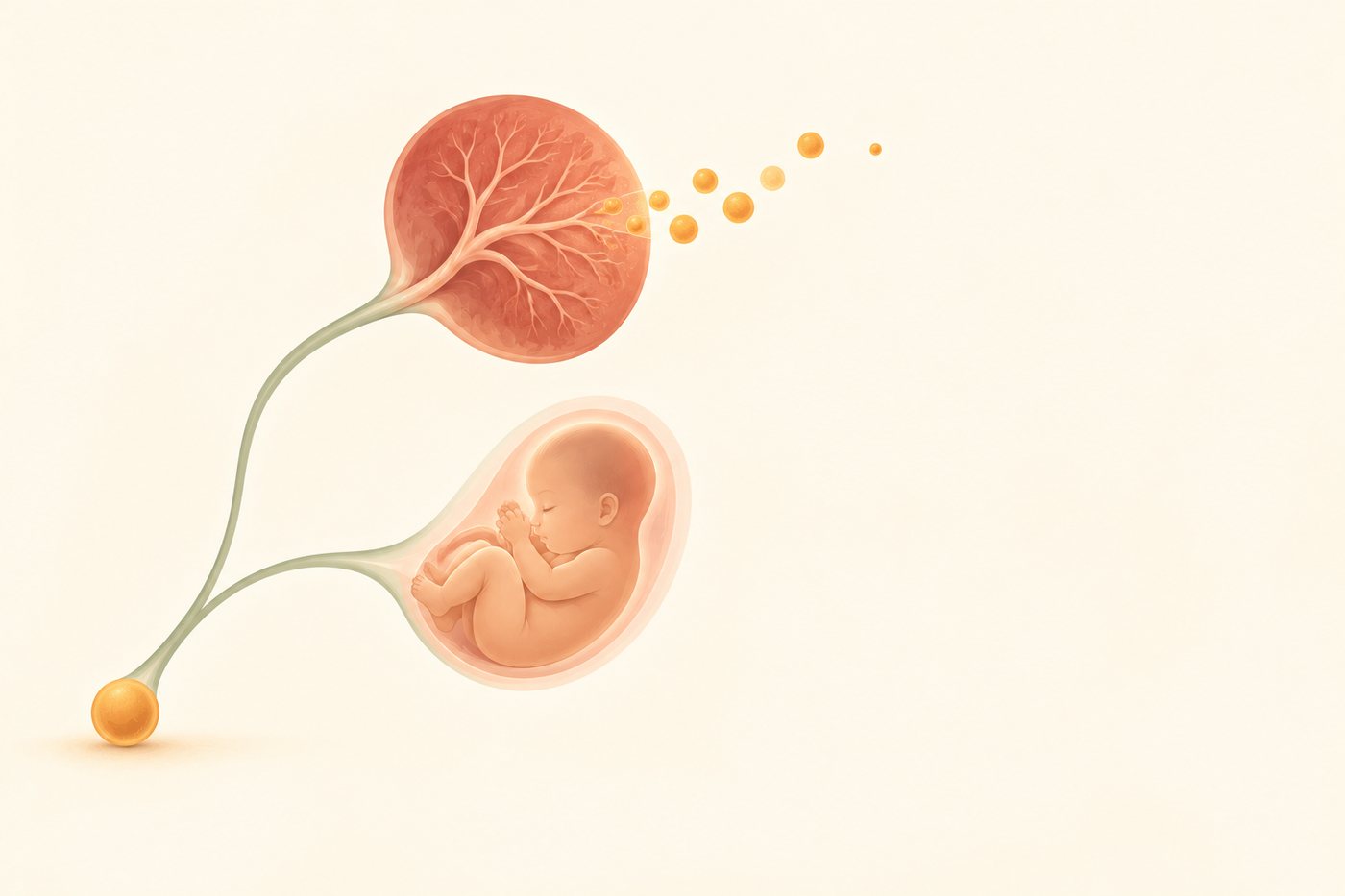
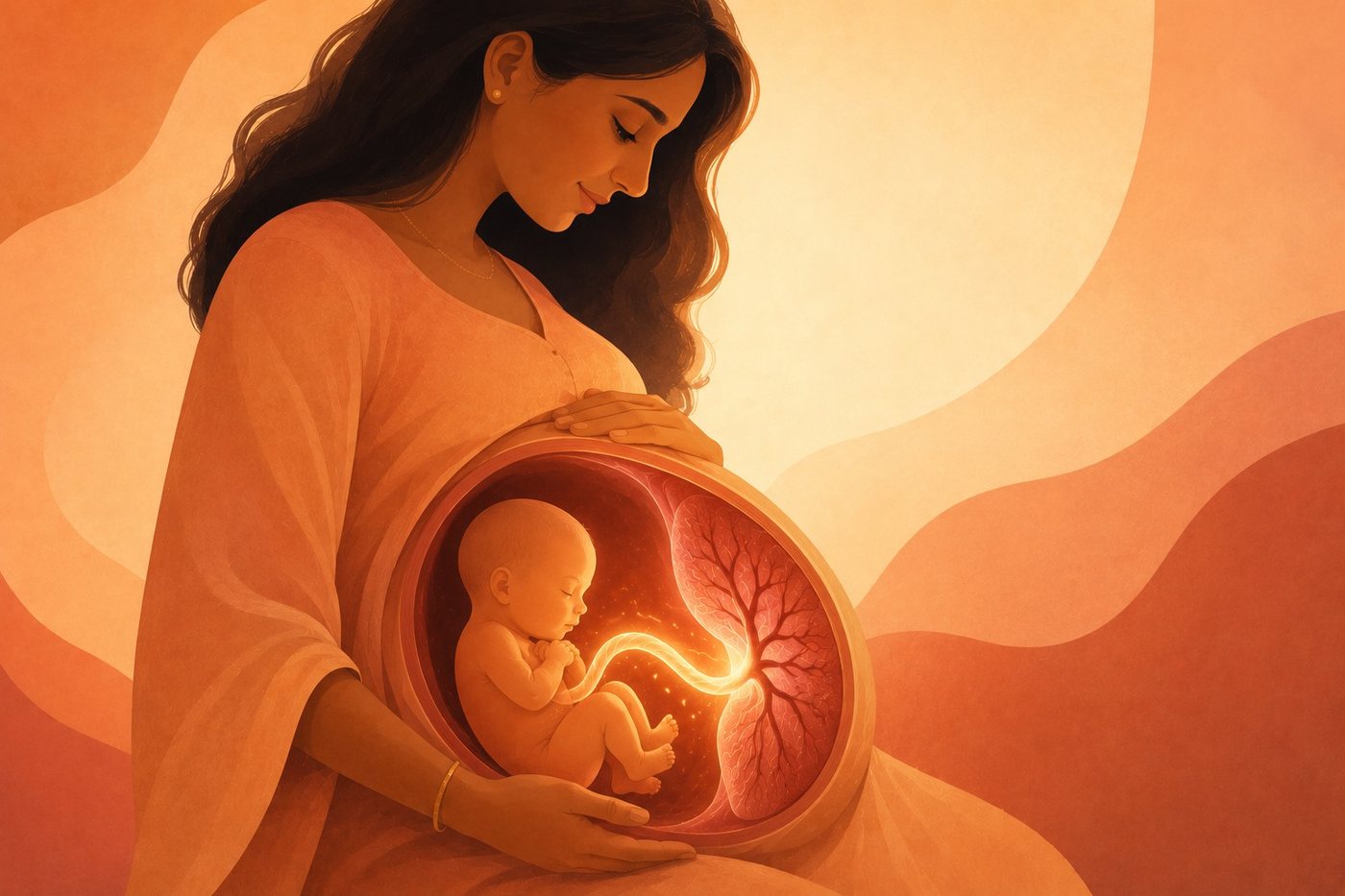
The first weeks of pregnancy are when your baby's organs begin to form. During this time your baby relies on your body for thyroid hormone, oxygen and protection from infection, so finding a problem now gives the most time to correct it.
These results also become your baseline. They help your doctor:
- understand your health at the start of pregnancy
- compare every later result against a known starting point
- notice changes early enough to act on them
What does each blood test check?
The first group below is part of standard antenatal care for most pregnancies in India. The second is ordered when your history, symptoms or local practice call for it.
Tests recommended for most pregnancies
| Test | What it checks | If the result is outside the expected range |
|---|---|---|
| CBC (Complete Blood Count) with haemoglobin | Red cells, white cells and platelets, and haemoglobin, which carries oxygen | Below 11 g/dL (grams per decilitre) counts as anaemia in pregnancy, which affects about half of pregnant women in India. It usually means iron tablets, iron-rich food and a repeat test |
| Blood group and Rh factor, with an antibody screen | Your blood group, Rh status and any unusual antibodies | If you are Rh negative, your doctor plans anti-D protection (explained below) |
| Blood sugar, often a 75 g OGTT (Oral Glucose Tolerance Test) | How your body handles sugar | It usually means food changes first, closer monitoring and sometimes medicine |
| HIV test | HIV infection | It needs confirmatory tests. If HIV is confirmed, treatment in pregnancy greatly lowers the chance of passing it to your baby |
| HBsAg (Hepatitis B surface Antigen) | Hepatitis B infection | It needs further tests. Your baby can be protected with injections soon after birth |
| VDRL (Venereal Disease Research Laboratory) or RPR (Rapid Plasma Reagin) | Syphilis | It needs a confirmatory test such as TPHA (Treponema Pallidum Haemagglutination Assay). If syphilis is confirmed, antibiotics protect your baby |
| TSH (Thyroid Stimulating Hormone) | How well your thyroid is working. India's national guidelines recommend this check | It may mean a thyroid tablet or a dose change, with rechecks every few weeks |
Tests ordered only in specific situations
| Test | What it checks | If the result is outside the expected range |
|---|---|---|
| Thalassaemia screen, often by HPLC (High-Performance Liquid Chromatography) | Whether you carry a thalassaemia gene. This test is commonly advised in India | Your partner is usually tested to understand the chance for your baby |
| Rubella IgG (Immunoglobulin G) | Immunity to German measles | If you are not immune, you avoid contact with the infection now and get vaccinated after birth |
| Hepatitis C, vitamin D or vitamin B12 | Specific concerns based on your history or symptoms | Your doctor explains the next step |
Almost all of these are screening tests. A screening test sorts people into lower and higher chance, so a result outside the range is a signal to look more closely, not a diagnosis.
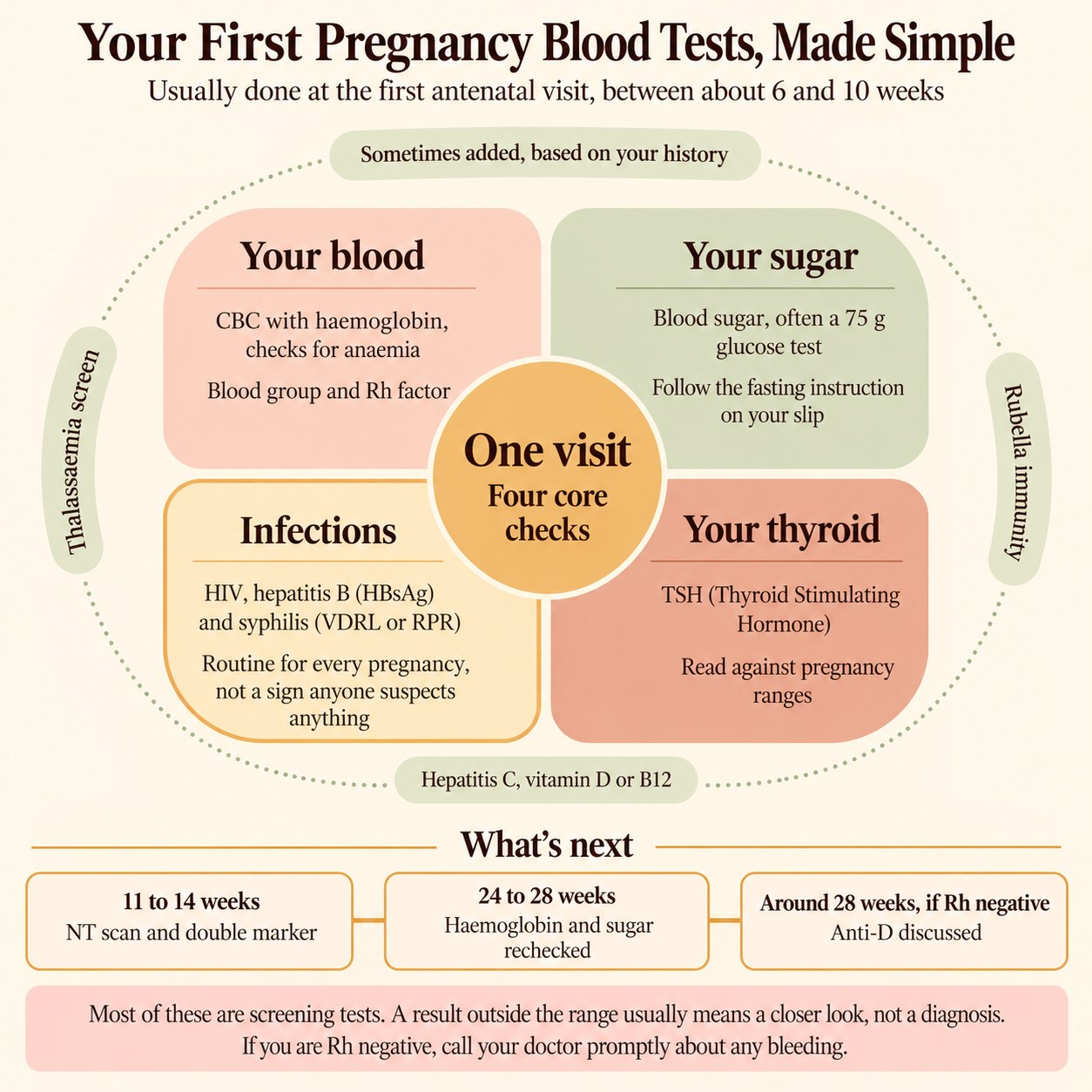
When is each test done, and do you need to fast?
Most of these tests are done together at your first visit and need no fasting. Only the sugar test may come with instructions.
| Test | Fasting needed? | Usually repeated later? |
|---|---|---|
| Haemoglobin (CBC) | No | Yes, around 24 to 28 weeks, and after iron treatment |
| Blood group and Rh factor | No | Blood group no. The antibody screen may be repeated around 28 weeks if you are Rh negative |
| Blood sugar | Not for the India guideline test. Yes, if your doctor orders a fasting test | Yes, around 24 to 28 weeks if the first result is normal |
| TSH | No | Only if the result is abnormal or you take thyroid medicine |
| HIV, HBsAg, VDRL | No | Usually not, unless your doctor advises a repeat |
| Thalassaemia, rubella | No | No |
India's national guidelines suggest a 75 g glucose drink with one blood reading at 2 hours, whatever time you last ate. Some doctors prefer a fasting test instead, so the instruction on your slip is the one to follow.
Before your appointment:
- Fast only if your slip or doctor asks you to. Plain water is usually allowed, but check if you are unsure.
- Take your regular medicines as usual unless your doctor has told you otherwise.
- Carry earlier reports and a list of any medicines. For the glucose test, plan to stay about 2 hours and avoid eating during that time.
An unusual result usually means a next step
Waiting for results can feel longer than the tests themselves. Seeing words like HIV or syphilis on a pregnancy slip can also feel uncomfortable. These tests are part of standard antenatal screening, not a sign that anyone suspects anything.
What a result means depends on the test.
A positive infection screen usually needs confirming. A reactive HIV or syphilis screen is checked with further tests, because screening tests can occasionally react for other reasons. A positive hepatitis B result leads to tests of how the virus is affecting the liver.
If an infection is confirmed, your doctor will explain treatment, may suggest testing your partner and will plan your care and birth to protect your baby. These infections are well managed in pregnancy when found early.
A low haemoglobin needs a cause. Iron deficiency is the most common reason. A thalassaemia trait can also lower haemoglobin, which is why some doctors check for thalassaemia before or alongside iron treatment.
A sugar result needs context. The first-visit test mainly picks up diabetes that may have been present before pregnancy. Gestational diabetes usually develops later, which is why a normal early result is often repeated at 24 to 28 weeks.
Thyroid results are read against pregnancy-appropriate ranges. These depend on your trimester and the lab. The upper limit used in early pregnancy is often a little lower than the range printed for adults who are not pregnant. For this reason, your doctor reads TSH alongside your history and sometimes a free T4 (free thyroxine) result.
If you are Rh negative
Being Rh negative is common and does not harm you. It matters only if your baby is Rh positive.
Some of your baby's blood can enter your bloodstream, which can happen at birth or during bleeding. If it does, your body may make antibodies that could affect a future Rh positive baby. The anti-D injection helps stop those antibodies from forming.
Your doctor will usually check whether you already have these antibodies, and may test your partner's blood group. Anti-D is commonly offered around 28 weeks, and again within 72 hours of birth if your baby is Rh positive. It may also be needed after bleeding, a fall or injury to the tummy, or a pregnancy loss, which is why bleeding needs a prompt call.
Where the double marker test fits in
It is not part of the 6 to 10 week set. The double marker is a blood test done alongside the NT (Nuchal Translucency) scan, between 11 weeks and 13 weeks 6 days.
Unlike the early tests, it looks at your baby. It estimates the chance of certain chromosomal conditions. Like most blood tests in pregnancy, it is a screening test, not a diagnosis.
When to see a doctor
| How urgent | Signs | What to do |
|---|---|---|
| Go to hospital now | Heavy bleeding, such as soaking a pad within an hour or passing clots. Severe tummy pain, especially on one side. Shoulder-tip pain. Fainting or feeling very dizzy | Go to the nearest emergency or labour room, or call the 108 ambulance service available in most states |
| Call your doctor the same day | Any spotting or bleeding, especially if you are Rh negative. Vomiting so severe that you cannot keep fluids down. Fever. Burning when you pass urine | Call and describe what is happening. If you are Rh negative, say so, as anti-D works best when given within 72 hours |
| Call soon or raise at your next visit | You already take thyroid medicine. Your results have not been explained within a week or two | For thyroid medicine, call as soon as your pregnancy is confirmed, as the dose often needs to go up early. Otherwise, ask at your next visit |
Your doctor is the right person to read your results in the context of your health. If something feels wrong, it is reasonable to call.
Looking ahead
Your next set of numbers arrives soon. The NT scan and double marker come between 11 and 14 weeks. Your haemoglobin and blood sugar are usually checked again around 24 to 28 weeks.
To see when the NT scan and every other scan usually happen, read the pregnancy ultrasound schedule.
If you are Rh negative, expect a conversation about anti-D around 28 weeks. Keep this first report in a folder you carry to every visit, because it becomes the page every later result is read against.
References
- Ministry of Health and Family Welfare, Government of India. Guidelines for Antenatal Care and Skilled Attendance at Birth by ANMs/LHVs/SNs. National Health Mission.
- Ministry of Health and Family Welfare, Government of India. Diagnosis & Management of Gestational Diabetes Mellitus: Technical and Operational Guidelines. 2018.
- Ministry of Health and Family Welfare, Government of India. National Guidelines for Screening of Hypothyroidism during Pregnancy. 2014.
- Alexander EK, Pearce EN, Brent GA, et al. 2017 Guidelines of the American Thyroid Association for the Diagnosis and Management of Thyroid Disease During Pregnancy and the Postpartum. Thyroid. 2017;27(3):315-389.
- World Health Organization. WHO recommendations on antenatal care for a positive pregnancy experience. 2016.
- American College of Obstetricians and Gynecologists. Routine Tests During Pregnancy.
- Cambridge University Hospitals NHS Foundation Trust. Rhesus D (RhD) negative blood type: care in pregnancy and after birth.
- NHS. Your antenatal care and appointments.
- American Thyroid Association. Hypothyroidism in Pregnancy (patient brochure).
- Guidelines for screening, diagnosis and management of hemoglobinopathies. Indian Journal of Human Genetics. 2014.
- Status of Anaemia amongst women in India: trend analysis of NFHS data. Indian Journal of Community Health. 2023;35(3).
Common questions
Is beta hCG a routine blood test in early pregnancy?
Not usually. Beta hCG (human Chorionic Gonadotropin) is the pregnancy hormone. It is checked when a pregnancy is too early to see clearly on a scan, or if you have bleeding or pain. Levels vary widely between healthy pregnancies, so doctors look at how the number changes over about 48 hours rather than at a single reading.
Can these blood tests tell whether my pregnancy is healthy?
Not directly. Early blood tests mainly look at your health. Your baby's growth is checked by scan, and chromosomal screening comes later with the double marker or other tests your doctor may suggest.
Can giving blood samples harm my baby?
No. The amount taken is small, and your body replaces it quickly. If you feel faint with needles, tell the lab staff so you can lie down.
I had thyroid and sugar tests before pregnancy. Do I need them again?
Usually, yes. Pregnancy changes your thyroid hormone needs and how your body handles sugar, so a pre-pregnancy result may not reflect what is happening now.
This article explains common early pregnancy blood tests to help you understand your care. It is not a substitute for advice from your own doctor, who knows your history and can interpret your results. Test panels, protocols and reference ranges differ between hospitals and labs, so please discuss your report with your doctor.
 Medically reviewed byDr. Mahender Singh, MBBS, DCH, MD (Paediatrics)A consultant child specialist and neonatologist with over four decades of practice in newborn and child health.
 Written bySarthak ThakurCo-founder, CTO and Chief Marketing Officer of ParentVeda, and the software engineer who builds its app and the pipeline that checks its articles.
This article explains; it doesn’t diagnose. If your doctor has told you something different, your doctor is right.