


Around the end of the third month, a scan turns up on your prescription with two initials that mean little until you look them up, and then mean a great deal. It might say NT scan, or NT/NB scan, with a "double marker test" mentioned in the same breath.
And somewhere between booking it and attending it, a quiet question tends to settle in: what is this scan really checking, and what happens if the number isn't right?
The answer is gentler than the worry.
The NT scan isn't hunting for something wrong with your baby. Its whole job is to take a shapeless fear, the one nearly every parent carries in these weeks, and turn it into a single number. For most, that number is ordinary reassurance.
What matters most
- It's done in a narrow window, between 11 and 13 weeks plus 6 days, most often around week 12.
- It measures a small pocket of fluid at the back of your baby's neck, read together with a blood test and your age.
- It's a screening test: it gives odds, not a diagnosis.
- A "low risk" result is real reassurance; a "higher risk" one calls for more information, not alarm, and most of those babies are healthy.
- Ultrasound has no known risk to you or your baby.
- In India it's usually paired with the double marker test, and your baby's sex is not disclosed.
This is for understanding, not diagnosis. What a scan estimates, and how any result is handled, vary from one pregnancy and centre to the next. Your doctor reads your specific result and guides what comes next.
What is the NT scan actually checking?
The NT scan is a first-trimester screening test. In plain terms, it estimates the chance that your baby has certain chromosomal conditions, most importantly Down syndrome, so that you have information early, while all your options are still open.
The important word there is chance. It's not looking for a problem, and it usually doesn't find one. It's putting a number on a question most parents are already asking silently, so the question stops floating and starts having an answer.
What does "nuchal translucency" mean?
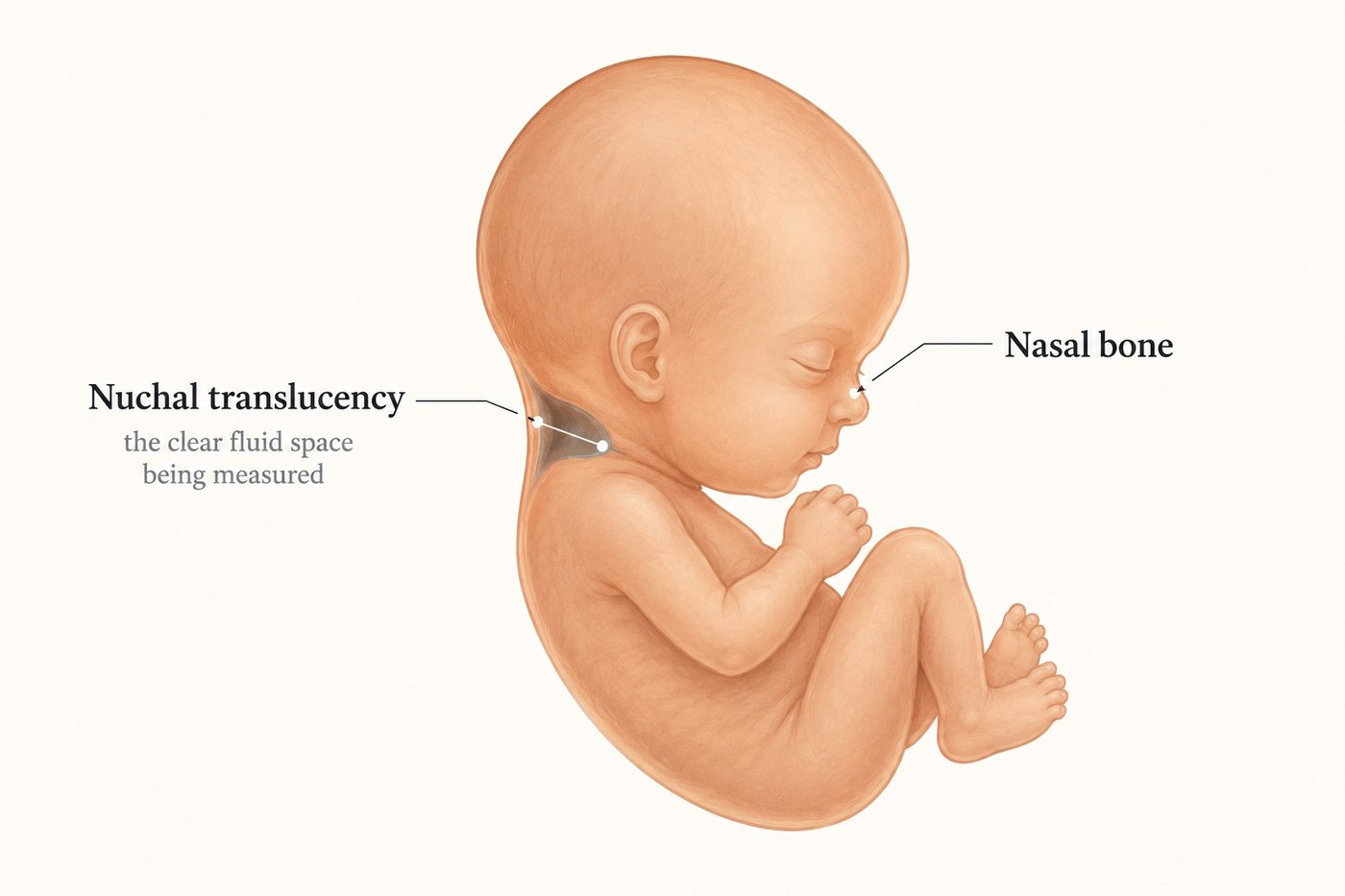
The name sounds clinical, but it describes something simple. Nuchal means the nape of the neck; translucency is a clear, fluid-filled space that shows up dark on ultrasound. So nuchal translucency is just the little pool of fluid that naturally sits at the back of every baby's neck at this stage.
Every baby has some. It's measured because a larger-than-expected pool can be linked to a higher chance of certain chromosomal conditions, chiefly Down syndrome (trisomy 21), and less often Edwards' (trisomy 18) and Patau's (trisomy 13). Now and then it's an early hint of a heart difference.
And here's a small piece of wonder to hold onto while you worry about the number: this measurement is taken to a fraction of a millimetre, on a baby the size of a lime, who is already moving, stretching, sometimes hiccupping on the screen, months before you'll feel any of it.
When a report reads NT/NB, the NB is the nasal bone, a second marker some centres check, because its presence can shift the overall picture.
Why does the timing matter so much?
Most scans are flexible about timing. This one isn't, and the reason is worth knowing.
The measurement only works between 11 weeks and 13 weeks plus 6 days, when your baby measures roughly 45 to 84 millimetres from head to bottom. Earlier, the baby is too small to measure that sliver of fluid reliably. After 14 weeks, the fluid is quietly reabsorbed, and the measurement stops meaning anything. Around 12 weeks is the sweet spot.
If you're reading this and the window feels tight, take a breath. Missing it isn't a crisis. A more advanced blood screen, or the later anomaly scan, can step in. But if the NT scan is on offer, this is the fortnight for it.
What happens on the day?
It looks much like your earlier scans. The sonographer moves a probe across your belly and your baby appears on screen. It's painless, uses only sound waves, and has no known risk. Occasionally an internal (vaginal) scan gives a clearer view, and that's safe too.
Your baby is measured head to bottom to confirm dates, then the nuchal fluid is measured, usually twenty to thirty minutes in all.
For many mothers, this is the first time you watch your baby move, months before you feel it. It's easy to arrive braced for a test and forget you're also about to meet your baby. Let yourself have that part too.
What if my baby won't cooperate?
This happens often enough that it's worth expecting rather than fearing.
The measurement needs your baby in a particular position, lying more or less sideways, neck neutral, not curled up or facing away. Babies at twelve weeks have opinions about this. So the sonographer may ask you to walk around, cough, empty your bladder, roll onto your side, or simply wait a while and try again. Sometimes you'll be asked to come back another day.
None of that means anything is wrong. It means your baby moved. A repeat visit inside the window is routine, not a red flag, and it's far better than recording a measurement the sonographer isn't confident about.
Why is there a blood test too?
This is the part that clears up the most confusion. The scan measurement, on its own, is only half the picture.
Its real power appears when it's paired with a blood test measuring two markers from the placenta, free beta-hCG and PAPP-A, known in India as the double marker test.
Put together, the scan, the two markers, and your age produce one combined result. This combined first-trimester screening picks up around 85 to 90 of every 100 babies with Down syndrome, far more than the scan could alone. The blood results take a few days, so the final figure usually arrives once both halves are in.
So when a prescription lists an NT scan and a double marker test together, that's why: two halves of one answer.
How do I read the result?
The result doesn't arrive as a yes or a no. It arrives as odds, a ratio like 1 in 1000, or 1 in 250. This is the single most important thing to understand, because odds are far gentler than they first look.
Read 1 in 1000 like this: if a thousand mothers had that exact result, about one baby would have the condition, and the other 999 would not. That's what your number is describing.
Most centres draw a line, often near 1 in 250 (though it varies): the reassuring side is reported as "low risk," the other as "higher risk."
It's easy to fixate on the millimetre. So it helps to know there's no single magic number. The fluid grows as the baby grows, and it's judged against your baby's size, not a fixed value. As a rough guide, many centres are reassured below about 3 millimetres and look more closely at 3.5 or above. But that reading is only one ingredient in the combined odds, weighed in context by your doctor, never read off a chart alone.
Because it's easy to confuse the tests that get mentioned together, here's how they relate:
| Test | What it is | What it tells you |
|---|---|---|
| NT scan | Ultrasound measuring the neck fluid | One input into the risk estimate |
| Double marker | Blood test (free beta-hCG, PAPP-A) | The other input, from the placenta |
| Combined result | NT + double marker + your age | Your overall odds (a screen, not a verdict) |
| NIPT | Blood test reading baby's DNA | A more accurate screen, if offered next |
| CVS / amniocentesis | Sample of placenta or fluid | A definite answer (diagnostic) |
What if the number comes back higher?
If your result lands on the higher-risk side, the first thing is to breathe.
It's natural, the moment you see "higher risk," to hear it as a diagnosis. It isn't one. A higher-risk result is not a diagnosis, and the great majority of these babies are born healthy. It simply means the sensible next step is more information, and that step is calm and structured:
- Genetic counselling first, to talk through what the number really means for you.
- NIPT, a more accurate blood screen that reads fragments of your baby's DNA from your blood. It's highly accurate for these conditions, though still a screen, so a positive is confirmed with a diagnostic test.
- A diagnostic test for a definite answer: CVS in the first trimester, or amniocentesis a little later.
- A closer look at the heart at the anomaly scan, if the nuchal measurement was raised.
Information first, then options, then support. You never have to jump from a number straight to the worst version of it. There are several careful, unhurried steps in between, and you walk them with a doctor beside you.
Speak to a doctor if
General information, not medical advice. It's worth reaching out if:
- 13 to 14 weeks is near or past and the scan hasn't been done. Ask about alternatives like a more advanced blood screen.
- Further testing or counselling is offered. Keeping that appointment is how the picture gets completed.
- At any point there's vaginal bleeding, severe pain, or another worrying symptom, which needs attention regardless of any scan.
Looking ahead
Once the scan and blood results are in, the intensity usually lifts. For most parents the combined result is reassuring, and the next checkpoint is the anomaly scan around week 20, a detailed look at how your baby is built.
By then you'll have had your baby's first measurement and first real reassurance, and you'll know the number for what it is: a set of odds, not a verdict.
A few weeks from now, there's a good chance this scan is simply the first grainy picture you kept, the one where they were the size of a lime, and already, unmistakably, yours.
References
- Fetal Medicine Foundation (FMF). Nuchal Translucency Scan, 11 to 13 Weeks Assessment.
- National Institute for Health and Care Excellence (NICE). Antenatal Care, NG201 (first-trimester combined screening).
- National Health Service (NHS UK). Screening for Down's, Edwards' and Patau's Syndromes.
- American College of Obstetricians and Gynecologists (ACOG). Prenatal Genetic Screening Tests, Patient FAQ.
- Cleveland Clinic. Nuchal Translucency Screening.
- Government of India. Pre-Conception and Pre-Natal Diagnostic Techniques (PCPNDT) Act, 1994.