
Finding out that two babies are on the way can bring a rush of excitement and a fair amount of worry at the same time. A twin pregnancy follows the same broad path as any other, but with a few important differences in care, comfort and monitoring.
The reassuring part is that most twin pregnancies lead to healthy babies. They simply need a little more attention along the way, and knowing what to expect makes the road ahead feel far less daunting.
Key takeaways
- A twin pregnancy means carrying two babies, either identical (from one egg) or fraternal (from two eggs).
- It usually involves more antenatal appointments and more ultrasound scans than a single pregnancy.
- The body works harder, so early symptoms and weight gain can be more noticeable.
- Most risks, such as early birth, are managed well when the pregnancy is monitored closely.
- Twins are often born a little earlier than single babies, and many arrive healthy.
This is for general understanding, not personal medical advice. Every pregnancy is different, and a qualified healthcare professional can give guidance suited to your situation.
A twin pregnancy begins in one of two ways
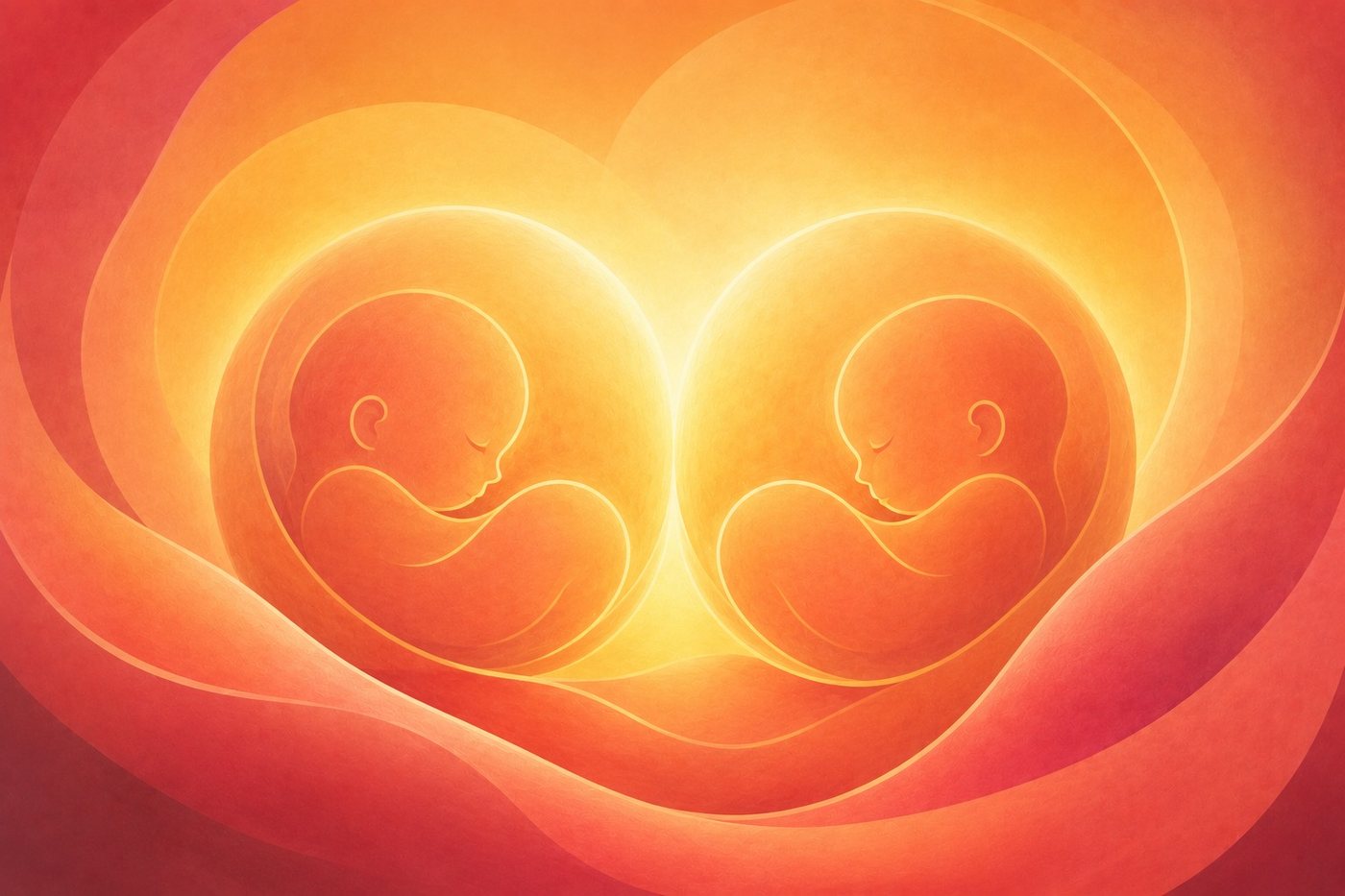
Twins form in one of two ways. Identical twins develop when a single fertilised egg splits into two, so the babies share the same genes. Fraternal twins, which are more common, develop when two separate eggs are fertilised by two different sperm, so they are no more alike than any brother or sister.
An early ultrasound scan also shows how the babies share the womb. When each baby has its own placenta and sac, this is called a dichorionic diamniotic (DCDA) pregnancy, which carries the lowest risk. When identical twins share one placenta, called a monochorionic diamniotic (MCDA) pregnancy, closer monitoring is needed. This is why the first scan matters so much: it sets the level of care for the months ahead.
How common are twins?
Twins are more common than many people expect. According to the Royal College of Obstetricians and Gynaecologists, multiple pregnancies, including twins, occur in roughly 1 in 60 pregnancies. Identical twins, where one egg splits, are less common, at about 1 in 250 pregnancies, and most twins are fraternal. The overall chance has risen over the years, mainly with fertility treatment and later motherhood.
Several things make twins more likely
A few things make twins, especially fraternal twins, more likely:
- Fertility treatment, such as IVF or medicines that stimulate ovulation
- Older age, particularly after 35
- A family history of fraternal twins on the mother's side
- Having been pregnant before, especially with twins
None of these guarantee twins. They simply raise the odds, and many twin pregnancies happen with none of them present.
What are the early signs of a twin pregnancy?
Because the body produces more pregnancy hormones when carrying two, some early signs can feel stronger. Greater tiredness, more nausea and tender breasts are common, and the bump may measure larger than expected for the dates. These signs only hint at twins, though, since every pregnancy feels different. A twin pregnancy is usually confirmed at the first scan, around 11 to 14 weeks.
Carrying twins differs from carrying one baby in a few key ways
Carrying two babies changes a few practical things, mostly around care and how hard the body works. The table below sets the main differences side by side.
| What changes | Single pregnancy | Twin pregnancy |
|---|---|---|
| Antenatal care | Standard schedule of check-ups | Specialist team, more frequent check-ups |
| Ultrasound scans | Usually two routine scans | More scans: DCDA twins often every 4 weeks, shared-placenta twins more often |
| The bump | Grows steadily | Tends to grow sooner and larger |
| Weight gain | Standard range | A little more is expected and healthy |
Eating well matters more than eating for two
Carrying twins raises the body's needs, but the goal is eating well, not eating for two. A balanced diet with enough iron, protein, calcium and folic acid supports both babies, and the antenatal team may suggest specific supplements. Rather than counting extra calories, most women do best focusing on regular, nourishing meals, plenty of fluids, and eating little and often when appetite is low.
Is it safe to exercise during a twin pregnancy?
For most women, gentle activity stays safe and helpful during a twin pregnancy. Walking, swimming and prenatal yoga can ease aches and support sleep and mood. Because twins are watched more closely, it is best to check with the obstetrician first, and to follow their guidance if they suggest scaling back at any stage.
Which risks need closer monitoring?
Most twin pregnancies are healthy. A few risks are simply more common with two babies, which is exactly why the extra monitoring exists:
- Early birth, before 37 weeks, the most common, which can mean a lower birth weight and a short stay in a neonatal unit.
- Pre-eclampsia, gestational diabetes, and iron-deficiency anaemia.
- Twin-to-twin transfusion syndrome, an unequal blood flow between identical twins who share one placenta.
Twins are usually born a little earlier
Twins usually arrive earlier than single babies. For twins with separate placentas, birth is often planned around 37 weeks, which is considered full term for twins, and a little earlier when a placenta is shared.
More than half of twins are born by caesarean section, though a vaginal birth is often possible, mainly depending on the position of the lower baby and how the pregnancy is progressing. The birth usually takes place in hospital, planned with the specialist team, so there is time to talk through the options and agree a plan.
When should you call your doctor?
Knowing when to reach out brings real peace of mind. It is worth contacting the maternity team promptly if any of these appear:
- Leaking fluid or vaginal bleeding
- Regular, painful tightenings or contractions
- A noticeable drop in the babies' movements later in pregnancy
- A severe headache, or changes in vision such as blurring or flashing lights
- Sudden swelling of the face, hands or feet
These do not always mean something is wrong, but with twins they are worth checking early rather than waiting.
Preparing early makes the newborn weeks easier
Because twins often arrive early, it helps to be ready a little sooner than for a single baby. A few things make the newborn weeks easier:
- Be ready by around 34 weeks, with the hospital bag packed and any antenatal classes finished, since twins often come ahead of time.
- Line up practical help from family or friends, especially for the first few months.
- Plan for feeding, whether by breast, bottle or a mix, with support from a midwife or feeding specialist.
- Protect rest and accept help, which with two babies are part of staying well rather than luxuries.
- Mention any lasting low mood or anxiety to a doctor, as this can be more common after a twin pregnancy.
Looking ahead
With the right care in place, a twin pregnancy can feel far more manageable than it first appears. Attending every appointment and keeping the specialist team close are the surest ways to give both babies a healthy start.
References
- Royal College of Obstetricians and Gynaecologists (RCOG). Multiple pregnancy: having more than one baby.
- American College of Obstetricians and Gynecologists (ACOG). Multifetal Gestations: Twin, Triplet, and Higher-Order Multifetal Pregnancies.
- NCT. Twins and multiple birth.
- East Kent Hospitals NHS Foundation Trust. Twins and multiple pregnancies.
- University Hospitals Sussex NHS Foundation Trust. Twins and more.
- Twins Trust. How to stay healthy whilst pregnant with twins.