Between 10 and 14 weeks of pregnancy, a new set of test names tends to arrive: NT scan, double marker and NIPT. It can feel like a lot to decide at a time when you are still getting used to being pregnant.
Maybe your doctor has just suggested it, a friend mentioned it, or you are planning ahead. Either way, the questions are usually the same. What does it check, how far can you trust it, and is it worth the cost?
Key takeaways
- NIPT reads tiny fragments of DNA (deoxyribonucleic acid) that the placenta releases into your blood.
- It picks up about 997 in 1,000 pregnancies with Down syndrome, but it does not check for every chromosomal condition.
- A "high chance" result is not a diagnosis. Whether it is correct depends partly on your age and background chance.
- NIPT and your pregnancy scans do different jobs, so a low-chance result does not replace them.
- In India, labs cannot reveal your baby's sex under the PCPNDT (Pre-Conception and Pre-Natal Diagnostic Techniques) Act.
This is for understanding, not diagnosis. Your obstetrician or a genetic counsellor is the right person to help you decide on testing and to read your report.
The quick answer
Non-invasive prenatal testing, usually shortened to NIPT, is a simple blood test, done from about 10 weeks. It checks the pregnancy for three chromosomal conditions, the best known being Down syndrome.
For these three conditions, leading medical guidelines describe it as the most accurate screening test available, and it carries no risk to your baby. It is still a screening test, though, so a "high chance" result is followed by an offer of a diagnostic test to confirm it.
What exactly does NIPT look at?
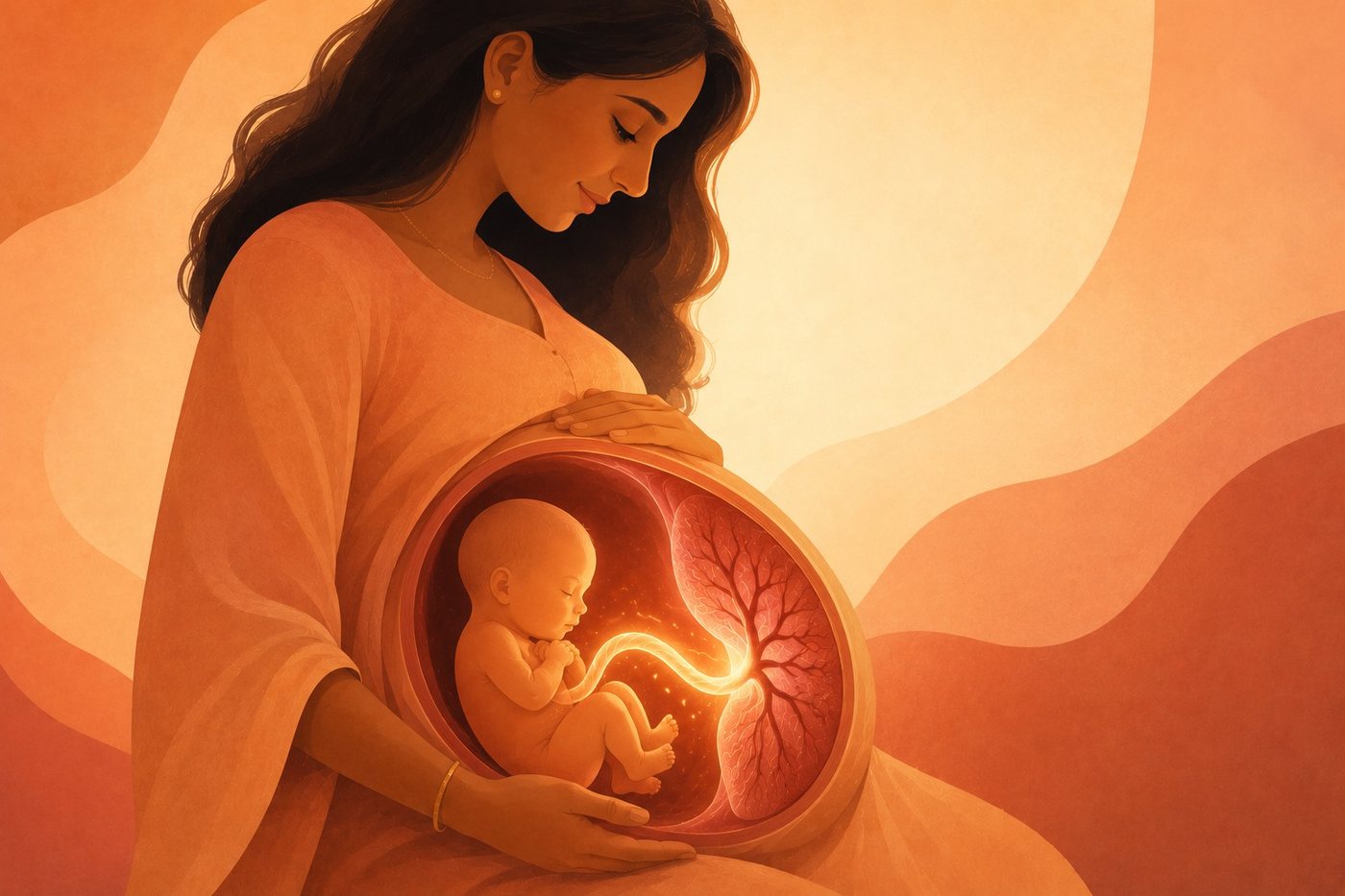
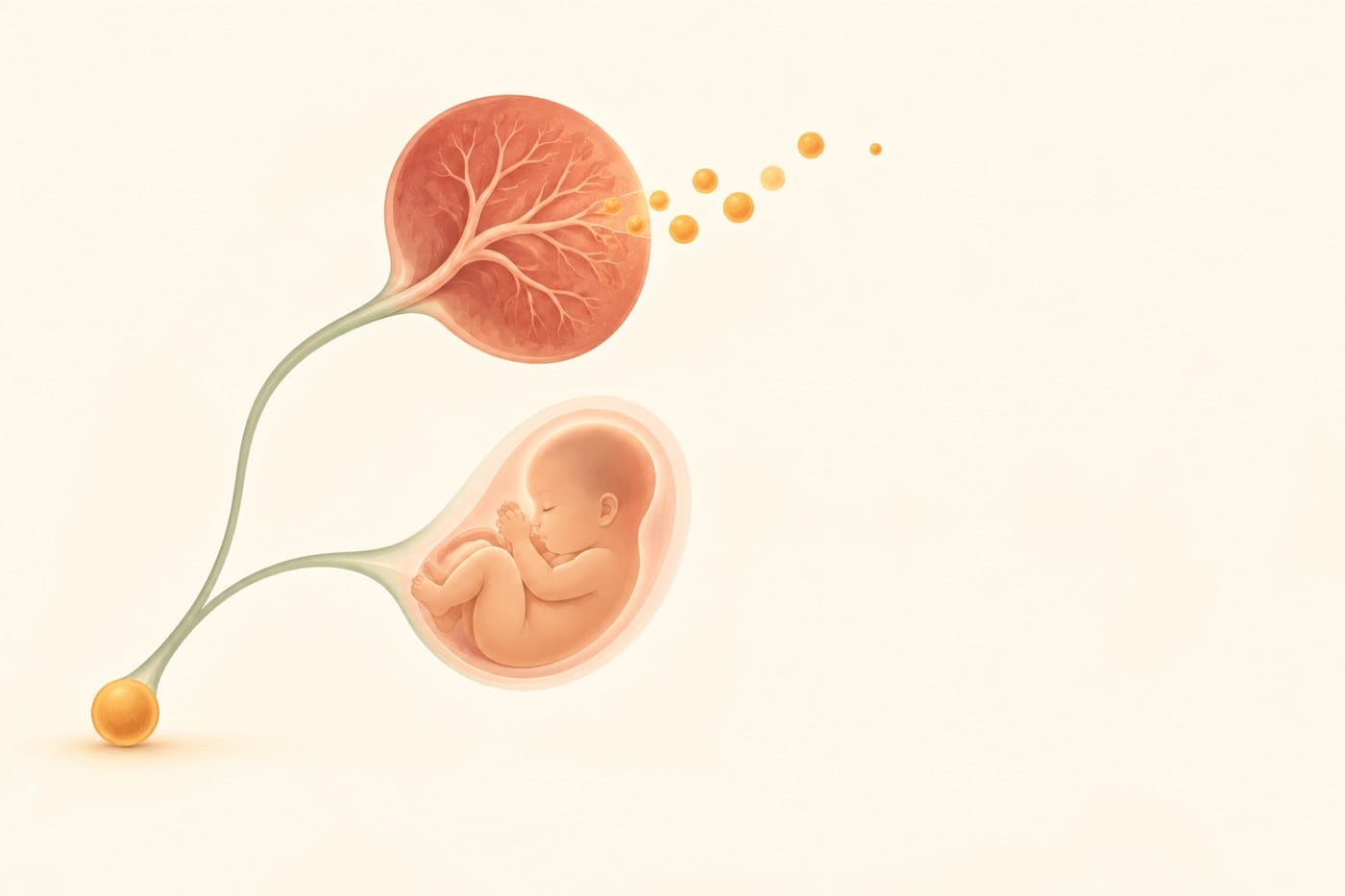
During pregnancy, the placenta sheds tiny pieces of its genetic material into your bloodstream. By around 10 weeks, there is usually enough of it for a lab to read.
The lab counts these fragments to see whether there is extra material from certain chromosomes. You may also hear the test called cfDNA (cell-free DNA) screening.
Here is something that may surprise you. Most of this DNA is shed by the placenta rather than by the baby itself, and it works as a stand-in because both grow from the same fertilised egg.
This clever shortcut also explains why NIPT is occasionally wrong. Very rarely, the placenta carries a chromosome change that your baby does not.
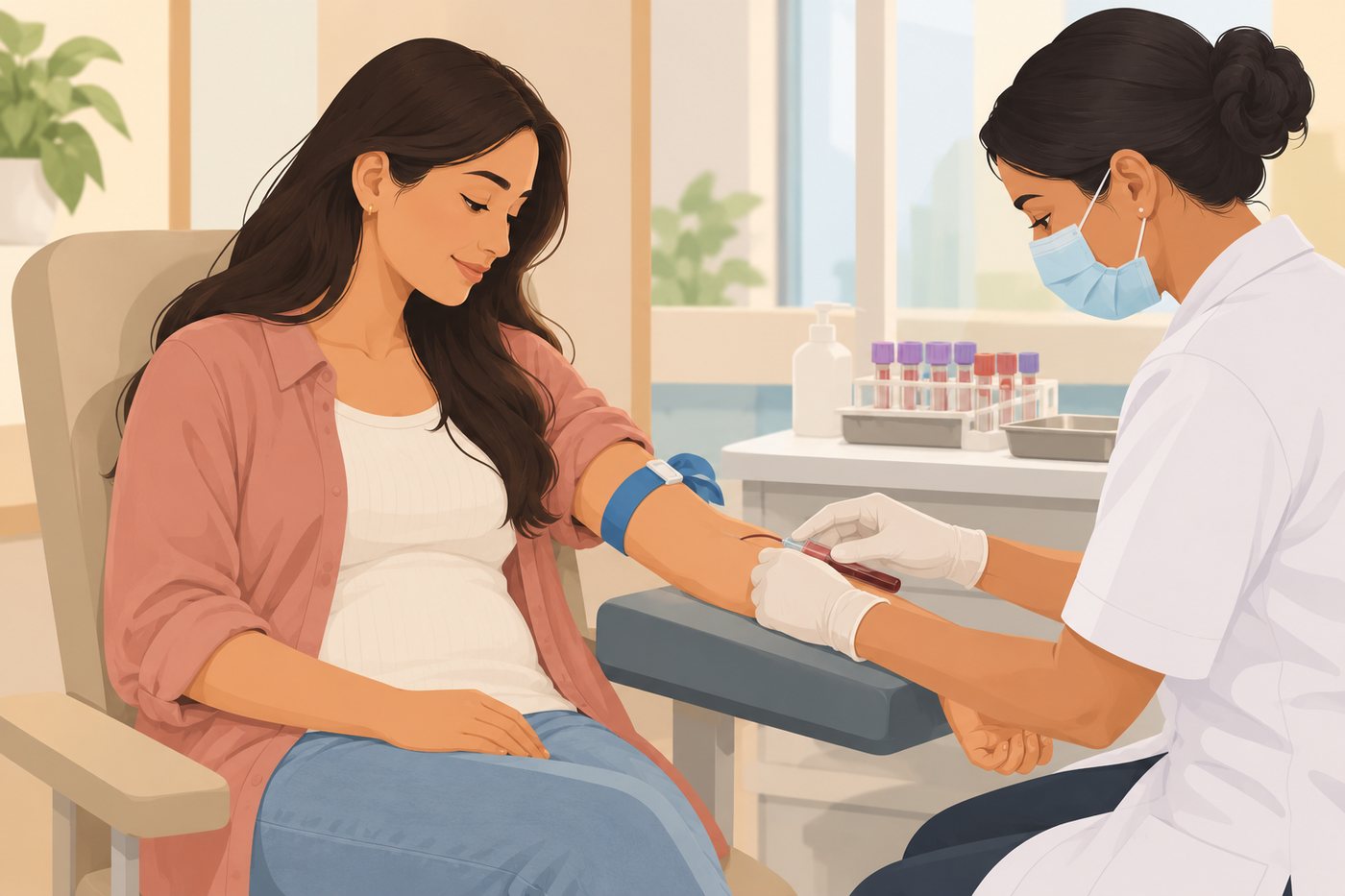
Usually, nothing is needed from you beyond a routine blood draw. There is no fasting and no full bladder. There is also no risk of miscarriage, because nothing enters the womb.
It screens for three main conditions, not everything
Every standard NIPT panel looks for an extra copy of one of three chromosomes.
| Condition | Medical name | What happens in the cells |
|---|---|---|
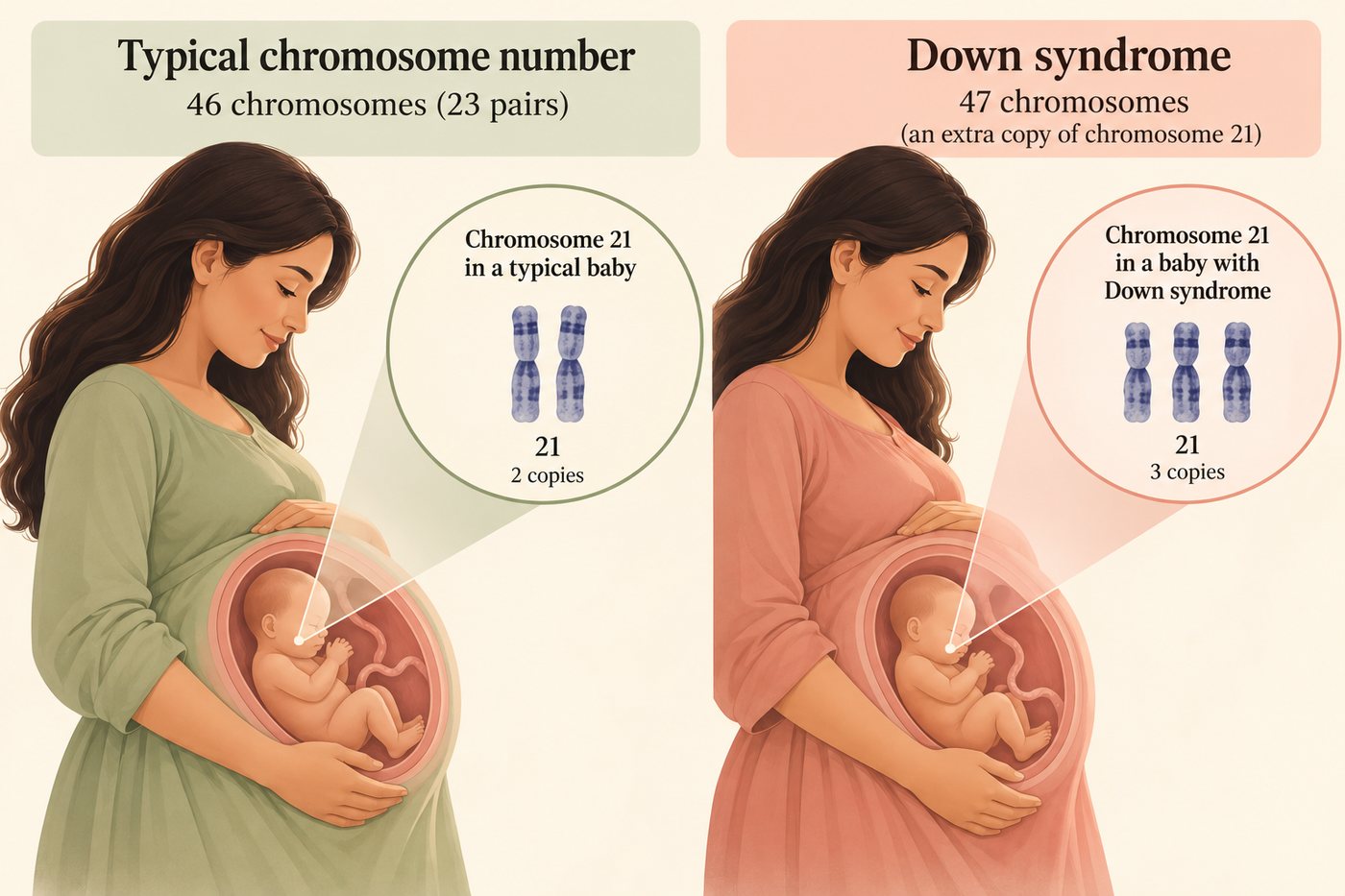
| Down syndrome | Trisomy 21 | Chromosome 21 is present in three copies instead of two |
| Edwards syndrome | Trisomy 18 | Chromosome 18 is present in three copies instead of two |
| Patau syndrome | Trisomy 13 | Chromosome 13 is present in three copies instead of two |
Some panels also offer checks for sex chromosome differences and for tiny missing pieces of chromosomes, called microdeletions. International guidance treats these as optional extras, because the results are less reliable.
NIPT cannot detect every chromosomal condition. It also cannot see:
- Physical differences such as heart defects, cleft lip or spine problems.
- Rarer or smaller chromosome changes outside the panel.
- Inherited single-gene conditions such as thalassaemia, which need separate carrier testing of both parents.
How accurate is NIPT, really?
Accuracy depends on the condition and on who is being tested. Three terms help make sense of the numbers you may see on a report or lab website.
| Term | What it means in plain words | Figure for Down syndrome screening |
|---|---|---|
| Detection rate (sensitivity) | Of babies who have the condition, how many the test flags | About 99.7% |
| False-positive rate | Of babies without the condition, how many are wrongly flagged | About 0.04% |
| Positive predictive value | Of all high-chance results, how many turn out to be correct | Varies with your background chance |
These figures come from a large review that pooled many research studies. In everyday practice, results can vary somewhat between laboratories and between groups of people tested.
In the same review, detection was about 98% for Edwards syndrome and about 99% for Patau syndrome, though far fewer pregnancies with these rarer conditions were studied.
Why a high-chance result is not a diagnosis
The chance of Down syndrome rises as your age at pregnancy rises. When your starting chance is lower, the few false alarms make up a bigger share of all positive results. As your starting chance rises, a positive result becomes more likely to be correct.
A patient guide from a United States health system shows this with two example groups. In one, Down syndrome occurs in about 1 in 1,000 pregnancies. In the other, it occurs in about 1 in 100 or more.
Out of every 100 high-chance results:
- In the 1 in 1,000 group, about 33 babies had Down syndrome.
- In the 1 in 100 group, about 83 did.
These are illustrations, not personal figures. Your own chance depends on your age, your scans and your history.
A study in the United States found a similar pattern in real life. It looked at 1,914 pregnancies from the general population, with an average age of 30, and just under half of the positive Down syndrome results were confirmed.
So a high-chance result tells you to look closer, not what the answer is. Your doctor can work out what it means for you.
Your report will show one of three results
Most reports say low chance or high chance for each condition. A smaller number come back with no result.
| Result | What it means | What usually happens next |
|---|---|---|
| Low chance | These conditions are very unlikely | Routine care continues, including your scans |
| High chance | The chance is raised, but this is not a diagnosis | Genetic counselling, then an offer of a diagnostic test: CVS (chorionic villus sampling), usually around 11 to 14 weeks, or amniocentesis, usually from 15 weeks |
| No result | There was too little placental DNA in the sample | A repeat sample, often with a detailed scan |
A no-result happens when the sample has too little placental DNA. This is more common very early in pregnancy or with a higher body weight.
A no-result is usually not a sign that something is wrong. However, a failed test is linked with a slightly higher chance of a chromosomal condition, so your doctor may suggest a detailed scan alongside a repeat sample.
If a second sample also gives no result, your doctor will talk you through the options. These may include a detailed scan, another type of screening or a diagnostic test.
Is NIPT better than the double marker test?
When the aim is to pick up Down syndrome, yes. NIPT catches more affected pregnancies and raises far fewer false alarms than the double marker blood test combined with the NT (nuchal translucency) scan.
| Feature | Double marker + NT scan | NIPT |
|---|---|---|
| What it uses | Two pregnancy hormones in your blood, plus an ultrasound measurement | Placental DNA in your blood |
| When it is done | 11 to 14 weeks | From 10 weeks |
| Down syndrome detection | About 82 to 87 in 100 | About 99 in 100 |
| Pregnancies flagged positive | About 5 in 100 | Well under 1 in 100 |
| Cost | Lower | Higher |
For a side-by-side look at all the screening options, including the triple test, read Down syndrome screening in India.
Why your scans still matter after a low-chance NIPT
NIPT answers one question: is there an extra copy of chromosome 21, 18 or 13? The NT scan measures a small pocket of fluid beneath the skin behind the baby's neck, and takes an early look at how the body is forming.
A thicker neck fold can sometimes point to a heart or other physical difference even when the chromosomes are normal. No blood test can pick that up.
This is why most doctors advise continuing your first-trimester scan and your anomaly scan, whatever your NIPT result.
To see when each of these scans usually happens, read the pregnancy ultrasound schedule.
Who is usually advised NIPT, and what it costs in India
Guidelines now say NIPT should be offered in every pregnancy. In India, doctors most often recommend it when:
- You are 35 or older.
- Your double marker or NT scan shows a high-chance result.
- You have had a previous pregnancy with a chromosomal condition.
- There is a family history your doctor wants to look at more closely.
NIPT is not part of free government screening in India, so you pay for it yourself. What you pay depends mostly on which panel you choose.
| Panel | What it usually screens for | Listed lab prices (2026) |
|---|---|---|
| Basic | Trisomy 21, 18 and 13 | About ₹10,000 to ₹20,000 |
| Comprehensive | The basic three, plus sex chromosome differences, microdeletions and, in some labs, all chromosomes | About ₹20,000 to ₹40,000 |
The basic panel covers the three conditions that guidelines recommend screening for. Comprehensive panels add conditions where results are less reliable and routine screening is not advised, so the extra cost buys breadth, not better accuracy.
Some premium packages that include genetic counselling cost more. What each lab calls "comprehensive" also varies, and prices overlap between labs. Always check exactly what is included, and confirm the current price, before you pay.
Before booking, it helps to ask your doctor:
- Which conditions does this panel screen for, and which does it not?
- Is the basic panel enough for my situation, or is there a reason to add more?
- What would we do next if the result is high chance or no result?
- Does my pregnancy, for example twins or donor eggs, change which test suits me?
When to see a doctor
Speak to your doctor if:
- Your NIPT result is high chance for any condition.
- The report says no result, or the lab asks for a repeat sample.
- You are carrying twins or more, conceived with donor eggs, or have had an organ transplant or a recent blood transfusion.
Seek care promptly if you notice bleeding, severe cramping or leaking fluid at any point in pregnancy.
Looking ahead
Your anomaly scan at around 18 to 20 weeks is the next big checkpoint. It looks at the heart, brain, spine and limbs in far more detail than the first-trimester scan.
If your result is high chance, you will usually be offered genetic counselling first. A fetal medicine specialist or genetic counsellor will explain your personal chance and whether CVS or amniocentesis suits how far along you are.
Any decision is yours to make with a qualified clinician, in your own time. There is usually no need to decide anything on the day the report arrives.
References
- Rink BD, Dugoff L, Kuller JA; Society for Maternal-Fetal Medicine. Consult Series #74: Cell-free DNA screening for aneuploidies: updated guidance. Pregnancy. 2025.
- American College of Obstetricians and Gynecologists. Practice Advisory: Screening for Fetal Chromosomal Abnormalities. January 2026.
- American College of Obstetricians and Gynecologists. Practice Bulletin No. 226: Screening for Fetal Chromosomal Abnormalities. Obstet Gynecol. 2020;136:e48-69.
- Gil MM, Accurti V, Santacruz B, Plana MN, Nicolaides KH. Analysis of cell-free DNA in maternal blood in screening for aneuploidies: updated meta-analysis. Ultrasound Obstet Gynecol. 2017;50:302-314.
- Iwarsson E, et al. Analysis of cell-free fetal DNA in maternal blood for detection of trisomy 21, 18 and 13: a systematic review and meta-analysis. Acta Obstet Gynecol Scand. 2017;96:7-18.
- Bianchi DW, et al. DNA sequencing versus standard prenatal aneuploidy screening. N Engl J Med. 2014;370:799-808. Summary.
- Huntington Health. Cell-free fetal DNA screening (NIPT) patient infographic.
- Norton ME, et al. Cell-free DNA analysis for noninvasive examination of trisomy. N Engl J Med. 2015;372:1589-1597.
- Prenatal cell-free DNA screening test failures: a systematic review of failure rates, risks of Down syndrome, and impact of repeat testing. Genetics in Medicine.
- Cell-free DNA screening in twin pregnancies (review).
- Carlson LM, Vora NL. Prenatal diagnosis: screening and diagnostic tools. Obstet Gynecol Clin North Am. 2017;44(2):245-256.
- Santoli CMA, Dotters-Katz SK, Sparks TN, Kuller JA. An overview of current prenatal genetic screening and diagnosis guidelines. Pregnancy. 2025.
- The emergence and global spread of noninvasive prenatal testing. Annual Review of Genomics and Human Genetics.
- Indicative lab prices, 2026: LifeCell, Fertilia Health, Mapmygenome, DNA Labs India, Lupin Diagnostics.
Common questions
Is NIPT safe for my baby?
Yes. NIPT needs only a blood sample from your arm, so it carries no risk of miscarriage and does not touch the pregnancy. The only risks are the usual minor ones of any blood test, such as a small bruise. Chorionic villus sampling and amniocentesis are different, because they collect cells from inside the womb.
Can NIPT tell my baby's gender in India?
No. Some panels can detect sex chromosomes, but the PCPNDT Act prohibits revealing a baby's sex before birth, so labs in India leave this out of the report. In India, NIPT is offered only as a medical screening test.
Can NIPT be done after the first trimester?
Yes. NIPT can be done any time from 10 weeks, including in the second and third trimesters. Many doctors time it around 11 to 13 weeks, close to the NT scan, so both results can be read together. Results usually arrive within one to two weeks.
Can NIPT be done in a twin or IVF pregnancy?
In twins, NIPT is a recommended first-line screen for Down syndrome. Detection of trisomy 18 and 13 also appears high, though fewer twin pregnancies with these conditions have been studied. Because data are still limited, screening for sex chromosome differences in twins, and NIPT for triplets or more, are not currently recommended. A vanishing twin (a twin that stops growing early in pregnancy) can also affect results, and labs differ in what they offer. IVF (in vitro fertilisation) with your own eggs does not change the test. Tell the lab if donor eggs were used.
This article explains how NIPT works so you can have a clearer conversation with your doctor. It is general education, not medical advice or a diagnosis. Decisions about prenatal testing depend on your own health history and are best made with your obstetrician, fetal medicine specialist or genetic counsellor.
 Medically reviewed byDr. Mahender Singh, MBBS, DCH, MD (Paediatrics)A consultant child specialist and neonatologist with over four decades of practice in newborn and child health.
 Written bySarthak ThakurCo-founder, CTO and Chief Marketing Officer of ParentVeda, and the software engineer who builds its app and the pipeline that checks its articles.
This article explains; it doesn’t diagnose. If your doctor has told you something different, your doctor is right.