Around your third month, "screening" starts appearing on your prescriptions. Your doctor mentions the double marker, a friend swears by NIPT (Non-Invasive Prenatal Testing), and the lab lists a triple test, each at a very different price.
It is natural to wonder which one your baby really needs. It is just as natural to feel a small knot of worry once the words "Down syndrome" enter the conversation.
Key takeaways
- All three tests estimate a chance. None of them diagnoses Down syndrome.
- The NT scan is a core part of first-trimester screening, not an optional add-on to the double marker.
- NIPT is the most accurate screen, but a high-chance or no-result NIPT still needs follow-up.
- None of these tests replaces the anomaly scan at 18 to 22 weeks.
This is for understanding, not diagnosis. Your own doctor or a genetic counsellor is the right person to read your report with you.
The quick answer
The double marker, triple test and NIPT are all screening tests. They estimate the chance of Down syndrome but cannot confirm it.
The double marker is done with your NT (nuchal translucency) scan at 11 to 14 weeks. The triple or quadruple test is done at about 14 to 20 weeks, and NIPT from 10 weeks. NIPT is the most accurate but costs more. A "high chance" result from any of them needs a diagnostic test to be sure.
Screening gives you a chance, not a diagnosis
A screening test combines blood markers with your age and weeks of pregnancy. It gives a number such as "1 in 1,500" or "1 in 150".
That number is an estimate. A result of 1 in 250 means that, among many pregnancies with a similar result, roughly 1 in 250 would be expected to have a baby with Down syndrome. It says nothing certain about your own baby.
Each lab sets its own cut-off for calling a result "high chance". Cut-offs commonly range from 1 in 150 to 1 in 270, so always read your report with your doctor.
How do NIPT, double marker and triple test compare?
| Test | When it is done | What is checked | Indicative price (private labs, September 2026) |
|---|---|---|---|
| Double marker + NT scan | 11 to 14 weeks | 2 pregnancy hormones in blood, plus the neck-fluid measurement on scan | Blood test about ₹1,200 to ₹3,600. The NT scan is usually billed separately. |
| Triple test | About 14 to 20 weeks | 3 blood markers | About ₹900 to ₹2,900 |
| Quadruple test | About 14 to 20 weeks | 4 blood markers | About ₹3,200 to ₹5,600 |
| NIPT | From 10 weeks | DNA (deoxyribonucleic acid, the genetic material) fragments from the placenta, found in your blood | About ₹12,000 to ₹15,000 for standard panels. Extended panels cost more. |
Prices are indicative listings from private labs in September 2026, not fixed national rates. Confirm what is included before booking.
Accuracy depends on the study behind the number
| Test | Picks up Down syndrome | False alarms | Where the figures come from |
|---|---|---|---|
| Double marker + NT scan | 82 to 87 in 100 (higher when done at 11 weeks than at 13) | About 5 in 100 | A large American trial of general-population pregnancies, with the cut-off set to flag about 5 in 100 |
| Triple test | About 65 to 70 in 100 | About 5 in 100 | Older pooled studies and American genetics guidance |
| Quadruple test | About 81 in 100 | About 5 in 100 | American obstetric guidance, using the same 5 in 100 cut-off |
| NIPT | More than 99 in 100 | About 1 in 1,000 or fewer | Pooled studies, mostly of higher-risk pregnancies, counting only samples that gave a result |
These figures come from specific studies. Your lab's real-world results can differ with your age, the quality of the scan and the population tested.
- Picks up (detection rate): out of 100 babies who do have Down syndrome, how many the test flags.
- False alarms (false-positive rate): out of 100 babies who do not, how many the test still flags.
Neither number is your personal chance of a wrong result. Because Down syndrome is uncommon, many high-chance results turn out fine, which is why even a high-chance NIPT needs confirming.
What each test does best
- Double marker with NT scan: The scan adds its own information and can spot some early physical differences. It also screens for Edwards and Patau syndromes.
- Triple or quadruple test: This is useful if you missed the first-trimester window. It can also flag a raised chance of open neural tube defects, such as spina bifida.
- NIPT: This test reads DNA fragments that come mostly from the placenta. The placenta usually matches the baby but occasionally does not, which is one reason NIPT remains a screen. It does not check for neural tube defects.
Screening panels differ between labs, and none of these tests checks for every chromosomal or physical condition.
Which test fits your pregnancy?
Screening should be offered in every pregnancy, at any age. No group has one test that is right for everyone in it. The choice depends on your weeks, your history, how much certainty you want and what is practical.
| Your situation | Options you may discuss | Worth knowing |
|---|---|---|
| Under 11 weeks, routine pregnancy | NT scan with double marker, or NIPT | The NT scan gives information no blood test can |
| Past 14 weeks, no screening yet | Quadruple or triple test before about 20 weeks, or NIPT | Each test has a time window |
| 35 or older | Any screening test, or a diagnostic test if you want a definite answer | Age raises the starting chance but does not decide the test |
| Pregnant through IVF (in vitro fertilisation) | The same options as any pregnancy | With donor eggs, the lab uses the donor's age, so share your IVF details |
| Expecting twins | Discuss your options with your doctor or a fetal medicine specialist | Screening is less straightforward in twins, and results may be less reliable if one twin has stopped growing |
| Previous baby or family history of a chromosomal condition | Genetic counselling first | Some conditions are not covered by screening panels |
You may quietly worry that choosing the cheaper test means doing less for your baby. It does not. A well-done NT scan with double marker is a sound screen, and what protects you most is acting on the result.
What happens if a result says "high chance"?
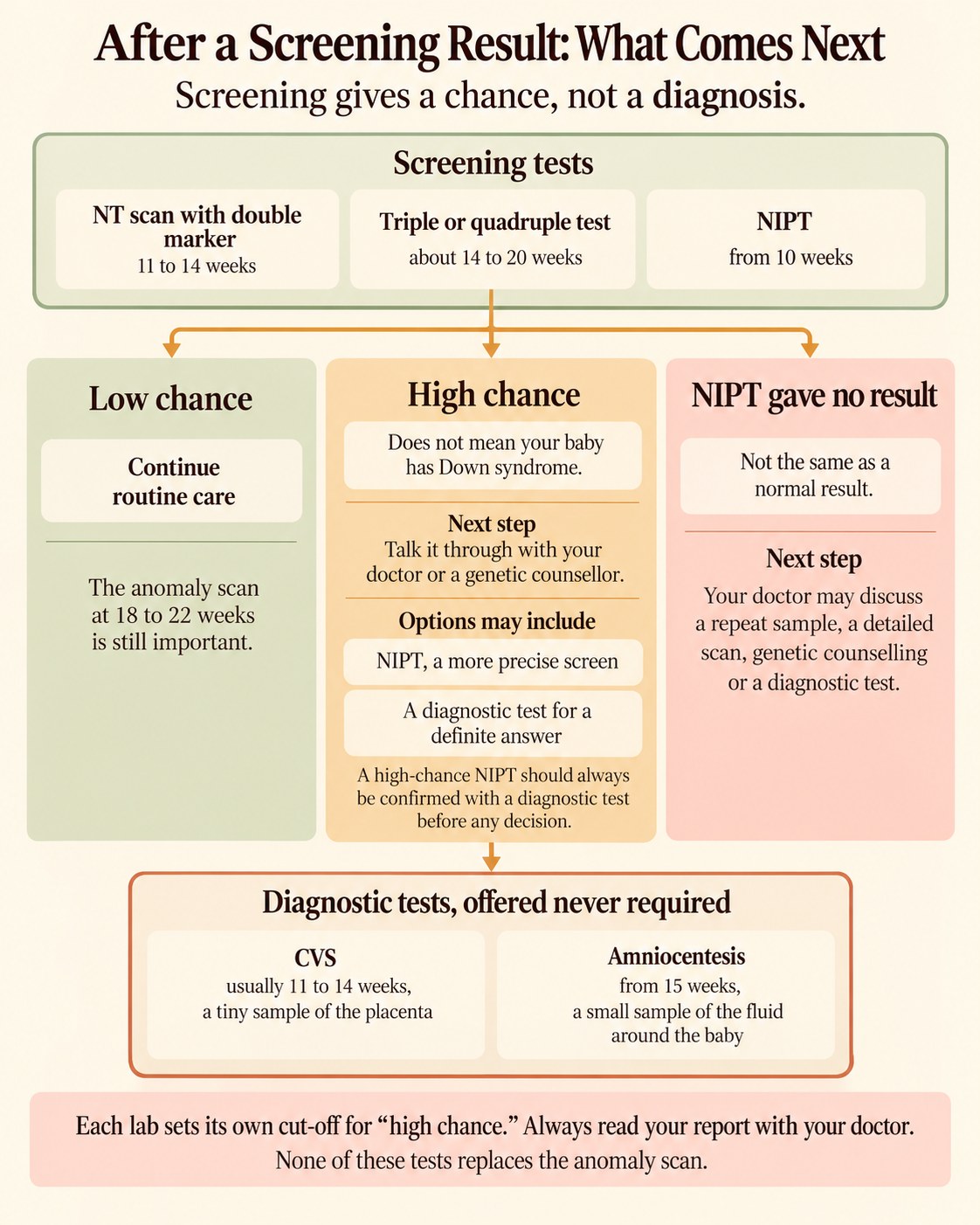
It does not mean your baby has Down syndrome. The next step depends on how high the number is, your weeks of pregnancy, what the scan showed and what you want to know.
Options your doctor or a genetic counsellor may discuss include:
- Talking through what your specific number means.
- NIPT, if you prefer a more precise screen without a procedure.
- A diagnostic test, CVS or amniocentesis, if you want a definite answer.
A high-chance NIPT should always be confirmed with a diagnostic test before any decision is made.
If NIPT gives no result
A no-result is not the same as a normal result. It can happen for different reasons, such as too little placental DNA in the sample, and it is linked with a higher chance of a chromosomal condition.
What comes next depends on the reason, your weeks and your earlier results. Your doctor may discuss a repeat sample, a detailed scan, genetic counselling or a diagnostic test.
Diagnostic tests give a far more definite answer
Diagnostic tests examine cells from the pregnancy directly. They carry a small risk, so they are offered, never required.
| CVS (chorionic villus sampling) | Amniocentesis | |
|---|---|---|
| Usually done | 11 to 14 weeks | From 15 weeks |
| What is sampled | A tiny piece of the placenta | A small amount of the fluid around your baby |
| Miscarriage risk | Often quoted as about 1 in 200. Recent pooled studies suggest the added risk may be lower. | Often quoted as about 1 in 200. Recent pooled studies suggest the added risk may be lower. |
| Worth knowing | Occasionally reflects the placenta rather than the baby, and an amniocentesis may then be advised | Gives results later in pregnancy |
When to see a doctor
Speak to your doctor if:
- You are nearing 14 weeks and have not booked your NT scan and double marker.
- Your report says "high chance", or your NIPT came back with no result.
- You are 35 or older, pregnant through IVF, expecting twins, or have a family history of a chromosomal condition.
- Waiting for results is affecting your sleep, appetite or daily life.
Looking ahead
For most families, screening ends with a low-chance result. The next milestone is the anomaly scan at 18 to 22 weeks, which looks closely at your baby's heart, brain, spine and limbs.
To see where this and every other scan falls, read the pregnancy ultrasound schedule.
If your path takes a different turn, support is there. Genetic counsellors, fetal medicine specialists and Down syndrome parent groups in India can walk the road ahead with you, one step at a time.
References
- American College of Obstetricians and Gynecologists. Practice Advisory: Screening for Fetal Chromosomal Abnormalities. 2026.
- American College of Obstetricians and Gynecologists. Practice Bulletin No. 226: Screening for Fetal Chromosomal Abnormalities. Obstet Gynecol 2020;136:e48–69.
- Society for Maternal-Fetal Medicine. Consult Series #74: Cell-free DNA screening for aneuploidies, updated guidance. 2025.
- American College of Obstetricians and Gynecologists. Current ACOG Guidance on Non-Invasive Prenatal Testing.
- American College of Obstetricians and Gynecologists. Committee Opinion No. 640: Cell-free DNA Screening for Fetal Aneuploidy.
- NHS. Screening for Down's syndrome, Edwards' syndrome and Patau's syndrome.
- NHS Genomics Education Programme. Chorionic villus sampling.
- NHS Genomics Education Programme. Amniocentesis.
- American College of Medical Genetics. Second trimester maternal serum screening for fetal open neural tube defects and aneuploidy. Genet Med 2004.
- Gil MM, Akolekar R, Quezada MS, Bregant B, Nicolaides KH. Analysis of cell-free DNA in maternal blood in screening for aneuploidies: meta-analysis.
- Norton ME, et al. Cell-free DNA Analysis for Noninvasive Examination of Trisomy. N Engl J Med 2015.
- Triple-marker test as screening for Down syndrome: a meta-analysis (DARE).
- Akolekar R, et al. Procedure-related risk of miscarriage following amniocentesis and chorionic villus sampling: systematic review and meta-analysis. Ultrasound Obstet Gynecol 2015.
- Hardisty E, et al. Cell-Free DNA Screening: Complexities and Challenges of Clinical Implementation.
- Feto-placental mosaicism and NIPT results (case report and review). Front Genet 2022.
- Pre-Conception and Pre-Natal Diagnostic Techniques Act, 1994. People's Archive of Rural India.
- Indicative lab prices, September 2026: Max Lab double marker, Metropolis dual marker, PharmEasy triple marker, Metropolis quadruple marker, Max Lab NIPT.
Common questions
Is NIPT better than the double marker test?
For accuracy, yes. NIPT flags more affected pregnancies with far fewer false alarms. The double marker with NT scan remains a sound, affordable first screen, and the scan adds information no blood test can.
Is the double marker test compulsory in India?
No. All Down syndrome screening is optional. Your doctor should explain what each test can and cannot tell you, and you can accept or decline.
Can NIPT tell my baby's sex in India?
NIPT can technically read the sex chromosomes. However, the PCPNDT Act (Pre-Conception and Pre-Natal Diagnostic Techniques Act) makes it illegal to reveal a baby's sex before birth. Labs and doctors must not share it in any form.
Do I need a triple test if my double marker was normal?
Usually not. A second, separate screen adds false alarms and can give conflicting results. Spine problems are usually checked through the anomaly scan.
Are these tests safe for my baby?
The screening tests are. They use a blood sample from your arm, and the NT scan is an ultrasound. Diagnostic tests such as CVS and amniocentesis are different, because they involve a procedure with a small risk of miscarriage.
This article is here to help you understand your screening options. It is not a substitute for personal medical advice. Every pregnancy is different, so please discuss your choices and results with your obstetrician or a genetic counsellor.
 Medically reviewed byDr. Mahender Singh, MBBS, DCH, MD (Paediatrics)A consultant child specialist and neonatologist with over four decades of practice in newborn and child health.
 Written bySarthak ThakurCo-founder, CTO and Chief Marketing Officer of ParentVeda, and the software engineer who builds its app and the pipeline that checks its articles.
This article explains; it doesn’t diagnose. If your doctor has told you something different, your doctor is right.