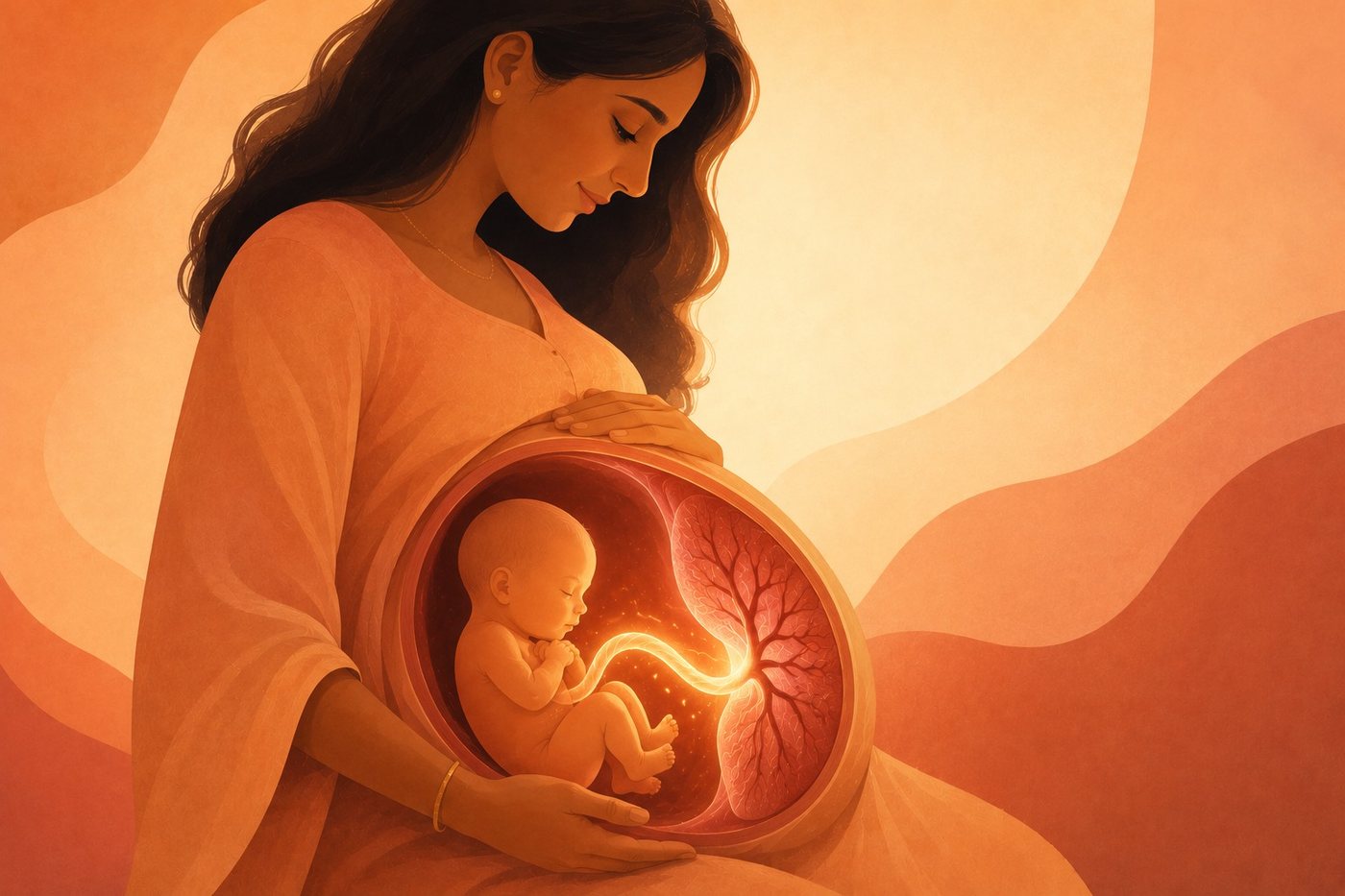


Most pregnancies bring some nausea. For a few women it becomes something else entirely: relentless vomiting many times a day, water itself impossible to keep down, weight and strength draining away.
There's a particular loneliness to it, because it's so often waved away. "Everyone feels sick in early pregnancy," comes the reply, while you can't cross a room without retching and start to wonder whether you're just being weak about it.
You're not.
This is hyperemesis gravidarum. It's a recognised medical condition, it's nobody's fault, and it can be treated.
What matters most
- It's severe, persistent vomiting in pregnancy, not ordinary morning sickness.
- The markers are being unable to keep food or fluid down, weight loss, and dehydration.
- It's driven by pregnancy hormones, not by anything you did or didn't do.
- Its main dangers, dehydration and weight loss, are both treatable.
- It usually eases by mid-pregnancy, though for some it lasts longer.
- Seeking help early isn't an overreaction. It's the step that works.
This is general information, not a diagnosis. Persistent vomiting in pregnancy needs a doctor's assessment, and anyone unable to keep fluids down should seek care promptly.
Is this more than morning sickness?
The difference isn't how bad it feels. It's what your body can hold on to.
| Morning sickness | Hyperemesis gravidarum | |
|---|---|---|
| Food and fluids | Some stays down | Even sips of water come back up |
| Weight | Still climbing | Falling, often more than 5 in every 100 of pre-pregnancy weight |
| Daily life | Grim, but doable | Work, chores and caring for others stop |
| Dehydration | Not usually | Yes: dark urine, dizziness, racing heart |
| What helps | Rest, small meals, ginger | Medical treatment, often IV fluids |
That crossing, from miserable-but-managing to unable to function and unable to stay hydrated, is the signal to seek help.
It's easy to believe that if you could just try a little harder to eat, this would settle. It doesn't work that way, and it isn't a matter of effort.
Why is this happening to me?
It isn't fully understood, but it closely tracks the first-trimester surge of pregnancy hormones, chiefly human chorionic gonadotropin (hCG), the hormone that rises fastest in early pregnancy, along with oestrogen.
There's a strange tenderness in that, if you can bear it right now: the hormone making you this ill is the same one that made the test turn positive. It's the signal that your baby is there, arriving louder than most.
That's why it usually starts around weeks 4 to 6, peaks near week 9, and often eases as hormone levels settle.
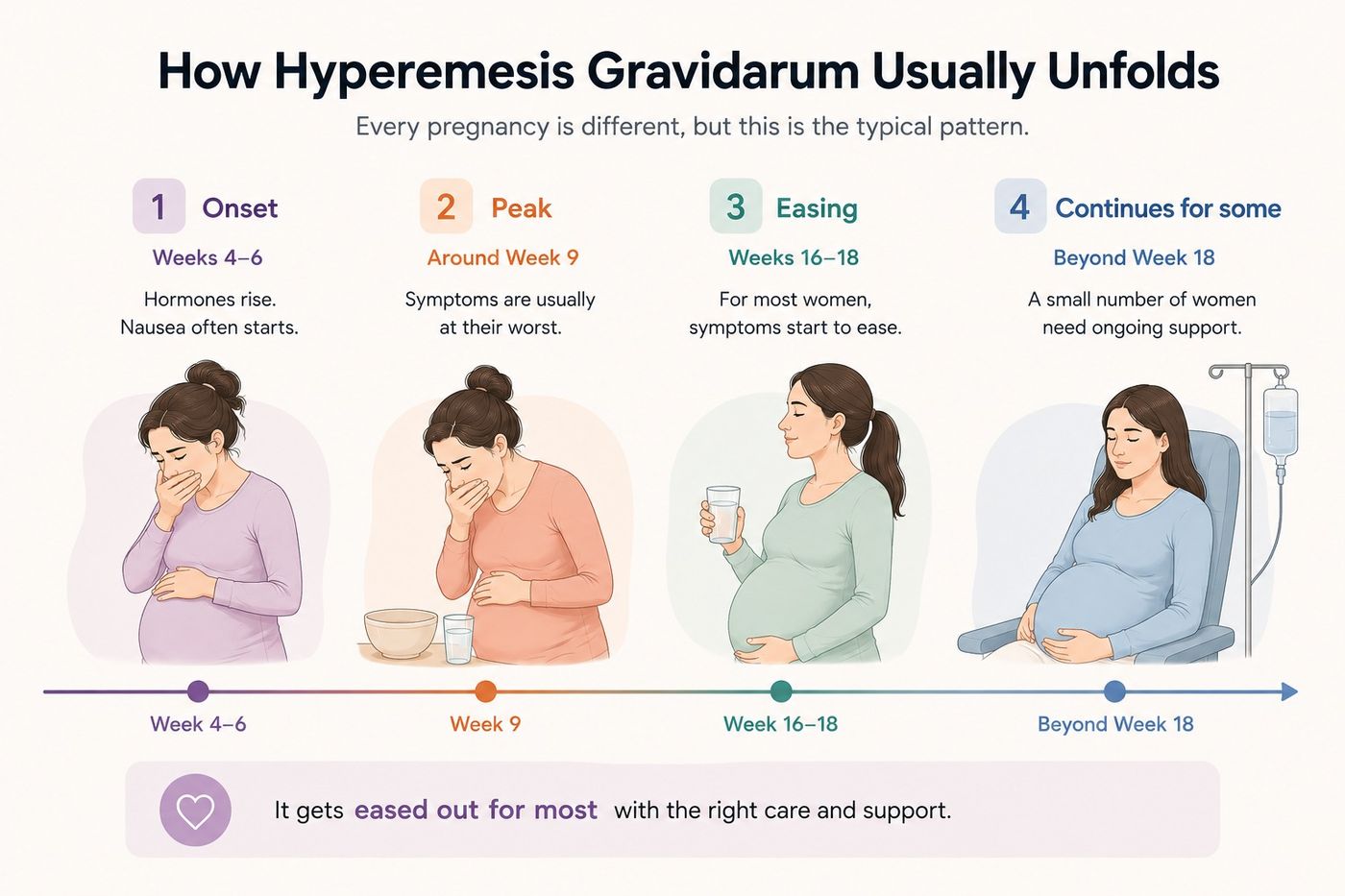
It's more likely in a first pregnancy, in a twin or multiple pregnancy where hCG runs higher, and in a woman who had it before. None of these is a failing. It's biology running high, not a body doing something wrong.
What are the signs?
- Vomiting many times a day, with little relief in between.
- Fluids won't stay down, even water in small sips.
- Weight loss, often more than about 5 in every 100 of your pre-pregnancy weight.
- Dehydration: dark, scanty urine, dizziness, dry mouth, a racing heart.
- Exhaustion and low mood, from sheer depletion.
Is my baby okay?
This is the worry underneath everything else, so, plainly: with treatment, the great majority of women with hyperemesis have healthy babies.
The vomiting doesn't reach your baby. What needs correcting is your dehydration and weight loss, and keeping you hydrated and nourished is exactly how your baby is kept well.
It's easy to feel that every meal that won't stay down is being taken from your baby. That isn't how it works. Your baby is being fed from reserves your body is holding onto for exactly this reason, and treatment tops those reserves back up faster than you'd think.
How is it treated?
The reassurance that matters most is that this is treatable. Care works as a ladder, from gentle steps to hospital support, with your doctor guiding each rung.
- First steps: small, frequent, bland meals, avoiding trigger smells, rest, and ginger.
- Medication: usually starting with vitamin B6, sometimes with an added anti-sickness medicine, stepping up to stronger antiemetics if needed. Medicines and doses are your doctor's decision, chosen for safety in pregnancy, never self-selected.
- Hospital care: when dehydration takes hold, fluids and salts go in through a drip. A vitamin called thiamine is often added to prevent deficiency, and prolonged cases can be fed through a tube or a vein.
Most women improve markedly once fluids are restored, which is why reaching that help matters far more than enduring without it.
Is it normal to love my baby and hate being pregnant?
Yes. And almost nobody says this out loud.
You can want this baby with everything you have and still wish, some days, that you weren't pregnant right now. Those two things sit side by side in a lot of women going through this, and holding both doesn't make you ungrateful or a bad mother. It makes you someone who is very unwell.
There's a part of hyperemesis that scans and prescriptions miss. When you can't eat, can't work, can't lift a toddler, and are told it's "just pregnancy," something wears thin well beyond the body.
Guilt that you're not enjoying the pregnancy the way you "should." Fear that your baby is being harmed. Low mood after weeks of feeling this ill and this unheard. Pregnancy Sickness Support, a UK charity for exactly this condition, describes that emotional toll as one of the least recognised parts of the illness.
None of it is weakness. It's the natural weight of a hard illness, and saying it out loud, to a partner, a doctor, or a counsellor, is part of the treatment. If the low mood deepens or lingers, that's treatable too, and worth raising.
When it can't wait
General information, not medical advice. Some situations shouldn't wait. Seek care promptly if you:
- can't keep any fluid down for more than a day,
- pass very little or very dark urine, or none,
- feel faint or dizzy, or have a racing heartbeat,
- are vomiting blood, or what looks like coffee grounds,
- have lost noticeable weight, or feel frighteningly unwell.
These point to dehydration your body can't fix alone, which is exactly what treatment corrects, often quickly.
Looking ahead
For most women, hyperemesis loosens its grip by the middle of pregnancy as hormones settle. A smaller number carry some of it further, and a few until birth.
Either way, this is a stretch to be got through with support, not alone. It ends. Strength comes back. The great majority reach the other side with a healthy baby.
Right now the days are long and the help feels far away. It isn't. And what this asks of you was never silent endurance, only that you reach for it, early and without apology.
References
- Royal College of Obstetricians and Gynaecologists (RCOG). The Management of Nausea and Vomiting of Pregnancy and Hyperemesis Gravidarum, Green-top Guideline No. 69.
- American College of Obstetricians and Gynecologists (ACOG). Practice Bulletin No. 189: Nausea and Vomiting of Pregnancy.
- National Health Service (NHS UK). Severe Vomiting in Pregnancy, Hyperemesis Gravidarum.
- Cleveland Clinic. Hyperemesis Gravidarum.
- Pregnancy Sickness Support. Information and support for hyperemesis gravidarum.
- Federation of Obstetric and Gynaecological Societies of India (FOGSI). Guidance on nausea and vomiting of pregnancy.
- StatPearls, National Center for Biotechnology Information (NCBI). Hyperemesis Gravidarum.