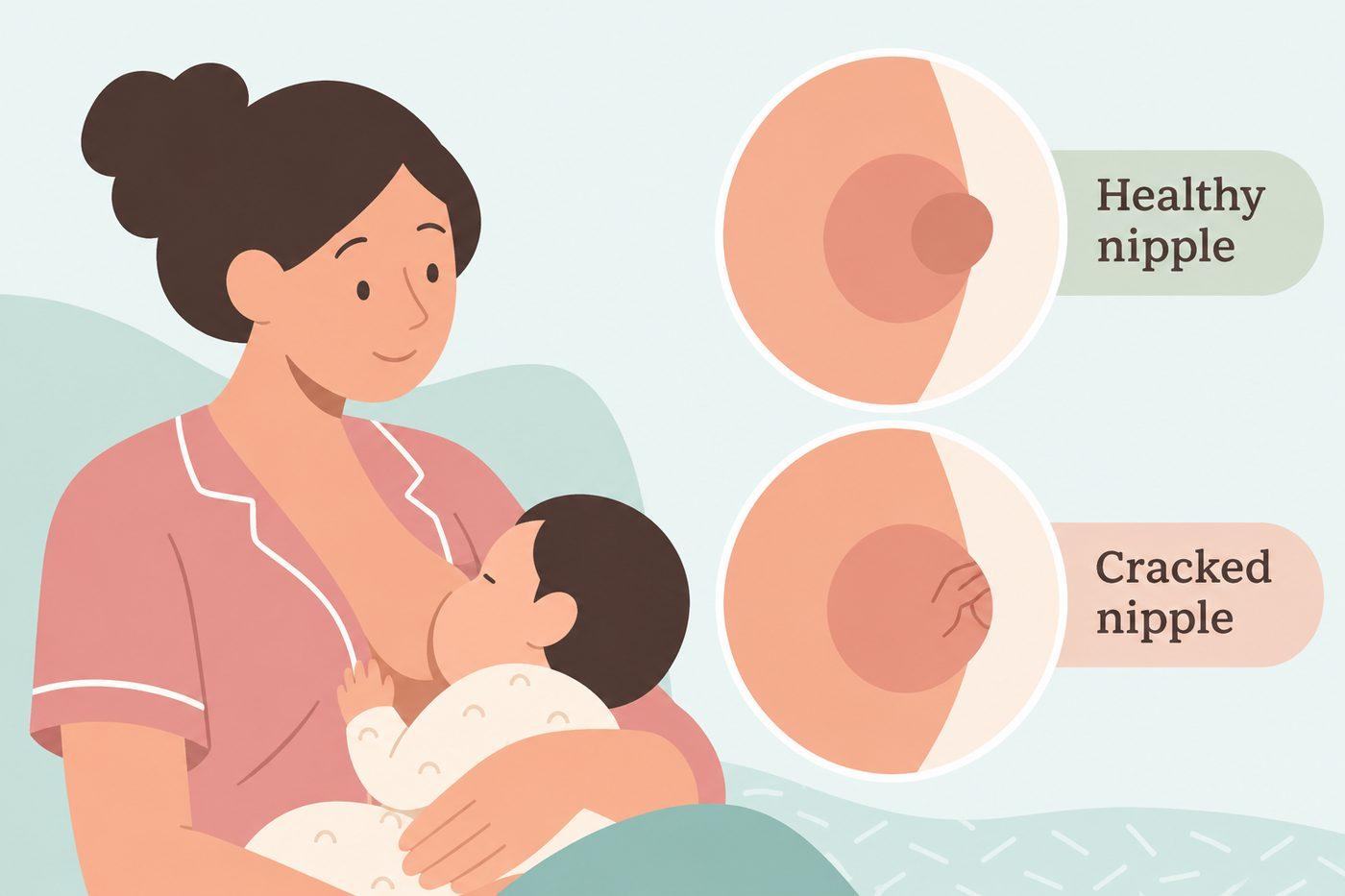
For some, breastfeeding settles quickly and feels comfortable almost from the start. For others, especially in the first days, latching brings a sharp pain that can make you tense before your baby even reaches the breast. If feeds have started to feel like something you brace against, you are not doing anything wrong.
Here is the short version. A brief tenderness the moment your baby first takes the breast can be normal at the start. Pain that stays sharp, keeps returning, or cracks or bleeds the skin does not have to be tolerated, and it usually deserves a check: most often of how your baby attaches, sometimes of another cause.
Poor attachment or a shallow latch is one of the most common reasons, though not the only one. In many cases, once attachment improves, the pain starts to ease and the skin recovers. Asking for help early tends to work better than pushing through.
Key takeaways
- Brief early tenderness is common, but pain that stays severe or worsens with feeds is worth getting assessed rather than tolerated.
- Poor attachment or a shallow latch is one of the most common causes, though vasospasm, skin irritation, infection, oral-motor issues and pump trauma can also play a part.
- A nipple that comes out squashed, ridged or wedge-shaped after a feed is a useful sign the latch may need adjusting.
- If poor attachment is causing the damage, correcting it helps prevent further trauma while the skin heals.
- Cracked or bleeding nipples need attention, because broken skin can make healing harder and may raise the chance of local infection.
Is some nipple pain normal at first?
Some tenderness or sensitivity can happen in the first days of breastfeeding, while you and your baby learn the skill together. Discomfort that fades once milk starts flowing is common in this early stage. The basics of those first feeds are covered in How to Breastfeed: A Simple Guide for New Mothers.
Pain is different when it stays severe, worsens with repeated feeds, or leaves the skin cracked or damaged. That pattern is not something to wait out. It usually points to a cause that can be found and corrected, so it is worth checking attachment and asking for help.
Why do nipples get sore or cracked?
Sore and cracked nipples often come from friction and pressure in the wrong place. With a shallow latch, the nipple ends up near the hard palate at the front, where every suck rubs and squeezes it, instead of lying safely further back.
Attachment is only one part of the picture, though. Several causes can look similar, and more than one can be present at the same time.
| Possible cause | What it may feel or look like |
|---|---|
| Poor attachment or shallow latch | Pinching pain during feeds; nipple may look creased or flattened afterwards |
| Poor positioning | Baby may drag or slide on the nipple; pain may change during the feed |
| Tongue-tie or other oral-motor issues | Baby may struggle to open wide or keep a deep latch |
| Engorgement | Breast may be firm or swollen, making a deep latch harder |
| Skin irritation or dermatitis | Itching, redness, scaling or cracking, sometimes linked to soaps, fragrances, creams or breast pads |
| Nipple vasospasm | Burning or throbbing pain, often after feeds; nipple may change colour |
| Pump-related trauma | Pain or damage linked to flange fit or excessive suction |
| Infection or another condition | Persistent burning, nipple changes or symptoms in your baby may need assessment |
How can you tell if the latch is causing the pain?
The clearest early clue is your nipple itself. Look at its shape just after a feed, and compare it with how it looked before.
- After a deep latch, the nipple usually comes out round and unchanged.
- After a shallow one, it may come out squashed, ridged or wedge-shaped at the tip.
- A blanched, whitish tip after feeds can mean the nipple is being compressed.
If attachment looks fine and the pain continues, the cause may lie elsewhere. It is worth considering the other causes above before assuming it is the latch.
What should a comfortable latch look and feel like?
No single sign confirms a good latch. Look for the overall pattern rather than any one detail.
- Before attaching, your baby gapes wide, almost like a big yawn.
- Your baby's chin presses into the breast while the nose stays clear or only just touches.
- You can see more areola (the darker skin) near your baby's upper lip than near the lower one.
- Both lips curl outwards instead of folding in.
- Attachment feels deep, and sucks slow into a steady pattern, with pauses where you can hear swallowing.
- Your nipple looks rounded, not pinched or flattened, after the feed.
- Feeding becomes more comfortable once attachment settles.
Step-by-step help is in How to Get a Good Latch (and Fix a Painful One).
What actually helps sore and cracked nipples heal?
Healing starts with the cause. Correcting how your baby attaches is what stops fresh damage, so the skin can recover. Creams, ointments and dressings can improve comfort, but they do not fix the underlying cause of nipple trauma, so attachment comes first.
- Correct the attachment and positioning first, since this is what prevents further damage.
- Keep the nipple clean and avoid irritants such as soaps, fragrances and harsh products.
- A nipple ointment such as purified lanolin may improve comfort for some people; stop if it irritates your skin.
- Gel pads designed for sore nipples (hydrogel dressings) may make the skin feel easier while it mends.
- Seek assessment if the wound is not improving.
At the feed itself, small changes can spare the sorest spot.
- Aim for a deeper latch: wait until your baby's mouth gapes wide, then bring them in, chin leading.
- Try different positions, such as cross-cradle, the rugby or football hold, or lying on your side. Breastfeeding Positions: Finding the Hold That Works for You shows each one.
- If one side is particularly sore, you may find it more comfortable to begin on the less painful side, while still removing milk effectively from both breasts.
- Before taking your baby off, slip a clean little finger into the side of their mouth to release the seal.
- If direct feeding is temporarily too painful, express milk gently to protect your supply, using settings that do not add further trauma.
- Nipple shields can be useful in some situations, but fit and feeding effectiveness matter, so it is best to use one with guidance from a lactation professional.
Looking ahead
For most, the tender early weeks are a phase, not the shape of the whole feeding journey. If the pain is easing, the next step is simply to protect the new latch while the skin heals.
If it is not easing, the answer is not to keep changing positions on your own. It is to have a full feed watched by a lactation professional or clinician, so the cause can be pinned down and treated.
When to get breastfeeding help, and when to seek medical care
Sore nipples are common, but ongoing pain deserves attention rather than patience. The kind of help you need depends on what you are seeing.
Get breastfeeding or lactation help from a lactation consultant, an International Board Certified Lactation Consultant (IBCLC), a doctor, or a breastfeeding specialist if you have:
- Pain that continues even after trying new positions
- A shallow latch you cannot seem to fix
- Cracked or damaged nipples
- Clicking sounds during feeds, or a baby who keeps sliding off the breast
- Concerns about milk transfer or weight gain
See a doctor without delay if you notice:
- A temperature, or feeling properly ill
- Redness or swelling of the breast that is spreading
- Pus or worrying discharge from a nipple wound
- Pain that is getting quickly worse, or a wound that will not heal
- Repeated or severe colour changes in the nipple
- White patches in your baby's mouth that do not wipe away, which should be assessed rather than assumed to be thrush
Engorgement, blocked ducts and mastitis are explained in Breast Engorgement, Cracked Nipples and Mastitis: Easing Breastfeeding Pain After Delivery.
References
- Berens P, Eglash A, Malloy M, Steube AM; Academy of Breastfeeding Medicine. ABM Clinical Protocol #26: Persistent Pain with Breastfeeding. Breastfeeding Medicine. 2016;11(2):46 to 53.
- Dennis CL, Jackson K, Watson J. Interventions for treating painful nipples among breastfeeding women. Cochrane Database of Systematic Reviews. 2014;(12):CD007366.
- National Health Service (NHS). Breastfeeding: positioning and attachment.
- Office on Women's Health, US Department of Health and Human Services. Getting a good latch.
- Mitchell KB, Johnson HM, Rodríguez JM, et al. Academy of Breastfeeding Medicine Clinical Protocol #36: The Mastitis Spectrum, Revised 2022. Breastfeeding Medicine. 2022;17(5):360 to 376.
Common questions
Should I stop breastfeeding until my nipples heal?
Usually you do not need to. Breastfeeding can generally continue while the cause of the damage is addressed, as long as feeding is tolerable and you have support, because a deeper latch protects the nipple from further rubbing. If direct feeding is temporarily too painful, expressing milk can keep milk removal going and protect your supply while the problem is assessed. The signs that your baby is still getting enough are explained in Am I Making Enough Breast Milk? The Real Signs and How to Increase Supply.
How long do cracked nipples take to heal?
Once the cause is corrected, pain often begins to improve within several days. The skin may take longer to settle fully, especially when cracks are deeper or the area keeps getting irritated. If there is no clear improvement after adjusting attachment, or the skin looks infected, the cause should be reassessed.
Why can my nipples hurt even when the latch looks good?
When attachment looks good but pain continues, it is worth looking beyond the latch. Nipple vasospasm can cause burning or throbbing pain and colour changes, often after feeds or in the cold. Skin irritation or dermatitis, a bacterial or fungal infection, an oral-motor issue such as tongue-tie, or trauma from a poorly fitting pump can all do the same. These can look alike, so persistent pain is best assessed in person rather than guessed at.
Is it safe for my baby to feed if my nipple is bleeding?
For a small amount of blood coming from a cracked nipple, breastfeeding can usually continue while the cause is addressed, and swallowing a little blood is generally not harmful to a healthy full-term baby. Bleeding does mean the skin is broken, so it is worth getting attachment checked. Persistent or heavier bleeding, or blood that does not seem to come from a surface crack, should be assessed by a doctor.
This article is for education and general understanding. It is not a substitute for personal medical advice, diagnosis, or treatment. Please speak with your doctor or a qualified lactation professional about your own situation, especially if you have pain that is not improving, signs of infection, or concerns about your baby's feeding or weight. Review of this article by a specialist lactation consultant is in progress.
 Medically reviewed byDr. Mahender Singh, MBBS, DCH, MD (Paediatrics)A consultant child specialist and neonatologist with over four decades of practice in newborn and child health.
 Written bySarthak ThakurCo-founder, CTO and Chief Marketing Officer of ParentVeda, and the software engineer who builds its app and the pipeline that checks its articles.
This article explains; it doesn’t diagnose. If your doctor has told you something different, your doctor is right.