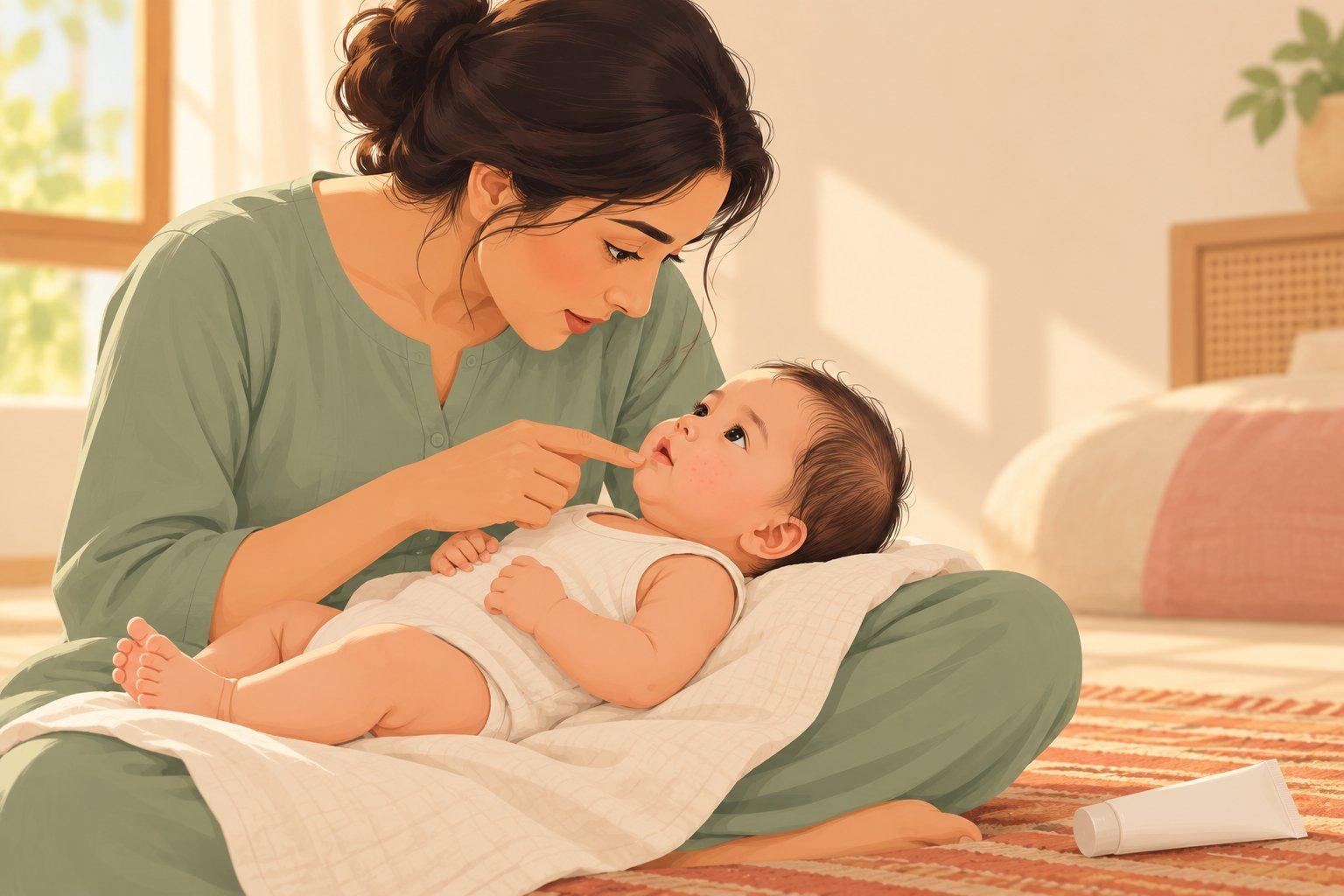
It is common for babies to develop patches of bumps, redness, dryness, or flaking during the first weeks and months. When several of these look alike, the hardest part is often not knowing what you are seeing and not knowing what to put on it.
Four common conditions can look surprisingly similar: baby acne, eczema, heat rash, and cradle cap. Each behaves differently and needs a different response, so telling them apart matters more than treating on instinct.
The reassuring news comes first: most of these are harmless and settle on their own.
Quick Answer: Baby acne usually shows as small, non-itchy bumps on a newborn's face. Eczema tends to be dry and itchy. Heat rash appears as tiny bumps in hot, sweaty areas, while cradle cap causes greasy scales on the scalp. Location, itch, and texture are the quickest clues, but a rash with fever, rapid spreading, blisters, or a baby who seems unwell needs medical assessment.
Key takeaways
-
Baby acne shows as small red or white bumps on a newborn's face, chin and sometimes scalp, does not itch, and clears on its own. Avoid heavy oils and greasy products, as they may worsen the bumps.
-
Eczema is dry, itchy, patchy skin, often on the face and cheeks in babies. It comes and goes and responds to regular fragrance-free moisturising.
-
Heat rash, called ghamori or prickly heat, appears as tiny bumps in sweaty, covered areas and settles once your baby cools down.
-
Cradle cap is greasy yellow or brown scales on the scalp. It is harmless and usually causes little discomfort.
-
Location, itch and texture separate them faster than any single sign. Fever, a rapidly spreading rash, blisters, or honey-coloured crusting is the signal to see a doctor.
Four common rashes at a glance
This table is the fastest way to place what you are seeing. Read across the row that matches where the rash sits, then see the section below for what helps.
| Rash | Where | Looks like | Itch? | Main clue |
|---|---|---|---|---|
| Baby acne | Face (cheeks, chin, forehead) | Small red or white bumps | Usually no | Newborn facial bumps |
| Eczema | Face, cheeks, sometimes folds | Dry, rough patches | Often | Itch with dryness |
| Heat rash (ghamori) | Neck, folds, back, covered areas | Tiny bumps or clear blisters | Sometimes | Appears with heat and sweating |
| Cradle cap | Scalp, eyebrows, behind ears | Greasy yellow or brown scales | Usually no | Yellow or brown scalp scale |
Is it baby acne?
Baby acne is common in newborns. If your newborn has small red or white bumps on the cheeks, chin, forehead or sometimes the scalp, and your baby seems comfortable, baby acne is a likely answer. It is not a sign of anything you did or missed.
Tiny firm white spots called milia can look similar. Milia are usually smooth and white without the surrounding redness that can come with baby acne, and they often sit on the nose, cheeks or chin.
It is thought to be linked to hormones passed from you to your baby before birth, which is why it often appears in the first few weeks. Baby acne typically begins at two to four weeks of age and usually fades by four to six months. It usually needs no treatment and tends to clear on its own.
The gentlest approach is often best. Plain water, or a very gentle cleanser, is usually enough, and the American Academy of Dermatology (AAD) advises avoiding oils and greasy products, which can make acne worse. Acne is not an allergy or an infection, so if bumps become pus-filled, spread, or come with fever, have your paediatrician take a look.
Baby eczema: the dry, itchy one
Eczema is common in infancy. It shows as dry, rough skin that forms patches rather than isolated bumps, and it can weep or crust when rubbed. Itch is an important clue for eczema, although other rashes can sometimes feel uncomfortable or itchy too.
In babies it commonly settles on the face and cheeks first, and the scalp, with the elbow and knee creases becoming more typical as your child grows. On deeper skin tones it may look darker or ashy rather than red, so texture matters as much as colour. The pattern can change with age, and that is normal.
Dry weather, heat, sweating and other environmental factors can sometimes aggravate eczema, and in India seasonal changes can make these triggers especially noticeable. Food allergies can sometimes be relevant in babies with eczema, but most parents should not remove foods from a baby's or a breastfeeding parent's diet without medical guidance.
Unlike acne or cradle cap, eczema tends to return rather than clear once, which is why a steady moisturising routine matters more than any single treatment.
Why does heat rash flare in Indian summers?
Heat rash, widely known as ghamori or prickly heat, is common in hot, humid conditions. It appears when a baby sweats more than their skin can easily drain, and the trapped sweat irritates the skin, producing tiny bumps or clear pinhead blisters.
It favours warm, covered, friction-prone areas: the neck, the skin folds, the back, and anywhere clothing traps heat. Babies appear more prone to heat rash than adults, and it usually resolves on its own. This makes it common through the Indian summer and monsoon months.
The first step is cooling rather than adding more products to the skin. Move your baby somewhere airy, switch to loose cotton, reduce layers, and keep the skin dry. Loose powders, particularly those containing talc, are best avoided because of the risk of inhalation.
Cradle cap: those yellow scalp scales
Cradle cap is common in young babies and becomes easier to recognise once you know its typical appearance: greasy, yellow or brown scaly patches on the scalp, sometimes reaching the eyebrows or behind the ears. It can look dramatic, but cradle cap is usually harmless and causes little discomfort.
It is not an infection, an allergy, or a sign of poor hygiene, and it is not the same as scalp eczema. Cradle cap shows greasy scales with little discomfort, while scalp eczema tends to look dry and red and often itches.
Gentle care is enough for most babies. A small amount of mineral oil may sometimes be used to soften stubborn scales before gentle washing, but ask your baby's doctor what is appropriate if the scalp is inflamed or the scales persist. Never pick or scratch the scales.
How do you tell them apart quickly?
When you are unsure, run through three questions in order. They separate these four faster than trying to match a photo.
-
Where is it? Scalp scales point to cradle cap. Facial bumps on a newborn point to acne. Dry patches on the face or in creases point to eczema. Bumps in sweaty, covered folds point to heat rash.
-
Does it seem to itch? Itch is a useful clue for eczema, and less typical of acne or cradle cap, though it is a pointer rather than proof.
-
What is the texture? Raised bumps suggest acne or heat rash, dry flaky patches suggest eczema, and greasy scales suggest cradle cap.
If two answers seem to fit, note which sign is strongest, and confirm with your paediatrician if it does not settle.
When should you see a doctor?
Most of these rashes need patience rather than a prescription. Some signs, though, mean your baby should be seen rather than watched. Contact a doctor promptly if your baby has:
-
A fever, which needs prompt attention in a young baby.
-
A baby who is unusually sleepy, difficult to wake, feeding poorly, or seems unwell.
-
A rash that spreads rapidly.
-
Blisters, or pus-filled spots.
-
Yellow or honey-coloured crusting.
-
Facial or lip swelling.
-
Any difficulty breathing, which needs urgent care.
When in doubt about a newborn's rash, a quick check with your paediatrician is always reasonable. Newborn skin changes fast, and a trained eye settles the question quickly.
Looking ahead
As your baby moves past the newborn weeks, most of this resolves quietly. Baby acne fades, cradle cap flakes away through the first year, and heat rash comes and goes only with the weather.
Eczema is the one most likely to need ongoing attention, because it can flare and settle repeatedly. Your natural next step is a simple, fragrance-free skincare routine and a working sense of your baby's triggers, so flares become shorter and less frequent.
Common questions
Can baby eczema look like cradle cap?
On the scalp, yes, which is the most common source of confusion. The quickest way to decide is how it looks and feels: cradle cap is greasy, yellow-scaled and usually comfortable, while scalp eczema looks dry and red and tends to itch. If it looks inflamed and itchy rather than greasy, ask your paediatrician.
Should I use oil on my baby's rash?
It depends on the rash. Avoid greasy products on baby acne, and avoid adding occlusive products to heat rash. For eczema, a fragrance-free emollient is generally preferred over household oils. For cradle cap, ask your baby's doctor about an appropriate way to soften stubborn scales.
How long before these rashes go away?
Baby acne usually fades by four to six months, cradle cap by around 12 months, and heat rash within days of cooling down. Eczema follows a flare-and-settle pattern rather than a fixed end date, which is why an ongoing routine matters more than a one-time fix.
Is it ever an emergency?
Rarely, but a rash with fever, rapid spreading, blisters, or honey-coloured crusting needs prompt medical attention. Any facial or lip swelling, or difficulty breathing, needs urgent care. These signs point beyond the four common rashes covered here.
This article is intended for education and general understanding. It is not a diagnosis or a substitute for personal medical advice. Every baby's skin is different, and if you are unsure about a rash, or your baby seems unwell, please consult your paediatrician or a qualified dermatologist.
 Medically reviewed byDr. Mahender Singh, MBBS, DCH, MD (Paediatrics)A consultant child specialist and neonatologist with over four decades of practice in newborn and child health.
 Written bySarthak ThakurCo-founder, CTO and Chief Marketing Officer of ParentVeda, and the software engineer who builds its app and the pipeline that checks its articles.
This article explains; it doesn’t diagnose. If your doctor has told you something different, your doctor is right.