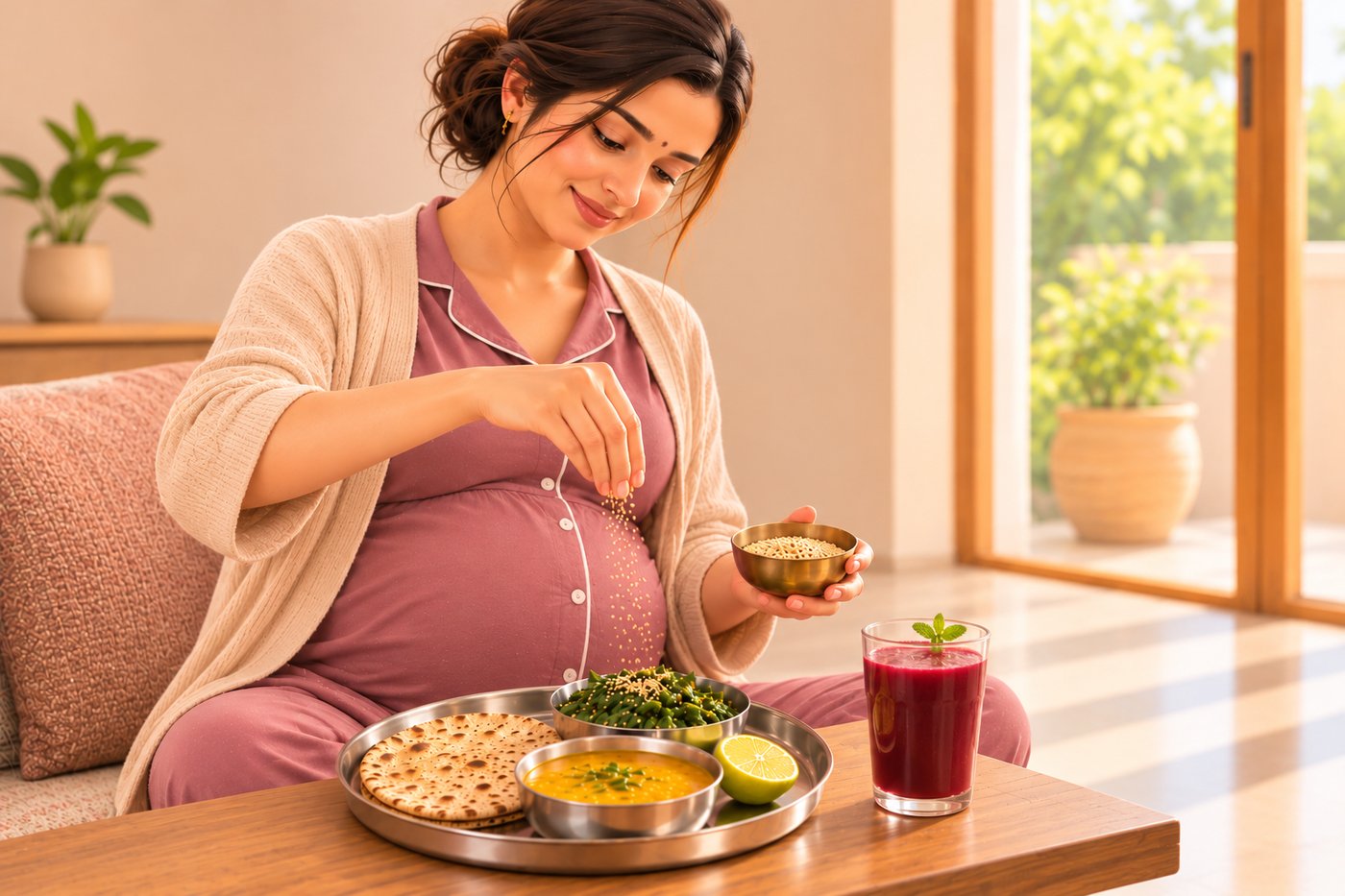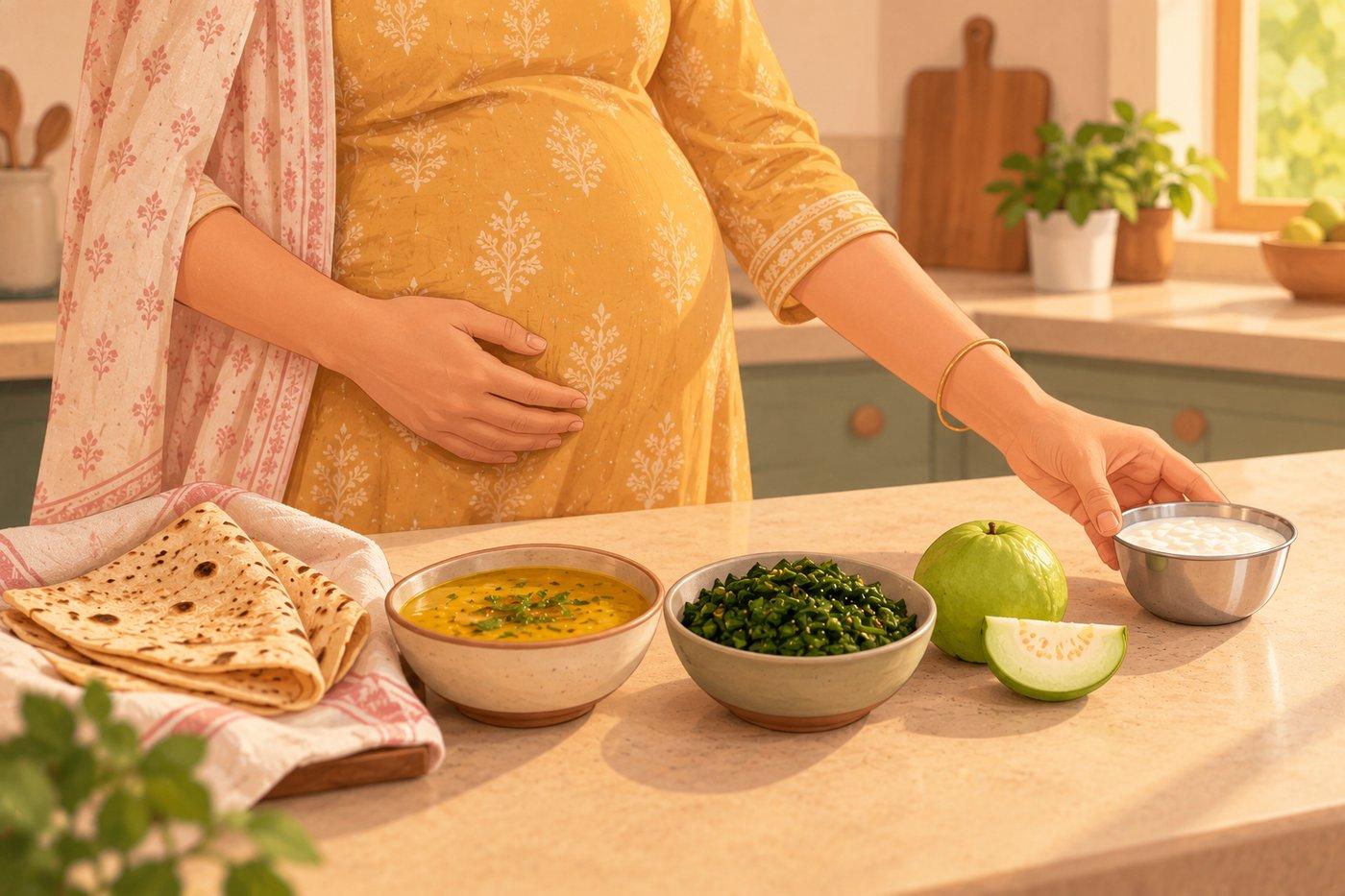
A good pregnancy diet chart for Indian families is built on familiar Indian meals, adjusted to changing nutritional needs. Most meals can be built from a cereal like roti, rice or millet, a protein like dal, paneer, egg, fish or chicken, vegetables or fruit, and a calcium food such as curd or milk.
In the first trimester, the focus is eating regularly through nausea, along with the folic acid her doctor advises. From the second trimester, her needs for protein, iron and calcium rise, and iron and calcium tablets are usually added as part of antenatal care.
Advice arrives from every side. This article turns it into one way of thinking that works for all nine months.
Key takeaways
- Four food groups (cereal, protein, vegetable or fruit, and a calcium food) make a flexible guide for planning the day’s meals.
- The trimester decides the emphasis, not the cuisine. The plate stays Indian and familiar.
- Indian Council of Medical Research estimates put pregnancy needs at about 350 extra kilocalories a day, adjusted for body weight. That is far from “eating for two.”
- Iron and calcium supplements are part of routine antenatal care in India, but her doctor sets the start date, dose and timing for her.
The four-part plate: a pregnancy diet chart she can carry in her head
A printed chart helps for a week. A way of thinking helps through festivals, travel and difficult days.
Four quick checks help when planning meals. Not every meal needs all four; what matters is that the day as a whole covers them.
| Check | Indian examples | Why it matters in pregnancy |
|---|---|---|
| A cereal or millet | Roti, rice, ragi, jowar, poha, dalia | Steady energy |
| A protein | Dal, rajma, chana, paneer, curd, egg, fish, chicken | Growth of the baby, placenta and her own tissues |
| A vegetable or fruit | Palak, methi, lauki, carrot, amla, guava, banana | Folate, vitamin C, fibre |
| A calcium food | Curd, milk, paneer, ragi, til | Baby’s bones and teeth |
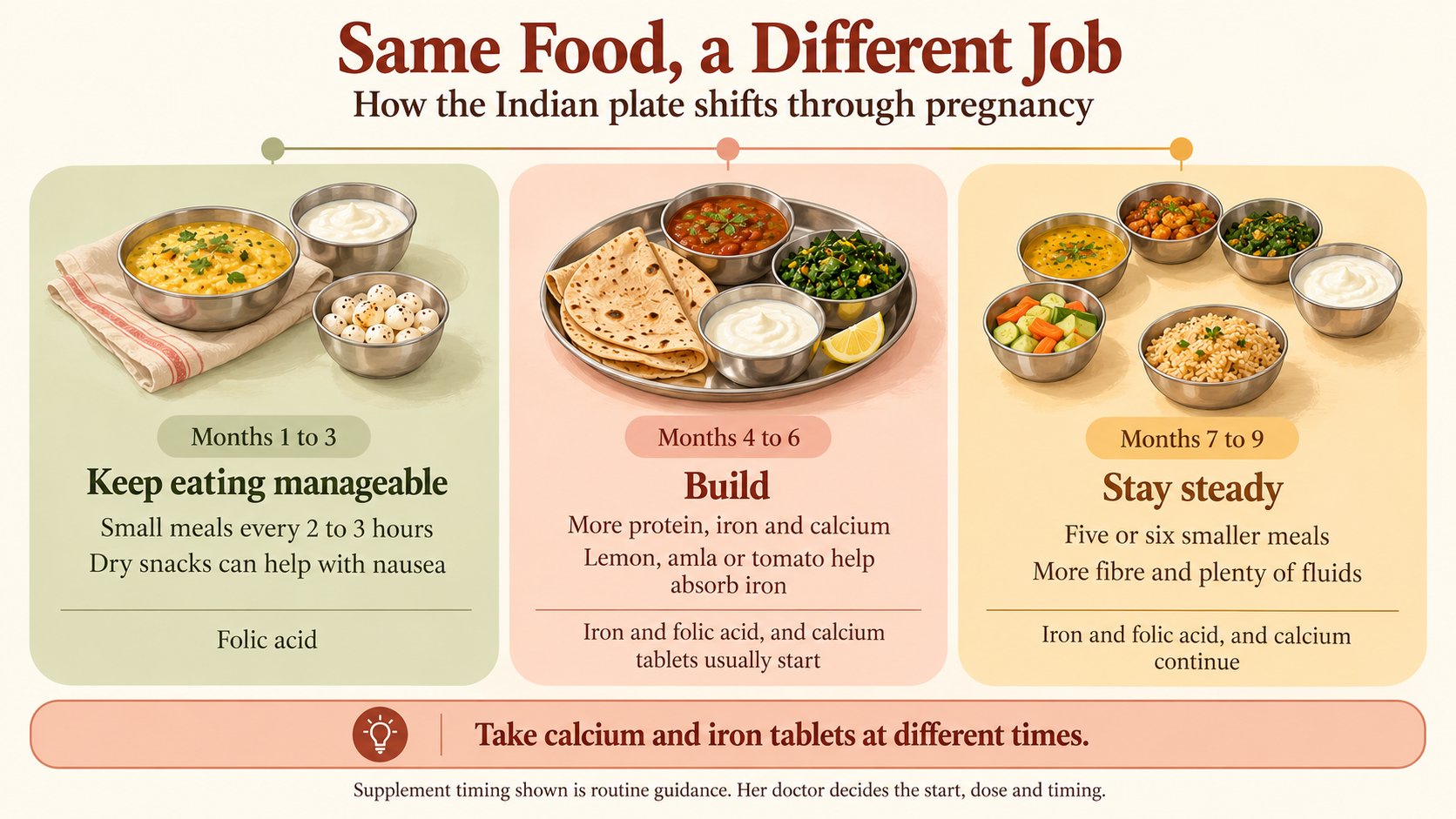
The trimester then changes the emphasis:
| Trimester | What the plate is asked to do | Typical public-health supplement timing in India |
|---|---|---|
| First (months 1 to 3) | Keep eating manageable: smaller, more frequent versions of the plate | Folic acid (also advised before conception) |
| Second (months 4 to 6) | Build: more protein, iron and calcium | Iron and folic acid (IFA) and calcium tablets usually start |
| Third (months 7 to 9) | Stay steady: the same plate split into smaller meals, with protein needs at their highest | IFA and calcium continue |
The Indian Council of Medical Research and National Institute of Nutrition (ICMR-NIN) gives a figure of about 350 extra kilocalories a day for pregnancy, adjusted for her body weight. For many women, this can come from a nutritious addition to their usual meals rather than a separate full meal.
Why that is far from double portions is explained in Eating for Two? Why Pregnancy Is Not Double Portions.
Her doctor or dietitian can advise when and how to add it. ICMR-NIN’s protein recommendation rises in the second trimester and further in the third.
The supplement column shows routine public-health timing, not a personal prescription. Her doctor may change the timing or dose based on her blood tests and history.
First trimester: how can she eat well when nausea takes over?
The baby’s organs begin developing in the early weeks, but nausea can make regular eating difficult. Small, manageable meals and the folic acid recommended by her doctor can help her navigate this stage.
Changing how she eats often helps more than changing what she aims for. An empty stomach often makes nausea worse, so small portions of the four-part plate every two to three hours usually work better than three full meals.
Sample 1 to 3 month pregnancy diet chart (Indian)
| Time | Vegetarian | Non-vegetarian swap |
|---|---|---|
| On waking | Plain khakhra, rusk or a few soaked almonds | Same |
| Breakfast | Vegetable poha, idli with sambar or besan chilla | Boiled egg with toast |
| Mid-morning | Banana, guava or coconut water | Same |
| Lunch | Dal, roti or rice, sabzi, curd | Add a small piece of well-cooked chicken |
| Evening | Roasted chana or makhana | Same |
| Dinner | Moong dal khichdi with curd | Egg curry with rice |
- Dry snacks before getting up may settle morning nausea.
- Cold or room-temperature foods often smell less strongly.
- Small sips of water through the day are easier than large glasses.
The second trimester is when the plate grows
Appetite often returns around the fourth month, as the baby grows faster and her blood volume rises. Protein, iron and calcium now get bigger portions.
| Time | Vegetarian | Non-vegetarian swap |
|---|---|---|
| Breakfast | Ragi dosa or methi paratha with curd | Egg bhurji with roti |
| Mid-morning | A piece of fruit and some roasted peanuts | Same |
| Lunch | Rajma or chole, rice, palak sabzi, freshly cut salad of washed vegetables with lemon | Well-cooked fish curry with rice |
| Evening | Steamed or well-cooked sprouts chaat, or til chikki | Same |
| Dinner | Paneer bhurji, roti, dal, sabzi | Chicken curry, roti, sabzi |
| Bedtime | Milk or buttermilk | Same |
Iron from plant foods like palak, rajma and ragi is absorbed less easily than iron from meat. Vitamin C improves absorption, so lemon, amla or tomato alongside these foods turns an ordinary meal into a better one.
Tea and coffee can reduce iron absorption, so they are best kept away from meals and the iron tablet. National guidance advises against taking calcium and IFA tablets together, since calcium reduces iron absorption. Calcium is taken with meals, and IFA preferably two hours after a meal.
A vegetarian plate meets protein needs through combination. Dal with rice or roti, plus curd, paneer, cooked sprouts and nuts across the day, adds up.
Third trimester: smaller meals, steadier energy
By the seventh month, the growing uterus leaves less room for the stomach, and heartburn and constipation often appear. The plate is split into five or six smaller meals, with more fibre from whole dals, vegetables, fruit and dalia, and plenty of fluids.
- An earlier dinner, without lying down right after, may ease heartburn.
- Snacks such as makhana, fruit, curd and roasted chana help keep energy steady.
Which foods need extra care for now?
Some foods carry a proven risk, mostly of food infections. Others are avoided as a precaution.
| Food | Why care is advised |
|---|---|
| Eggs, meat and fish that are not cooked through | Risk of food infections |
| Unpasteurised milk, or paneer of unknown source | Risk of listeria infection |
| Raw sprouts | Can carry bacteria that washing does not remove |
| Raw or semi-ripe papaya | A precaution, not a proven risk: its latex may possibly trigger contractions, but evidence in humans is limited |
| Shark, swordfish and king mackerel | Named as high-mercury fish to avoid in pregnancy in United States Food and Drug Administration advice |
| Alcohol | No safe amount is known in pregnancy |
These fish names come from United States advice, and fish in India are sold under many local names. Her doctor can help her match the fish her family eats to lower-mercury choices.
Caffeine advice differs between bodies. The World Health Organization (WHO) advises cutting down if intake is above 300 milligrams a day. The American College of Obstetricians and Gynecologists suggests staying under 200 milligrams, which is the more cautious of the two.
There is no fixed cup count, because caffeine varies with brew strength and cup size. A practical habit is to count every source in a day: chai, coffee, cola, energy drinks and chocolate. Her doctor can then help her settle on a comfortable daily amount.
What about ghee, dry fruits and advice from home?
Dry fruits, til or gond ladoos and homemade ghee in normal amounts fit the four-part plate well. The catch is quantity: extra ghee does not make delivery easier, and daily sweets can push weight and blood sugar higher than ideal.
For any suggestion, three questions help: is it hygienically prepared, is the portion normal, and does it suit her own health?
When to see a doctor
She should seek emergency care straight away if she:
- Vomits blood, or her vomit looks like coffee grounds
- Faints, or becomes confused or very drowsy
She should contact her antenatal team the same day if she:
- Cannot keep fluids down, passes very little or dark urine, or feels dizzy
- Cannot keep her prescribed tablets down
She should raise her diet at an antenatal visit if she:
- Feels very tired or breathless, which can be symptoms of anaemia, among other causes
- Has diabetes, thyroid problems or food allergies, or follows a vegan diet
- Notices very low or very rapid weight gain
Looking ahead
Around the fourth month, the antenatal visit usually brings iron and calcium supplements and a haemoglobin check. That is a good moment to look at a typical day of her meals with her doctor.
Between 24 and 28 weeks, a glucose test may also shape her plate. If sugar levels are high, the same foods are usually rearranged, not replaced.
References
- Indian Council of Medical Research and National Institute of Nutrition (ICMR-NIN). A Brief Note on Nutrient Requirements for Indians, the Recommended Dietary Allowances (RDA) and the Estimated Average Requirements (EAR), 2020.
- Ministry of Health and Family Welfare (MoHFW), Government of India. National Guidelines for Calcium Supplementation During Pregnancy and Lactation, December 2014.
- MoHFW, Nutrition Division. Anemia Mukt Bharat Abhiyaan Operational Guidelines, June 2026.
- World Health Organization. WHO Recommendations on Antenatal Care for a Positive Pregnancy Experience. Geneva: WHO; 2016.
- American College of Obstetricians and Gynecologists. Committee Opinion No. 462: Moderate Caffeine Consumption During Pregnancy. Obstetrics & Gynecology. 2010;116(2 Pt 1):467-468.
- United States Food and Drug Administration and Environmental Protection Agency. Advice About Eating Fish.
- FIGO Working Group on Good Clinical Practice in Maternal-Fetal Medicine. Good Clinical Practice Advice: Micronutrients in the Periconceptional Period and Pregnancy. International Journal of Gynecology and Obstetrics. 2019;144(3):317-321.
Common questions
Pregnancy me kya khana chahiye?
Ghar ka khana is the best starting point: roti or rice, dal, sabzi, curd and fruit through the day. Green leafy vegetables, dals and cooked sprouts add iron and folate, while curd, paneer, ragi and til add calcium. Eggs, chicken and well-cooked fish suit non-vegetarian families. Supplements recommended by her doctor complement this food; they do not replace a varied plate.
Is milk necessary during pregnancy?
Milk is an easy calcium source but not the only one. Curd, buttermilk, paneer, ragi, til and green leafy vegetables also provide calcium. If milk causes discomfort, her doctor can guide her calcium intake.
Is there a different diet chart for each month?
Needs change gradually, so one trimester chart works across all three months of that trimester. Conditions like diabetes or anaemia may need a personalised plan.
This article is for general education and does not replace advice from a doctor or registered dietitian. Every pregnancy is different, so any diet plan or supplement should be discussed with the healthcare team caring for her.
 Medically reviewed byDr. Mahender Singh, MBBS, DCH, MD (Paediatrics)A consultant child specialist and neonatologist with over four decades of practice in newborn and child health.
 Written bySarthak ThakurCo-founder, CTO and Chief Marketing Officer of ParentVeda, and the software engineer who builds its app and the pipeline that checks its articles.
This article explains; it doesn’t diagnose. If your doctor has told you something different, your doctor is right.