
As your due date comes closer, you may hear the same advice from a friend, your mother, or a pregnancy group. Eat a few dates every day, they say, and your labour may go more smoothly.
Key takeaways
- Studies have found that including dates in the diet over the final three to four weeks of pregnancy may be linked with an easier start to labour.
- In one early study, the date-eating group arrived more dilated and needed less medicine to bring on or strengthen labour.
- The amount usually studied is about six dates a day, but this is a study amount, not a medically recommended dose.
- Dates do not force labour to begin and are not a treatment for going past your due date.
- Dates are carbohydrate-rich, so check with your doctor first if you have gestational diabetes.
This is for understanding, not medical advice. Speak to your own doctor before changing your diet, especially if you have gestational diabetes.
The quick answer
There is some research behind it. Studies have found possible benefits, although the evidence is not strong enough to say that dates reliably make labour easier or avoid induction.
In studies, those eating roughly six dates daily during the final weeks of pregnancy were often more ready for labour on arrival at hospital. Dates are a gentle, food-based option, not a guaranteed way to bring labour on.
What does the research actually say?
The most quoted study tracked a group eating six dates daily over the four weeks leading up to the due date, alongside a group that skipped them (Al-Kuran and colleagues, 2011). At the hospital, the two groups looked different.
Later reviews that pooled many trials found broadly similar directions for some outcomes. But the overall evidence quality is limited, and the effect on the caesarean rate stayed uncertain.
The figures below come from the 2011 study. They are not expected results for every pregnancy.
| What the study measured | Date group | No-date group |
|---|---|---|
| Cervical dilatation on admission (how open the cervix was when the women arrived) | around 3.5 cm | around 2 cm |
| Labour started on its own | about 96% | about 79% |
| Used prostin or oxytocin (medicine to bring on or strengthen labour) | about 28% | about 47% |
Figures from Al-Kuran et al., 2011 (69 in the date group, 45 in the comparison group). The study reported prostin and oxytocin use as a single combined measure.
Why might dates make a difference?
Researchers have proposed several possible explanations for the findings, including effects on cervical ripening and the activity of the uterus. None of these has been established, so the biology behind the results is still uncertain.
This is why dates are best seen as a possible support rather than a proven treatment. The clearer evidence is about outcomes measured in studies, not about how dates work.
How many dates, and when should you start?
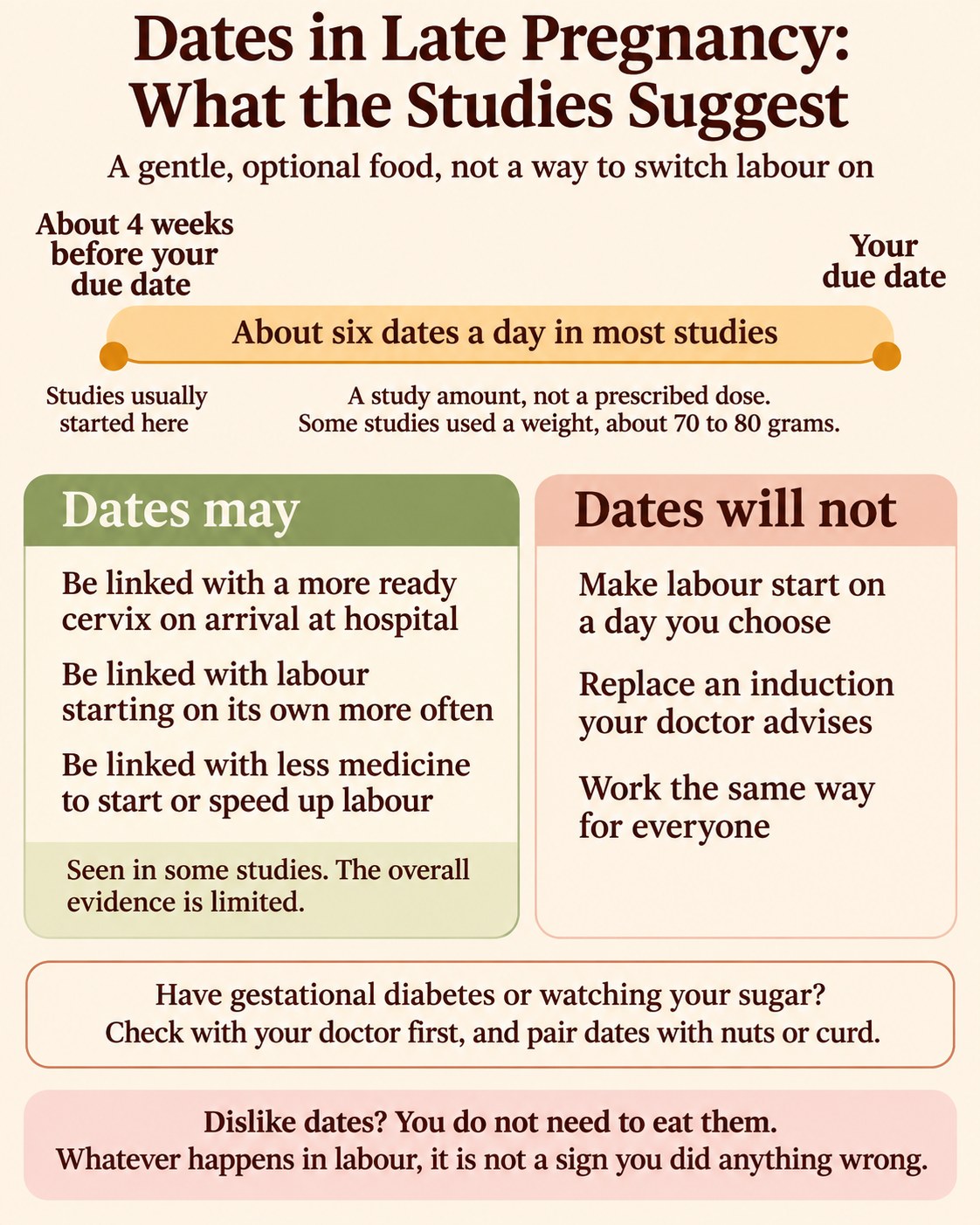
Studies vary in the number, weight, and type of dates used. The most common amount studied is about six dates a day, but this reflects what researchers tested, not a dose your doctor has prescribed.
- Amount: about six dates a day in the studies (some used a set weight, roughly 70 to 80 grams).
- Timing: usually started around four weeks before the due date, in the third trimester.
- How: if you choose to eat them, you can include them as part of your usual meals or snacks.
If you dislike dates, there is no need to force them down. They are a possible option, not a rule you have to follow.
Dates will not do everything
It helps to be clear about what this habit can and cannot do, so your hopes stay realistic. Dates are a mild support, not a switch that turns labour on.
- They will not make labour start on a day you choose.
- They will not replace a medically advised induction if your doctor recommends one.
- The research is promising but has limits, so results vary from woman to woman.
Dates also carry a little iron, but nowhere near enough to fix low haemoglobin.
Knowing this takes the pressure off. Whatever happens with your labour, it is not a sign that you did anything wrong.
If you are watching your blood sugar
Dates are rich in carbohydrate, so this is the one part that needs care, particularly if you are managing your blood glucose. If you have a healthy pregnancy, dates can be part of a balanced diet, but the amount that may suit you depends on your overall diet and health. For a calmer way to think about the whole plate, read why pregnancy nutrition isn't about double portions.
If you are managing gestational diabetes (raised blood sugar during pregnancy), or your doctor has asked you to limit sugar, do not start this habit without checking first. A few simple steps help:
- Ask your doctor or dietitian what amount is safe for you.
- Pair dates with protein or fat, such as nuts or curd, to slow the sugar rise.
- Keep an eye on your readings if you monitor your blood sugar at home.
When to see a doctor
Check with your doctor or midwife if any of these apply to you:
- You have gestational diabetes or are managing your blood sugar.
- You have been advised to follow a restricted or specific diet.
- You have passed your due date and are wondering about your options.
- You feel regular, tightening contractions, or your waters break.
Looking ahead
As your due date nears, the more useful things to focus on are recognising the early signs that labour has started and knowing when to head to hospital. If you go past your due date, your doctor will talk you through monitoring and, if it is needed, induction.
Dates can sit quietly alongside all of that. They are one small choice, while the decisions that matter most will be made with your doctor as labour approaches.
References
- Al-Kuran O, Al-Mehaisen L, Bawadi H, Beitawi S, Amarin Z. The effect of late pregnancy consumption of date fruit on labour and delivery. Journal of Obstetrics and Gynaecology. 2011;31(1):29-31.
- Bagherzadeh Karimi A, Elmi A, Mirghafourvand M, Baghervand Navid R. Effects of date fruit (Phoenix dactylifera L.) on labor and delivery outcomes: a systematic review and meta-analysis. BMC Pregnancy and Childbirth. 2020;20:210.
- Nasiri M, Gheibi Z, Miri A, et al. Effects of consuming date fruits on gestation, labor, and delivery: an updated systematic review and meta-analysis of clinical trials. Complementary Therapies in Medicine. 2019;45:71-84.
- Salajegheh Z, Nasiri M, Imanipour M, et al. Is oral consumption of dates in the peripartum period effective and safe integrative care to facilitate childbirth. BMC Pregnancy and Childbirth. 2024;24:12.
Common questions
When should I start eating dates in pregnancy?
Most studies began about four weeks before the due date, in the third trimester. The labour research focuses on these final weeks. If you are unsure about the right timing for your pregnancy, ask your doctor.
How many dates a day should I eat?
The commonly studied amount is around six dates a day, roughly 70 to 80 grams. This is the amount researchers tested, not a prescribed dose. Eating far more brings no proven extra benefit and only adds carbohydrate.
Can I eat dates earlier in pregnancy too?
The labour research has mainly looked at the final few weeks of pregnancy. If you want to eat dates earlier, your usual dietary needs and any pregnancy-specific advice from your doctor are more relevant to you than the labour studies.
Will eating dates start my labour if I am overdue?
No. Some studies suggest dates may support how your body prepares, but they do not reliably trigger labour. If you are past your due date, your doctor will guide you on monitoring and, if needed, induction.
This article is for education and general understanding. It is not medical advice and does not replace guidance from your own doctor or midwife, who knows your health and pregnancy. Always speak to a qualified professional before changing your diet, especially if you have gestational diabetes or any other condition.
 Medically reviewed byDr. Mahender Singh, MBBS, DCH, MD (Paediatrics)A consultant child specialist and neonatologist with over four decades of practice in newborn and child health.
 Written bySarthak ThakurCo-founder, CTO and Chief Marketing Officer of ParentVeda, and the software engineer who builds its app and the pipeline that checks its articles.
This article explains; it doesn’t diagnose. If your doctor has told you something different, your doctor is right.