


Somewhere in the final weeks, you may start asking the same quiet question with every twinge and cramp: is this it? Waiting for labour to begin is one of the most uncertain stretches of pregnancy, partly because your body often rehearses long before the real thing arrives.
Here is the short answer. Labour has usually started when your contractions become regular, grow stronger and longer, and keep coming closer together, no matter how much you rest or move.
A few other signs, a streak of blood-tinged discharge as the mucus plug comes away, a backache that will not settle, or your waters breaking, can appear alongside or before this. Early labour can last hours, so there is often time to stay calm, eat something, and get ready before heading in.
Key takeaways
- Regular contractions that get longer, stronger and closer together are the clearest sign that labour is truly underway.
- Braxton Hicks contractions are irregular and usually ease when you rest or change position; real ones do not.
- Early labour can be slow. Active labour, when your cervix opens to around four centimetres or more, is when things speed up.
- You are usually advised to head in when contractions are roughly five minutes apart and last about a minute, for an hour, though you should confirm your own hospital's advice.
- If your waters break, contractions start before 37 weeks, or there is heavy bright red bleeding, contact the hospital straight away.
This is for education and general understanding, not a diagnosis. Every pregnancy is different, and you should always follow the guidance of your own doctor or midwife, especially about when to come in.
What are the first signs that labour is starting?
Labour rarely begins with one dramatic moment. Most often, it builds gradually, one small sign at a time.
In the final weeks your baby often settles lower into your pelvis, a shift called lightening, or the baby dropping. You may breathe more easily but feel more pressure low down. This can happen weeks ahead, especially with a first baby, so it is not a precise signal.
Another early sign is the mucus plug coming away, a pinkish or brownish jelly-like discharge (you might hear it called a show). It can appear days before labour or as it begins, so on its own it is not a reason to rush anywhere.
You may also notice a persistent low backache, loose motions, or cramping that feels like period pain. Then come the contractions, tightenings across your bump that, once labour is real, settle into a rhythm. The National Health Service describes established labour as regular contractions that gradually open the cervix.
Is this real labour or just a false alarm?
This is the question that sends most parents searching in the middle of the night. The difference shows in how the tightenings behave over time.
| What to notice | Braxton Hicks (practice tightenings) | True labour contractions |
|---|---|---|
| Timing | Irregular | Come at regular intervals |
| Strength over time | Do not grow stronger | Last longer and grow more intense as time passes |
| Response to movement or rest | Often fade when you move, rest, or drink some water | Do not ease off when you change what you are doing |
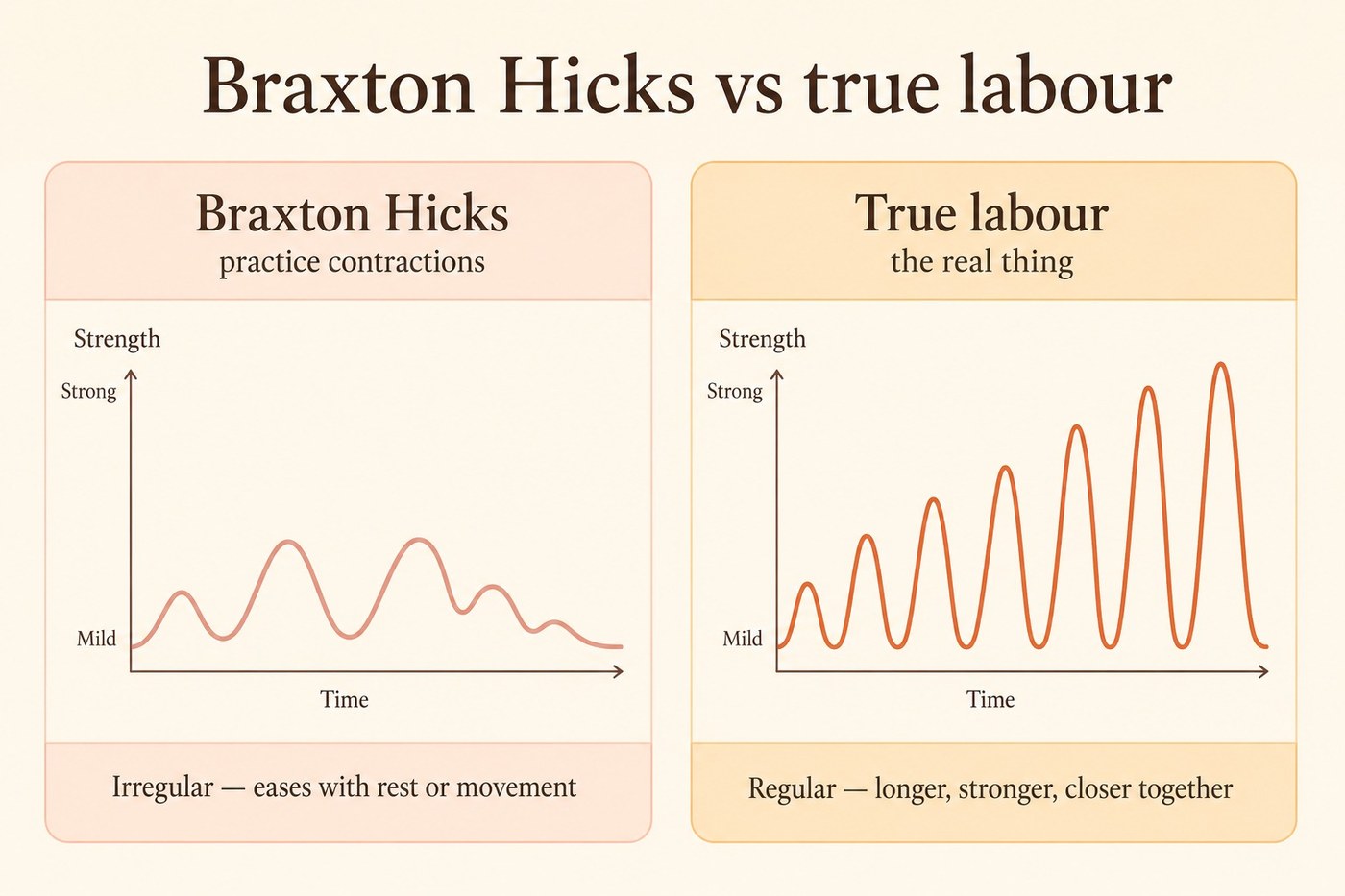
Labour can begin at any time, day or night. What matters is not the clock but whether your contractions are becoming regular and steadily stronger.
A simple check is to time them: if the gaps are shrinking and the tightenings are getting harder to talk through, labour is likely on its way.
How early labour feels different from active labour
Early labour is the long, gentle beginning. Your cervix is softening and starting to open, contractions may be twenty or thirty minutes apart, and this phase can last for hours, especially with a first baby. It is usually the best time to stay home, rest, and keep sipping fluids.
Active labour is when the pace picks up. Your cervix has opened to around four centimetres or more, contractions are stronger, longer and closer together, and coping needs real focus. Knowing which phase you are in helps you judge when staying home stops making sense.
When should you head to the hospital?
Timing the trip in is where much of the worry sits. As a general guide, head in when:
- Your contractions are about 5 minutes apart
- Each one lasts around 1 minute
- This pattern continues for about an hour (the 5-1-1 rule)
- Your waters break
- Your doctor has advised you to come in earlier, for example if you live far away or are expecting a second baby
Every hospital is a little different, so always follow your own maternity team's advice.
Which signs need urgent attention?
Most labour signs are a normal part of the process. A few are not, and they deserve an immediate call rather than a wait-and-see approach. Contact the maternity unit straight away if:
- your waters are green or brown rather than clear
- there is heavy, bright red bleeding
- your baby's movements slow down or change
- contractions begin before 37 weeks
- you have a severe headache, sudden swelling, or changes in your vision
That last one can point to a blood pressure problem rather than labour, so it needs the same quick call.
Looking ahead
Once you can recognise the real signs, the waiting feels a little less unnerving. The next thing worth understanding is what happens after you arrive: how labour moves through its stages, and the pain relief and breathing options available along the way.
References
- National Health Service (NHS UK). Signs that labour has begun.
- National Health Service (NHS UK). The stages of labour and birth.
- American College of Obstetricians and Gynecologists (ACOG). How to Tell When Labor Begins.
- Mayo Clinic. Stages of labor and birth.
- Cleveland Clinic. Labor.
- National Institute for Health and Care Excellence (NICE). NG235: Intrapartum care.