Most tests in pregnancy tell you something about right now. The swab for Group B Streptococcus, known as GBS, is different. Its result is meant for one day: the day you give birth.
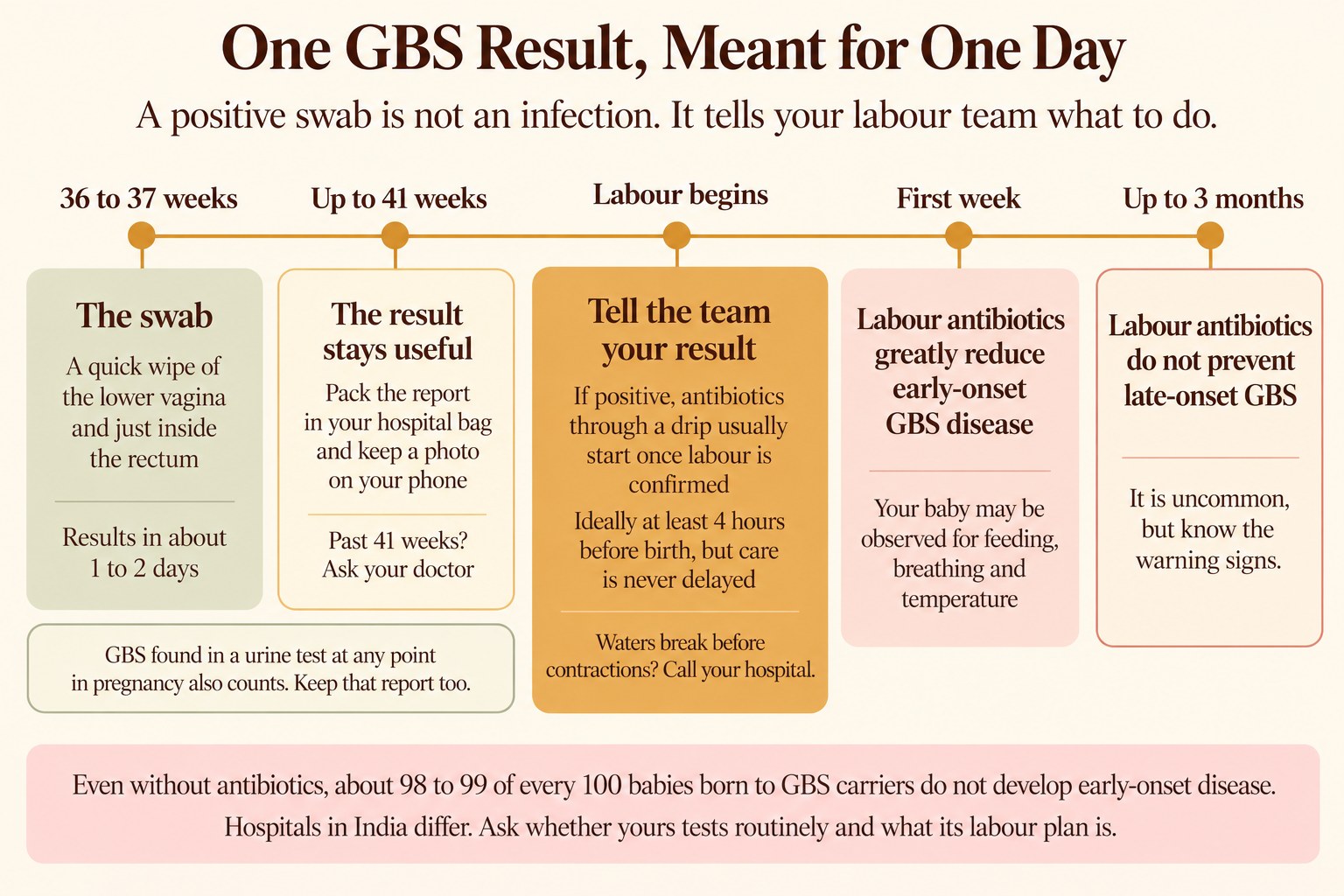
It checks whether you carry GBS, a common bacterium that is usually harmless to you but can, rarely, pass to your baby around birth. Where it is done, the swab is usually taken in the 36th or 37th week, though timing, and whether it is offered at all, varies by hospital in India.
Key takeaways
- Even without antibiotics, about 98 to 99 of every 100 babies born to GBS carriers stay free of serious first-week illness (early-onset disease).
- The swab is timed close to your due date because GBS comes and goes.
- On Indian lab reports, GBS is often written by its scientific name, Streptococcus agalactiae.
- A urine report showing GBS, from any stage of pregnancy, matters for your labour plan, so make sure your team knows about it.
- A drip of antibiotics once labour starts sharply lowers the chance of first-week GBS illness, but it cannot remove every risk or stop infection that appears later.
This is for understanding, not diagnosis. Your obstetrician knows your hospital's GBS policy and is the right person to plan your labour care.
The quick answer
Testing positive for GBS is not a sign of infection, in your body or in your baby's. It tells your labour team whether a drip of antibiotics should be started once labour begins, a step that sharply cuts the chance of a newborn falling ill with GBS in the first seven days.
Practice differs between hospitals in India: some test everyone late in pregnancy, others act only on risk factors. Ask your obstetrician which approach your hospital follows.
What exactly is Group B Strep?
Group B Streptococcus is a bacterium that makes its home in the bowel and around the vagina of many healthy adults. It is not the germ behind a sore "strep throat".
Carrying it rarely brings any itching, discharge or pain. It is not a sign of poor hygiene, and it is not a sexually transmitted infection.
About 1 in 4 pregnancies tested in the United States show GBS. Individual studies from India report lower figures, from about 3 to 13 in every 100, varying with the hospital and testing method.
Hearing "positive" can bring a sudden wave of worry, and sometimes guilt. That reaction is natural. You did nothing to cause it and could have done nothing to prevent it.
How could it reach your baby?
GBS usually passes to a baby during labour and birth, especially once the waters have broken. Less often, it can reach the baby before labour begins.
This is why the risk is concentrated around birth, and why doctors watch how long the waters have been broken. It is also why antibiotics are timed for labour, when exposure is most likely.
To picture the numbers, imagine 100 babies born to GBS carriers, with no antibiotics given. Each baby falls into just one of these groups.
| Group | About how many of the 100 |
|---|---|
| Do not pick up GBS during birth | About 50 |
| Pick up GBS on the skin or in the mouth, and stay well | About 48 to 49 |
| Pick up GBS and become seriously ill in the first week (early-onset disease) | About 1 to 2 |
Figures are rounded, and studies vary in how many babies pick up GBS. Because early-onset disease can be serious, doctors act on these small numbers.
Timing is everything with this test
GBS can appear and disappear over a few weeks, so a swab taken too early may not reflect what is present at birth.
Current American guidance places the swab in the 36th or 37th week. Older guidance and some hospitals use 35 to 37 weeks, and the United Kingdom does not test everyone routinely. Your doctor will tell you which schedule your hospital follows.
This late window was chosen so that the result stays useful for births up to at least 41 weeks. If your pregnancy continues beyond that, ask your doctor how your hospital handles it.
That makes the swab one of the last checks of pregnancy, unlike early screening such as NIPT. To see how it fits alongside your scans, read the pregnancy ultrasound schedule.
What happens during the swab?
The swab takes less than a minute and needs no fasting or preparation. One cotton swab is gently wiped in the lower vagina, then just inside the rectum (back passage).
It may feel slightly uncomfortable but is usually not painful, and some doctors let you take it yourself. Results usually arrive within one to two days.
The rectum is included because the gut is where GBS naturally lives, and the vagina is often colonised from there. Testing both sites finds more carriers than a vaginal swab alone.
How to read your GBS report
Knowing what each line means can save you an anxious evening of searching.
| What the report says | What it means |
|---|---|
| Specimen: rectovaginal, or vaginal and rectal, swab | Both recommended sites were sampled |
| Organism: Streptococcus agalactiae (Group B) | This is GBS, under its scientific name |
| "Isolated" or "Detected" | Positive. GBS was found in the sample |
| "Not isolated" or "Not detected" | Negative. GBS was not found in the sample |
| Growth: scanty, light or heavy | How much grew in the lab. A positive is usually managed the same way, whatever the amount |
| Method: culture | The lab grew the bacteria over one to two days. This allows a sensitivity test |
| Method: PCR (polymerase chain reaction) | The lab detected GBS genetic material. This can be faster, but on its own it usually cannot show which antibiotics work |
| Antibiotic sensitivity table | Which medicines worked against your sample in the lab. It is most useful if you have a penicillin allergy |
Some labs first grow the sample in an enrichment broth before culture. In one review of Indian studies, this step raised detection from about 5 to about 8 in every 100 samples. If you are unsure how your sample was processed, your doctor can check with the lab.
What your result actually means
| Your result | What it means | What usually happens next |
|---|---|---|
| Negative | GBS was not detected in the sample | Antibiotics are generally not needed for GBS, unless other reasons arise in labour |
| Positive | GBS was detected in the sample. It is not a diagnosis of infection for either of you | Your team assesses the need for antibiotics during labour |
| Unknown | The result is unavailable, or the test was not done | Your team reviews your records, any risk factors and the hospital's protocol |
A positive swab tells your team about bacteria in your body, not about your baby's health. It needs no treatment right now, and on its own it is not a reason to change your birth plan.
GBS on a urine report: what changes?
Urine tests are repeated through pregnancy in India, and they sometimes pick up GBS. Doctors call this GBS bacteriuria. It raises two separate questions: does the urine need treatment now, and what does it mean for labour?
| What the urine test shows | Treatment during pregnancy | Effect on your labour plan |
|---|---|---|
| Burning or other signs of a UTI (urinary tract infection), with GBS found | Treated as a UTI, guided by the culture result | Labour antibiotics advised |
| No symptoms, GBS at a high count: 100,000 or more CFU/mL (colony-forming units per millilitre) | Usually treated when found | Labour antibiotics advised |
| No symptoms, GBS at a lower count | Usually not needed during pregnancy | Labour antibiotics still advised |
Under American guidance, GBS in urine at any count, even a low one, is treated as a sign that GBS is heavily present in the vagina and rectum. Treatment during pregnancy clears the urine, but GBS often returns, which is why the labour plan still applies.
In this situation, a late-pregnancy swab is usually not needed. Keep the urine report in your pregnancy file, even if it is from your first trimester.
Why not just take antibiotics now?
Tablets taken weeks before birth do not work, because GBS returns once the course ends. Protection depends on antibiotics being present when your baby is most likely to be exposed.
If your swab or urine showed GBS, this is how the plan usually changes with your birth. Your team also weighs your stage of pregnancy, your allergy history and the hospital's protocol.
| Situation | What usually happens |
|---|---|
| Labour starts | A drip of antibiotics (given intravenously, IV, into a vein) usually starts once labour is confirmed |
| Waters go before contractions start | Call your hospital. Your team decides, based on your result and how far along you are, when to start antibiotics and whether to plan an induction |
| Planned caesarean, before labour and with waters intact | GBS antibiotics are usually not needed. You still receive the routine antibiotic given at every caesarean to guard against infection of the wound |
| Planned caesarean, but labour starts or waters break first | The usual labour plan for GBS applies |
| Labour moves very fast | Care is never delayed to fit an antibiotic schedule. Your baby's team is told your result and when antibiotics were given |
Penicillin or a related medicine is the usual choice. Ideally the drip has been running for four hours or longer by the time the baby is born, but even a shorter time offers some protection, and necessary care is never delayed to reach it.
Why your allergy history matters
If you have a penicillin allergy, your team needs details, not just a yes. Tell them whether a doctor confirmed it, what reaction you had, and whether it ever needed emergency treatment.
This matters because alternatives do not always work against GBS. A South Indian study found about 1 in 5 GBS samples resistant to clindamycin, one common substitute.
Your team weighs your allergy history, the sensitivity results and clinical guidance together. Not every antibiotic listed on a report is a suitable choice for protecting a baby during labour.
What happens for your baby after birth?
Three different things can happen, and they are easy to mix up.
| Stage | Who it is for | What happens |
|---|---|---|
| Prevention | You, during labour | A drip of antibiotics lowers the chance of your newborn falling ill with GBS in the first seven days |
| Observation | A baby who seems well | Your team may watch feeding, breathing, temperature and alertness. How closely, and for how long, is guided by the circumstances of birth and hospital protocol |
| Assessment and treatment | A baby who shows signs of infection | Tests such as blood tests, and antibiotics for your baby if needed |
Antibiotics given in labour target early-onset disease, the kind that shows up in the first seven days, often within 12 to 48 hours of birth. They do not protect against late-onset disease, which can appear from about day 7 up to three months of age.
Late-onset infection is uncommon. Still, it is why the warning signs below are worth knowing through your baby's first three months. Skin-to-skin contact and breastfeeding continue as normal.
Will your hospital test you?
The United States tests everyone in late pregnancy, while the United Kingdom mainly acts on risk factors. In India, practice varies between hospitals.
Ask your obstetrician two things: whether the hospital tests routinely, and what its labour antibiotic plan is. If your status is unknown when labour begins, your team reviews your records and your situation using pathways like these.
| Your situation | Usual approach |
|---|---|
| GBS in urine this pregnancy, or a previous baby with GBS infection | Labour antibiotics, usually with no swab needed |
| Status unknown, with labour before 37 weeks or waters broken for 18 hours or longer | Labour antibiotics commonly advised |
| Fever of 38 degrees Celsius or higher in labour | You are checked for infection of the womb, and treatment usually uses broader antibiotics that also cover GBS |
When to see a doctor
Before birth, contact your hospital promptly if:
- your waters break, especially if you are GBS positive
- you have a fever or feel unwell with chills
- you have burning or pain while passing urine
- contractions begin before 37 weeks
- you are unsure whether you have a penicillin allergy
After birth, seek urgent care if, during the first three months, your baby:
- feels hot or unusually cold
- is feeding poorly or refusing feeds
- seems floppy, very sleepy or unusually irritable
- is breathing fast or grunting
- changes colour, looking pale, blue or blotchy
Looking ahead
Once the swab is done, there is nothing more to do about GBS until labour. The weeks ahead are for learning to recognise the signs of labour.
If you are GBS positive, the one moment not to wait at home is when your waters go before contractions begin. Call your hospital straight away.
References
- American College of Obstetricians and Gynecologists. Prevention of Group B Streptococcal Early-Onset Disease in Newborns. Committee Opinion No. 797. Obstet Gynecol 2020;135:e51-e72.
- American College of Obstetricians and Gynecologists. Urinary Tract Infections in Pregnant Individuals. Clinical Consensus No. 4. Obstet Gynecol 2023;142(2):435-445.
- American College of Obstetricians and Gynecologists. Group B Strep and Pregnancy (patient FAQ).
- Centers for Disease Control and Prevention. Prevention of Perinatal Group B Streptococcal Disease: Revised Guidelines from CDC, 2010. MMWR Recomm Rep 2010;59(RR-10).
- Centers for Disease Control and Prevention. Preventing Group B Strep Disease in Newborns.
- Risk of Early-Onset Neonatal Group B Streptococcal Disease With Maternal Colonization Worldwide: Systematic Review and Meta-analyses. Clin Infect Dis 2017;65(Suppl 2):S152-S159.
- World Health Organization. WHO recommendation on screening of pregnant women for intrapartum antibiotic prophylaxis for the prevention of early onset Group B streptococcus disease in newborns. 2024.
- Hughes RG, et al., Royal College of Obstetricians and Gynaecologists. Prevention of Early-onset Neonatal Group B Streptococcal Disease. Green-top Guideline No. 36. BJOG 2017;124(12):e280-e305.
- Meta-analysis on prevalence of vaginal group B streptococcus colonization and preterm births in India. J Matern Fetal Neonatal Med.
- Group B Streptococcal Colonization among Pregnant Women and Neonates in a Tertiary Care Hospital in South India. Indian J Pediatr 2022.
- Group B Streptococcus in Indian pregnant women: Its prevalence and risk factors.
- Santhanam S, Jose R, Sahni RD, Thomas N, Beck MM. Prevalence of group B Streptococcal colonization among pregnant women and neonates in a tertiary hospital in India. J Turk Ger Gynecol Assoc 2017;18:181-4.
- Federation of Obstetric and Gynaecological Societies of India. Routine Antenatal Care for the Healthy Pregnant Women. 2024.
- Cleveland Clinic. Group B Strep in Pregnancy: Test, Risks and Treatment.
Common questions
What if I go into labour before my GBS test?
Your team checks what is already known, such as urine results or a previous baby with GBS infection. Labour before 37 weeks is itself a reason doctors often give antibiotics. Some hospitals also take a swab on arrival.
My report says "scanty growth". Does that still count?
Usually, yes. Any GBS found on the swab is generally treated as positive. The growth level reflects what grew in the lab, not your baby's risk.
Can I have a normal delivery if I am GBS positive?
Yes. A positive result alone is not a reason for a caesarean. Most GBS-positive births are vaginal deliveries, with antibiotics given during labour.
Will I be positive again in my next pregnancy?
Not necessarily. GBS comes and goes, so you are tested again in each pregnancy. If a previous baby had GBS infection, antibiotics in labour are usually offered without a new test.
Can diet, probiotics or home remedies clear GBS?
There is no reliable evidence that food, probiotics, curd or home remedies clear GBS before birth. Probiotics are still being studied. Antibiotics during labour remain the only proven protection.
This article is for education and general understanding. It is not a diagnosis or a substitute for advice from your own doctor. Every pregnancy is different, so please discuss your test results, allergies and birth plan with your healthcare team.
 Medically reviewed byDr. Mahender Singh, MBBS, DCH, MD (Paediatrics)A consultant child specialist and neonatologist with over four decades of practice in newborn and child health.
 Written bySarthak ThakurCo-founder, CTO and Chief Marketing Officer of ParentVeda, and the software engineer who builds its app and the pipeline that checks its articles.
This article explains; it doesn’t diagnose. If your doctor has told you something different, your doctor is right.