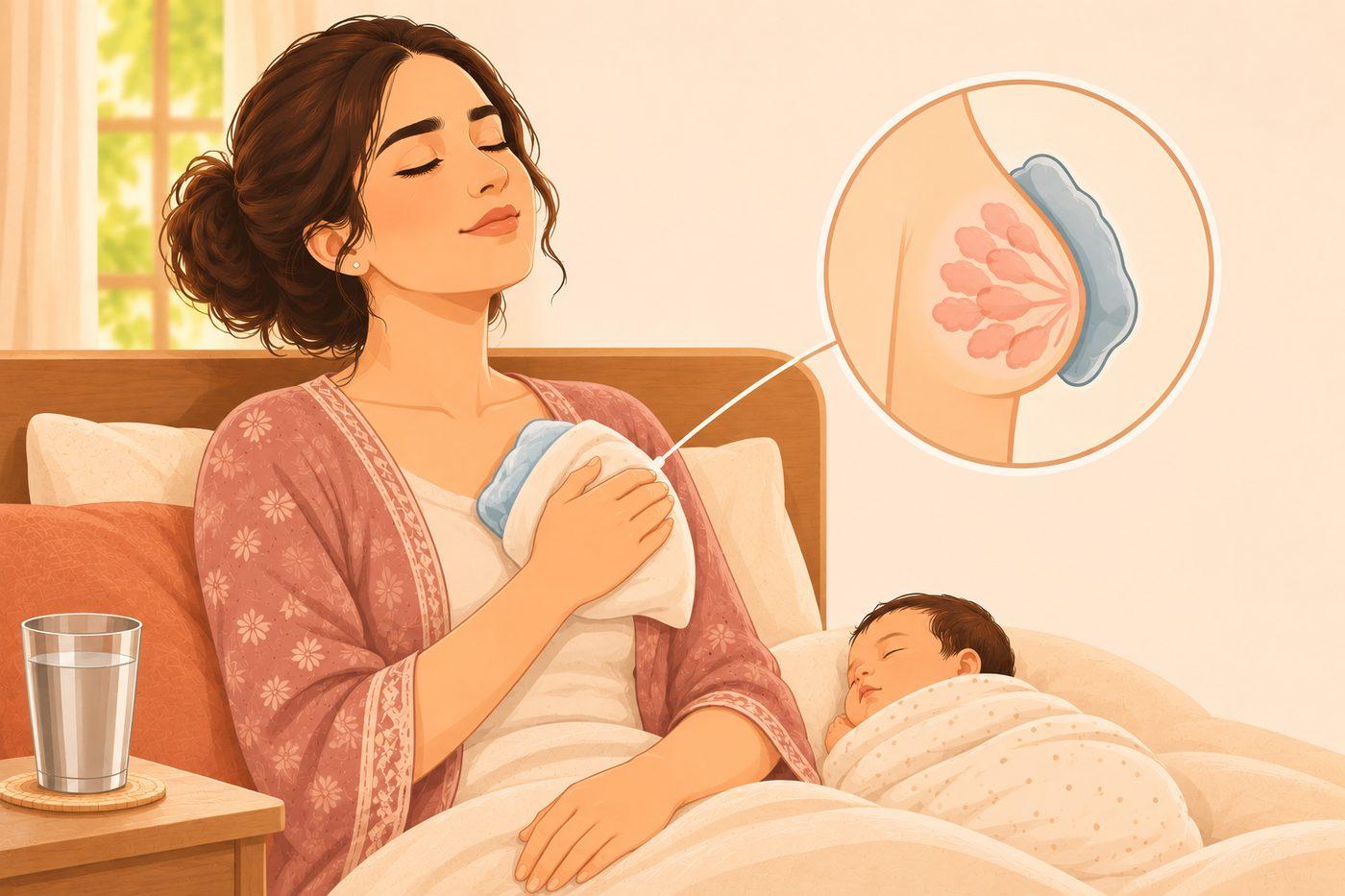
The first weeks of breastfeeding can bring a kind of pain that rarely gets talked about before the baby arrives. Breasts can suddenly feel rock hard, nipples crack, and a sore lump appears out of nowhere.
Whether you are feeding a newborn now or preparing for the weeks after birth, the worry is the same. Is this normal, or is something going wrong?
Most breast pain while breastfeeding after delivery improves with frequent feeds and a deeper latch. It usually comes from engorgement, sore or cracked nipples, or a sore patch many people call a blocked duct. Fever, chills or a run-down, feverish feeling change the picture. With a painful breast, they may mean mastitis, which needs a doctor the same day.
This article covers the first six weeks after delivery. Pain that starts later, or that is not linked to feeding, deserves its own check with your doctor.
Key takeaways
- Engorgement affects both breasts, begins as milk comes in during the first week and usually calms down within 24 to 48 hours.
- Sore or cracked nipples are usually linked to how your baby is positioned and attached.
- A tender spot in one breast tends to respond better to cold and gentle care than to forceful kneading.
- A painful breast plus fever, chills or body aches needs a doctor the same day.
Why do breasts hurt so much after delivery?
In the first week, your body switches from small amounts of colostrum to full milk production. Blood flow and fluid rise at the same time, so the breast swells as well as fills.
While you and your baby are still learning to latch, milk may not drain well, so these problems often arrive together.
Newer breastfeeding guidance sees a blocked duct and mastitis as points along one range of breast inflammation, with engorgement as a closely related problem. Where the pain sits, and how your whole body feels, show where you are on that range.
It is easy to wonder whether you are doing something wrong. Early pain is far more often a sign of a changing body and a latch still being learnt.
Which breast problem might this be?
| Problem | Where you feel it | What else you notice | Usually appears |
|---|---|---|---|
| Engorgement | Both breasts, all over | Full, hard, warm; nipples may flatten; you feel well | Once milk comes in, usually in the first week |
| Sore or cracked nipples | The nipple itself, mostly during feeds | Pinching pain, cracks or bleeding | First week or two |
| Blocked duct | One tender area in one breast | Firm, sore spot; no fever | Any time, often weeks 1 to 6 |
| Mastitis | One area, often wedge-shaped | Hot, red or darker skin, plus fever, chills or aches | Most often in the first six weeks |
Engorgement often peaks the day your milk comes in
Engorged breasts feel heavy, tight and too full to touch, sometimes up to the armpits. The nipple may flatten, making latching harder. With frequent feeds, the swelling usually settles within about 48 hours.
- Feed whenever your baby shows hunger cues, often 8 to 12 times in 24 hours.
- When the breast is too tight for a good latch, hand expressing a few drops first can soften the area your baby needs to grip.
- Use a cloth-wrapped cold pack for 10 to 15 minutes between feeds.
- Avoid pumping to "empty" the breasts, as extra removal signals your body to make more.
When does nipple pain need help?
Some tenderness is common in the first days as your nipples adjust. The difference lies in how the pain behaves during a feed.
| Usually part of adjusting | Worth getting help for |
|---|---|
| Mild tenderness as the feed starts | Pinching or sharp pain through the whole feed |
| Eases within the first minute or so | Gets worse from one day to the next |
| Nipple looks rounded after feeds | Nipple looks flattened, creased or white after feeds |
| Skin stays intact | Cracks, blisters or bleeding |
When your baby takes only the nipple, it is pressed against the hard roof of the mouth. A deeper latch, with more of the areola (the darker circle of skin) inside the mouth, moves it back to safety.
- Aim for a wide-open mouth, chin pressed into the breast and lips turned outwards.
- If a feed hurts, slide a clean finger into the corner of your baby's mouth to break the suction, then try again. A different hold can also help, as shown in Breastfeeding Positions: Finding the Hold That Works for You.
- Let nipples air dry after feeds and skip soap on them.
- Purified lanolin cream may soothe, but it cannot replace a better latch.
Each step of a good feed is shown in How to Breastfeed: A Simple Guide for New Mothers. Why nipples crack, and what helps the skin heal, is covered in Sore and Cracked Nipples While Breastfeeding: Why They Happen and How to Heal.
Less often, the cause is something else, such as tongue-tie (a restricted tongue) or a skin infection. If pain continues after latch help, a lactation consultant or doctor can check all the possibilities.
A tender lump is often called a blocked duct
A firm, sore spot in one breast is usually called a blocked duct, and it is the term you will hear most. Current understanding is different: the tissue around a duct swells and narrows it, rather than a solid plug forming inside.
So cold and gentle care tend to help more than force. Unlike mastitis, a blocked duct usually leaves you feeling well in yourself, without fever or aches.
In many Indian homes, a hard breast is met with hot fomentation and firm kneading to "clear the milk." The intention is kind, but deep pressure can bruise the tissue and add to the swelling.
- Keep breastfeeding whenever your baby wants to, without extra pumping.
- Use a light, skin-deep stroke from the tender area towards the armpit instead of deep massage.
- Choose cold packs over long spells of heat.
- Ask your doctor which pain relief suits you. Some common options, such as paracetamol and ibuprofen, are generally considered compatible with breastfeeding.
If the sore spot has not begun to settle by the next day, or fever or chills appear, see a doctor.
Mastitis needs a doctor the same day
Most breast pain in these weeks can be eased at home. What raises the urgency is how your whole body feels.
Mastitis often starts like a blocked duct, then spreads. The patch becomes hot, puffy and sore, sometimes in a wedge shape, and your whole body may ache as if a fever is coming on. On brown skin, it may look darker rather than red.
See a doctor today if a painful breast comes with:
- a high temperature (38°C or above)
- chills, body aches or feeling feverish, even without a thermometer reading
- no improvement 12 to 24 hours after starting self-care
- pus or blood from the nipple
Mastitis can be inflammation alone, which often settles with rest, feeding and pain relief. It can also be a bacterial infection that needs antibiotics safe for breastfeeding. The two can be hard to tell apart at home, which is why same-day review matters.
If a lump stays painful, grows or feels soft and fluid-filled after treatment, go back to your doctor promptly. It may be an abscess, a pocket of pus that needs a scan and drainage.
Looking ahead
Engorgement tends to pass quickly, and feeds tend to grow more comfortable as you and your baby practise. Timelines vary, and needing longer does not mean you are doing it wrong.
If feeding still hurts at six weeks, raise it at your postnatal check. How to Get a Good Latch (and Fix a Painful One) is the best next read, because a deeper latch keeps many of these problems from returning.
When to speak to a doctor
Breast pain can be linked to how well milk is moving, so your baby's feeding matters too.
| Situation | What to do |
|---|---|
| Feeling very unwell, faint or confused, a racing heartbeat, or redness spreading fast | Go to emergency care now |
| Any of the mastitis signs above | See a doctor the same day |
| On antibiotics but no better after 48 hours | Go back to your doctor |
| A lump that stays painful, grows or feels fluid-filled after treatment | Go back to your doctor promptly |
| Nipple pain beyond the first week despite latch changes, or repeated blocked ducts | See a lactation consultant or doctor within a few days |
| Baby has few wet nappies, seems hungry after most feeds, or has not regained birth weight by about two weeks | See your paediatrician soon |
The signs that show your baby is feeding well are explained in Am I Making Enough Breast Milk? The Real Signs and How to Increase Supply.
References
- Mitchell KB, Johnson HM, Rodríguez JM, et al. Academy of Breastfeeding Medicine Clinical Protocol #36: The Mastitis Spectrum, Revised 2022. Breastfeeding Medicine. 2022;17(5):360 to 376.
- National Health Service (NHS). Mastitis.
- National Health Service (NHS) Start for Life. Mastitis.
- National Health Service (NHS). Breastfeeding: positioning and attachment.
- The Breastfeeding Network. Analgesics and breastfeeding.
Common questions
Can I keep breastfeeding with mastitis?
In most cases, yes. Feeding from the affected breast is generally safe for your baby and helps milk keep moving. Feed as often as your baby wants, without pumping extra. If that side is too painful, start on the other breast and switch once milk is flowing, or express gently by hand. Stopping suddenly can make the swelling worse, so speak to your doctor before making changes.
Are antibiotics for mastitis safe while breastfeeding?
Doctors usually choose antibiotics known to be compatible with breastfeeding. Small amounts can pass into milk, and some babies have looser stools or seem a little unsettled during the course. Mention that you are breastfeeding each time a medicine is prescribed, and finish the full course even when you start to feel better.
Should I use hot or cold compresses?
Cold is usually more helpful for engorgement and a tender spot. A cloth-wrapped cold pack for 10 to 15 minutes between feeds can ease swelling and pain. Long spells of heat can increase swelling. Never place ice directly on the skin.
How long do cracked nipples take to heal?
Healing time varies, but the sign to watch is progress. Once the latch improves, feeds should start to feel more comfortable and cracks should begin to close. If a crack is not improving, looks infected, or burns with shiny, flaky skin around it, see your doctor or a lactation consultant.
This article is for general education and does not replace personal medical advice. Breast pain can have many causes, so any concern about your breasts or your baby's feeding is best discussed with a doctor or qualified lactation consultant who can examine you. Review of this article by a specialist obstetrician-gynaecologist and lactation consultant is in progress.
 Medically reviewed byDr. Mahender Singh, MBBS, DCH, MD (Paediatrics)A consultant child specialist and neonatologist with over four decades of practice in newborn and child health.
 Written bySarthak ThakurCo-founder, CTO and Chief Marketing Officer of ParentVeda, and the software engineer who builds its app and the pipeline that checks its articles.
This article explains; it doesn’t diagnose. If your doctor has told you something different, your doctor is right.