The fourth month of pregnancy
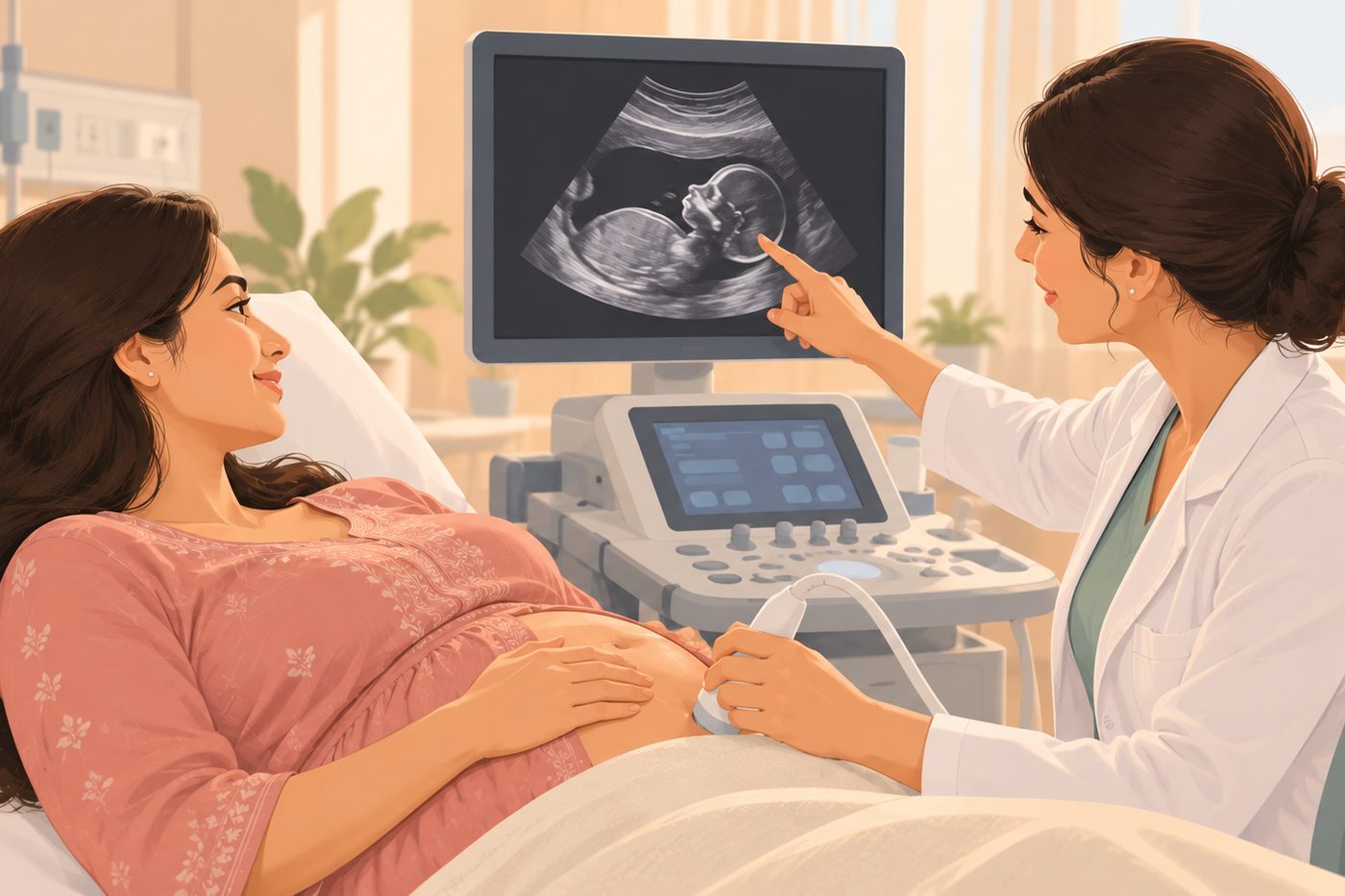
The fourth month, roughly weeks 14 to 17, marks your entry into the second trimester. For most women, this is when the hardest first-trimester symptoms genuinely ease, while your baby grows quickly, developing fine body hair, facial expressions, and the earliest workings of hearing.

- Your baby grows from
- a peach to a pomegranate
- By week 17
- 11.5 to 13.5 cm, about 150 g
- Milestones
- Facial Expressions Begin · Growing Stronger · Listening Begins · Getting Stronger
Week by week
 Week 14
Facial Expressions Begin
About the size of a peach · 8.0 to 8.7 cm, about 40 g
Your baby's face can make tiny expressions now, and small movements happen all day.
Your baby
The muscles in my face are growing, so I can make tiny expressions. My neck is getting stronger, and for the first time my body is growing faster than my head.
Your body
Your uterus is growing steadily, and your bump may start to show. Many women have more energy now.
- Improved energy
- Increased appetite
- Round ligament discomfort
- Mild nasal congestion
For you: Mind your posture. Your centre of balance is slowly starting to shift.
 Week 15
Growing Stronger
About the size of an apple · 9.0 to 10.5 cm, about 70 g
Your baby's body is growing quickly, and tiny movements are getting smoother every day.
Your baby
My muscles and bones are getting stronger. I can move my arms, legs and joints more smoothly now. My ears are forming, and I'm getting ready to hear the world around me in the coming weeks.
Your body
Your bump may show more now. Extra blood flow can give your skin a healthy glow, and your growing uterus may cause the odd stretching feeling.
- Growing bump
- Increased appetite
- Round ligament pain
- Occasional headaches
For you: Keep moving gently, and watch your posture as your body changes.
 Week 16
Listening Begins
About the size of an avocado · 11.5 to 12.5 cm, about 100 g
Your baby is getting stronger, and the tiny parts needed for hearing are growing.
Your baby
My bones are hardening, my muscles are getting stronger, and my ears are growing fast. Soon I'll start reacting to sounds from outside.
Your body
Your uterus keeps growing, and your bump may be easy to see now. Some women notice more energy and a healthy glow.
- Growing bump
- Increased appetite
- Back discomfort
- Occasional round ligament pain
For you: Watch your posture and wear supportive shoes as your centre of balance shifts.
- Week 17
Getting Stronger
About the size of a pomegranate · 11.5 to 13.5 cm, about 150 g
Your baby's skeleton is getting stronger, a little body fat is forming, and movements are getting smoother.
Your baby
My skeleton is changing from soft cartilage into stronger bone. My muscles are getting stronger, and I'm practising the movements that help me grow.
Your body
Your bump is showing more, and your uterus keeps growing upward. You're making a lot more blood now for your baby.
- Growing bump
- Increased appetite
- Mild back discomfort
- Occasional dizziness when standing quickly
For you: Stand up slowly, and keep drinking water through the day.
Eating well this month
Your baby's bones are getting stronger, and they need steady calcium and protein.
Your baby's bones and future teeth are forming fast, and they need calcium and vitamin D.
- Milk
- Paneer
- Curd
- Ragi
- Sesame Seeds
- Moong Dal
- Chana
- Pumpkin Seeds
One of India's richest natural sources of calcium, with fibre and iron too.
Ragi dosa, ragi porridge or ragi roti.
Gives you calcium, healthy fats and minerals that help bones grow.
Til laddoo, sprinkled over salad, or mixed into chutney.
Worth doing
- Take a bump photo each week, keep up gentle exercise, and stick with your healthy routines.
- Talk to your baby every day, keep up your healthy routines, and make time to relax.
- Spend time outdoors, keep moving every day, and start talking to your baby often.
- Notice any new feelings in your tummy, and keep building your healthy daily routines.
Worth skipping
- Buying every baby product you see online.
- Brushing off stress, or trying to keep up your pre-pregnancy pace.
- Standing for a long time without a break.
- Worrying if you haven't felt the baby move yet.
When to call your doctor
Call your doctor if you have heavy bleeding, severe pain in your tummy, fluid leaking, severe headaches, fever, or a lot of swelling.
Myth or truth
Myth A bigger bump means a bigger baby.
Truth A bigger bump doesn't reliably tell you your baby's size. Bump size depends on lots of things, and your scans show how your baby is growing.
Myth Your baby can't hear you yet, so talking doesn't matter.
Truth Your baby's ears are forming now, and soon they'll hear your voice. So it's a lovely time to start talking to your baby.
For your partner
Notice her changing body, and be kind and encouraging about it.
Questions in the fourth month
What is the "second trimester," and why is it often called the easier trimester?
The second trimester runs from week 14 through week 27, and many women do find it more comfortable. Morning sickness and exhaustion typically ease, energy returns, and the miscarriage risk drops considerably compared to the first trimester.
What is placenta previa?
Placenta previa is when the placenta implants low in the womb and covers all or part of the cervix, the opening to the birth canal. It is found in roughly 1 in 200 pregnancies, is usually picked up on a routine second trimester scan, and the majority of women with it go on to have healthy babies, often needing a planned caesarean rather than facing an emergency.
Why do stretch marks form in pregnancy, and can they be prevented?
Stretch marks form when skin stretches faster than its deeper supportive fibres can keep up with, and genetics is the single strongest factor in who gets them and how severely. No cream, oil, or supplement has been reliably proven to prevent them, according to a Cochrane systematic review of the evidence.
When will I feel my baby move for the first time?
Most women feel their baby's first movements, called quickening, somewhere between 16 and 20 weeks, though the range runs anywhere from 13 to 25 weeks. If this is your first pregnancy, it commonly takes until 18 to 20 weeks or a little later; in later pregnancies, many women recognise it earlier, often around 16 weeks.
What emotions are common in the second trimester?
Many women describe the second trimester as an emotional relief: the acute anxiety of early pregnancy often eases alongside physical symptoms, and a sense of calm or excitement tends to grow, especially once movement is felt. That said, new worries, about screening results, finances, or simply becoming a parent, are just as normal.
Which ragas or music are traditionally used in Garbh Sanskar, trimester by trimester?
Certain Indian classical ragas, including Yaman, Bhairavi, Bhairav, Malkauns, and Bageshri, are traditionally recommended in Garbh Sanskar practice for their calm, soothing quality. There isn't a strict trimester-by-trimester rule; the consistent principle is simply choosing gentle, slow, soothing music throughout, rather than anything jarring or high-energy.
How do I talk to my partner about fears, money, and the changes ahead?
Bring these conversations up directly and early rather than waiting for the "right moment," since worries about money, changing roles, and the future rarely resolve simply by staying quiet about them. Naming a specific worry out loud, rather than a vague sense of unease, usually makes it far easier for your partner to actually respond to.
Does a twin pregnancy need more frequent monitoring in the second trimester?
Yes, twin pregnancies are monitored more closely than single-baby pregnancies, and how often depends on whether your twins share one placenta or have separate ones. Twins sharing a placenta (monochorionic) are typically scanned every 2 weeks from 16 weeks onward; twins with separate placentas (dichorionic) usually have their anomaly scan around 20 weeks, then scans every 4 weeks after that.
Second trimester weight gain: is my pace on track?
In the second trimester, a common general guideline is gaining roughly half a kilogram (about 1 pound) per week, though your specific healthy range depends on your pre-pregnancy BMI. Gaining faster or slower than this occasionally isn't automatically concerning; your doctor tracks your overall pattern over several visits, not any single week.
Are antenatal classes worth it, and what do they cover?
Yes, most parents find antenatal classes genuinely worthwhile, even though they're not compulsory. They typically cover labour stages, breathing and coping techniques, birth planning, pain relief options, and early newborn care, and can meaningfully boost confidence for both you and your partner.
Every pregnancy moves at its own pace. Sizes and changes are typical ones, not targets, and the scans listed are the usual pattern; your doctor may add, move or skip tests for you. If something feels wrong, call your doctor rather than waiting for the next visit.