
Some changes in pregnancy arrive loudly, like morning ulti, while others creep in quietly, like swollen feet by evening or a new itch at night. Almost every pregnant woman wonders, at some point, whether a new change is simply pregnancy or a sign to call the doctor.
Most pregnancy symptoms are a normal part of a body adjusting to a growing baby, and they shift as the months pass. A few signs need a doctor quickly, and knowing which is which brings real peace of mind.
Key takeaways
- Pregnancy symptoms tend to follow a pattern: first the hormones, then the growth, then the room.
- A symptom is best judged by when it started, how strong it is and what came with it, not by its name alone.
- Warning signs, and how quickly each one needs a doctor, are set out under "When to speak to a doctor".
This is for education and general understanding, not a diagnosis. Every pregnancy is different, so please speak with your doctor about your own symptoms.
Why do pregnancy symptoms change every month?
A simple way to remember it: first the hormones, then the growth, then the room.
Early on, rising hormones affect almost every system at once, so nausea, tiredness and sore breasts arrive together. In the middle months, most changes come from the growing uterus and baby.
Near the end, the baby takes up space the stomach, lungs and bladder were using. That is why heartburn, breathlessness and frequent urination often return.
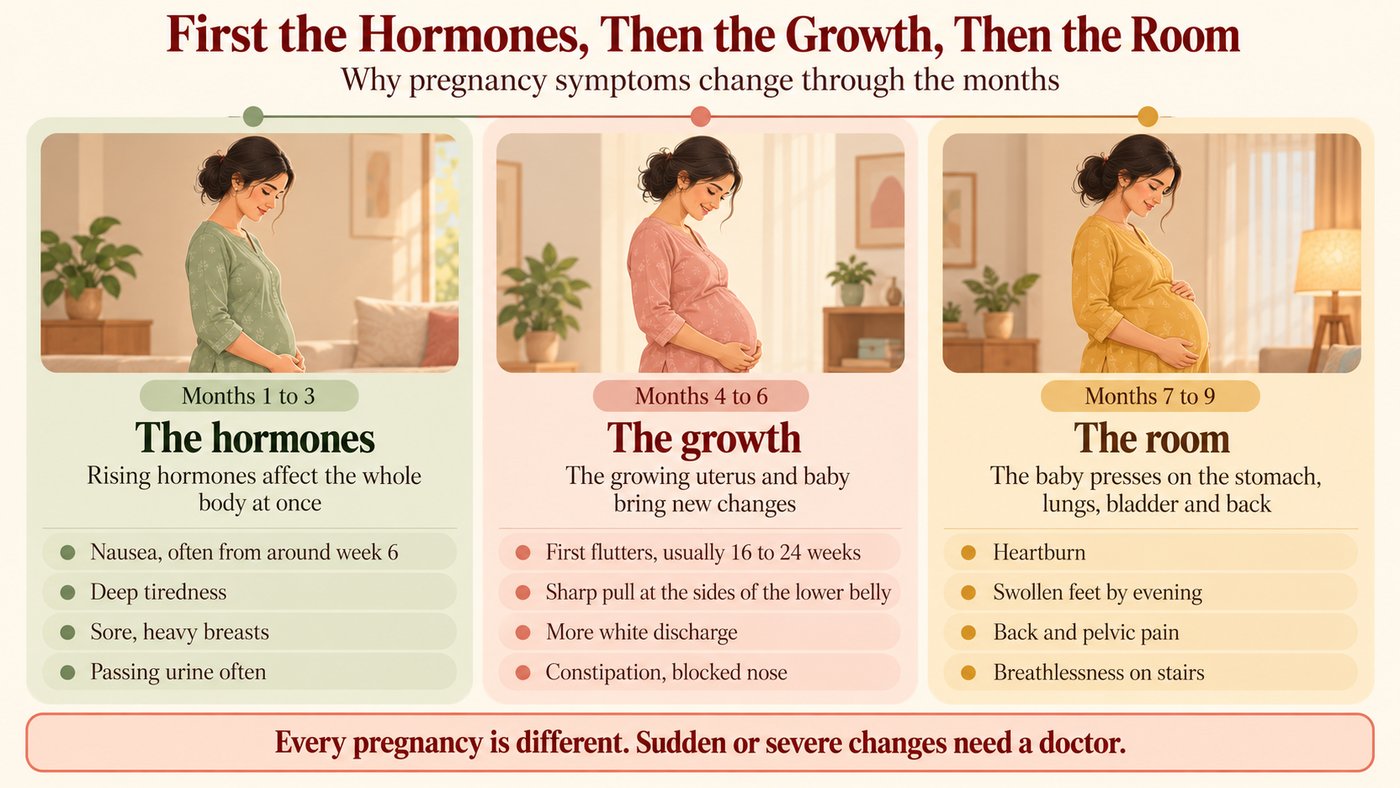
This article groups pregnancy symptoms month by month into three stages, because symptoms overlap and not every pregnancy follows the same timetable.
Months 1 to 3: What symptoms are common early in pregnancy?
Pregnancy is usually dated from the first day of the last menstrual period, so the first two weeks of the count pass before conception. Early pregnancy symptoms usually begin a little later, around weeks 5 to 6.
| Symptom (what families call it) | What is usually normal | See a doctor if |
|---|---|---|
| Nausea and vomiting (ulti, ji machlana) | Starts around week 6, often peaks in month 2 or 3 | Nothing stays down for a day, urine is very dark, or feeling faint on standing |
| Deep tiredness | Needing naps, early nights | Breathless at rest, racing heart, very pale lips or nails |
| Sore, heavy breasts | Tender and fuller from early weeks | A hard, red, painful lump |
| Passing urine often | Common from the start | Burning, fever or blood in urine |
| Mild cramps | Light, period-like pulling | Any bleeding, severe or one-sided pain, or shoulder-tip pain |
| Food aversions, mood swings | Sudden dislikes, tearful days | Low mood most days for two weeks or more |
The full week-by-week detail for this stage is in our guide to first trimester symptoms, week by week. As the hormones settle, the next stage brings a different kind of change.
Months 4 to 6: What changes as the baby grows?
For many women this is the easier stretch. Nausea fades, energy returns and the bump starts to show.
| Symptom (what families call it) | What is usually normal | See a doctor if |
|---|---|---|
| First baby movements | First flutters are usually felt between about 16 and 24 weeks; timing varies, and is often later in a first pregnancy | No movement felt by around 24 weeks |
| Sharp pull at the sides of the lower belly | Brief, on turning or standing up | Pain that stays, or comes with fever or bleeding |
| White discharge (safed pani) | Thin, milky, mild smell, more than before | Itching, curd-like, green or foul-smelling discharge may mean infection. A watery leak that keeps coming may be the waters and needs checking straight away |
| Constipation (qabz), piles | Common; iron-folic acid (IFA) tablets can add to it | Bleeding from the back passage or severe pain |
| Blocked nose, bleeding gums | Common from extra blood flow | Heavy or frequent nosebleeds |
| Dark line on the belly, darker skin patches | Usually fade after delivery | Not a concern on their own |
For more detail, see our guides to discharge during pregnancy and what a baby's kicks and flutters mean. From month 7, size starts to matter more than hormones.
Months 7 to 9: Which symptoms become common as space gets tight?
The uterus now presses on the stomach, lungs, bladder and back, so some early discomforts return.
| Symptom (what families call it) | What is usually normal | See a doctor if |
|---|---|---|
| Heartburn (seene mein jalan) | After meals and when lying down | Pain under the right ribs with headache or blurred vision |
| Swollen feet (pairon mein sujan) | Worse by evening, better after rest | Sudden puffy face or hands, or one leg swollen, red and painful |
| Back and pelvic pain (kamar dard) | Achy, eased by rest and changing position | Rhythmic back pain that comes and goes before 37 weeks |
| Practice tightenings | Irregular, painless or mild, ease with rest | Regular, stronger tightenings before 37 weeks |
| Breathlessness | On stairs or after walking | At rest, or with chest pain |
| Itching (khujli) | Mild itching, often on the belly or breasts as skin stretches | Palms and soles, worse at night, with no rash |
| Leaking urine | A little on coughing or laughing | A steady watery trickle that cannot be held back |
| Baby movements | A regular pattern right up to labour | Fewer or weaker movements than usual |
For burning that spoils sleep, see our guide to heartburn and acidity relief in pregnancy.
How to tell a normal symptom from a warning sign
The same symptom can mean different things at different stages. A headache in month 2 is often linked to hormones or not drinking enough water. A severe headache with blurred vision after 20 weeks can be an early sign of pre-eclampsia, a blood pressure problem of pregnancy.
So it helps to look past the symptom's name and ask three questions:
- When did it start? Swelling that builds over weeks is common; swelling that appears overnight is not.
- How strong is it? Mild discomfort that eases with rest differs from pain that is severe or keeps getting worse.
- What came with it? Heartburn alone is common; heartburn with headache and blurred vision is not.
When a symptom feels different from the usual pattern, noting these three details before calling the doctor helps them judge quickly how urgent it is.
Sometimes the delay comes from home. Elders may say "sab normal hai, humne bhi sab jhela tha", and that well-meant reassurance can hold back a call that was needed. Doctors would much rather hear about a symptom that turns out normal than miss one that was not.
When to speak to a doctor
This safety list is informed by the Ministry of Health and Family Welfare (MoHFW) antenatal care guidelines, the Federation of Obstetric and Gynaecological Societies of India (FOGSI) recommendations and the other clinical guidance listed in the references.
Go to the hospital straight away, or call an ambulance (102 or 108 in most states), if there is:
- Any bleeding from the vagina, at any stage
- A gush or steady trickle of fluid
- Severe headache with blurred vision or flashing lights
- Fits (convulsions) or fainting
- The baby moving less than usual, or not at all
- Severe or constant belly pain
- Fever of 38°C or higher
- Breathlessness at rest or chest pain
- Vomiting so much that nothing stays down
Call the doctor the same day for:
- Sudden swelling of the face, hands or one leg
- Pain under the right ribs
- Itching of the palms and soles
- Burning while passing urine
- Regular tightenings before 37 weeks
Mention at the next visit: ordinary heartburn, constipation, back ache, tiredness, and discharge that looks and smells normal.
Looking ahead
The months ahead bring regular antenatal check-ups, at least eight across pregnancy as the World Health Organization (WHO) recommends. Each visit records blood pressure, weight and haemoglobin on the Mother and Child Protection (MCP) card, so carrying it every time gives any doctor the full picture.
Under the Pradhan Mantri Surakshit Matritva Abhiyan (PMSMA), designated government facilities provide antenatal services on the 9th of every month for women in the second and third trimesters.
As month 9 approaches, attention gently shifts from symptoms to the signs of labour, and to the moment the waiting ends.
References
- Ministry of Health and Family Welfare, Government of India. Guidelines for Antenatal Care and Skilled Attendance at Birth by ANMs/LHVs/SNs. Maternal Health Division, 2010.
- Federation of Obstetric and Gynaecological Societies of India (FOGSI), Gestosis India and Indian College of Obstetricians and Gynaecologists (ICOG). Hypertensive Disorders in Pregnancy: Good Clinical Practice Recommendations, 3rd edition, 2026.
- World Health Organization. WHO recommendations on antenatal care for a positive pregnancy experience, 2016.
- Royal College of Obstetricians and Gynaecologists. Intrahepatic cholestasis of pregnancy (patient information, updated April 2026).
- Centers for Disease Control and Prevention. Urgent Maternal Warning Signs and Symptoms (HEAR HER campaign), 2026.
- National Health Service (UK). Vomiting and morning sickness.
- Ministry of Health and Family Welfare, Government of India. Pradhan Mantri Surakshit Matritva Abhiyan: About the scheme.
Common questions
Can pregnancy symptoms suddenly disappear?
Yes, and this is often normal. Nausea and breast tenderness commonly ease near the end of the first trimester. If symptoms vanish suddenly in early pregnancy along with cramps or bleeding, contact a doctor.
Is it normal to have no pregnancy symptoms?
Yes. Some women have very few symptoms, and this alone is not a sign of a problem. Check-ups, not symptoms, show how the pregnancy is progressing.
What are pregnancy symptoms called in Hindi?
They are usually called pregnancy ke lakshan. Many women describe them to the doctor in everyday words, such as ulti (vomiting), chakkar (dizziness), seene mein jalan (heartburn), safed pani (white discharge) or pet mein khinchav (pulling in the belly). Doctors understand these words well, so there is no need to find the English term first.
Do pregnancy symptoms come and go?
Yes. Nausea, tiredness and aches often vary from day to day. A lasting change in pattern, especially fewer baby movements later in pregnancy, is what deserves a call.
This article is for general education and does not replace a check-up. Every pregnancy is different, so any symptom that causes worry is best discussed with a doctor who knows the full history.
 Medically reviewed byDr. Mahender Singh, MBBS, DCH, MD (Paediatrics)A consultant child specialist and neonatologist with over four decades of practice in newborn and child health.
 Written bySarthak ThakurCo-founder, CTO and Chief Marketing Officer of ParentVeda, and the software engineer who builds its app and the pipeline that checks its articles.
This article explains; it doesn’t diagnose. If your doctor has told you something different, your doctor is right.