
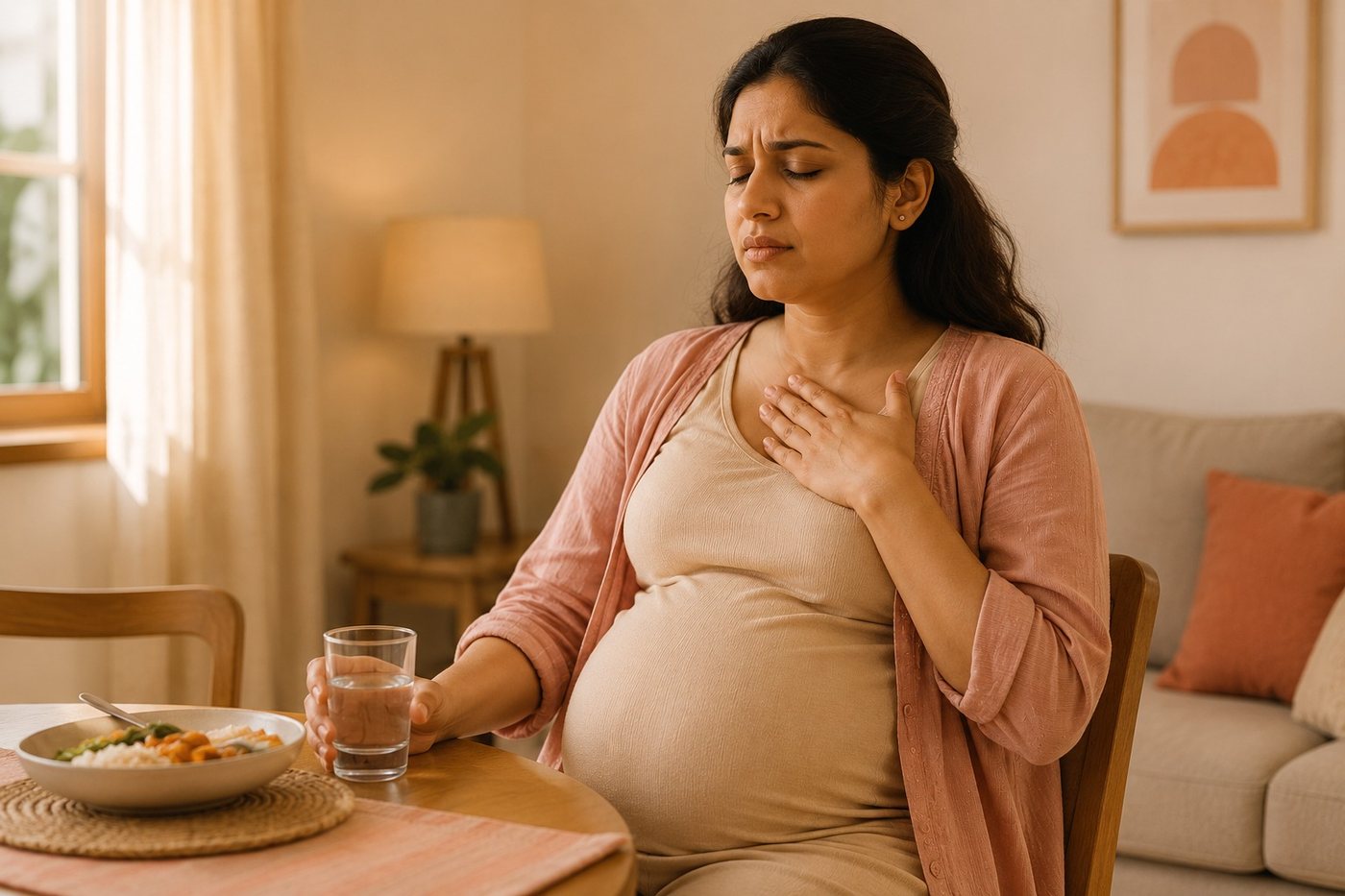
A burning feeling that climbs from your stomach toward your throat after meals is one of the most common discomforts of pregnancy. Some women feel it for the first time in these months. Others notice their old acidity returning, stronger than before.
Whatever brought you here, the answer is reassuring. Heartburn and acidity in pregnancy are very common, do not usually harm your baby, and often ease with a few simple changes to how and when you eat.
Key takeaways
- Heartburn is very common during pregnancy, so experiencing it is not usually a warning sign.
- It happens because pregnancy hormones soften the valve at the top of your stomach, while your growing uterus adds pressure from below.
- It often becomes stronger in the third trimester, when your stomach has the least room.
- Small, frequent meals and staying upright after eating usually help more than any single food rule.
- Some antacids are safe in pregnancy and some are not, so check with your doctor or pharmacist before buying one.
- Heartburn that will not settle with antacids, especially alongside a headache, vision changes or sudden swelling, needs prompt medical review.
This is for education and general understanding, not a diagnosis. Please speak with your doctor or midwife about your own symptoms, and before taking any medicine in pregnancy.
Why does pregnancy make heartburn worse?
Two things happen together. The hormone progesterone rises to relax the muscles of your womb, and the same hormone softens the ring of muscle that normally keeps acid down in your stomach. When that valve relaxes, small amounts of acid drift back up into your food pipe, and that is the burn you feel.
The second reason arrives later. As your baby grows, your uterus presses upward on your stomach and leaves it less room, pushing its contents toward that softened valve. This is why acidity that felt mild earlier often becomes far more noticeable in the third trimester.
None of this means something is wrong. Heartburn itself does not usually harm your baby, and the discomfort is a side effect of a pregnancy that is progressing as it should. That fact alone takes some of the worry out of the burn.
What helps, day to day?
Most acidity settles with everyday habits rather than medicine, and gentle changes tend to work better than strict rules. It usually helps to know both what to lean on and what to ease off.
| What tends to help | What tends to trigger it |
|---|---|
| Smaller meals, more often | Fried and very oily food |
| Eating slowly, staying upright after meals | Very spicy foods |
| A two to three hour gap before bed | Tea, coffee and other caffeine |
| Raising your upper body slightly at night | Chocolate and very sour or citrus foods |
| Sipping fluids between meals, if drinks with food make it worse | Carbonated drinks |
Sleeping on your side and propping your upper body up may also help some women at night. None of these need to be perfect. Small, consistent habits carry you further than any one remedy.
Which medicines are safe if food changes are not enough?
If habits alone do not control the burning, medicines can help, but not every product on the shelf is suitable in pregnancy. The common options are antacids, which neutralise stomach acid, and alginates, which form a barrier that stops acid from drifting up.
One point matters especially here, because iron supplements are routine in Indian pregnancies. Antacids can reduce how well your body absorbs iron, so they are best not taken at the same time as your iron tablet. Ask your doctor which product suits you and how to space it out.
When is heartburn not just heartburn?
Ordinary heartburn is a burning that rises toward your throat and usually eases with antacids or sitting up. Occasionally, pain higher in the abdomen comes from something that needs attention rather than a simple acid problem, and the two can feel alike.
| Usually ordinary heartburn | Worth getting checked promptly |
|---|---|
| Burning behind the breastbone, rising toward the throat | An ache or pressure high in the abdomen, often under the right ribs |
| Comes after meals, eases with antacids or upright posture | Does not settle with antacids or habit changes |
| No other new symptoms | Comes with severe headache, vision changes, or sudden swelling of face, hands or feet |
| Feels like your usual acidity | New, severe or persistent, especially in later pregnancy |
Pain high under the right ribs that does not settle can sometimes be an early sign of pre-eclampsia, a blood-pressure condition of pregnancy. If you notice it, contact your maternity team or doctor the same day rather than waiting. For frequent heartburn that is disturbing your sleep, it is enough to mention it at your next antenatal visit.
Looking ahead
For most people, pregnancy-related heartburn improves after birth as the hormonal and physical changes of pregnancy settle. Until then, the goal is not to find one perfect cure, but to find the small changes that make your own symptoms easier to live with.
References
- National Health Service (NHS UK). Indigestion and heartburn in pregnancy.
- Health Service Executive (HSE Ireland). Heartburn and indigestion in pregnancy.
- Johns Hopkins Medicine. Pregnancy and Heartburn.
- National Institute for Health and Care Excellence (NICE). NG201: Management of heartburn in pregnancy.