Gas during pregnancy is very common, and in most cases it is a normal side effect of the hormonal and physical changes that happen during pregnancy. It often shows up as a tight, swollen tummy by evening, frequent burps, or a sudden need to pass wind at an awkward moment.
It can start in the early weeks, settle in the middle months and return as the baby grows. It usually cannot be switched off completely. Simple changes in an Indian kitchen often make it much easier to live with, such as soaked dals, smaller plates and an easy walk after meals.
This article explains why digestion slows in pregnancy and how to tell gas from symptoms that need a doctor. It also covers which everyday Indian foods are most likely to cause bloating, and what genuinely helps.
Key takeaways
- Gas during pregnancy is usually normal. It is mainly linked to progesterone, a hormone that slows digestion.
- The growing uterus and iron supplements can add to bloating during pregnancy, because iron supplements commonly cause constipation.
- Rajma, chana, cabbage, fried snacks and fizzy drinks are common triggers. Changing how they are prepared and portioned usually works better than cutting out whole food groups.
- Jeera, ajwain, hing and saunf are everyday cooking spices. There is little research on them for gas in pregnancy, and concentrated oils, extracts and arak need a doctor’s advice.
- Severe or worsening pain, bleeding, fever, regular tightening or reduced baby movements should never be put down to gas.
The quick answer
Gas during pregnancy is very common and usually normal. It happens mainly because progesterone slows digestion, and later because the growing uterus presses on the bowel. Smaller, slower meals, soaked and well-cooked dals, a gradual increase in fibre and a gentle walk after meals often help.
Why is gas during pregnancy so common?
The main reason is progesterone, a hormone that rises sharply in pregnancy. It relaxes smooth muscle to keep the uterus calm. The same relaxing effect is thought to slow the muscles of the gut.
A helpful way to picture it: pregnancy turns the gut from an express train into a slow passenger train. Nothing is broken. Food simply stays longer, and gut bacteria get more time to ferment it, which releases gas.
Later in pregnancy, two more things add to this. The growing uterus presses on the stomach and bowel, so a normal meal feels heavier. Iron supplements are part of routine Indian antenatal care, and they commonly cause constipation. A sluggish bowel traps more gas.
| Stage | What drives the gas | What she may notice |
|---|---|---|
| First trimester | Progesterone rising quickly | Bloating, burping and feeling full early, often alongside nausea |
| Second trimester | Hormones steadier | Gas eases for many women |
| Third trimester | Uterus pressing on the stomach and bowel, plus constipation | Heaviness after meals and more wind |
Gas tends to come and go across pregnancy rather than stay constant. It is worth discussing with the doctor if it is getting worse, does not settle with simple changes, or affects eating and sleep.
Is it gas, acidity or something else?
Gas, acidity and other tummy symptoms can overlap, so it helps to know the difference.
| Gas and bloating | Acidity and indigestion | Get urgent medical help |
|---|---|---|
| Tight, swollen tummy, burping, passing wind | Burning in the chest or throat, sour taste, feeling full or heavy after eating | Bleeding or spotting from the vagina |
| Often eases after passing wind or a bowel movement | Often worse after large or late meals, or when lying down | Severe or worsening tummy pain |
| Regular tightening, fever, or pain below the ribs with headache or vision changes | ||
| Fewer baby movements than usual, or a change in the usual pattern |
Ordinary gas and acidity come and go, and they do not come with the signs in the third column. Severe pain should not be assumed to be gas, even if she has had gas before.
Gas or acidity that keeps returning, is getting worse or disturbs eating and sleep does not usually need emergency care on its own. It is still worth raising at the next antenatal visit.
Everyday Indian foods behind the bloating
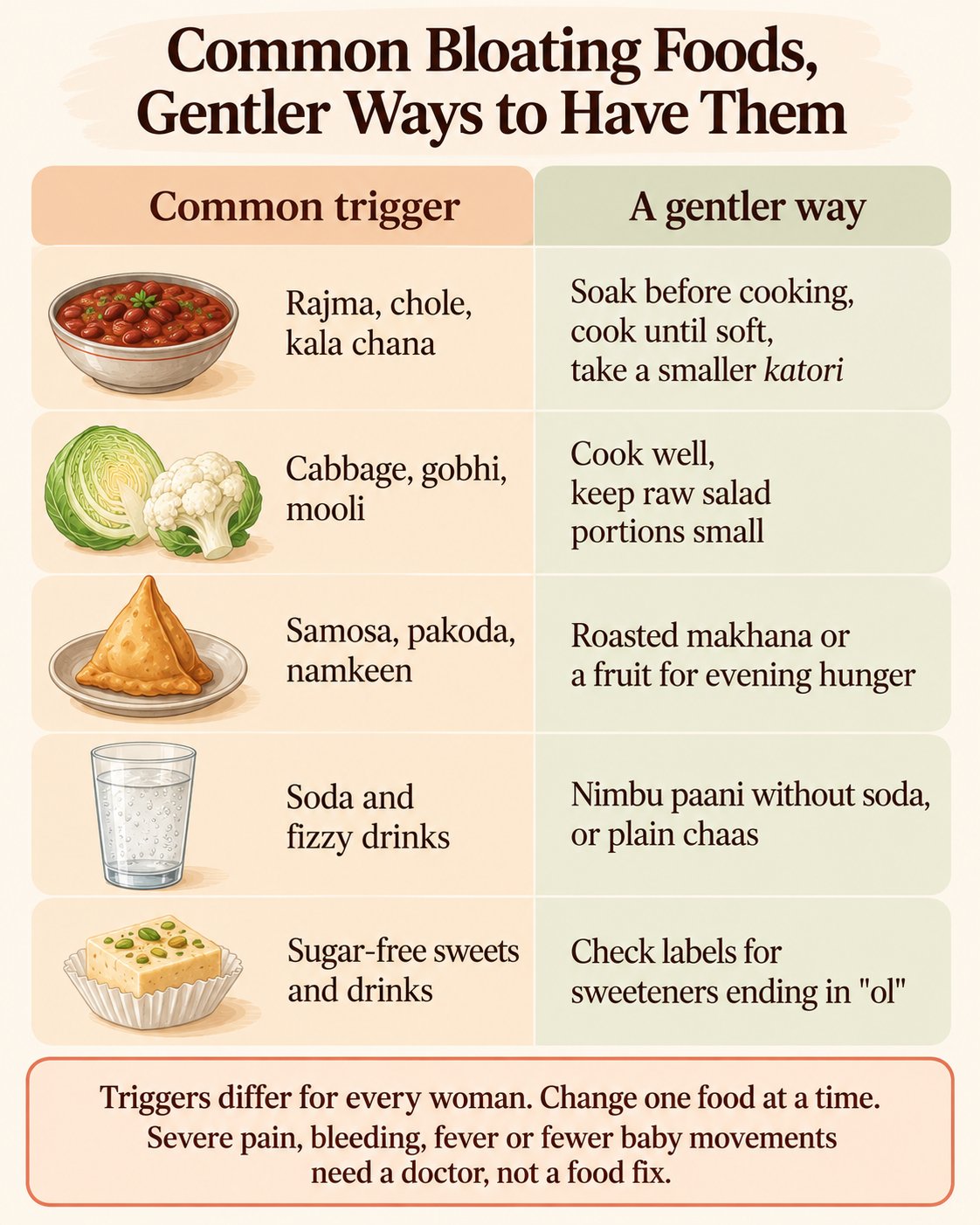
Most bloating in Indian homes comes from a handful of familiar foods. These foods are not unhealthy. They contain sugars and fibres that the slowed-down gut ferments more easily.
| Food | Why it can cause gas | A gentler way to have it |
|---|---|---|
| Rajma, chole, kala chana, lobia | Contain sugars the gut ferments | Soak before cooking, cook until soft, and take a smaller katori |
| Whole urad dal, dal makhani | Heavy and slow to digest | Some women find moong or masoor dal easier; tolerance varies |
| Cabbage, cauliflower (gobhi), onion, mooli | Fermentable fibre | Cook well; if raw salads seem to trigger bloating, try smaller portions or cooked vegetables instead |
| Samosa, pakoda, namkeen, bhujia | Fat slows the stomach further | Roasted makhana or a fruit for evening hunger |
| Soda and fizzy drinks | Swallowed bubbles | Nimbu paani without soda, or plain chaas |
| Milk and paneer (for some women) | Some women digest lactose poorly | Some women find curd or chaas easier, but tolerance varies |
| “Sugar-free” sweets and drinks | Sweeteners such as sorbitol ferment in the gut | Check labels for sweeteners ending in “ol” |
Research on lentils, chickpeas and peas suggests that soaking can lower some of the sugars linked to gas. Many families also discard the soaking water and cook the pulses in fresh water.
Cutting these foods out completely is rarely the answer. Dals and vegetables provide protein, iron and fibre. The Indian Council of Medical Research’s National Institute of Nutrition (ICMR-NIN) notes that fibre with enough fluids helps prevent constipation, which itself worsens gas.
Triggers differ from woman to woman. She can note her meals, portion sizes and symptoms for a few days, then change one food at a time. This usually shows the real culprit better than dropping several foods at once.
Do jeera, ajwain and hing help with gas in pregnancy?
Jeera, ajwain, hing and saunf are part of everyday Indian cooking, and many families use them for a heavy stomach. Their use for gas comes from tradition rather than research, and there are few studies on them in pregnancy.
| Spice | Everyday cooking use | Needs a doctor’s advice first |
|---|---|---|
| Jeera | In tadka, or as jeera water, a traditional warm drink in many homes. There is no proof it treats gas. | Jeera oils, extracts or supplements |
| Ajwain | A pinch in parathas or dal | Ajwain arak, oil or extracts |
| Hing | A pinch in the tadka for dals and beans | Hing supplements or medicinal doses |
| Saunf | A small pinch after meals | Saunf oil or concentrated preparations |
| Fresh ginger | In dal, sabzi or chai | Ginger supplements or capsules |
Packaged churans, digestive tablets and herbal powders also fall outside everyday cooking. Their ingredients and strength vary between brands, and most have not been studied in pregnancy. It is best to check with the doctor before using them.
Home remedies for gas in pregnancy start with how she eats
Many women find gas the most awkward symptom to mention. A burp at the dining table with family, or worry about passing wind in an office meeting, can feel embarrassing enough that it never comes up at the antenatal visit. It is worth raising, because doctors hear about it often and can help.
Small changes in eating habits usually make the biggest difference:
- Eat smaller meals more often instead of 3 large ones. A full plate pressing against a crowded stomach is a common cause of evening bloating.
- Eat slowly and chew well. Talking while eating, gulping water or drinking through a straw adds swallowed air.
- Keep dinner light and early, ideally about 3 hours before lying down.
- Increase fibre gradually. Whole grains, dals, fruit and vegetables help bowel regularity, but adding a lot at once can briefly increase gas.
- Drink fluids regularly through the day, as fibre works best with enough fluid. Her doctor can advise on amounts if she has swelling or another condition.
- Take a short, gentle walk after meals if the doctor has not advised rest.
- Wear clothes that are loose at the waist.
When constipation is behind the bloating
When bloating comes with hard stools or days without a bowel movement, constipation is often the real problem. If it continues despite changes to food and fluids, she should raise it with the antenatal doctor rather than wait.
She should check with the doctor before using any laxative, stool softener, isabgol, churan or home remedy for constipation. Iron supplements should not be stopped without medical advice. The doctor can review the constipation, the supplement and simple ways to manage its side effects.
When to see a doctor
Gas on its own is rarely a concern, but other conditions can also cause tummy pain in pregnancy. These symptoms should never be put down to gas.
Get medical help straight away for:
- Bleeding or spotting from the vagina
- Severe tummy pain, or pain that keeps getting worse
- Regular cramping or tightening of the tummy, or new lower back pain
- A fever
- Vomiting that will not stop, or diarrhoea that does not settle
- Pain or burning while passing urine
- A swollen, tight tummy with vomiting, when she cannot pass stool or wind
- Pain just below the ribs, especially with a severe headache, blurred vision or flashing lights, or sudden swelling of the face, hands or feet. These can be signs of pre-eclampsia, a blood pressure condition of pregnancy.
- Fewer movements than usual, or a change in the baby’s usual pattern. She should call the hospital immediately, even at night, and not wait until the next day.
Raise at the next antenatal visit:
- Gas or bloating that keeps returning, is getting worse, or affects eating or sleep
- Constipation that continues despite changes to food and fluids
- Side effects from iron supplements
- Questions about any medicine, churan or herbal remedy
Looking ahead
For many women, gas eases in the second trimester and may return in the last weeks as the baby takes up more room. After delivery, as hormones settle and the uterus shrinks, digestion usually finds its old rhythm over the following weeks.
If bloating comes with hard stools, straining or pain while passing stool, it is worth reading about piles during pregnancy, as constipation and piles often go together. To see how gas fits with the other changes of each month, Pregnancy Symptoms Month by Month: Normal vs See a Doctor is a useful next read.
References
- World Health Organization (WHO). WHO recommendations on antenatal care for a positive pregnancy experience. 2016.
- Federation of Obstetric and Gynaecological Societies of India (FOGSI). General Clinical Practice Recommendations: Management of Iron Deficiency Anemia in Pregnancy. 2016.
- ICMR-National Institute of Nutrition. Dietary Guidelines for Indians. Revised edition, 2024.
- American College of Obstetricians and Gynecologists (ACOG). Problems of the Digestive System (FAQ120).
- Body C, Christie JA. Gastrointestinal Diseases in Pregnancy: Nausea, Vomiting, Hyperemesis Gravidarum, Gastroesophageal Reflux Disease, Constipation, and Diarrhea. Gastroenterol Clin North Am. 2016;45(2):267-283.
- Han IH, Baik BK. Oligosaccharide Content and Composition of Legumes and Their Reduction by Soaking, Cooking, Ultrasound, and High Hydrostatic Pressure. Cereal Chemistry. 2006;83(4):428-433.
- Ingold CJ, Akhondi H. Simethicone. StatPearls. Treasure Island (FL): StatPearls Publishing; updated 2023.
- National Health Service (NHS). Indigestion and heartburn in pregnancy.
- National Health Service (NHS). Stomach pain in pregnancy.
- National Health Service (NHS). Your baby’s movements.
- National Health Service (NHS). Pre-eclampsia.
- National Health Service (NHS). Side effects of ferrous sulfate.
- National Health Service (NHS). Bloating.
- National Institute of Diabetes and Digestive and Kidney Diseases (NIDDK). Treatment for Gas in the Digestive Tract.
- Mayo Clinic. Gas and gas pains: Diagnosis and treatment.
Common questions
Is gas normal during pregnancy, and can it be an early sign?
Yes, gas is normal during pregnancy. Bloating can be one of the early changes, because progesterone rises soon after conception. But the same bloating is common before a period, so it cannot confirm pregnancy. A home pregnancy test after a missed period is more reliable.
What helps with gas during pregnancy?
The safest first steps are:
- smaller, slower meals
- soaked and well-cooked dals and beans
- a gradual increase in fibre, with regular fluids
- a gentle walk after meals
If gas continues, the doctor can check for constipation, iron side effects and suitable medicines.
Can gas or bloating harm the baby?
Gas itself does not harm the baby. It builds up in the bowel, while the baby develops inside the uterus, surrounded by amniotic fluid. Although the discomfort can be unpleasant for her, gas is not considered harmful to the baby.
How can she tell gas bubbles from the baby moving?
Not reliably. First movements are usually felt between 16 and 24 weeks and can feel like flutters or bubbles, much like gas. Timing does not settle the question either. Babies may move after meals, and easing after a burp does not rule out movement.
Each baby has its own pattern. Once movements are established, any reduction or change in that pattern needs a call to the hospital straight away.
Which medicines help with gas in pregnancy?
Antacids and simethicone do different jobs. Antacids neutralise stomach acid and are used for acidity and heartburn, but some are not suitable in pregnancy. They should also be taken at least 2 hours apart from iron or folic acid tablets, because they can stop the body absorbing them.
Simethicone helps small gas bubbles join so they pass more easily. It is not absorbed into the blood, but there is little evidence on how well it relieves gas. She should check with her doctor or pharmacist before taking either, and mention that she is pregnant.
Do iron tablets cause gas?
Iron supplements commonly cause constipation, and they can also cause stomach discomfort and darker stools. A sluggish bowel can add to bloating.
The Federation of Obstetric and Gynaecological Societies of India (FOGSI) recommends that women on oral iron be counselled on reducing these side effects. It is worth asking the doctor rather than stopping the tablets.
This article is for general education and is not a substitute for personal medical advice. Every pregnancy is different. For any new, severe or worrying symptom, please speak to a doctor or visit the nearest hospital.
 Medically reviewed byDr. Mahender Singh, MBBS, DCH, MD (Paediatrics)A consultant child specialist and neonatologist with over four decades of practice in newborn and child health.
 Written bySarthak ThakurCo-founder, CTO and Chief Marketing Officer of ParentVeda, and the software engineer who builds its app and the pipeline that checks its articles.
This article explains; it doesn’t diagnose. If your doctor has told you something different, your doctor is right.