
Lying on the table during a pregnancy ultrasound, it is natural to watch the screen and the doctor's face, and to read meaning into every pause. Knowing what is really happening in that room can make the wait easier.
Your scan doctor can tell you what the scan shows today. They cannot tell you your baby's sex, because Indian law forbids it, and no scan can rule out every condition.
Key takeaways
- In India, pregnancy ultrasound is done by a qualified doctor at a centre registered under the law.
- A quiet room cannot tell you whether a scan is normal, so ask the doctor in plain words.
- Indian law bans both finding out and sharing your baby's sex during pregnancy.
- Ultrasound can spot signs linked to some conditions, but it cannot diagnose a chromosomal condition or rule out every problem.
- An unclear view or unexpected finding usually leads to a closer look, and the next step depends on what was seen.
This is for understanding, not diagnosis or legal advice. Your obstetrician and scan doctor are the right people to interpret your results.
The quick answer
Your scan doctor can tell you what the scan shows today: the heartbeat, your baby's size and position, the placenta, the fluid, and whether the parts checked look as expected.
They cannot tell you your baby's sex, because the PCPNDT Act makes it illegal, and no scan can rule out every condition. Silence is not a result, so it is fine to ask what the doctor is seeing.
Who does your pregnancy ultrasound in India?
In many countries, scans are done by trained technicians called sonographers. In India, a pregnancy ultrasound can only be done at a centre registered under the law, by a doctor with the qualifications the rules require, such as a radiologist, a sonologist (a doctor trained in ultrasound) or a trained obstetrician.
So the person holding the probe is a doctor who can describe what they see. Their role and your obstetrician's role are different, though.
| Who | What they do |
|---|---|
| Scan doctor | Performs the scan, takes measurements, and writes and signs the report. Can describe what was seen today. |
| Your obstetrician | Reads the report with your history, blood tests and symptoms. Explains what it means for you and plans the next steps. |
Why the room can go quiet
A pregnancy scan follows a careful checklist. The doctor moves through the brain, spine, heart, kidneys, limbs, placenta and fluid, taking set measurements along the way. This needs concentration, so the room may go quiet.
Silence on its own tells you nothing about the result. A doctor may be quiet during a normal scan and chatty during one that needs follow-up. The only reliable way to know is to ask.
You may replay the scan later, wondering what a long pause meant. That worry is common. It is fine to ask, during or after the scan: "Is everything looking as expected so far?"
What a pregnancy ultrasound can and cannot tell you
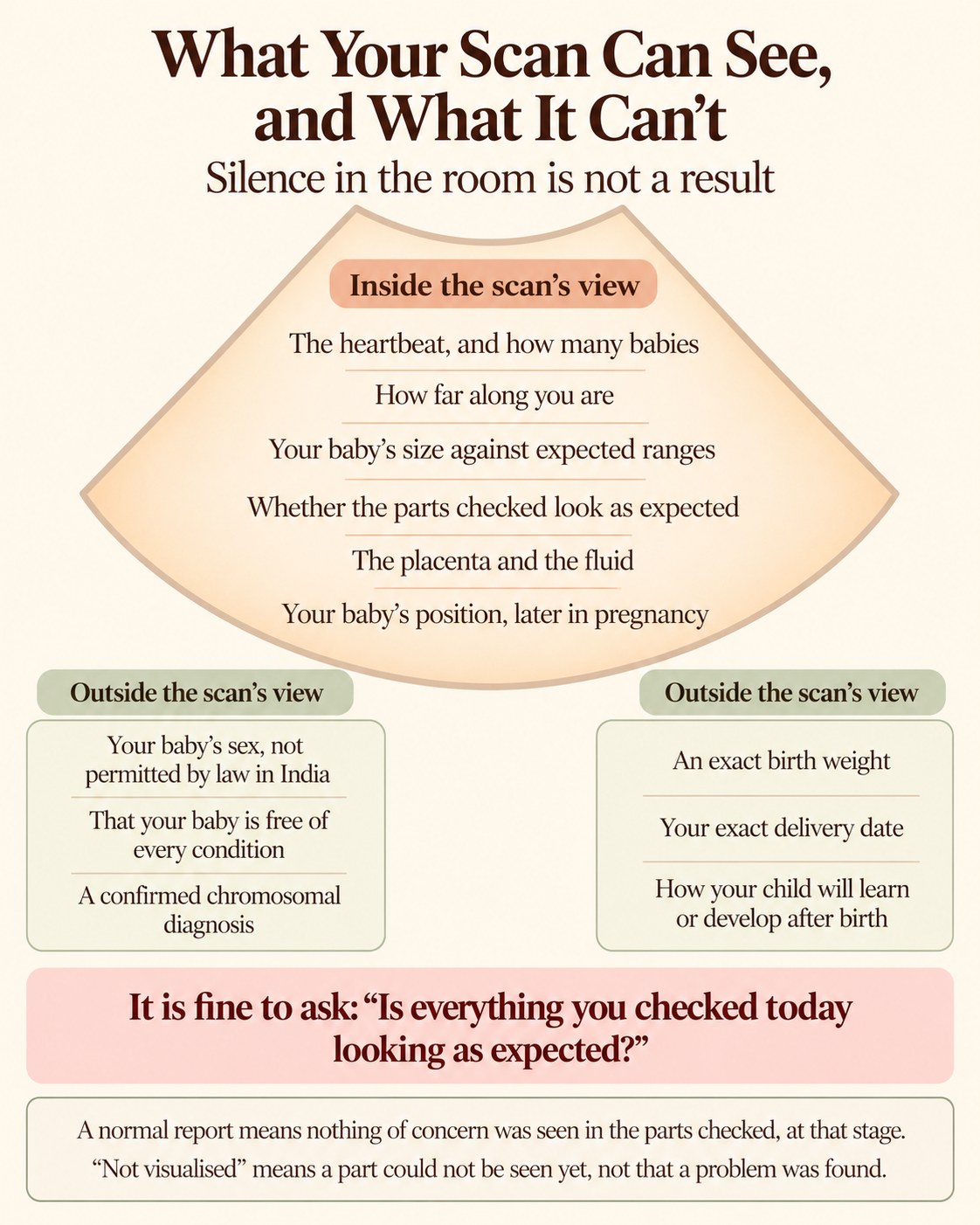
| A scan can usually tell you | A scan cannot tell you |
|---|---|
| Whether there is a heartbeat, and how many babies | Your baby's sex (not permitted by law in India) |
| How far along you are, especially in early pregnancy | Whether your baby is free of every condition |
| Your baby's size compared with expected ranges | An exact birth weight |
| Whether the parts checked at this stage look as expected | A confirmed diagnosis of a chromosomal condition |
| Where the placenta is and how much fluid there is | How your child will learn, hear or develop after birth |
| Your baby's position in later pregnancy | Your exact delivery date |
What each scan focuses on depends on your stage of pregnancy and why it was advised.
| Scan type | Typical timing | Main purpose |
|---|---|---|
| Early or dating scan | First trimester | Confirms the pregnancy is in the uterus, checks the heartbeat, dates the pregnancy |
| Nuchal translucency (NT) scan | 11 to 14 weeks | Checks early development and measures fluid behind the neck, as part of screening |
| Anomaly scan | 18 to 22 weeks | Examines your baby's body parts in detail |
| Growth scan | Third trimester, if advised | Checks size and fluid; may include blood flow, depending on why it was advised |
Why won't they tell you if it's a boy or a girl?
Because the law does not allow it. The Pre-Conception and Pre-Natal Diagnostic Techniques (PCPNDT) Act, 1994 bans finding out a baby's sex during pregnancy, and bans sharing it through words, signs or hints. This applies at every centre in India, government or private.
So there is no hidden message to decode. A smile, a colour or a comment about "strong kicks" says nothing about your baby's sex.
Before the scan, you will sign a short declaration that you do not want to know the sex. Your report will also state that the doctor has neither found nor shared it. This is standard paperwork the law requires, not a sign of concern.
What a normal report does and does not mean
For most people, the scan shows a baby developing as expected, and that is genuine reassurance. It means nothing of concern was seen in the parts checked, at that stage. It is not a guarantee about every aspect of your baby's health.
Some conditions are harder to see than others. In England's national screening programme, where anomaly scans follow set standards, the scan is expected to pick up about 9 in 10 cases of open spina bifida but only about half of serious heart conditions.
These are targets for that programme, not Indian figures. Detection anywhere depends on the equipment, the doctor's expertise and how clearly your baby can be seen.
Estimated fetal weight (EFW) is also an approximation. How close it comes to the actual birth weight varies from baby to baby, depending on size, stage of pregnancy and how clear the view is. As a rough illustration only, a 3 kg estimate might turn out a few hundred grams higher or lower, and the gap can be smaller or larger.
What if a scan is unclear or shows something unexpected?
Sometimes a part cannot be seen clearly because of your baby's position or the stage of pregnancy. The report may then say "not visualised" or "suboptimal views". This means that part could not be assessed yet, not that a problem was found, and a repeat scan is often suggested to complete the check.
If the doctor sees something unexpected, you will usually be told, and your obstetrician will explain what it means for you. It helps to know the difference between a screening finding and a diagnosis.
| Type | What it means | Examples |
|---|---|---|
| Screening finding | A sign that raises or lowers the chance of a condition. It does not confirm anything. | A thicker nuchal translucency, a soft marker on the anomaly scan |
| Diagnostic test | A test that can confirm or rule out a specific condition | Chorionic villus sampling (CVS), amniocentesis |
The next step depends on what was seen, how clear it is and your own history. It may be a repeat scan, a detailed scan with a fetal medicine specialist, a blood test such as NIPT, or a diagnostic test.
Not every finding needs every step. Some findings turn out to be of no concern once a specialist takes a closer look.
Questions worth asking before you leave
- Is everything you checked today looking as expected?
- Was any part hard to see, and do I need a repeat scan?
- Are my baby's measurements in the expected range for this week?
- Where is the placenta, and is the fluid level normal?
- When should I show this report to my obstetrician?
If the doctor has a long queue, ask when your obstetrician can go through the report with you.
When to see a doctor
| Situation | What to do |
|---|---|
| You were told a finding needs follow-up but have no appointment yet | Call your obstetrician soon |
| Your report uses terms you do not understand, such as "soft marker" | Ask your obstetrician to explain them |
| A repeat scan was advised | Book it within the time suggested, as some checks are time-sensitive |
| Vaginal bleeding, severe tummy pain or fluid leaking from the vagina | Seek urgent care. Do not wait for your scan date |
| Your baby is moving less than usual, or the pattern has changed | Contact your hospital immediately, even at night. Do not wait until the next day |
Looking ahead
Each scan in your pregnancy answers a different question. The early scan checks that the pregnancy is growing in the right place. The NT scan looks at early development, the anomaly scan checks your baby's body part by part, and growth scans, if advised, watch how your baby is preparing for birth.
To see when each of these usually happens, read the pregnancy ultrasound schedule.
Before your next scan, note down two or three questions and carry your previous reports. Walking in knowing what today's scan can and cannot answer turns a nervous wait into a real conversation.
References
- National Health Service (NHS). Ultrasound scans in pregnancy.
- GOV.UK. Screening tests for you and your baby: 11 physical conditions (20-week scan).
- Norfolk and Norwich University Hospitals NHS Foundation Trust. Trust Guideline for 18 to 20 weeks Fetal Anomaly Ultrasound Scan.
- University Hospitals Sussex NHS Foundation Trust. 20-week Anomaly scan (patient information).
- Government of India. Pre-conception and Pre-natal Diagnostic Techniques (Prohibition of Sex Selection) Act, 1994. India Code.
- Press Information Bureau, Government of India. PC & PNDT Act, 1994: prohibitions and penalties.
- Analysis of the PC-PNDT Act sections and rules, including Rule 10(1A) declarations. Indian Journal of Radiology and Imaging.
- National Health Mission, Government of Meghalaya. PCPNDT Act: salient features.
- Fetal Weight Extrapolation following a Third-Trimester Ultrasound Examination Using the Gestation-Adjusted Projection Method: A Systematic Review and Meta-analysis.
- Healthy Blue NC Medical Policy RAD.00038. Use of 3-D, 4-D or 5-D Ultrasound in Maternity Care (summarising ACOG and AIUM positions).
- National Health Service (NHS). Your baby's movements.
Common questions
Can the scan doctor explain my report straight away?
Many scan doctors share the main findings during or right after the scan, and most centres hand over a signed report the same day. What the findings mean for your pregnancy is best explained by your obstetrician, who can connect them with your history and other tests. If you leave unsure, ask when the report will be reviewed.
What does it mean if my scan is inconclusive?
It usually means one or more parts could not be seen clearly, often because of your baby's position or the stage of pregnancy. It does not mean a problem was found. Your doctor may suggest a repeat scan, often within a short window, so the check can be completed. Book it within the time advised.
Can the NT scan show my baby's gender?
No. In India, a baby's sex cannot be determined or revealed on any scan, including the NT scan, under the PCPNDT Act. Any clinic offering to tell you, or hinting at it, is breaking the law. The NT scan is there to check early development and, with blood tests, to help assess the chance of certain chromosomal conditions.
Is a 4D scan better at spotting problems?
Not as a rule. Standard two-dimensional (2D) images remain the main way to check your baby's organs. Three-dimensional (3D) and 4D views can help in selected cases but do not replace 2D, and scans done only for keepsake pictures are discouraged.
Can my husband or mother come into the scan room?
It depends on the centre and on local rules. Some centres, and some local authorities, limit who can enter the ultrasound room, partly to prevent sex determination. Ask the centre when you book, so you know what to expect on the day.
This article is for education, to help you understand your pregnancy scans. It is not a diagnosis or personal medical advice, and it does not replace legal advice on the PCPNDT Act. Your obstetrician and scan doctor know your full history and are the right people to interpret your results. If something feels wrong, contact your healthcare provider.
 Medically reviewed byDr. Mahender Singh, MBBS, DCH, MD (Paediatrics)A consultant child specialist and neonatologist with over four decades of practice in newborn and child health.
 Written bySarthak ThakurCo-founder, CTO and Chief Marketing Officer of ParentVeda, and the software engineer who builds its app and the pipeline that checks its articles.
This article explains; it doesn’t diagnose. If your doctor has told you something different, your doctor is right.