
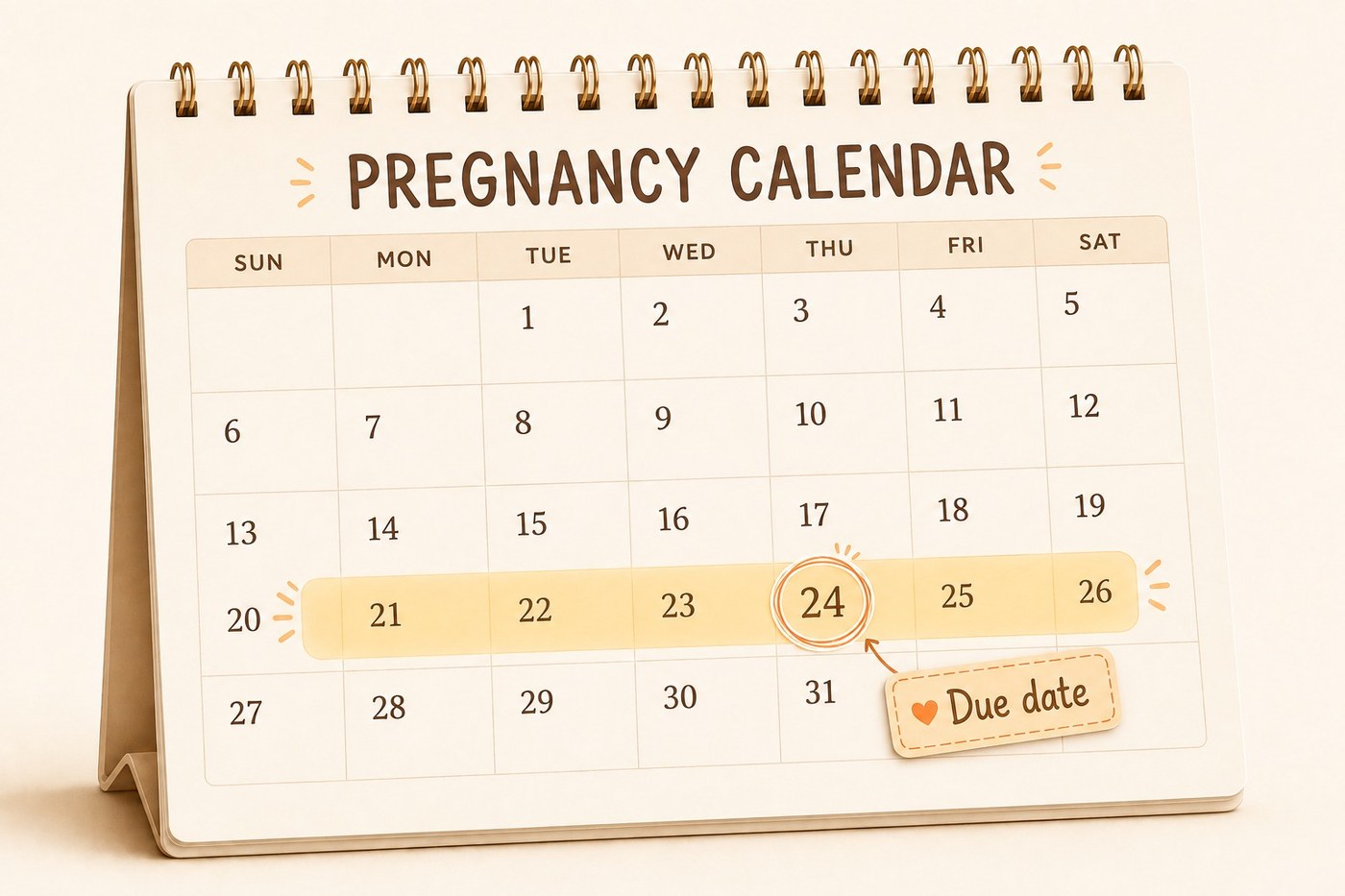
Finding out roughly when your baby will arrive is one of the first things you want to know after a positive test. A due date is an estimate of that day, and here is the short version: it falls about 40 weeks, or 280 days, from the first day of your last period, and an early ultrasound usually confirms or fine-tunes it. Only about 1 in 20 babies actually arrive on the exact date, so it helps to think of it as the middle of a window rather than a fixed appointment.
Key takeaways
- Your due date is counted as 40 weeks from the first day of your last period, not from the day you conceived.
- A first-trimester dating scan is the most accurate way to confirm it, and doctors usually go with the scan if the two dates disagree by more than about a week.
- A normal, full-term birth can happen anytime between 37 and 42 weeks, so an early or slightly late arrival is still expected.
How your due date is calculated
The standard method is a small piece of arithmetic called Naegele's rule. You take the first day of your last period and count forward 40 weeks, which gives your estimated due date. The quick calendar version of that sum is to add one year, subtract three months, then add seven days:
Estimated due date = first day of your last period + 1 year − 3 months + 7 days
The sum assumes a regular 28-day cycle, so if your cycles are longer or shorter, the date can shift by a few days, which is one reason an early scan is used to confirm it.
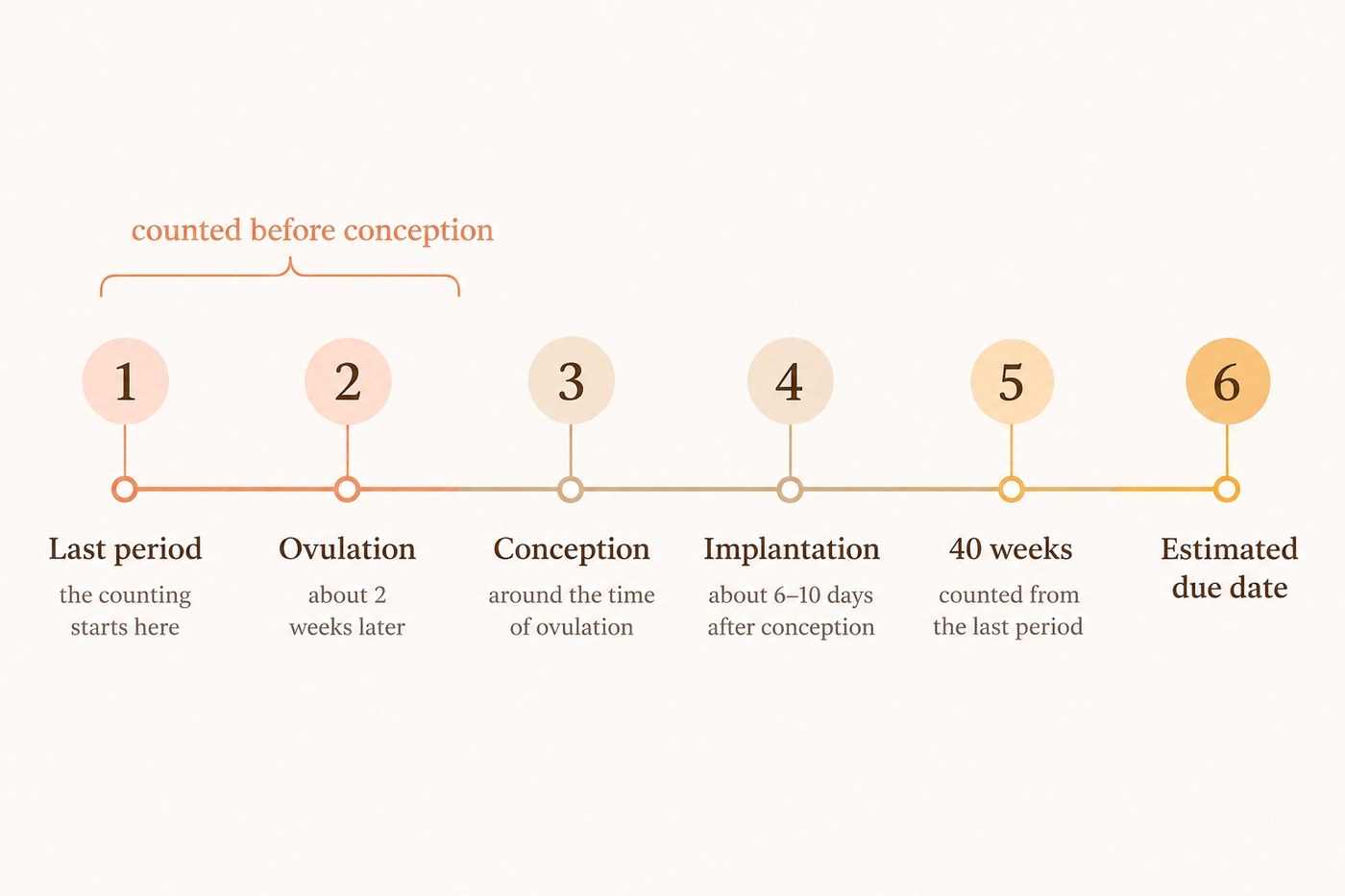
One detail surprises a lot of people. Pregnancy is measured from your last period, but you don't usually conceive until about two weeks later, around the time you ovulate. So when you are told you are "six weeks pregnant," roughly two of those weeks are counted before the baby was conceived. It sounds odd, yet it gives everyone a consistent starting point, because the date of a period is far easier to pin down than the exact day of conception.
Here is how those first weeks line up, from your last period through to your due date:
It can be a real relief to finally have a date to picture. It is just as natural to wonder how much you should lean on it, and that is exactly what the rest of this article is here to help with.
Why your due date matters
Your due date quickly becomes the date everything else is planned around. It sets when your scans and tests fall, helps your team check that your baby is growing on track, and makes sense of results that depend on how far along you are. It is also what decides whether your pregnancy counts as early term, full term, or overdue as you get closer to the end.
Why a dating scan can change your due date
A scan measures your baby directly, which makes it more accurate than counting from a period. In the first trimester, babies grow at a very similar and predictable rate. During a dating scan, usually done between about 8 and 14 weeks, the sonographer measures the length of your baby from head to bottom and works out how far along you are from that measurement.
If the scan date sits close to your period-based date, nothing changes. If it differs by more than roughly a week, your doctor will update your due date to match the scan. This is routine and does not mean anything is wrong. It simply means the scan gave a clearer reading than the calendar could.
Many parents worry that if their due date changes, it means something has gone wrong with the pregnancy. In reality, changing a due date after an early dating scan is common and usually just means the scan has provided a more accurate estimate of how far along the pregnancy is.
After that first-trimester dating scan, your due date is usually left as it is for the rest of your pregnancy, because babies naturally begin to grow at different rates and later measurements are less reliable for dating.
Which is more accurate: your last period or a scan?
Both methods are useful, but they are reliable in different ways.
| Last period (LMP) | First-trimester dating scan | |
|---|---|---|
| How it works | Counts 40 weeks from your last period | Measures the baby's length on ultrasound |
| Best when | Your cycles are regular and you know the date | Almost always, and most accurate in early pregnancy |
| Accuracy | Good if your cycle is a steady 28 days | Usually accurate within 5 to 7 days |
| Main limitation | Less reliable with irregular or unknown cycles | Needs an early scan to be at its best |
How accurate is a due date, really?
This is one of the biggest surprises in early pregnancy. A due date is less precise than the single date suggests, and that is completely normal. It marks the most likely day, not a promise. Most babies arrive in the two weeks before or after it, and only around 1 in 20 are born on the day itself. A pregnancy is considered full term from 37 weeks, and reaching 41 or even 42 weeks is still within the normal range. If you go past your date, your doctor keeps a closer eye on things and talks through the options with you, rather than treating it as a problem straight away.
Common due date myths, cleared up
A few beliefs about due dates cause more worry than they need to. Here is what actually holds up.
| Myth | What's actually true |
|---|---|
| Your baby will be born on your due date | It is the single most likely day, not a guarantee. Most babies arrive within two weeks either side. |
| Going past your due date means something is wrong | Reaching 41 or 42 weeks can be normal. Your doctor simply monitors more closely and talks through options. |
| The date from your last period is more reliable than the scan | An early dating scan is usually more accurate, and is used to correct the period-based date when the two disagree. |
| The shape or size of your bump shows when labour will come | Bump shape and size do not predict when labour will start. |
| Second babies always arrive earlier | There is no reliable rule. Each pregnancy can differ, and the due date stays an estimate either way. |
What if your cycles are irregular or your dates are unclear?
This is common, and it is exactly where the dating scan earns its place. When your cycles are long, short, or unpredictable, counting 40 weeks from your last period can mislead, because you may have ovulated earlier or later than the usual midpoint. If you cannot remember the first day of your last period at all, the scan can date the pregnancy on its own. Whatever your situation, there is a dependable way to arrive at your due date, so this is not something you need to worry about getting exactly right on your own.
How is a due date worked out after IVF?
With IVF there is no guesswork about when conception happened, because the embryo was created and placed on a known day. That makes IVF dating the most precise of all. Your due date is counted from the transfer date, adjusted for how old the embryo was at transfer:
- Day-5 (blastocyst) transfer: due date = transfer date + 261 days
- Day-3 (embryo) transfer: due date = transfer date + 263 days
A frozen embryo transfer follows the same rule, based on whether a day-3 or day-5 embryo was used. Because the date comes from a known day of conception, your early scan usually confirms it rather than shifts it, and if the two differ slightly your team generally keeps the IVF date.
Looking ahead
Once your due date is set, the wait starts to feel real. That single date quietly shapes everything ahead: the trimester you are in, the scans you will start to look forward to, and the first tiny movements you will one day feel. Right now, week by week, your baby is already growing and getting ready to meet you. The next step is the part you may enjoy most, watching your dates turn into what your baby is actually doing, beginning with your first dating scan.
References
- American College of Obstetricians and Gynecologists (ACOG). Committee Opinion 700: Methods for Estimating the Due Date.
- National Health Service (NHS UK). 12-week scan (dating scan).
- National Institute for Health and Care Excellence (NICE). NG201: Antenatal care.
- National Health Service (NHS UK). You and your baby at 12 weeks pregnant.