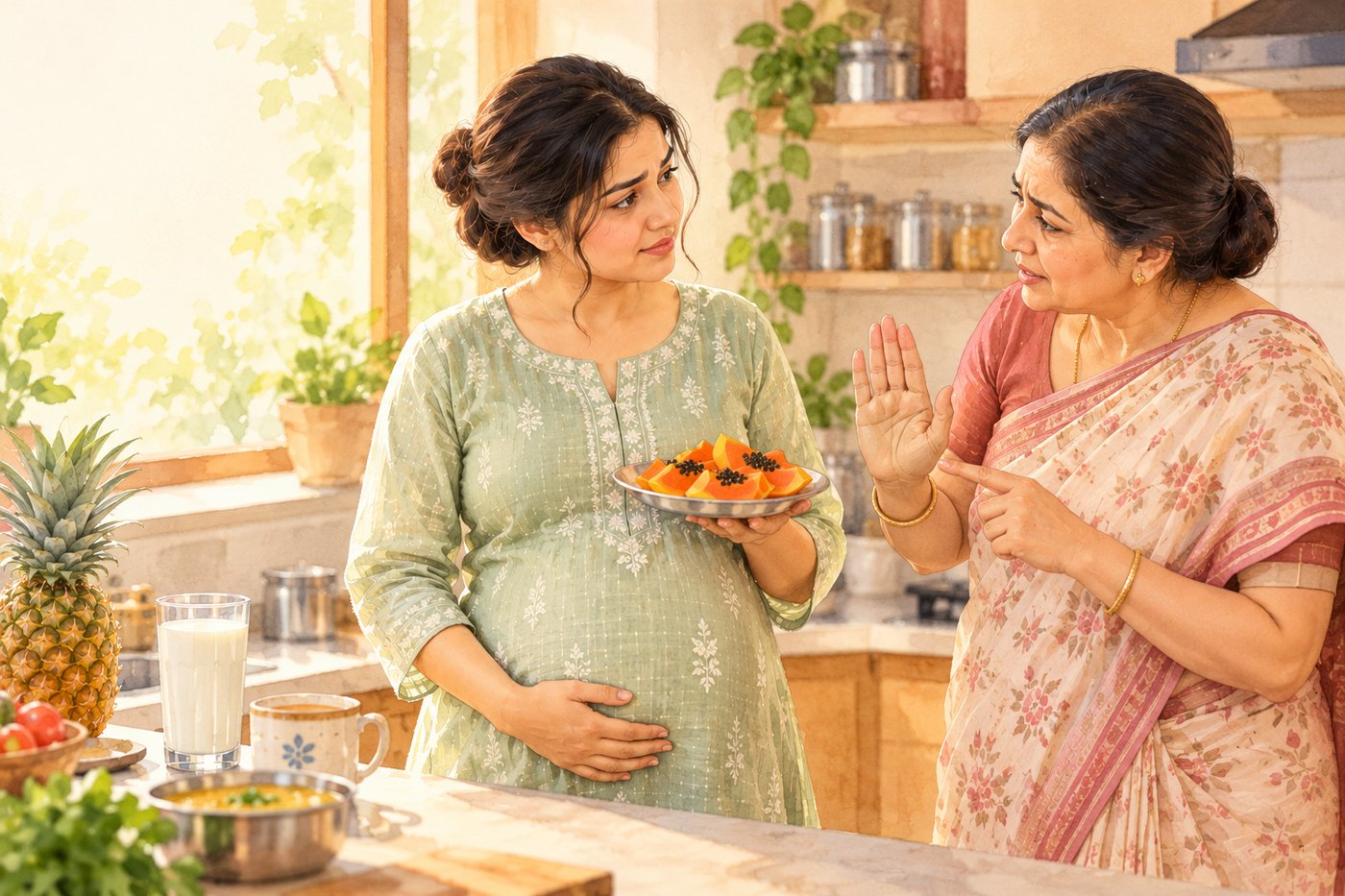
Few foods carry as much pregnancy folklore in Indian homes as papaya. You may have been warned off it by your mother, your mother-in-law, or a neighbour, often without being told why, or which kind.
Available evidence does not show a clear pregnancy risk from eating papaya that is fully ripe, in ordinary food amounts. The traditional caution is mainly directed at green or half-ripe fruit, because of its higher latex content.
The concern about uterine contractions comes mainly from experimental research, and human pregnancy evidence is limited. Understanding that difference helps put the traditional warning into perspective.
Key takeaways
- Available evidence does not show a clear pregnancy risk from properly ripe papaya eaten in normal food portions.
- As a precaution, it makes sense to skip papaya that is raw, green or only half-ripe.
- The caution centres on papaya latex, which is present in much larger amounts in unripe fruit.
- In lab experiments, latex has made uterine tissue from animals tighten; research in pregnant women is scarce.
- If you have already eaten some ripe papaya, there is little reason to worry.
The quick answer
Fully ripe papaya in ordinary food amounts has no clear evidence of pregnancy risk. Raw or semi-ripe papaya is best avoided as a precaution because it contains more latex. The uterine-contraction concern comes from experimental studies, and human evidence is limited.
Ripe papaya versus raw papaya
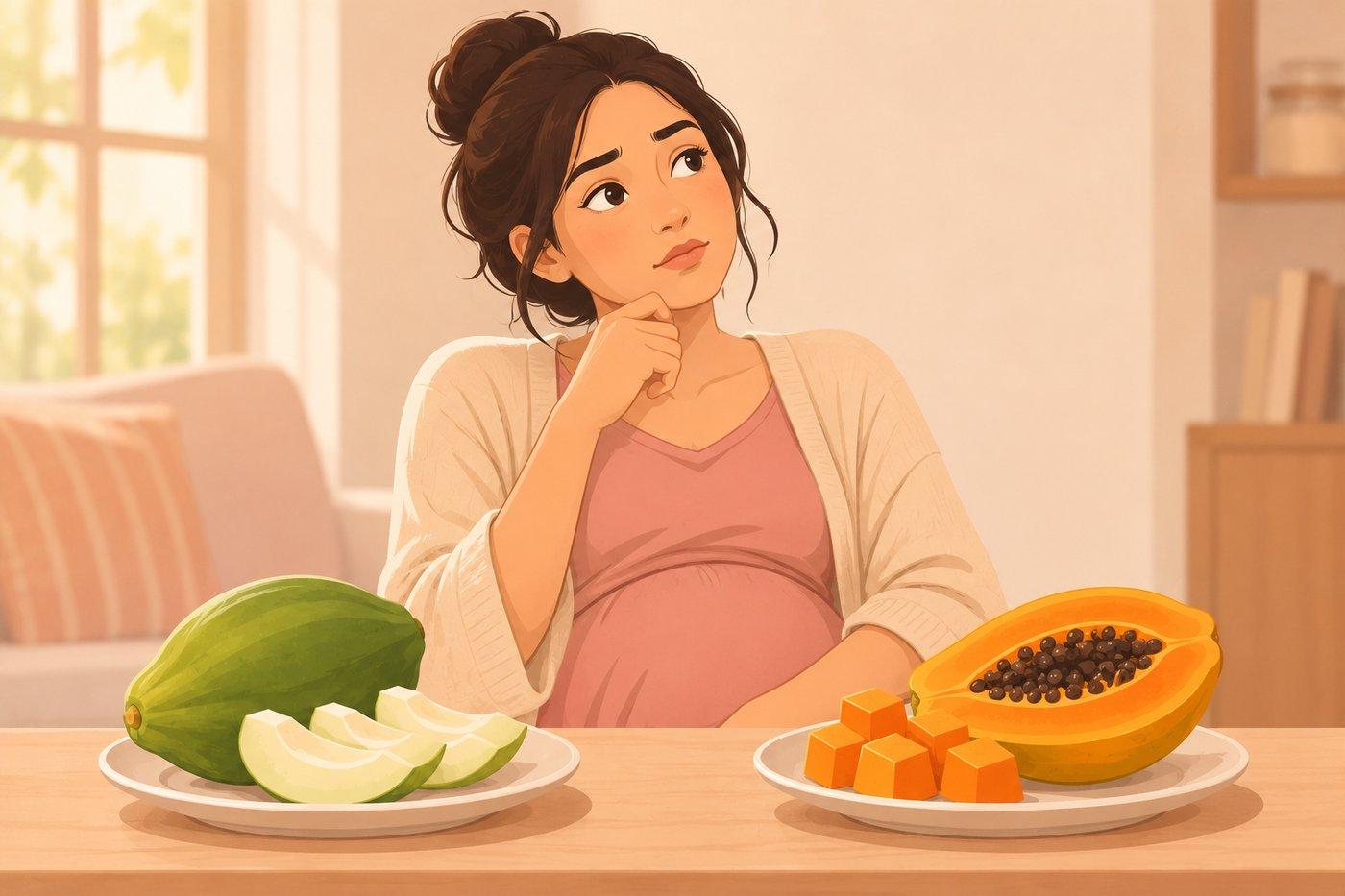
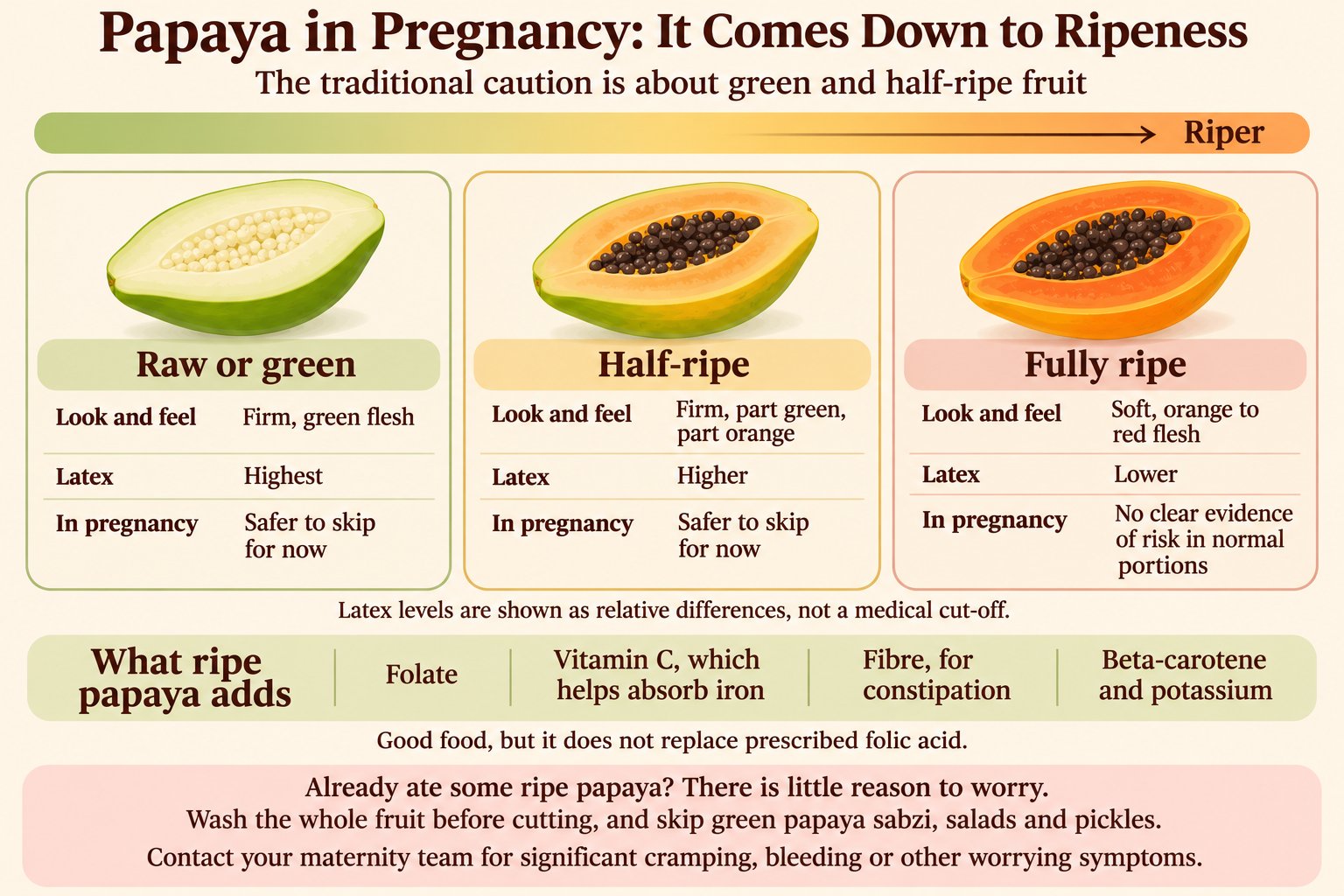
Not all papaya is the same, and this distinction helps put most of the debate into perspective. The real question is how ripe the fruit is when you eat it.
| What changes | Fully ripe | Half-ripe | Raw / unripe (green) |
|---|---|---|---|
| Look and feel | Soft, orange to red flesh | Firm, part green and part orange | Firm, green flesh |
| Relative latex exposure | Lower | Higher | Highest |
| In pregnancy | No clear evidence of risk | Safer to skip for now | Safer to skip for now |
Latex content varies with ripeness, and there is no established pregnancy-safe latex threshold. The table shows relative differences, not a clinical cut-off.
Why does raw papaya cause concern?
The traditional warning is not entirely disconnected from biology, but the evidence has often been simplified over generations. Unripe and half-ripe papaya contain more latex, the white sap that oozes from cut green fruit, which holds enzymes such as papain, along with other compounds.
In laboratory studies using animal tissue, crude papaya latex has made the womb muscle tighten in a way broadly similar to hormones involved in labour. Researchers noted this effect likely comes from a combination of substances in the latex, not papain alone.
Since green and half-ripe fruit hold far more latex than soft, ripe fruit, ripe and raw papaya are treated differently. That is the biological reason behind the traditional caution.
What we know, and what we don’t
This is the honest centre of the papaya question. Most of the evidence behind the raw-papaya concern comes from laboratory and animal research.
These studies can show a biological effect, such as uterine contractions from latex, but they cannot tell us how often eating raw papaya actually leads to pregnancy loss or an early birth. Research in pregnant women remains thin.
For someone who wants to take a precautionary approach, skipping green and half-ripe papaya is reasonable, while the available evidence does not establish ripe papaya as a pregnancy risk.
Is ripe papaya good for you?
This is the part the warnings usually leave out. Alongside its pleasant taste, ripe papaya provides nutrients that are useful in a varied pregnancy diet.
A bowl of ripe fruit brings:
- Folate, which supports early development
- Vitamin C, which helps your body absorb iron from food
- Fibre, which can ease the constipation many women face in pregnancy
- Beta-carotene and potassium as part of overall nutrition
It can add nutrients to a varied pregnancy diet, but it does not replace prescribed prenatal supplements such as folic acid.
What if you already ate papaya?
If you ate a bowl of ripe papaya before reading any of this, try not to panic. Being told after the fact that a food was “unsafe” can make an ordinary eating decision feel frightening.
If you have already eaten some ripe papaya, there is no good evidence that this by itself means something has gone wrong. If it was green or only half-ripe, the evidence is limited, so avoid further exposure.
Contact your maternity team if you develop significant cramping, bleeding, or other concerning symptoms. Reassurance after any one-off exposure is best judged with your own clinician, who knows your full situation.
How much papaya is safe?
There is no established medical dose of ripe papaya in pregnancy, so a strict gram count would be inventing precision the evidence does not support.
If you choose to eat it, keep ripe papaya as part of your usual varied diet, and follow any dietary advice specific to your pregnancy. A few simple habits help:
- Choose fully ripe, soft, orange fruit rather than firm greenish ones
- Wash the whole papaya under running water before cutting it, even if you plan to remove the skin
- If you want to follow the precaution used in pregnancy, choose fully ripe papaya and skip dishes made with green or half-ripe papaya, such as green papaya sabzi, salads, or pickles
When to see a doctor
Papaya is rarely an emergency, but a few situations deserve a quick conversation.
Speak to your doctor or maternity team if:
- You have eaten a large amount of raw or unripe papaya and feel cramping or unusual pain
- You notice any vaginal bleeding or strong abdominal cramps, which always need prompt attention regardless of food
- You have gestational diabetes and want to fit fruit into your sugar limits
- You have a known allergy to papaya or latex and are unsure whether the fruit is suitable for you
Looking ahead
Papaya is one question inside a larger one that most expecting mothers ask: what is truly worth avoiding on the plate? The same calm, evidence-first approach works for pineapple, certain fish, and unpasteurised dairy.
A natural next step is Foods to Avoid During Pregnancy: Indian Kitchen Guide and Pregnancy Diet Chart: Trimester by Trimester (Indian), which place papaya within the full picture of eating well.
References
- Adebiyi A, Adaikan PG, Prasad RN. Papaya (Carica papaya) consumption is unsafe in pregnancy: fact or fable? Scientific evaluation of a common belief in some parts of Asia using a rat model. British Journal of Nutrition, 2002.
- Cherian T. Effect of papaya latex extract on gravid and non-gravid rat uterine preparations in vitro. Journal of Ethnopharmacology, 2000.
- U.S. Department of Agriculture, FoodData Central. Papayas, raw (FDC #169926).
- National Health Service (United Kingdom). Foods to avoid in pregnancy; and Vitamins, supplements and nutrition in pregnancy.
- U.S. Food and Drug Administration. Fruits, Veggies and Juices (Food Safety for Moms-to-Be).
Common questions
Can eating ripe papaya cause a miscarriage?
There is no good human evidence that ordinary amounts of ripe papaya cause miscarriage. The caution applies to raw and semi-ripe papaya because of their higher latex content, and even that rests mainly on animal and laboratory studies.
Is papaya safe in the first trimester?
There is no good human evidence showing that ordinary consumption of fully ripe papaya causes harm in the first trimester. The experimental concern has mainly involved latex from unripe or semi-ripe papaya, but human pregnancy data are limited.
Why do elders say papaya is dangerous in pregnancy?
The traditional warning is commonly associated with raw or unripe papaya. It is often extended to ripe papaya as well, even though the latex exposure differs with ripeness.
Can I eat papaya if I have gestational diabetes?
Papaya contains natural sugars, so portion size matters. Small servings can fit a balanced plan, but confirm amounts with your doctor or dietitian.
This article is for education and general understanding. It is not a substitute for personal medical advice. Please speak with your doctor or a qualified health professional about your own pregnancy and diet.
 Medically reviewed byDr. Mahender Singh, MBBS, DCH, MD (Paediatrics)A consultant child specialist and neonatologist with over four decades of practice in newborn and child health.
 Written bySarthak ThakurCo-founder, CTO and Chief Marketing Officer of ParentVeda, and the software engineer who builds its app and the pipeline that checks its articles.
This article explains; it doesn’t diagnose. If your doctor has told you something different, your doctor is right.