Few things unsettle a parent like a sudden crop of blisters on a small child's hands, feet, and mouth, usually after a day or two of fever and misery. Here is the reassurance to hold first. This is almost always hand, foot and mouth disease: common, contagious, deeply unpleasant for a few days, and then gone on its own.
It is especially familiar across India, where outbreaks rise through the monsoon and the months after, sweeping through daycares and households in a matter of days. No medicine cures it. But there is a great deal a parent can do to carry a child comfortably through it.
One confusion is worth clearing at once. Despite the name, this has nothing to do with the foot-and-mouth disease of cattle. They are entirely different infections, and the animal one does not infect people.
What matters most
- HFMD is a common viral infection in under-5s: fever, then blisters on the hands, feet, and mouth.
- It is caused by enteroviruses, not by anything a parent did or failed to do.
- There is no cure, and none is needed; it passes in 7 to 10 days.
- The single biggest risk is dehydration, because sore mouths make drinking painful.
- It is most contagious in the first week, though the virus lingers in the stool for weeks.
- Most children recover completely; serious complications are rare.
What HFMD actually is
It comes from a family of viruses called enteroviruses. Most often the culprit is Coxsackievirus A16, though a strain called Coxsackievirus A6, which can bring a more widespread rash, is increasingly common. A less frequent one, Enterovirus 71, is the strain occasionally linked to more serious illness.
What makes it spread so fast is how many routes it travels: close contact, coughs and sneezes, the fluid inside the blisters, and traces of stool. That last one matters more than parents expect, and it comes back later, in how long a child stays infectious. For now, the useful point is simply that it moves quickly through any place small children share, and that catching it is nobody's failure of hygiene.
What it looks like, and how to tell it apart
It usually announces itself in a familiar order: first the fever and off-colour mood, then the rash a day or two behind.
- Day 1 to 2: fever, a sore throat, tiredness, and often reduced appetite or extra drooling in babies.
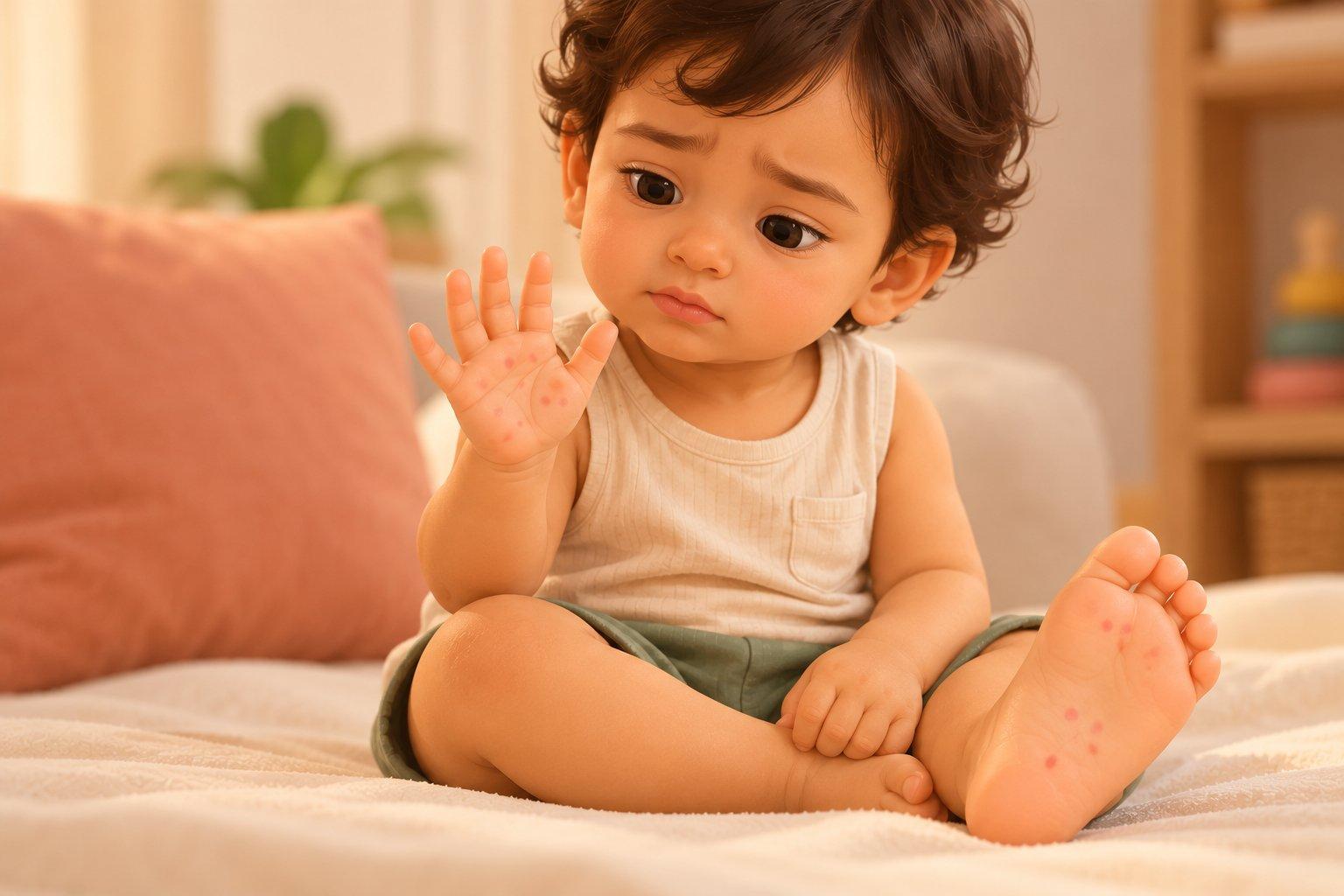
- Day 3 to 5: small flat red spots that turn into little blisters, on the palms, the soles, between fingers and toes, and sometimes the buttocks.
- Inside the mouth: small painful ulcers on the tongue, gums, and cheeks, usually the part that upsets a child most.
The worry underneath, of course, is whether it is something more serious. Most of the time the pattern gives it away.
- Chickenpox scatters blisters across the whole body and trunk, rather than clustering on hands, feet, and mouth.
- Heat rash is fine, prickly bumps in sweaty folds, with no fever and no mouth ulcers.
- Roseola runs a few days of high fever, then a rash mainly on the trunk as the fever breaks.
When the picture is unclear, a doctor settles it in minutes. That is worth a visit, rather than a long anxious guess at home.
The stages, day by day
Knowing roughly what comes next takes a lot of the fear out of the week.
- Incubation (3 to 6 days): the child has caught it but shows nothing yet.
- Days 1 to 2: fever and sore throat.
- Days 3 to 5: mouth ulcers and the blister rash appear; the hardest stretch.
- Days 6 to 7: blisters begin to dry, and the child turns less contagious.
- Week 2 to 3: skin may peel where blisters were, and with some strains a nail can shed weeks later. Both are harmless, and both grow back.
Caring for a child at home
Here is the part that feels strange to accept: there is nothing to give that cures this. No antiviral touches it, and antibiotics do nothing to a virus. The whole of good care is comfort, while a small body does the actual healing. And within that, one thing outranks everything else.
Fluids come first, always. A sore mouth makes a child refuse to drink, and dehydration is the one complication that turns a mild illness into a hospital visit. Frequent small sips of water, milk, or an oral rehydration solution, and cold drinks tend to soothe more than warm ones.
Everything after that is support:
- Cold, soft foods: curd, cold milk, smoothies, khichdi, or a little ice cream go down more easily than hot, salty, or spicy food, which stings raw ulcers.
- Fever and pain: paracetamol, or ibuprofen for older babies, can ease both. The medicine and dose depend on the child's weight and age and are set by the doctor, never guessed, and aspirin is never given to children.
- The skin: leave blisters alone rather than bursting them, which lowers the chance of infection. Calamine can calm itch on the body.
- Comfort and rest: a few miserable days are normal, and closeness helps as much as anything in a bottle.
A word of caution, because this advice circulates widely and is wrong: numbing mouth gels with benzocaine or lidocaine are not safe for babies and young children. Any mouth-pain relief for a small child belongs with the doctor, not the pharmacy shelf.
What about creams?
Parents often go looking for the right cream, so it is worth saying plainly that none treats the infection itself. A couple help with comfort, and a couple are best kept away.
- Calamine lotion eases itch on the body rash.
- A gentle, fragrance-free moisturiser helps dry, peeling skin during recovery.
- Best avoided: steroid creams and thick petroleum jelly over active blisters, and numbing gels in babies.
When to see a doctor
Most children never need more than what is above. A smaller number do, and a few need help quickly, so these are the signs worth holding in mind. A doctor is needed if a child:
- is drinking very little, or shows dehydration: no wet nappy for 6 or more hours, no tears, a dry mouth, or sunken eyes,
- has a fever that stays high or will not settle,
- is unusually drowsy, limp, or hard to wake,
- has a stiff neck, a severe headache, or keeps vomiting,
- has blisters turning infected, with spreading redness, warmth, or pus,
- is a newborn or very young infant, where any illness deserves earlier advice.
Three of those deserve a line of their own. Deep drowsiness, a stiff neck, and a severe headache are the signs never to wait on, because in rare cases certain strains can reach the brain. They are uncommon. They are also exactly why fast action matters if they appear.
School, siblings, and staying home
This is where that earlier point about stool returns, because it shapes how long a child stays home and how easily the rest of the house catches it.
- Keep the child home until the fever has gone and the blisters have dried, usually about 7 to 10 days.
- Tell the creche or school, as a courtesy, so others can watch for it.
- Expect siblings to be exposed: separate towels, cups, and spoons, and wash hands often, especially after nappy changes, since the virus lingers in stool long after the rash fades.
- Adults can catch it too, usually mildly, so the same handwashing guards the whole household.
On homeopathy and home remedies
Many families in India reach for homeopathy with HFMD, and it deserves an honest answer rather than a dismissive one. There is no reliable evidence that homeopathic remedies shorten the illness or change its course. In themselves they are unlikely to do harm.
The real risk is subtler: that they become a reason to relax on the one thing that truly matters. Whatever else a family chooses to try, nothing should displace keeping a child drinking and watching for the red flags above. Comfort and hydration are the treatment. Everything else is, at most, alongside.
Looking ahead
In a week to ten days, the fever lifts, the blisters dry, the peeling settles, and the child is themselves again, usually carrying lasting immunity to that particular strain. A bout of HFMD is one of those early illnesses that feels enormous in the moment and shrinks, soon enough, into an ordinary chapter of growing up. What it asks for now is nothing clever, only fluids, comfort, and a watchful eye, which is the hand a parent is already holding out.
Common questions
How long is a child contagious?
Most in the first week, until the blisters dry, but the virus can stay in the stool for weeks, so handwashing matters even after recovery.
Can a child get HFMD more than once?
Yes. Immunity is only to that one strain, and several viruses cause it, so a second, usually milder, bout is possible.
Can parents catch it from their child?
Yes, usually mildly. The hygiene that protects siblings protects adults too.
A nail fell off a few weeks later, is that normal?
Yes. With some strains a nail sheds after the illness. It is harmless and grows back.
This is general information, not a diagnosis. A doctor should confirm what a rash actually is and guide care for a specific child, especially a baby.
 Medically reviewed byDr. Mahender Singh, MBBS, DCH, MD (Paediatrics)A consultant child specialist and neonatologist with over four decades of practice in newborn and child health.
 Written bySarthak ThakurCo-founder, CTO and Chief Marketing Officer of ParentVeda, and the software engineer who builds its app and the pipeline that checks its articles.
This article explains; it doesn’t diagnose. If your doctor has told you something different, your doctor is right.