
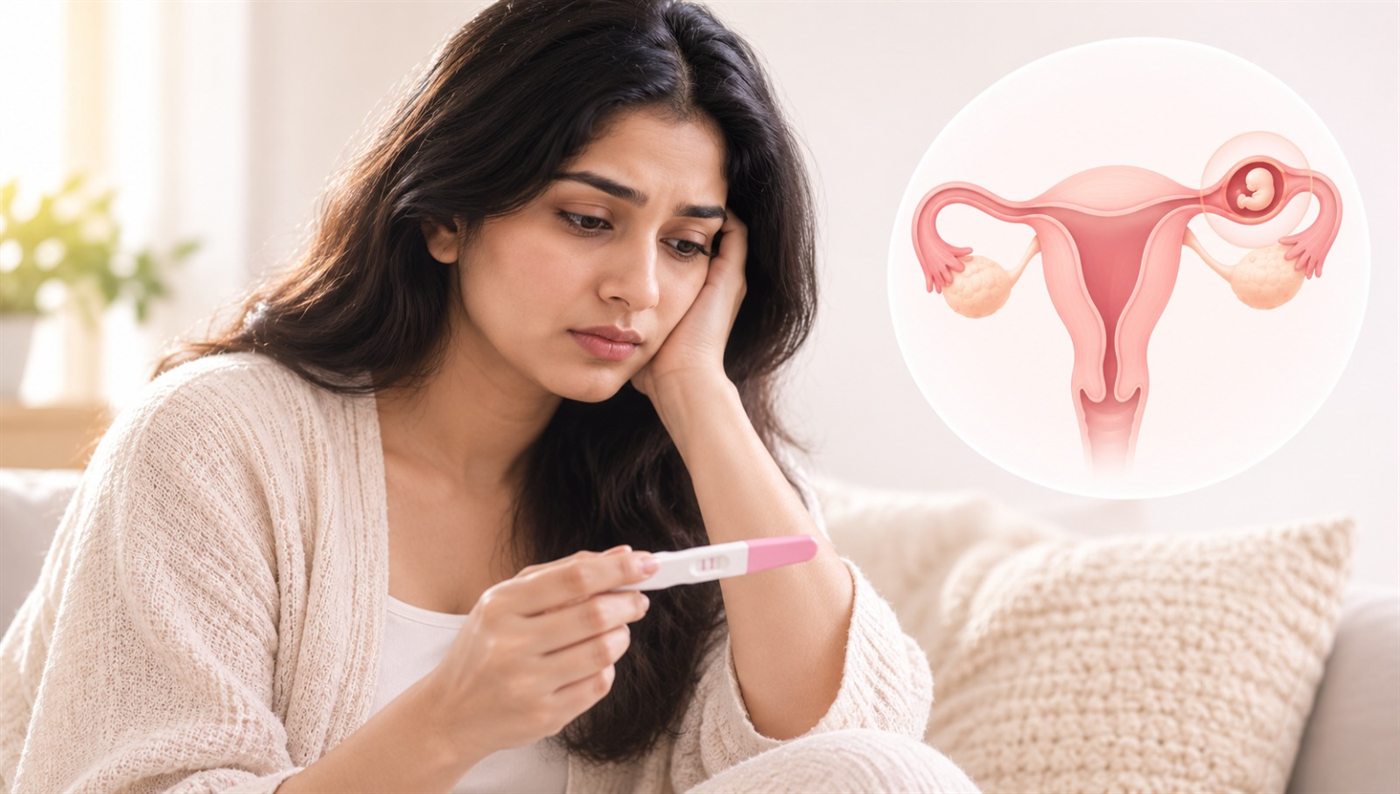
If you're reading this, chances are you've just heard the words "ectopic pregnancy". From a doctor, on a scan report, or somewhere late at night when everything feels heavier than it should.
Take a breath. You're in the right place.
Here's the answer, before anything else.
An ectopic pregnancy is a pregnancy that has implanted outside the uterus, almost always in a fallopian tube. That space can't hold a pregnancy, so it can't continue and can't be moved to the womb.
Left unnoticed, it can rupture the tube and cause internal bleeding. That's the dangerous part.
Caught early, and it usually is, it's treated safely with medicine or keyhole surgery. Most women who go through one conceive again afterwards.
What matters most
- It implants outside the womb, usually in a fallopian tube, and can't be saved.
- Caught early, it's very treatable, with medicine or minimally invasive surgery.
- The real danger is rupture and internal bleeding, which is what the emergency signs point to.
- About half of women who have one had no known risk factor at all (RCOG Green-top Guideline 21).
- Most go on to have a healthy pregnancy afterwards, even with a single fallopian tube.
- The grief that comes with it is real, and it doesn't need to be justified to anyone.
What's actually happening
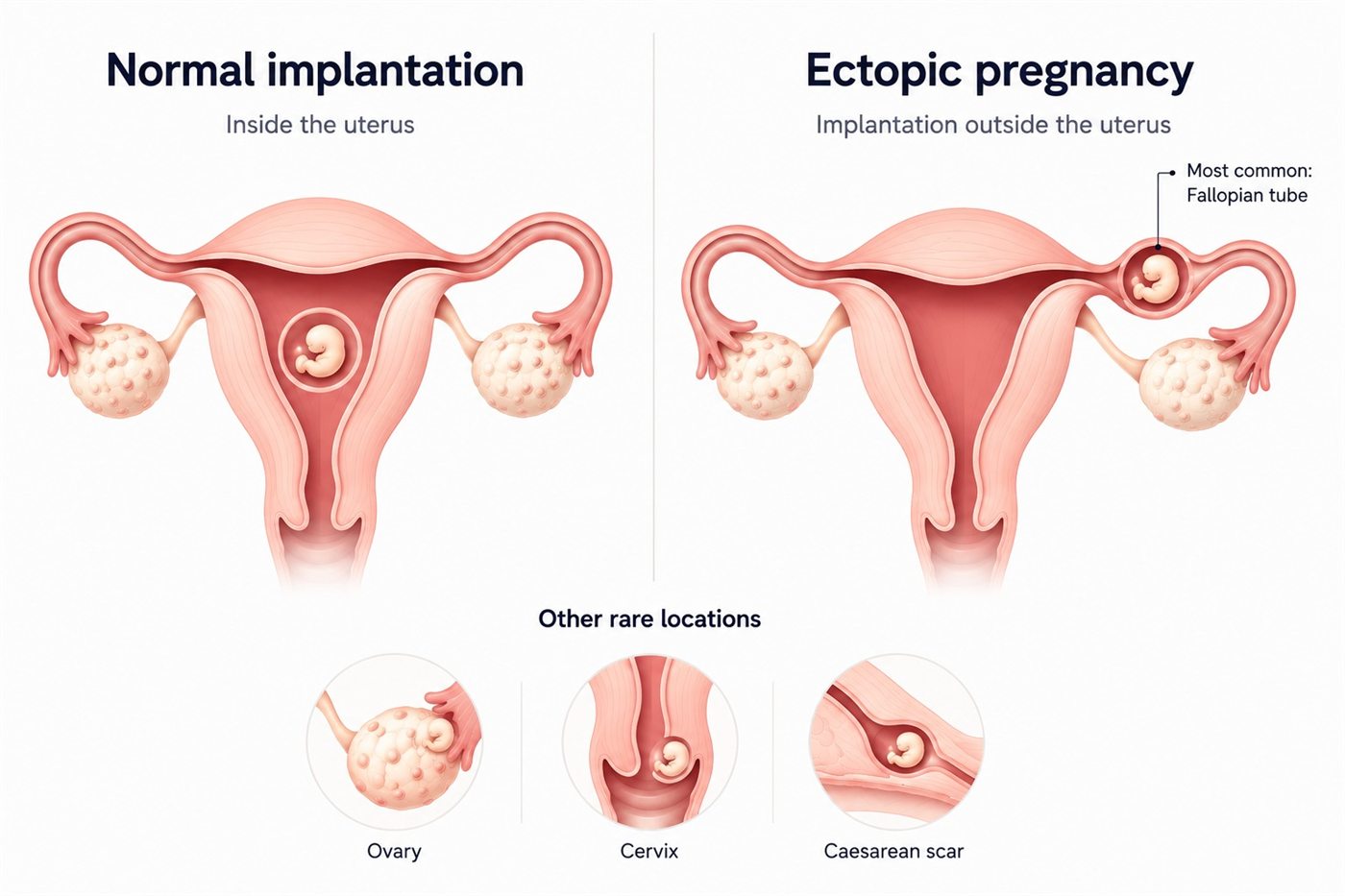
A pregnancy is supposed to travel down to the uterus, the one organ built to stretch and hold a baby for nine months. In an ectopic pregnancy, it doesn't get there. It settles somewhere else, most often inside a fallopian tube.
Around 97 out of 100 ectopic pregnancies happen in a tube (FOGSI Good Clinical Practice Recommendations). In India, this happens in roughly 1 to 2 out of every 100 pregnancies. Less commonly, it can implant on an ovary, on the cervix, or in the scar of an earlier caesarean.
That's the fact of it. Knowing what your body is doing doesn't take the weight off. It does put some ground under your feet.
How you'll know something is wrong
At first, an ectopic can feel like any other pregnancy. A missed period, a positive test, tender breasts, some nausea.
The signs that something's off usually show up between weeks 4 and 12. Most are picked up between weeks 6 and 10 (RCOG patient information).
Signs worth a doctor's call
- Pain low in the belly or pelvis, often on one side.
- Vaginal bleeding, sometimes darker or more watery than a period.
On their own, these can have gentler causes. In early pregnancy, they're worth a prompt call.
Signs that need immediate medical attention
- Sudden or severe pain in the belly or pelvis.
- Pain at the very tip of your shoulder.
- Feeling faint, or collapsing.
- Heavy vaginal bleeding.
The shoulder-tip pain is an odd but useful clue. It happens because internal bleeding irritates a nerve just under the diaphragm, and it's often what tips a diagnosis fast.
How it's found, and what happens next
The days after hearing "this might be an ectopic pregnancy" usually pass in a blur of scans, blood draws and waiting. Knowing what usually happens next helps a little.
How doctors confirm it
- Transvaginal ultrasound of the uterus and tubes.
- Blood tests measuring hCG, the pregnancy hormone, usually repeated over a couple of days to see which way the number is going.
Sometimes, very early, a scan can't yet show where the pregnancy is. Doctors call this a "pregnancy of unknown location." It sounds worse than it is. It only means a little more monitoring is needed, which is what keeps you safe.
How it's treated
Once the location is confirmed, what happens next depends on how early it was caught, how high the hormone is, whether the tube has ruptured, and how you're doing. Your doctor picks the path with you. You won't be asked to choose alone.
There are three broad treatment paths, drawn from ACOG and RCOG guidance:
| Option | When it usually fits | What happens | Timeline |
|---|---|---|---|
| Watchful monitoring | Small, early ectopic; low, falling hCG; no symptoms of rupture | Blood tests track the hormone falling on its own | A few weeks of follow-up |
| Medicine (methotrexate injection) | Unruptured; lower hCG; you're stable | An injection stops the tissue growing; the body reabsorbs it | Follow-up blood tests over 4–6 weeks |
| Keyhole surgery (laparoscopy) | Higher hCG, symptoms, tube damage, or if medicine isn't right | The surgeon removes the affected tube, or opens it and preserves it | Same-day surgery; recovery in 1 to 3 weeks |
| Emergency surgery | Ruptured tube, internal bleeding | Urgent, life-saving operation to stop the bleeding | Immediate; longer stay in hospital |
None of these is a failure. None is a punishment. Each is the safest way, in that situation, to protect you and your future.
If you're on methotrexate follow-up and you get new pain, shoulder pain, or feel faint, tell the doctor right away.
Was any of this your fault?
If your mind keeps going back to what you ate, or lifted, or should have done differently, that isn't weakness. It's grief looking for a reason.
Most of us look backwards after something painful. It's what a mind does. The answers rarely help, but the searching itself is human. So here's what doctors actually know.
The RCOG's guideline on ectopic pregnancy says something important: most women who have one have no known risk factor at all. It happens to healthy women who did nothing wrong.
Where risk factors do exist, they usually trace back to something that quietly affected the fallopian tubes:
- a previous ectopic pregnancy,
- a past pelvic infection (like an untreated STI, which can scar the tubes),
- earlier surgery on the tubes or pelvis, or endometriosis,
- a pregnancy conceived through IVF, or with an IUD in place,
- smoking, or being over 35.
Few of those are things you chose.
There's a quieter question underneath all of these. Could the pregnancy have been saved if someone had caught it sooner, or done something different? The honest answer is no. A fallopian tube can't hold a pregnancy, and there's no procedure anywhere in the world that can move one from a tube into the uterus.
This isn't about timing. It isn't about choice. It's biology.
This wasn't your fault.
That's a hard sentence to read. It's also the one that quietly starts to loosen the "if only" loop.
Nothing about this came from a choice you made, or a care you failed to take. It was a matter of location. Not fault, not effort, not love.
Will you be able to have a baby in future
Underneath the other fears sits the one that's rarely said out loud: will this take away my chance of a baby?
For most women, it doesn't. Here are the numbers, plainly.
- One tube is enough. Even if a fallopian tube has been removed, the other usually takes over. Natural pregnancy is still very possible.
- Recurrence sits at about 10%. About 1 in 10 women who've had an ectopic will have another (ACOG). That's why the next pregnancy gets an early ultrasound, around weeks 6 to 8, to check it has settled in the right place (RCOG).
- Wait about 3 months after methotrexate. The medicine affects folate levels, so most doctors advise around three months before trying again. After keyhole surgery, the wait is usually shorter. It depends on how you're healing.
- IVF is an option if both tubes are gone. IVF doesn't need the tubes, so pregnancy is still possible even then.
When the time feels right, in body and in heart, your doctor can help you think it through.
Navigating the feeling
An ectopic pregnancy is a strange kind of loss. It comes tangled up with a medical emergency.
In the rush of scans and decisions, your own grief is often the last thing anyone tends to, yourself included. It shouldn't be.
It's the loss of a pregnancy. It may also have meant real fear for your life, or surgery, or the news that a part of your body has changed. All of it is worth grieving.
The Ectopic Pregnancy Trust, a UK charity focused on this experience, notes that early feelings often include shock, disbelief, guilt, jealousy, and relief. Sometimes all in the same week, sometimes in the same day. That doesn't mean anything is wrong with you.
There's no correct timeline. Leaning on a partner, a friend, or a counsellor isn't weakness. It's care. If the sadness sits heavy or stays a long while, a doctor or a mental-health professional can help you find support meant for exactly this.
A gentle reminder
With an ectopic pregnancy, people around you may feel relieved that you're safe.
That relief comes from love.
Your grief comes from love too.
Those two feelings don't compete with each other. You're allowed to be grateful your life was protected, and still mourn the pregnancy you had already begun to imagine. You don't have to choose one feeling over the other. Most people who go through this carry both for a while.
Just for today
If today feels like too much to organise, three things are enough.
- Stay in touch with your doctor.
- Let someone close stay with you if you can.
- Don't carry the questions alone.
Looking ahead
Right now, the horizon is hard to see. That's normal.
Most women who go through an ectopic pregnancy heal in body, slowly heal in heart, and, when they're ready, go on to have the family they hoped for.
This is a hard chapter. It isn't the whole book.
References
- Federation of Obstetric and Gynaecological Societies of India (FOGSI). FOGSI Good Clinical Practice Recommendations on Ectopic Pregnancy.
- American College of Obstetricians and Gynecologists (ACOG). Ectopic Pregnancy, Patient FAQ.
- American College of Obstetricians and Gynecologists (ACOG). Practice Bulletin No. 193: Tubal Ectopic Pregnancy, 2018.
- Royal College of Obstetricians and Gynaecologists (RCOG). Ectopic Pregnancy, Information for You. Patient information leaflet, Nov 2016 (reviewed March 2020).
- Royal College of Obstetricians and Gynaecologists (RCOG). Diagnosis and Management of Ectopic Pregnancy, Green-top Guideline No. 21.
- National Institute for Health and Care Excellence (NICE). Ectopic Pregnancy and Miscarriage: Diagnosis and Initial Management, NG126.
- The Ectopic Pregnancy Trust. Emotional Recovery from an Ectopic Pregnancy.
- National Health Service (NHS UK). Ectopic Pregnancy, Symptoms, Causes and Treatment.