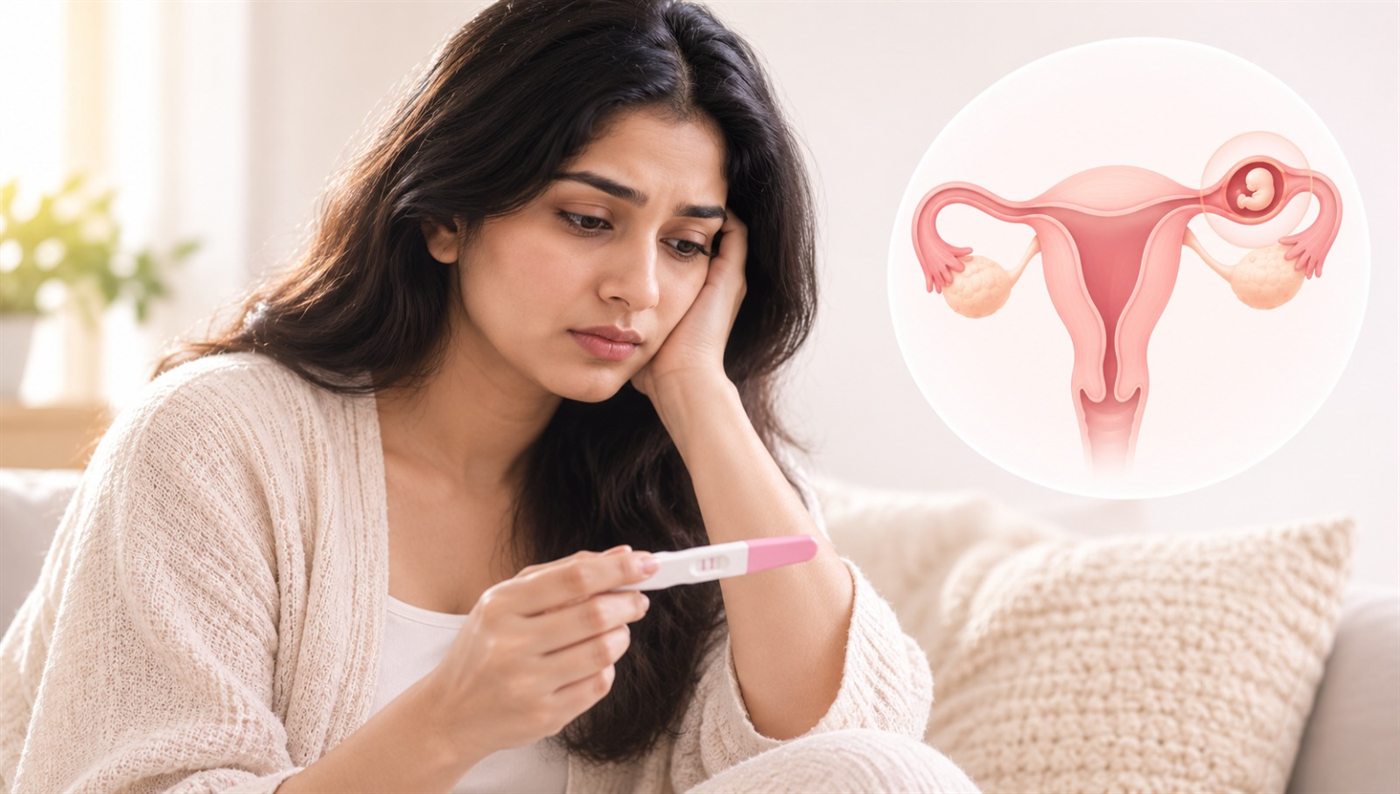

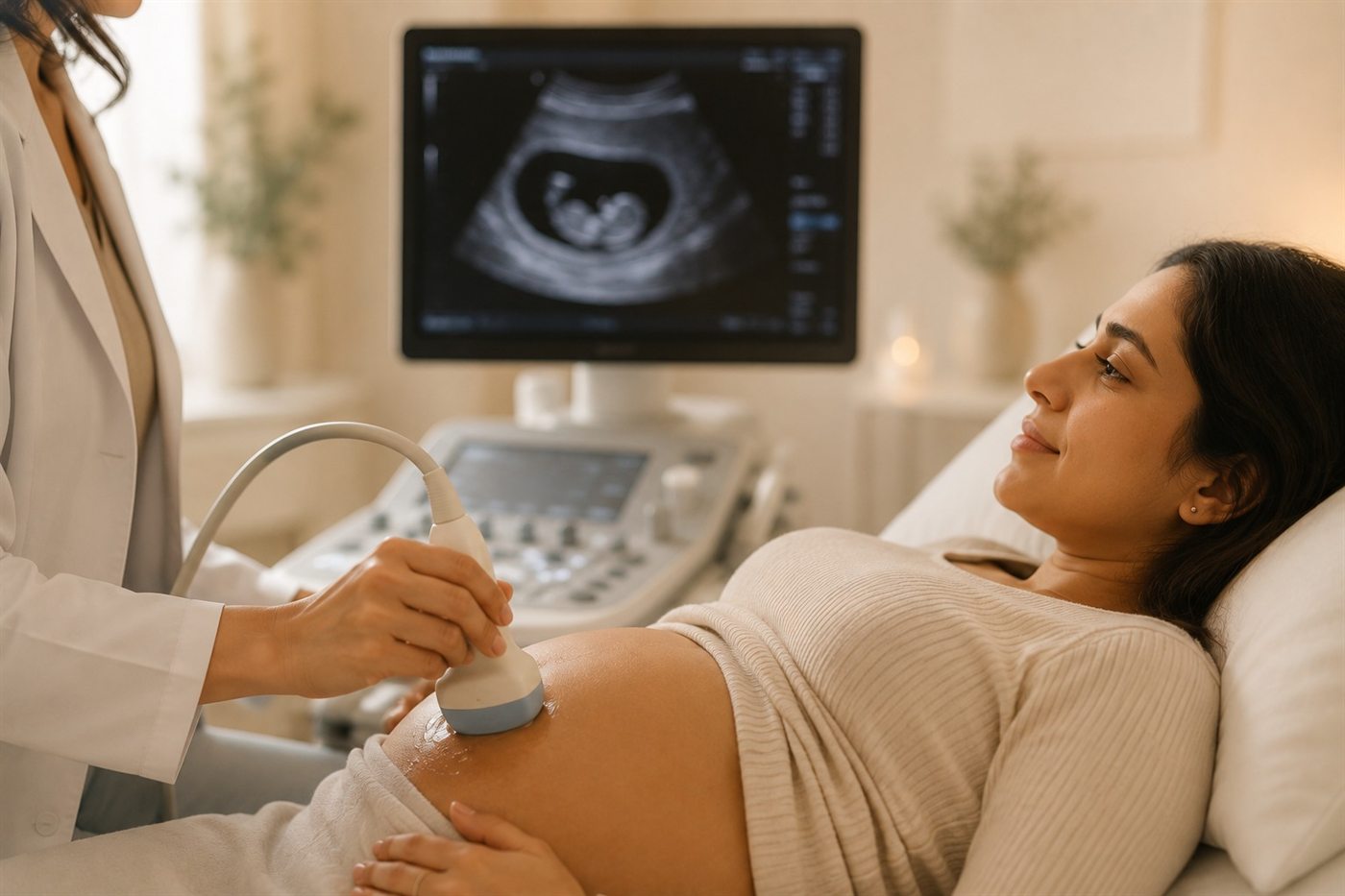
You may have known about these for years. Or the word may have arrived this week, on a scan report you were expecting to be straightforwardly happy about: a heartbeat, and also a fibroid, sitting in a line of text you're now reading for the fourth time.
Either way, two things are true at once, and it's worth having both from the start.
Most pregnancies with fibroids are straightforward. And fibroids do make some complications more likely, which is why yours will be watched a little more closely than it otherwise would.
That's the honest shape of it. Not nothing, and not the disaster the word suggests.
What matters most
- Fibroids are benign growths of the uterus's own muscle. They are not cancer, and nothing you did caused them.
- They're found in roughly 2 to 11 out of every 100 pregnancies, most often by chance on a scan.
- Most pregnancies with fibroids are uncomplicated. Around 10 to 30 in 100 run into some complication, and most of those are manageable rather than dangerous.
- Larger fibroids (above about 5 cm), several fibroids, and fibroids low in the uterus carry more risk than small single ones.
- The commonest problem is a painful episode called red degeneration, which almost always settles with rest and pain relief.
- Caesarean is more likely, but far from automatic.
This is for understanding, not diagnosis. Fibroids vary enormously in size, number and position, and only your own doctor, who has your scans, can say what yours means for your pregnancy.
What a fibroid actually is
A benign growth made of the same muscle that forms the wall of your uterus. Not something foreign that has arrived and set up camp, but your own uterine muscle, copying itself a little too enthusiastically in one spot.
Doctors also call them myomas or leiomyomas, and Indian reports sometimes use the word "tumour", which in medicine simply means a growth, not a cancer.
They respond to oestrogen and progesterone, they run in families, and they become more common with age. Nothing you ate, lifted, took or postponed caused this.
Will it affect my baby?
Usually not, and the reason is anatomical.
Your baby grows inside the cavity of the uterus. Most fibroids sit within the muscular wall or on the outer surface, outside that space entirely. They are not sharing a room with your baby, and they are not taking nourishment from them.
It's easy to picture a fibroid crowding your baby out. That's rarely how it works. The uterus is not a fixed-size room, and it stretches around a fibroid much as it does without one.
Where fibroids genuinely raise risk, the research points fairly consistently to a handful of things: preterm birth, the baby lying breech or sideways, waters breaking early, a low-lying placenta, placental abruption, and heavier bleeding after delivery. A large review puts the increase in preterm birth at roughly one and a half times the background risk.
Those are real, and they're the reason for closer monitoring. They are also, for most women, risks that never materialise.
One reassurance worth stating plainly, because it's the fear underneath: a meta-analysis of nine studies covering more than twenty thousand pregnancies found no overall association between having fibroids and pregnancy loss.
What do fibroids usually feel like?
Often, like nothing at all. That's precisely why most are discovered by accident.
When they do cause symptoms, outside pregnancy these are the usual ones:
- Heavy or prolonged periods.
- A sense of pressure or fullness low in the abdomen.
- Needing to pass urine more often, if a fibroid presses on the bladder.
- Constipation, if one presses backwards on the bowel.
- Discomfort during sex, or a dull lower backache.
In pregnancy, pressure symptoms can become more noticeable simply because everything is enlarging together. Fibroid pain, when it comes, tends to be localised over one spot rather than general.
One distinction matters more than the rest. Heavy bleeding is a classic fibroid symptom outside pregnancy. It is not something to attribute to fibroids during pregnancy. Any vaginal bleeding while pregnant needs checking, whatever else is going on.
Size, number, position: what your doctor is weighing
All three matter, and it's a mistake to reduce it to any one of them.
Size is the most consistently reported factor. Fibroids above about 5 cm are more likely to cause problems, and those above 10 cm are associated with significantly more maternal complications.
Number matters too. Several fibroids carry more risk than one, though plenty of women have three or four small ones and an entirely ordinary pregnancy.
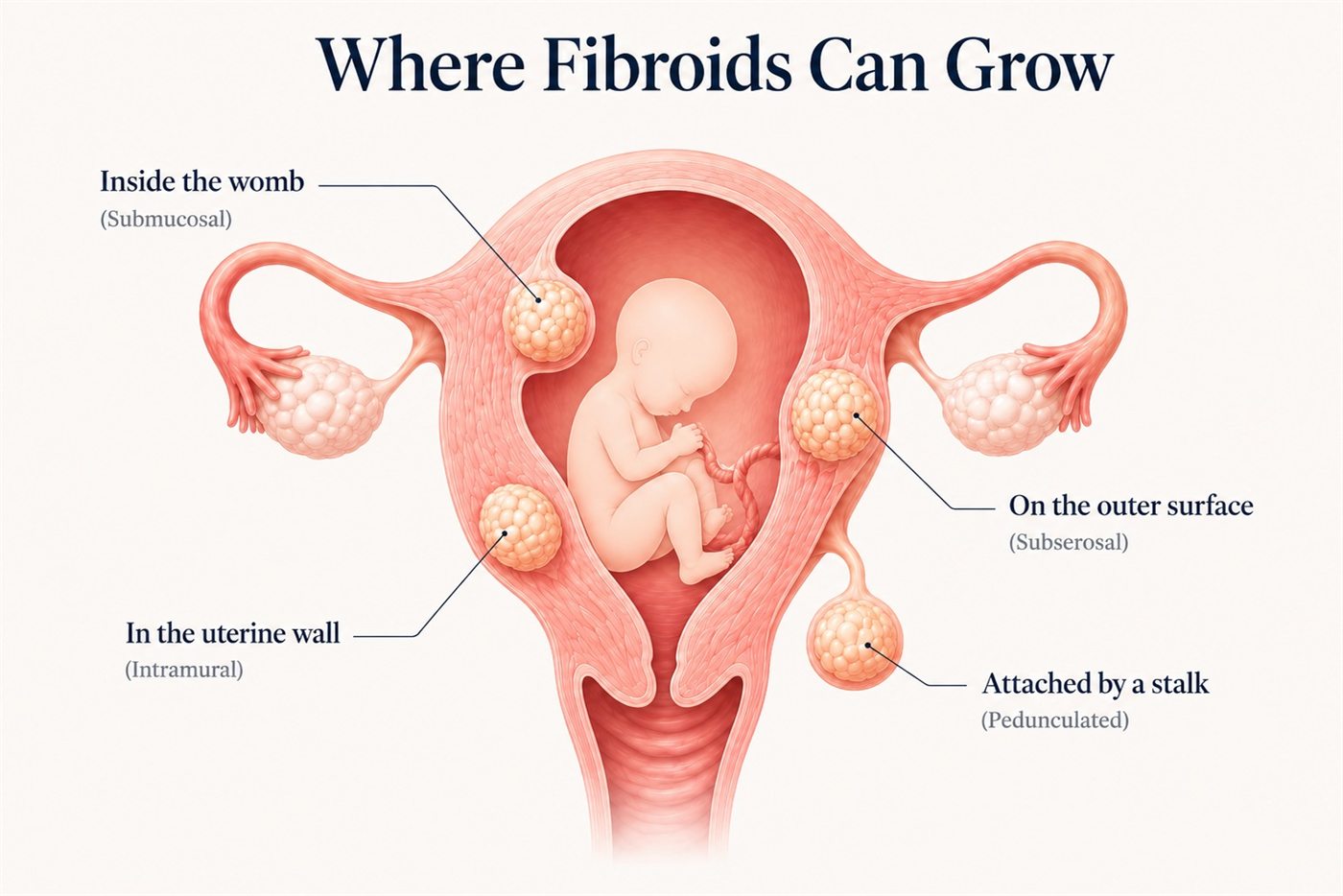
Position matters in specific ways rather than generally. A submucosal fibroid, one bulging into the cavity where implantation happens, is the type most linked to early pregnancy problems. Fibroids low in the uterus or in the cervix are watched for their effect on delivery. But two large cohort studies found location made less difference to overall obstetric outcomes than many people assume, and the evidence here is genuinely mixed.
| Type | Where it sits | What it tends to mean |
|---|---|---|
| Submucosal | Bulging into the cavity where the baby grows | The type most associated with implantation and early pregnancy problems |
| Intramural | Within the muscle wall | Very common; risk rises with size and number |
| Subserosal | On the outer surface | Often causes pressure symptoms rather than pregnancy problems |
| Pedunculated | On a stalk, attached by a narrow neck | Uncommon; can twist, which causes severe pain and needs surgery |
| Cervical / lower segment | Low down, near or in the cervix | Watched for the effect on delivery route |
So the useful question at your next appointment isn't "how big is it" alone. It's how big, how many, and where, because your doctor is weighing all three together.
The pain that frightens people most
Around 8 or 9 in 100 pregnant women with fibroids get an episode of red degeneration, and it's the complication most worth understanding before it happens.
A fibroid grows faster than its own blood supply can follow, and part of it starts to break down. It's most common with fibroids over 5 cm, and it typically strikes in late first trimester or the second.
What it feels like: a sharp, well-localised pain over the fibroid, often with a low fever, sometimes nausea, and raised inflammatory markers on blood tests. It frightens people partly because "degeneration" sounds catastrophic.
It isn't. The pain usually settles within about a week to ten days, and treatment is rest, fluids and pain relief your doctor prescribes. Surgery is almost never needed.
One practical warning while you wait to be seen: don't reach for anti-inflammatory painkillers such as ibuprofen. They're generally avoided in pregnancy, and paracetamol is usually the first choice, but the decision, and the dose, belong to your doctor.
It will probably grow. That's expected.
Fibroids respond to oestrogen, which rises steeply in early pregnancy, so most of the growth happens in the first trimester.
But growth isn't one-directional. Across a pregnancy, roughly 60 in 100 fibroids change size by more than a tenth. Some larger, some smaller.
This is worth knowing because outside pregnancy, a rapidly growing fibroid is something doctors investigate. Inside pregnancy, growth is the expected behaviour, not a warning sign.
If your next scan report notes that it's bigger, that is very often just what fibroids do here.
What extra monitoring might I need?
"You'll be watched more closely" is a phrase that gets used a lot and explained rarely. Here's what it usually means in practice.
Nothing here is universal. A single small fibroid may need no more than your standard antenatal care, while several large ones may mean a noticeably fuller calendar. Your doctor builds the plan around your specific scan.
Early pregnancy: where is it, exactly?
Your dating scan, and any early scan, establishes the map: how many fibroids, how big, and crucially where they sit relative to the cavity and the cervix. This is the reference point everything later gets compared against.
Around 20 weeks: the anomaly scan does double duty
Alongside checking how your baby is built, this scan looks at where the placenta has settled and whether a fibroid sits near or behind it. It's also a natural point to re-measure the fibroids themselves.
Third trimester: growth and position
This is where extra scans are most likely to be added. Depending on your situation, that can include:
- Growth scans, often every four weeks from around 28 to 32 weeks, checking your baby is growing well and has room to move.
- A repeat look at the fibroid, particularly if you've had pain.
- Checking your baby's position as term approaches, since fibroids make breech and transverse lie more likely.
- A closer look at the cervix and lower uterus if a fibroid sits low, to see whether it's in the way of a vaginal birth.
- Occasionally an MRI, if ultrasound can't give a clear enough picture for planning the delivery.
Near the end: the delivery plan
By the last few weeks the conversation shifts from watching to planning: which route, which hospital setup, and what precautions are worth having ready given the higher chance of heavier bleeding afterwards.
If your appointments feel more frequent than a friend's, that's the system working as intended. The monitoring is not evidence that something is wrong. It's the reason most of these pregnancies stay uneventful.
| Your situation | What it usually means for monitoring |
|---|---|
| One small fibroid (under about 3 cm) in the muscle wall, away from the cervix | Usually routine antenatal care, often with no extra scans |
| A fibroid bulging into the cavity where the baby grows (submucosal) | Closer attention in early pregnancy |
| Several fibroids, or any measuring more than about 5 cm | Extra growth scans usually offered |
| A fibroid low down near the cervix, or in the cervix itself | Delivery route reviewed carefully; caesarean more likely |
| A fibroid on a stalk (pedunculated, attached by a narrow neck) | Watched for twisting, which causes sudden severe pain |
| A fibroid near or behind the placenta | Placental position and your baby's growth followed more closely |
A gentle reminder
For many women this doesn't arrive as a warning. It arrives in the same appointment as the heartbeat.
A day you'd been picturing for weeks now carries a second piece of information you hadn't prepared for, and the joy gets tangled up with something you have to go home and read about.
That tangle deserves naming, because almost nobody does. You're allowed to have been delighted and worried within the same ten minutes. You're allowed to feel a little robbed of the uncomplicated version of that scan.
And here is the thing that gets lost in the reading afterwards. That fibroid was almost certainly there before you conceived, quietly doing nothing, while your body went ahead and got pregnant anyway.
The scan didn't create a problem. It switched on a light in a room that was already occupied.
Will I need a caesarean?
More likely than average. Not automatic.
Caesarean rates are higher in pregnancies with fibroids, and with very large fibroids they're higher still. The usual reasons are a fibroid low in the uterus sitting in the baby's way, or one that has pushed the baby into a breech or transverse position.
Fibroids also raise the risk of heavier bleeding after birth, because a uterus with fibroids may not contract down as firmly. Your team knows this in advance and prepares for it, which is exactly why it's on your notes rather than a surprise on the day.
For most women with small or moderate fibroids, a normal delivery remains entirely on the table.
After the birth
Oestrogen falls sharply, and fibroids usually shrink over the following months. Many women find that symptoms they had before pregnancy are milder afterwards.
A few practical things worth knowing:
- Breastfeeding doesn't make fibroids worse. If anything, the lower oestrogen levels that come with it may help keep them small.
- Repeat imaging isn't automatic. If your fibroids were being followed, a scan a few months after birth gives a clean picture once everything has shrunk back, but there's no reason to rush it in the first weeks.
- Treatment decisions belong later. If one is still causing heavy periods, pressure or pain once your cycles return, that's the point to discuss options, which range from medication to surgery.
- A future pregnancy is a separate conversation. How this pregnancy went is genuinely useful information for the next one, and your doctor will have a record of exactly where yours sit.
When to consult your doctor
General information, not medical advice. Contact your doctor or maternity unit promptly for:
- Severe or persistent abdominal pain, particularly in one spot.
- Fever alongside pain.
- Any vaginal bleeding.
- Regular tightenings or contractions before 37 weeks.
- A noticeable change in your baby's movements.
Pain over a known fibroid is often red degeneration, and often settles with rest. That call belongs to your doctor, not to guesswork at home.
Looking ahead
You may have a few extra scans. You may have one difficult week of pain somewhere in the middle. You may have a slightly more attentive team on the day.
What you're unlikely to have is the outcome the word made you imagine when you first read it.
For most women this ends up being a line on a report rather than the story of the pregnancy, and a fibroid that quietly shrinks afterwards, having spent nine months doing very little.
References
- Society for Maternal-Fetal Medicine (SMFM). Consult Series: Fibroids in pregnancy, meaning and management.
- Fibroids and pregnancy: a narrative review. PMC / National Library of Medicine.
- American Journal of Obstetrics & Gynecology. Fibroids larger than 10 cm and pregnancy outcomes: does location matter? 2024.
- American College of Obstetricians and Gynecologists (ACOG). Practice Bulletin No. 228: Management of Symptomatic Uterine Leiomyomas. 2021.
- Pritts EA, Parker WH, Olive DL. Fibroids and infertility: an updated systematic review of the evidence. Fertility and Sterility, 2009.
- Fibroids in Pregnancy: A Case Series. Cureus / PMC, 2025.
- National Health Service (NHS UK). Fibroids.
- Federation of Obstetric and Gynaecological Societies of India (FOGSI). Good Clinical Practice Recommendations on uterine fibroids and abnormal uterine bleeding.
- StatPearls / NCBI. Uterine Fibroids (Leiomyomas).